As a young leader, I was fortunate to discover two authors who set a lifelong foundation of influence for me as a leader: General Colin Powell and John C. Maxwell. I read My American Journey in high school, five years after General Powell led a 35-country coalition to victory in the Gulf War and mere months before my own leadership journey began as a cadet. Inspired by his real-world leadership lessons in and out of combat, I typed up four pages of quotes and carried them with me for years. I called My American Journey my leadership bible.
John C. Maxwell, who I came across a few years later, perfectly complemented Powell’s influence in my life. In case you haven’t read his books yet, John Maxwell is the #1 bestselling leadership author of all time. His most popular work is The 21 Irrefutable Laws of Leadership. He writes in stories and simple principles and his books perfectly weave together insight, inspiration, humor, and conviction.
Simply put, John Maxwell is the Michael Jordan of leadership coaching. And his new book, The 16 Undeniable Laws of Communication, dives into the most important skill a leader can have.
You Can’t Lead Without Communication
John Maxwell teaches that “leaders cannot deliver what they have not developed.” Talent, skills, intellect, and experience are indeed important components of success…but how do those leader attributes make it into the world for others to benefit from? Think about your own effect as a leader…how do you give to others what you have inside you? If all leadership is influence, what enables you to achieve that influence?
The answer is simple but sometimes not obvious. It’s your ability to communicate.
Regardless of the medium…verbal, nonverbal, visual, or written…good communication skills are a necessary component of leadership. You can’t lead without them. Communication is the key to inspiring followers, collaborating with peers, and influencing bosses. Communication is where influence begins and, without question, it is decisive for personal and professional success.
Here’s another truth: leaders don’t become good communicators by accident. They must study, practice, test, and cultivate their communication skills as if they were learning a sport or becoming a surgeon. Thankfully, John Maxwell wrote The 16 Undeniable Laws of Communication to help leaders develop those communication skills.
16 Laws to Help You Lead
This idea that leaders can only give what they have inside them…it comes from “The Law of Preparation” that John Maxwell talks about in the book. Whether delivering a keynote address, chairing a meeting, or sitting down for one on one counseling, John Maxwell emphasizes that communicating deserves intentional effort and preparation. How you prepare determines how you will perform.
Of course, we preach this principle when it comes to training our teams but it’s easy to shortchange our own preparation when it comes to communication…usually because we assume that we’re good enough communicators to just wing it. Paradoxically, our rank, authority, or position in the organization can actually work against our commitment to preparedness.
Typically, the more authority a leader has, the more likely it is that followers will listen without dissent. And the leader’s own extensive experience reinforces the notion that they don’t need to prepare. In 16 Laws, John Maxwell asserts that this communication comfort zone prevents good leaders from becoming great communicators…that they will never approach their full potential until they realize that they need to develop their communication skills. This attitude hurts not only the leader but those they lead, as well.
Kickstart Your Communication
Whether you are a seasoned leader in need of a refresh, or a young leader looking for new skills, The 16 Undeniable Laws of Communication is the best book you can have on your shelf right now. I just touched on “The Law of Preparation”…there are 15 more laws to dive into.
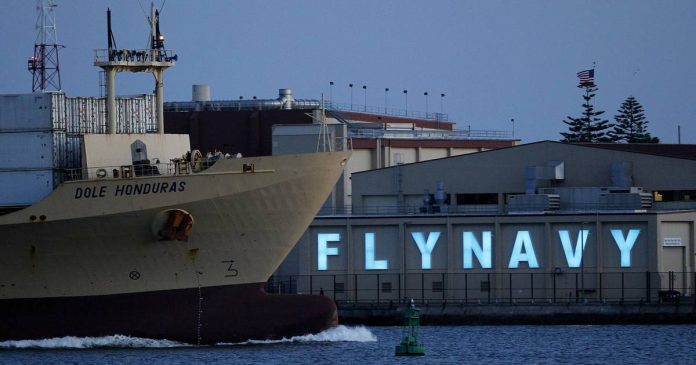
CORONADO, Calif. — A California military base was put in lockdown after a vehicle went through the facility’s main gate without stopping, a military spokesperson said.
Naval Base Coronado spokesperson Kevin Dixon told KNSD-TV that the driver was taken into custody by base guards after the “gate runner” drove without stopping Friday night through the entrance of Naval Air Station North Island, part of Naval Base Coronado.
Several patrol cars surrounded the entrance near 3rd Street and Alameda Boulevard in Coronado around 10:30 p.m., KNSD-TV reported.
Multiple gates at the air station near San Diego were closed while security personnel checked the facility, Dixon said.
A post on the Facebook page of Naval Base Coronado early Saturday said, “The main gate at Naval Air Station North Island is currently closed due to a security incident. Please stay away from the main gate while security conducts its investigation.”
The Coronado Police Department was investigating along with military police, KNSD-TV reported.
Naval Air Station North Island is one of eight U.S. military installations that make up Naval Base Coronado.
In February 2022, a motorist was found with bomb-making materials at the same gate on the base. The materials were not assembled into a device, and the driver was detained for questioning, the base said at the time.
One might forgive German civilian leadership for failing to recognize and act on the likely result of changes in warfare since 1870-71 following such a long period of relative peace, and perhaps German military planners should have made their risk assumptions more explicit. However, Japan’s path to war with the United States illustrates how the same mechanism enabled by optimism bias can play out even in a society with military leadership integrated into the highest levels of government and significant recent experience of major war.
Japan was a rising imperial power that had fought a series of victorious wars in Asia—mostly against China and Russia—throughout the first half of the 20th century. But it was Japan’s spectacular naval victories over Russia in 1904 and 1905 that captured its national imagination. By 1941, Japan’s fear of American hegemonic designs, its inability—or unwillingness—to disentangle itself from its imperial adventure in China, and its national pride brought it to the brink of war with the United States. Neither side wanted war, but Japan couldn’t seem to find a way to avoid it. Once again, recognition that a protracted conflict would be ruinous for Japan failed to spark a renewed emphasis on diplomacy, instead driving Japan’s cabinet to accept a high-risk offensive plan in the vain hope of high-payoff success.
Admiral Isoroku Yamamoto planned the attack on Pearl Harbor as an attempt to force the United States to accept Japanese hegemony in the western Pacific as a fait accompli. He also predicted that it wouldn’t work, anticipating that even if the attack were successful, the U.S. would refuse to accept a tactical defeat as decisive and continue fighting.[6] He knew the U.S. was a very different opponent than Russia, and personally opposed the war because he considered Japan’s chances for victory slim. However, he considered it his duty to keep his reservations to himself and focus his efforts on maximizing those chances. His plan for the Pearl Harbor attack and subsequent operations was explicitly designed to recreate—against all odds—the successes of Japan’s naval victories over Russia in 1904-1905.[7]
Within the cabinet, bureaucratic politics, inter-service rivalry and unique characteristics of Japanese culture and language clouded the cabinet debate throughout 1941 and increasingly made war seem unavoidable.[8] The integration of senior military officers into the highest levels of government did not prevent optimism bias from influencing the decision-making process. Japanese leaders had been closely watching German successes in France in 1940 and against the USSR in 1941. Despite clear evidence that war with the U.S. would be ruinous for Japan, lurking always in the backs of their minds was their own unlikely success against Russia in 1905. They had done it once; perhaps they could do it again?[9] Yamamoto’s bold plan made it easier to take what seemed their only chance of success, or as wartime prime minister General Hideki Tojo put it, “to close one’s eyes, and jump.”[10]
2003: Shock and Awe after the End of History
Both Germany in 1914 and Japan in 1941 felt forced into war by circumstances, grasping at overly optimistic war plans to stave off what they considered the unacceptable consequences of other options. In both cases their attempts to recreate historical successes failed. Germany’s 1914 offensive stalled before it could achieve a meaningful tactical result. Japan’s initial attacks in 1941 were more successful, but the U.S refused to accept the fait accompli. When the U.S. invaded Iraq in 2003 for the second time in twenty years, it didn’t do so out of desperation. Yet the same optimism bias was at work. This time, instead of offering a false hope of escape from disaster, it resulted in an overconfident assumption that the U.S. could control outcomes through military force. Instead of attempting to recreate past victories, American decision makers convinced themselves that history was no longer relevant, thanks to a transformative approach to warfare developed by a cadre of pentagon military theorists—what was called at the time the Revolution in Military Affairs or RMA.
Saddam Hussein had been a thorn in America’s side since the first Gulf War. In the aftermath of the 9/11 attacks, a mix of neoconservative ideology, reputational anxiety and a sense of unfinished business combined to create a strong consensus within the George W. Bush administration that Hussein had to go.[11] Donald Rumsfeld, Bush’s Secretary of Defense, was enamoured with the RMA, which relied on lighter, leaner forces employing precision weapons to achieve decisive effects through speed and maneuver. Rumsfeld saw the unconventional and unexpectedly quick victory over the Taliban in Afghanistan in 2001 as evidence that this approach represented a whole new paradigm for American military power.[12] Rumsfeld’s new paradigm promised a quick victory, and optimistic neoconservative theories about the flourishing of democracy suggested a newly liberated Iraqi society would take care of itself. Concerns about what would come after Hussein’s regime was toppled were waved away. Administration officials ignored historical lessons about the critical importance of post-war stability and reconstruction.[13]
“Throughout our history, we’ve learned this lesson: When dictators do not pay a price for their aggression, they cause more chaos; they keep moving; and the costs, the threats to [America and the world keep] rising.” —President Joseph Biden, 2022 State of the Union Address[1]
President Biden at the 2022 State of the Union address (Reuters)
Why did Vladimir Putin risk a full-blown war in Ukraine? Why did he believe he could get away with invasion and aggression? We do not need to see into the Kremlin to appreciate the West’s role in encouraging Putin’s confidence by its response to the attack on Armenian separatists in Azerbaijan by the Azerbaijani Army in September 2020, the first outbreak of war in Europe since the 1999 Kosovo war. The West’s failure to respond to this war in ways established during and post-Cold War was a new precedent for resolving territorial disputes in Europe.
The surprise attack that launched the 44-day Nagorno-Karabakh War in 2020 was, in the words of U.S. Senators Bob Menendez and Marco Rubio, “an attack by Azerbaijani forces [that] ignited a conflict that killed more than 6,500 people and displaced almost 100,000 ethnic Armenians.”[2] The territories populated by ethnic Armenians at issue in the 2020 war were within a separatist region of Azerbaijan proper, a region Azerbaijan lost control over to local Armenians in the early 1990s in a brutal ethnic war as the Soviet Union collapsed.[3]
The U.S. and most of its allies remained neutral in this unprovoked war waged by oil-rich Azerbaijan to settle a complex post-Soviet territorial and ethnic dispute that had been frozen for nearly 30 years. This neutrality was a clear change in policy since the U.S., Russia, and France had already invested nearly 30 years in mediating the conflict under the Organization for Security Cooperation in Europe’s (OSCE) Minsk Group.[4] None of the countries involved in mediation had a clear policy opinion as one of the sides in the conflict (Azerbaijan) broke the mediation format and decided to settle the conflict through war. This clear signal of neutrality as a European country decided to use war to settle a territory dispute was impossible to miss. With such a clear change in policy in post-war Europe, Russia could be forgiven for taking this as a signal that democracies and traditional institutions like the United Nations, the North Atlantic Treaty Organization (NATO), the European Union, and the OSCE would not interfere in Russia’s near-abroad even to restore international norms.
In spite of the West’s much stronger reaction to Russia’s invasion of Ukraine in 2022, Azerbaijan has continued to test those limits. Its willingness to do so is a sign that Western policy is still undecided about what international norm it is trying to establish with the Ukraine response. This leaves open questions. What is the new international norm? Is there a level or conditions under which war will be permitted by the international community to settle disputes?
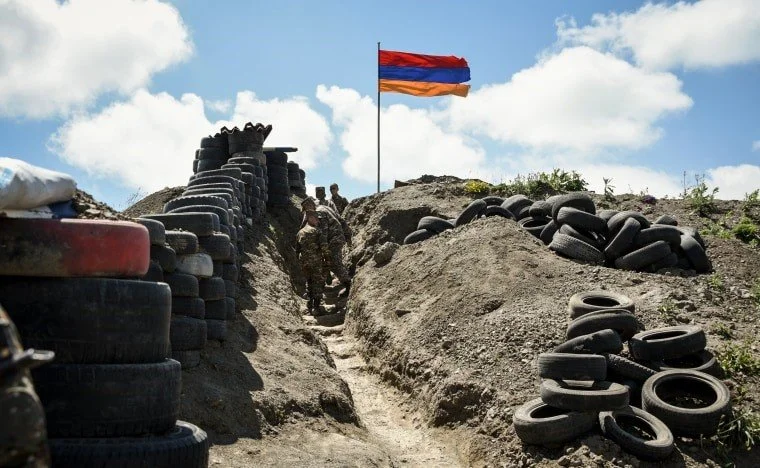
Soldiers walk in a trench at a border checkpoint between Armenia and Azerbaijan near the village of Sotk, Armenia, where clashes between Armenian and Azerbaijani forces took place in September 2022. (Karen Minaysan/AFP)
The most severe test of the West’s reaction since the 2020 war began on September 12, 2022, when Azerbaijan launched an unprovoked invasion of neighboring sovereign Republic of Armenia, killing hundreds, displacing over 7,000 people, and occupying positions inside Armenia’s borders in a few days of action.[5] Unlike the 2020 Nagorno-Karabakh War, which many observers saw as an internal matter in Azerbaijan, this test involved an international border. That Azerbaijan saw this as a worthwhile escalation in spite of the Ukraine response makes clear that the norm, whatever it is, is not clear.
Azerbaijan’s invasion of Armenia is a case study of dictatorships targeting democratic neighbors when those dictatorships see democratic neighbors as direct threats to their regional influence. The differences between the two countries in terms of democratization and economics are critical to understanding how an autocracy could perceive democratization as a threat to its position.
Azerbaijan ranks 190th out of 210 nations on Freedom House’s Global Freedom Index, classified as a “consolidated authoritarian regime.” In sharp contrast, Armenia has repeatedly held competitive elections and expanded civil liberties and the rule of law, classified by Freedom House as a “transitional regime.”[6] Azerbaijan is also larger and wealthier than its democratizing neighbor, Armenia.
Compounding its general democratization trend, Armenia went through a revolution in spring 2018 that replaced a weakening post-Soviet oligarchic government with a popular government.[7] This change, the culmination of a growing democratic movement, received support and significant attention from the west.[8] From Azerbaijan’s point of view it would not be a stretch to think that a more popular Armenia might lead to a change in the stalemate of the Minsk Group process over the status in Nagorno-Karabakh. In other words, Azerbaijan, a totalitarian autocracy, could fear that the West may be more sympathetic to the Armenian position as Armenia drifted closer to Western norms, making the choice of war to change the status quo on the ground in the frozen conflict more attractive.
Unlike the response to Azerbaijani aggression, the response of the U.S. and European partners to Russia’s invasion of Ukraine fundamentally changed the expected outcome of that war. What was originally predicted to be a quick victory for Russia, has turned into a drawn-out bloodbath. The damage to the Russian army, economy, and influence is orders of magnitude higher than what Putin must have expected the cost to be. All of these effects were achieved not only by direct U.S. and E.U. military aid, but also by the application of Western power against the diplomatic and economic resources Russia would need to fight the war. None of these effects were attempted in the case of Azerbaijan, leaving the international community with two completely different responses to two scenarios of war being used to resolve ethnic-territorial disputes between early democracies and autocratic neighbors.
Azerbaijan has not yet paid a price for its illegal attacks. While the U.S. has significantly shifted away from its traditionally neutral position in the Caucasus region—marked by the introduction of Congressional Resolutions, a change in rhetoric condemning Azerbaijan’s aggression, and U.S. Speaker of the House Nancy Pelosi’s visit to Armenia in the aftermath of the September 2022 invasion—the overall response has still hedged toward a diplomatic solution without parallel soft-power policy changes to raise the stakes of aggression.[9]
Yet the history of the 30-year-old conflict, including the unprovoked attacks in 2020 and 2022, demonstrates that Azerbaijan does not prefer normalization, but pursues an opportunistic policy of maximalist gains through force when it believes the West will not respond. Absent a consequential response to Azerbaijan’s aggressions, it is incentivized to make such gambles even as it feigns diplomatic willingness in international forums.[10]
Thus, the U.S. and international institutions have struggled with how to respond to Azerbaijan’s overt flaunting of norms around the use of force to settle territorial disputes. U.S. policymakers have condemned Azerbaijan’s aggression without any meaningful policy changes following the condemnations. In part, this is likely driven by the fact that Azerbaijan has an abundance of oil and gas, making it an attractive energy partner alternative to Russia.[11] In addition, Azerbaijan has an aggressive ally in Turkey, a NATO member, and is a willing partner to Western powers in countering Iran.[12] However, absent effective U.S.-led sanctions, Azerbaijan has been emboldened to continue its pattern of violence against Armenia and the Armenians of Nagorno-Karabakh. It is a pattern that endangers the very system the U.S. claims to be preserving with its aid to Ukraine.
Like the powder keg that led to the outbreak of World War I, military adventurism by autocracies endanger more than just the people caught in the crosshairs of dictators. Such aggression endangers all of us. Beyond the issue of an autocracy attacking a democracy, there is a humanitarian aspect to this conflict that the Western response has not addressed. Azerbaijan is overt in its racism towards Armenians, publicly celebrated brutality, documented war crimes, and clear genocidal intent against all Armenians, those in the Republic of Armenia as well as the minority Armenian population besieged in the disputed Nagorno-Karabakh region.[13] The Lemkin Institute for Genocide Prevention updated an existing “Red Flag Alert” warning on September 16th, 2022, stating:
“Given the extreme racialized othering of Armenians by the Azerbaijani government, military, press, and educational system, any Azerbaijani incursions into territories that include ethnic Armenians can be expected to be characterized by genocidal atrocities.”[14]
Setting and enforcing an international norm that makes such things extremely costly for those considering them is essential to mitigating risk of a wider conflagration. Russia’s invasion of Ukraine proved what can happen when such norms break down. The Western response to that invasion showed what the international community is able to do to enforce those norms. Reversing it in one place while allowing the norm to be violated in another sets a dangerous precedent that will lead to more adventurism and testing of what a regime can get away with when it chooses war to advance its policies.
Timur R. Nersesov is an officer in the U.S. Army Reserve and Iraq War veteran, with 17 years in uniform and over 12 years as a consultant to U.S. national security agencies (US Departments of Defense, State, and Homeland Security). He is also a member of the Truman National Security Project. He holds a MS degree in Analytics, and his current work centers on cloud technologies and Artificial Intelligence applications in defense and civil government. The views expressed in this article are the author’s and do not represent the views of the U.S. Army, Department of Defense, the U.S. Government or any company.
The Strategy Bridge is read, respected, and referenced across the worldwide national security community—in conversation, education, and professional and academic discourse.
Thank you for being a part of The Strategy Bridge community. Together, we can #BuildTheBridge.
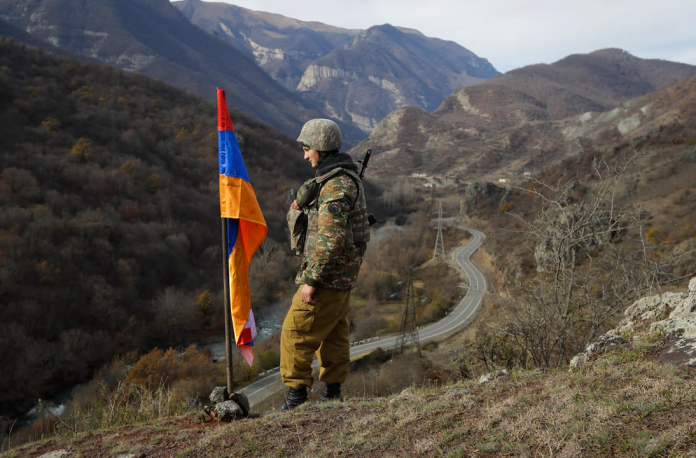
Header Image: An ethnic Armenian soldier stands guard next to Nagorno-Karabakh’s flag atop a hill in the separatist region in Azerbaijan in November 2020. (Sergei Grits/AP)
The American military is exceptionally competent at learning tactical lessons, developing new ways to fight on the ground while producing better equipment. However, the American military consistently fails to maintain lessons learned past the tactical level of command. The current rush of the military to move past its failures of the last 20 years is reminiscent of the rush to do so post-Vietnam. American military strategic culture has consistently lacked the connection with the formulation of policy. This culture, discussed in depth in works such as Russell Weigley’s The American Way of War and Donald Stoker’s Why America Loses Wars, maintains its stranglehold on American strategists today.[1]
To understand this strategic amnesia and rushing to the next war, this paper will briefly examine the war with the largest impression on the military, World War II. It will continue from there to the Afghanistan withdrawal. This article suggests a continuity in how quickly the Army moves towards the next fight. This paper then explores the reasons behind the loss of institutional knowledge, building off the historical analysis to show how the Army fails to adapt and reassess.
Historical Background
World War II
World War II began when the imperial Japanese Army invaded Manchuria in 1931, and Nazi Germany invaded Poland in 1939.[2] America remained a non-combatant until the 7 Dec 1941 Japanese surprise attack on Pearl Harbor. The American military mobilized more force than ever before, fighting from the deserts of North Africa to the island of Okinawa. The trials and tribulations of World War II are remembered fondly; every Army cadet reads Band of Brothers at least once before commissioning. However, the victory disease from the war continues to infect today.[3]
The history of World War II continues to dominate the learning institutions of the Army because it was so clearly won, in myth.[4] Large tank battles, control of the air, domination of the sea, movie-worthy airborne drops, and daring amphibious assaults are the highlighted stories of the war. While the war does deserve a place in the U.S. Army’s institutional memory, it is also important to remember what has changed. What followed the victories of WWII should have diminished the impact it had on the U.S. Army, yet it has remained on a pedestal. The stalemate and failure of the next two major wars are direct consequences of the victory disease brought on by WWII.
The Korean War
As World War II ended and relations between the communist Union of Soviet Socialist Republics (USSR) and the United States soured, the Cold War began. Soon China fell into the grip of communism. As the world spiraled closer to the possibility of all-out nuclear war, North Korea crossed the 38th parallel into South Korea, setting off the Korean War.[5] North Korea’s initial push was explosive and might have culminated in the desired quick decisive victory if not for the quick deployment of U.S. and United Nations troops. In the seesaw events of the Korean War, the U.S. and North Korean/Chinese troops launched massive offensives. These culminated when U.S. troops regrouped and methodically pushed back the combined Chinese/North Korean forces and halted at the 38th parallel.
This was America’s first true lesson on limited war in the post-war period. American forces had to deal with hostile locals as they moved past the 38th parallel. The U.S. oversimplified the Chinese attack as hordes of Chinese soldiers, yet the attacks against U.S. lines were organized and pointed at breaking the defense at multiple spots. The U.S. also failed to understand how important cultural understanding was, it did not know that the occupation of U.S. troops had a negative impact on the newly formed South Korean government.[6] In continuing to rush to the next war, the Army never institutionalized the lessons learned.
The American War in Vietnam
The decolonization struggle between the Vietnamese and the French colonial government took on a Cold War framing. Once the French failed in Vietnam, the U.S. supported South Vietnam. The U.S. slowly escalated involvement until the Gulf of Tonkin incident in 1964, which led to the United States committing full combat troops to South Vietnam. The U.S. military failed to ever realize its nation building and counterinsurgent mission in South Vietnam. The military overused its firepower, failed to pacify the countryside, and failed to understand the culture. Under General William Westmoreland and General Creighton Abrams, the military emphasized the statistical measurement of body counts and other arbitrary statistics.[7] It was a war that held an elusive enemy that fought in unconventional ways, sometimes as conventional units from the North and sometimes as communist insurgents from the South. After many years of failing to pacify South Vietnam, the U.S. pulled out its combat forces in 1973, and in 1975 the Saigon Government fell.
The American war in Vietnam has had resounding implications on the wars that followed; however, the U.S. Army failed to learn lessons from Vietnam. As seen above, the U.S. Army failed to fully institutionalize lessons learned because it is always in a rush to move on. The Army did not believe it could learn much from a war it lost and predicted that it still needed to only face the Russian Army in large-scale combat. The Army failed to come to terms with its shortcomings, instead pretending that Vietnam was a one-off. The idea of the Vietnam Syndrome shows that the Army thought of the war only as its loss and not as a way to develop better counterinsurgency doctrine.
The End of the Cold War, Desert Storm, and GWOT
In the aftermath of Vietnam, the Army was disgraced by its loss in Vietnam, failed further during the botched Desert One rescue attempt, and fell into a malaise. However, under President Ronald Reagan, the military worked towards ending the malaise of failure. As it participated in small operations, such as Operation Just Cause, it began to feel its might again. Two major events occurred that imparted the Army with victory disease so rancid that it contributed to the failure of the occupations of Iraq and Afghanistan.
The first major event was the success of the U.S. mission during Operation Desert Storm from August 1990 to February 1991. In repelling, routing, and utterly demoralizing the Iraqi Army, the U.S. Army felt it had finally kicked the Vietnam War syndrome. Unfortunately, America was drunk on its military victory and forgot the loss of Vietnam. The second event was the dissolution of the USSR and the end of the Cold War in 1991. America, so it seemed, was now the invincible superpower. Intoxicated by these two victories, the 21st century crashed into America.
This jubilation did not last long; on 11 Sept 2001, terrorists attacked the World Trade Center and the Pentagon. Beginning in October of 2001, the Global War on Terror commenced with the invasion of Afghanistan.[8] The war in Afghanistan was eerily similar to that of Vietnam. Yet, the U.S. had not learned its lessons fully and was unprepared for the pacifying mission in Afghanistan following the fall of the Taliban. The United States also failed to follow the warning of Clausewitz against opening a second front, and started a second war in Iraq in 2003. The ensuing occupation of Iraq led to the creation of ISIS and other terrorist organizations, and in Afghanistan, the government made no headway into the rural areas. In the fallout of the disastrous withdrawal from Afghanistan, it looks like the Army is preparing to continue the mistake of failing to learn.
Military families are no stranger to the phrase “force readiness.” But swap “force” with the words “social,” “emotional” or “academic,” and readiness can be a struggle for military-connected children preparing to begin kindergarten.
Active duty families typically relocate every three years. The frequent moves interrupt the development of children under the age of 5, creating gaps in what should be a solid foundation.
One local program works to fill in the developmental gaps that widen with each permanent change of station.
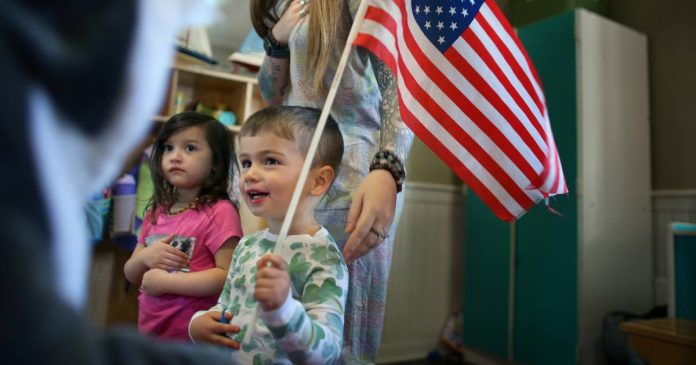
Laughter bounced off the walls of the Little Creek Community Center as about a dozen parents and children gathered Wednesday for week #9 of the Operation Little Learners program. Everyone — parents included — sat on the floor for “circle time,” where they went over the days of the week, counted to 15, learned the letter “Q” and talked about the cold, windy weather.
“What should we wear when it is windy?” the class facilitator asked the kids.
“A jacket!” exclaimed 3-year-old Eli Herold.
Just 4 months old when the coronavirus pandemic shut down the world, the chatty toddler was once a shy introvert who wanted nothing to do with other children, educational games or arts and crafts, his mother, Brett Herold, said.
“A typical COVID baby,” Brett said. “When we first started, he would hide behind me and wouldn’t participate, but now he answers questions when asked, he sings … He has really come out of his shell.”
The parent-and-me preschool readiness program — provided by the Armed Services YMCA of Hampton Roads — introduces active duty military children aged 18 months to 5 years to a classroom setting in which they learn letters, numbers, shapes, and developmental concepts. Two-hour-long classes are offered twice weekly for 13 weeks across seven Hampton Roads locations, stretching from Chesapeake up to Fort Eustis.
The mornings start with circle time, when Operation Little Learners Facilitator Kari Carnes works with the children on counting March 8, 2023, during an Armed Services YMCA program “Operation Little Learners,” held at Little Creek Community Center. (Stephen M. Katz/The Virginian-Pilot)
The reason behind the program, according to Tessa Davis, Early Education Director for ASYMCA, is because school readiness is not universally defined and no two preschool programs are identical across state lines.
“A family PCSing (permanent change of station) here from Florida might plan to put their child in VPK (voluntary prekindergarten program), but we don’t have VPK here. We have pre-K programs, but it is not like it is in Florida,” Davis said.
Congress passed the Interstate Military Compact Act in 2009, which ensures the child of an active duty service member is placed in classes consistent with the education he or she was receiving at their previous school. For example, if a student was taking an advanced placement course, the new school must place the student in an identical or comparable course without delay.
“But that doesn’t apply until you begin grade school. So, you might think you know what school readiness you can do, but it is just not going to happen,” Davis said.
According to Shanan Chappell Moots, a professor for Old Dominion University’s Center for Educational Partnerships, military families are hard-pressed to find a preschool program when they relocate, particularly to another state.
“While the content is largely the same, the scope and sequence might be different,” Moot said.
So while one curriculum is teaching numbers, another may be teaching the alphabet. And when a military-connected child is placed in another preschool, prepared to learn what number comes after 10, the curriculum may be focused on teaching the child what letter comes after M.
“It’s likely early preschool military-connected kids are missing chunks of instruction. Even if it’s just four or five days, maybe a week — those are the foundational skills they’re missing out on that they’re gonna have to recover at some point,” Moots said.
The program is about teaching the parents just as much as it is the children. While each session is led by a volunteer facilitator, a parent or guardian must participate in all 13 weeks of Operation Little Learners alongside their child, acting as his or her personal teacher.
“We are trying to push the teaching to the parent, to help the parent feel secure as their child’s first and best teacher. Active duty spouses might not know where they will be next school year. So it’s about having that security of knowing ‘I can do this and I have the abilities … I don’t have to have a degree in education to teach my child,’” Davis said.
Two-year-old Avery Figueroa climbed into a small plastic chair. Kari Carnes, a facilitator for Operation Little Learners sessions, helped Avery push up the sleeves of her plaid footed pajamas before she dipped an index finger into the colorful palette of paint on the table and began tracing the letter of the day on a piece of paper.
“Before this program, she wouldn’t have had anything to do with finger painting or arts and crafts. Or should would have just put the paint right in her mouth,” said Sebastian Figueroa, Avery’s father, as he stepped back to marvel at her progress.
Monica Osorio checks out her 3-year-old daughter Neela’s hands after painting, as Tina Gourley watches hers, Skylar, 2, load up her brush. (Stephen M. Katz/The Virginian-Pilot)
Sebastian and Avery have participated in two consecutive semesters of Operation Little Learners while Avery’s mother, Jessica Figueroa, has been deployed with the USS George H. Bush. This is the Figueroa family’s first deployment since Avery’s birth.
As a new dad, solo parenting for the first time, Sebastian said seeing Avery’s cognitive growth during the program guides his home teachings.
“This adds a nice little layer of how to reach her, as opposed to just figuring it out as I go,” Sebastian said.
Daywatch
Weekdays
Start your morning with today’s local news
As Avery painted, 16-month-old Jacob Herold sat on the floor playing with a piece of paper — the large “Q” printed across it colored with red, blue and green markers. While Jacob is too young to qualify for the program, he is allowed to tag along with his mother and brother. Jacob, his mother said, is already grasping concepts and participating in group activities.
The Herolds, an active duty Navy family, expect to relocate by January — right in the middle of the school year. Like most military families, they don’t know where they’re going yet.
“I have never moved with a kid before, so I am nervous. But we have the tools to bounce back,” Brett said.
The winter semester concludes the first week of April. There were 250 participants across Hampton Roads.
The program will expand next semester adding two additional locations — one at the Larchmont Library in Norfolk for all active duty families and another in the Norfolk Pointe community exclusively for Liberty Military Housing residents. The two additional locations will allow for around 50 extra spots, 25 at each, bringing the participant cap to 300 parents and children.
[1] Andrew Roberts, Napoleon: A Life (New York: Penguin Books, 2014), 580.
[2] Andrew Roberts, Napoleon: A Life (New York: Penguin Books, 2014), 595.
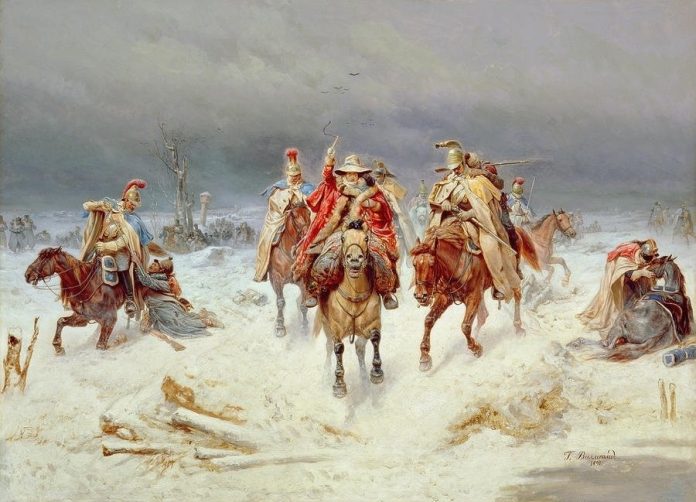
[3] During the Great Northern War from 1700 to 1721, Charles XII’s Swedish Empire confronted an anti-Swedish Coalition, led by Russia’s Peter the Great, determined to roll back Sweden’s domination of Europe. Enjoying early success against coalition members in the west, Charles invaded Russia in early 1708. Roberts, 569.
[4] Stephanie Pain, “1709: The Year That Europe Froze,” New Scientist, accessed December 30, 2022, https://www.newscientist.com/article/mg20126942-100-1709-the-year-that-europe-froze/.
[5] 1694-1778 Voltaire and Winifred Todhunter, Voltaire’s History of Charles XII, King of Sweden (London : J.M. Dent, 1908), http://archive.org/details/voltaireshistory00voltuoft.
[6] Roberts, Napoleon, 434.
[7] Roberts, 451–56.
[8] Roberts, 578.
[9] Roberts, 590.
[10] Roberts, 615.
[11] Roberts, 612.
[12] Daniel Kahneman, Thinking, Fast and Slow, 1st edition (Farrar, Straus and Giroux, 2011), 207.
[13] Niccolò Machiavelli, Selected Political Writings, ed. David Wootton (Hackett Publishing, 1994), 74–75.
[14] Machiavelli, 75.
[15] Machiavelli, 75.
[16] Machiavelli, 74.
[17] Carl von Clausewitz, On War, Indexed Edition, trans. Michael Eliot Howard and Peter Paret, Reprint edition (Princeton, N.J: Princeton University Press, 1989), 136.
[18] Clausewitz, 141.
[19] Clausewitz, 134.
[20] Clausewitz, 134.
[21] Clausewitz, 6.
[22] Clausewitz, 109.
[23] Clausewitz, 88–89.
[24] Clausewitz, 140.
[25] Clausewitz, 146.
[26] Roberts, Napoleon, 595.
[27] Machiavelli, Selected Political Writings, 76.
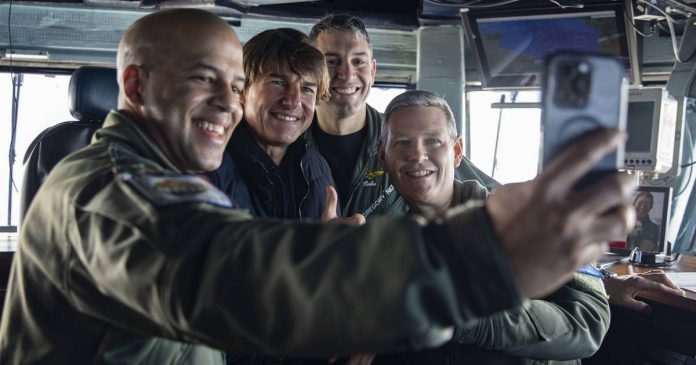
“Top Gun” star Tom Cruise visited the crew of the Norfolk-based USS George H.W. Bush last week while the warship is in the Adriatic Sea.
Cruise, as well as Hannah Waddingham from the Apple TV+ show “Ted Lasso,” led a special viewing of “Top Gun: Maverick” for sailors in the hangar bay on March 3.
Tom Cruise meets with Sailors aboard the Nimitz-class aircraft carrier USS George H.W. Bush (CVN 77) during a visit to the ship, March 2, 2023. The George H.W. Bush Carrier Strike Group is on a scheduled deployment in the U.S. Naval Forces Europe area of operations, employed by U.S. Sixth Fleet to defend U.S., allied and partner interests. (U.S. Navy photo by Mass Communication Specialist 2nd Class Novalee Manzella) (Petty Officer 2nd Class Novalee Manzella/USS George H.W. Bush (CVN 77))
“I know our sailors will never forget that night in the hangar bay, and I am equally as certain that neither will Mr. Cruise,” said Rear Adm. Dennis Velez, commander of the strike group, in a statement released Thursday by the Navy.
The carrier’s commanding officer and a Top Gun graduate, Capt. Dave Pollard, said thevisit “paid dividends” toward crew morale.
“It buoys my spirits to know that the leading entertainers and filmmakers of our day not only conceptually know what we do, but they can relate to what our nation’s warriors do on a daily basis through their personal experiences aboard USS George H. W. Bush (CVN 77),” Pollard said.
After departing Naval Station Norfolk more than seven months ago, the crew are nearing the end of a scheduled deployment to the U.S. Naval Forces Europe-Africa’s area of responsibility.
Tom Cruise addresses the crew on the 1MC during a visit to the Nimitz-class aircraft carrier USS George H.W. Bush (CVN 77), March 3, 2023. The George H.W. Bush Carrier Strike Group is on a scheduled deployment in the U.S. Naval Forces Europe area of operations, employed by U.S. Sixth Fleet to defend U.S., allied and partner interests. (U.S. Navy photo by Mass Communication Specialist 3rd Class Samuel Wagner) (Petty Officer 3rd Class Samuel Wagner/USS George H.W. Bush (CVN 77))
“This is my first deployment, and it’s difficult sometimes to be gone from home and family for such long time,” said Olivia Morton, an aviation support equipment technician, in the release. “Spending time with my friends at the hangar bay event and getting a photo with all of the guests – especially Tom Cruise – was the highlight of a memorable deployment.”
Cruise and Waddingham were also joined on the carrier by “Top Gun: Maverick” writer and producer Christopher McQuarrie and editor Eddie Hamilton.
Waddingham will share the screen with Cruise for part two of “Mission: Impossible — Dead Reckoning.”
[1] B.H. Liddell Hart, Why Don’t We Learn From History? (London: Allen and Unwin, 1944).
[2] Micah Zenko, “100% Right 0% of the Time,” Foreign Policy, October 16, 2012, https://foreignpolicy.com/2012/10/16/100-right-0-of-the-time/ and Robert Scales, “Forecasting the Future of Warfare,” War on the Rocks, April 9, 2018, https://warontherocks.com/2018/04/forecasting-the-future-of-warfare/.
[3] B.H. Liddell Hart, Why Don’t We Learn From History?
[4] John Antal, 7 Seconds to Die (Casemate, 2022).
[6] Michael Kofman, Katya Migacheva, Brian Nichiporuk, Andrew Radin, Olesya Tkacheva, and Jenny Oberholtzer, Lessons from Russia’s Operations in Crimea and Eastern Ukraine. Santa Monica, CA: RAND Corporation, 2017. https://www.rand.org/pubs/research_reports/RR1498.html.
[7] Cited in Hal Brands, What Good Is Grand Strategy? Power and Purpose in American Statecraft
from Harry S. Truman to George W. Bush (Ithaca: Cornell University Press, 2014), 100.
[8] Examples before Ukraine include Georgia and Estonia.
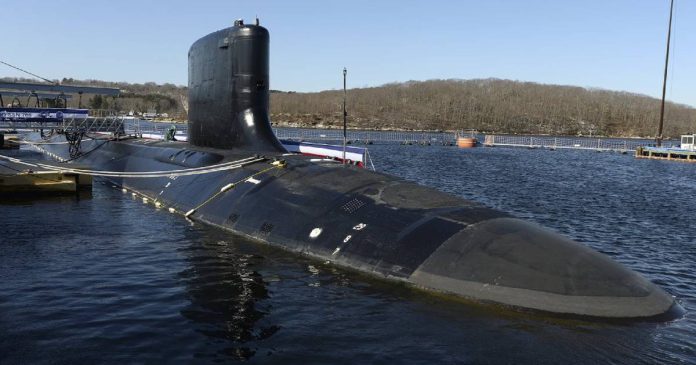
WASHINGTON — Australia will purchase U.S.-manufactured, nuclear-powered attack submarines to modernize its fleet, a European official and a person familiar with the matter said Thursday, amid growing concerns about China’s influence in the Indo-Pacific region.
The purchase agreement for Virginia-class submarines will be announced Monday when President Joe Biden, Australian Prime Minister Anthony Albanese and U.K. Prime Minister Rishi Sunak meet in San Diego for talks on the 18-month-old nuclear partnership known by the acronym AUKUS. The people spoke on the condition of anonymity to discuss the matter ahead of the announcement.
The AUKUS agreement, announced in 2021, paved the way for Australia to get access to nuclear-powered submarines, which are stealthier and more capable than conventionally powered boats.
“We all recognize the imperative of ensuring peace and stability in the Indo-Pacific over the long term,” Biden said in September 2021 when the partnership was announced. “We need to be able to address both the current strategic environment in the region and how it may evolve.”
The secretly brokered deal included the Australian government’s cancellation of a $66 billion contract for a French-built fleet of conventional submarines, which sparked a diplomatic row within the Western alliance that took months to mend.
The European official said France had been briefed on the terms of the purchase agreement. Biden spoke with French President Emmanuel Macron on Tuesday, the White House said, adding that they “discussed the cooperation between the United States and France in the Indo-Pacific region.”
The submarines, which cost $3 billion each, are built at shipbuilding plants in Virginia and Connecticut. Under the terms of the agreement, subs would eventually also be built in the U.K. and in Australia with U.S. technology and support, the person familiar with the matter said. The initial plans called for all of the subs to be constructed in Adelaide, Australia.
The U.S. would also step up its port visits in Australia to provide the country with more familiarity with the nuclear-powered technology.
The White House declined to comment on the submarine purchase ahead of the planned meeting on Monday.

 This idea that leaders can only give what they have inside them…it comes from “The Law of Preparation” that John Maxwell talks about in the book. Whether delivering a keynote address, chairing a meeting, or sitting down for one on one counseling, John Maxwell emphasizes that communicating deserves intentional effort and preparation. How you prepare determines how you will perform.


:quality(70)/cloudfront-us-east-1.images.arcpublishing.com/tronc/NZYDPYOQI5AXBHL4JFZ7OHU2AI.jpg)
:quality(70)/cloudfront-us-east-1.images.arcpublishing.com/tronc/PWFPTVMTV5GWTJXNMPRWZR4WGA.jpg)