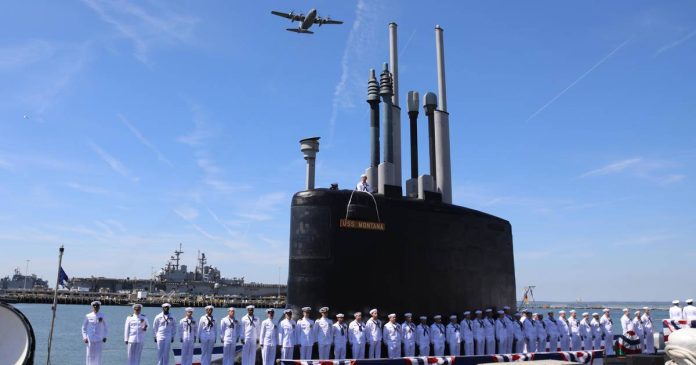
The Navy is investigating the death of a sailor assigned to the USS Montana who was found Monday at Newport News Shipbuilding.
The sailor, who has not been identified, was found on the pier adjacent to the fast-attack submarine by another crew member.
“The injured Sailor was taken to Riverside Regional Medical Center and pronounced deceased,” said Cmdr. Paul Macapagal, spokesperson for Submarine Force Atlantic.
The Montana was commissioned into the Navy in June 2022. It is undergoing a post-shakedown availability at the Newport News shipyard.
Todd Corillo, a spokesperson for HII’s Newport News Shipbuilding division, declined to provide additional details.
“Out of respect for our customer and to protect the privacy of military families, Newport News Shipbuilding does not discuss deaths of our U.S. Navy teammates with the exception of a workplace accident,” Corillo said.
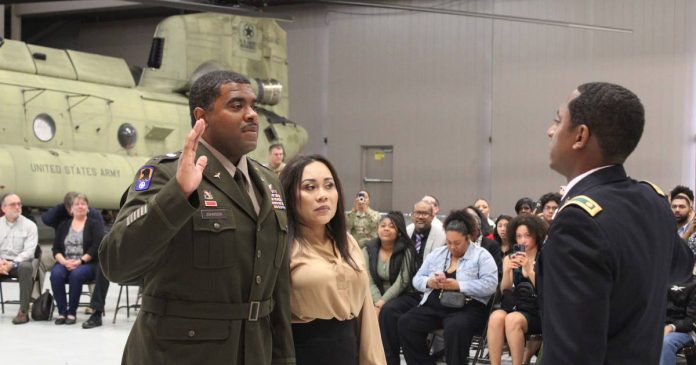
Newport News native Daren Johnson returned to Fort Eustis to be pinned as a chief warrant officer 5, at the same base he first served the Army Reserves as a recruit 20 years ago.
“This is where is all began,” Johnson said.
Johnson was promoted to chief warrant officer 5 during a ceremony Saturday. The U.S. Army Reserve Command confirmed that the 38-year-old Johnson will be the youngest actively serving chief warrant officer 5, beating the average age by 16 years.
“There are so many people in this area — family, friends, mentors — who saw in me what I couldn’t see. I truly owe my career to those people because it was them who shaped my career, who told me the do’s and don’ts, who guided me, when in reality I was just along for the ride,” Johnson said.
Johnson attended Denbigh High School’s Aviation Academy, and in 2002, before he even graduated from high school, his father allowed Johnson to enlist in the Army Reserves. His exposure to aviation through the Newport News STEM academy put the 17-year-old on a fast-tracked military career.
“They say I am less than 2% of less than 2%,” Johnson said.
The Warrant Officer Corps, who serve in manager positions as technical and tactical experts, make up approximately 2% of the Army Reserve’s total force. Of that, only about 2% of warrant officers go on to attain the rank of chief warrant officer 5, with 113 serving across the branch.
Chief Warrant Officer 5 Daren Johnson addresses the audience during his promotion ceremony, as Maj. Antonio Nixon, his host for the ceremony, is seated. (Jason Louis Wright/Handout) (Courtesy Chief Warrant Officer 5 Daren Johnson)
Originally, Johnson spent the early years of his career training to be a flight engineer or a crew chief for Chinook helicopters.
“I was 19 years old and had no plans to be a pilot. But some guys in the unit took an interest in me and my hunger for knowledge,” Johnson said.
Two people — Bill Basabilbaso and Jim MacVaugh — encouraged Johnson to consider piloting. Johnson gave it a shot, passing the Army’s flight test by the skin of his teeth with a 92. The minimum pass score for the test was 90 with top scores coming in at 160.
“But I passed, and the rest is history,” Johnson said with a laugh.
Johnson graduated from flight school and served in inactive reserves until 2014, at which point he transferred to active guard.
His time with the service has taken him on missions to all 48 states of the continental U.S., Puerto Rico and Africa, as well as deployments to Kuwait, Iraq and Afghanistan. He recently returned from a mission to Africa, in which he flew a C-12 V-model plane back to the U.S., traveling over Europe, Iceland, Greenland and Canada.
“It was amazing. It was something I daydreamed about. Having the chance to fly like that was the best experience ever,” Johnson said.
Army Reserves offers pilots four tracks on which they can steer their careers — instructor pilot, maintenance test pilot, aviation safety officer or aviation mission survivability officer. Johnson completed all four tracks.
“Some will take you out of the cockpit. Some will take you on deployments. But you have to be willing to step out of your comfort zone, taking on a new responsibility or something that may not be in your purview,” Johnson said.
But Johnson never aimed to become a chief warrant officer 5.
“I never when into it chasing trophies or a title. Your work will speak for itself and the people you work with will propel your career. So, instead of stepping on toes to climb up, you reach down to pull somebody up with you. You all climb together,” Johnson said.
To become a chief warrant officer 5, a service member must be recommended to the promotional board. The board takes into consideration time in service, education, skill certifications, performance and career progression.
“Sometimes, if you hang around long enough, they just give you a rank — this isn’t one of those,” Johnson said with a laugh. “You have to do things that set you apart, because on paper, most people look the same. You have to make yourself relevant, go above and beyond. Not only do you want to be the person always raising their hand, but you have to own the responsibilities with your performance level and your performance potential,” Johnson said.
Following Saturday’s ceremony, Johnson will report to the U.S. Army Reserve Command at Fort Bragg. He will serve as the command’s aviation maintenance officer.
Daywatch
Weekdays
Start your morning with today’s local news
Professionally, Johnson said he has reached the mountain top. And the view is “larger than life.”
“At the start of my career, I was like a child standing on a giant’s shoulder. Whereas now, I’m recognized as that giant with the potential to put children on my shoulder. I am now that titan with seat at the table,” Johnson said.
In reflecting on his career to date, he said the most challenging aspect was getting past obstacles he created in his own mind.
“There were times where I either doubted myself or didn’t think I had what it took to get to the next level — being less than confident, less than comfortable, and not thinking I had what it took,” Johnson said.
Even now, he said he still feels like the 19-year-old taking the flight exam, with no idea what opportunities lay before him.
“But my village, they saw it in me. It wasn’t if I made chief warrant officer 5. It was when I made chief warrant officer 5,” Johnson said.
The delivery date for the second Ford-class aircraft carrier has been pushed back another year, according to budget documents released this week.
The USS John F. Kennedy (CVN-79) is slated to be delivered in July 2025 to support a revised ship delivery and post-delivery strategy. The Kennedy will be the second Ford-class carrier to join the fleet, following the USS Gerald R. Ford (CVN-78), which is currently undergoing a training exercise to certify for deployment.
“The Navy is implementing a strategy to pull baseline work from the post-shakedown availability into the construction period in order to provide more capability at ship delivery,” the documents read.
A post-shakedown availability is done to correct deficiencies found during the shakedown cruise or to make other improvements.
“This approach will prepare CVN-79 as the first Ford-class aircraft carrier to operate in the Indo-Pacific region and decrease the amount of time CVN-79 would be required to be at the shipyard after ship delivery to conduct the PSA,” the documents read.
In a media availability held Friday, Sen. Tim Kaine said the Kennedy’s delivery delay is “disappointing” but “it’s not unexpected.”
Kaine pointed to supply chain issues that built up during the pandemic that are delaying the delivery of some equipment and materials needed on all shipbuilding and submarine platforms.
The Kennedy’s delayed delivery is reminiscent of the first-in-class USS Gerald R. Ford, which was years late and $4 billion over budget.
”The Ford was an ordeal but the capacity the Ford provides are already getting rave reviews. I have no doubt the JFK will be even better but its not ideal,” Kaine said.
Daywatch
Weekdays
Start your morning with today’s local news
The Kennedy is being built at HII’s Newport News Shipbuilding Division. Its construction is more than 80% complete.
When the Kennedy was christened in December 2019 at Newport News Shipbuilding, the Navy was looking at a 2022 delivery date. The July 2025 delivery date puts the Kennedy roughly three years behind schedule, in part because the Navy shifted gears in 2020.
The Navy had originally planned to accept delivery of Kennedy in two steps, basically to stretch out payments for the ship. The idea was to avoid having both the Kennedy and USS Nimitz — the carrier it is replacing — in the fleet at the same time, which would have stretched Navy personnel and budgets thin. The Navy decided to return to a single-step delivery in November 2020.
While the Kennedy’s delivery date has been pushed back yet again, the budget documents emphasize the post-shakedown availability will “align to a traditional period of resolving discrepancies discovered during trials.”
The post-shakedown availability can take around 4 months. The USS Gerald R. Ford completed its availability in October 2019 after about 3 1/2 months.
COLUMBIA, S.C. — A decorated 20-year member of the U.S. Army has been identified as one of the five people killed in a shooting Tuesday night at a South Carolina home.
Command Sgt. Maj. Carlos Evans, 38, was killed by a former soldier in an attack that officials say left three sleeping children dead while their surviving mother frantically sought help.
The ex-soldier, Charles Slacks Jr., then killed himself. Slacks and the woman were divorced, but he used a key to enter the home in Sumter around 10 p.m. Tuesday, Sumter Police Chief Russell Roark said Wednesday.
Slacks, 42, killed his own children, 5-year-old Aayden Holliday-Slacks and his 6-year-old Aason Holliday-Slacks, and also killed their half-sister, 11-year-old Ava Holliday, Sumter County Coroner Robbie Baker said. Before the divorce, Slacks had been Ava’s stepfather.
Slacks had just begun working as a budget analyst with U.S. Army Central last month, according to Major Jason Welch. Slacks served as a tracked vehicle mechanic from June 1999 to July 2006, Welch said, and had been deployed to Iraq and Kuwait in two separate stints.
Evans worked with the children’s mother and happened to be at the home, Roark said. Evans had no relationship with the woman outside of work and investigators do not know why Slacks came to the home, Roark said.
“CMS Evans was well known and respected by all, and the influence and impact he made within the unit will never fade,” Lt. Gen. Patrick D. Frank said Thursday in a statement offering condolences to his family. “We collectively mourn the immense loss of his presence in our lives.”
The Virginia native joined the Army in July 2002 and served in Iraq and Kuwait among other tours in the Middle East, Welch said. Evans was awarded the Bronze Star Medal and another recognition for valor under fire, according to information from the U.S. Army.
“He was a hero,” State Sen. Thomas McElveen, a Democrat who represents Sumter, said Thursday.
—-
Associated Press writer Jeffrey Collins contributed to this report. James Pollard is a corps member for the Associated Press/Report for America Statehouse News Initiative. Report for America is a nonprofit national service program that places journalists in local newsrooms to report on undercovered issues.
Bloch displayed an impressive knowledge of the weapons’ technical capabilities that the great powers employed on land and sea. He applied this knowledge to data from recent battles to predict the cost of human life in the next major conflict between European powers, predicting catastrophic losses for all sides in the conflict due mainly to the introduction of more accurate rifles that did not emit smoke when fired. The introduction of these weapons would disrupt the typical use of large formations and give an advantage to riflemen hidden in the terrain or dug into protected positions. For this reason, he proclaimed that future wars would be long struggles for fortified positions where whole nations would be called to arms. The result, he predicted, would impose an economic and human cost that would make war prohibitively expensive.
The most interesting aspect of Bloch’s work is that his theories were tested fifteen years later during World War I. The grand strokes of his predictions hold up well. The Great War was a defensive slog that required the participants to mobilize the whole of their economies. Interestingly, Bloch’s weakness was that he did not go far enough in his predictions. He underestimated the cost of a great war, projecting that France would need to spend $1.8 billion annually to finance a conflict between Germany and Austria. The actual cost was more than $6 billion a year.
Any precise cost estimation of a future conflict is bound to be incorrect, but the magnitude of the difference between his prediction and reality displays the weakness with all forecasts.
Despite his attempt to update the lessons from regional conflicts with technical and economic data, his model could not account for all the political factors that would lead countries to go to war even when the decision guaranteed mass destruction. His assessment also failed to leave room for the possibility of further evolutions in military technology. Two years after his death, the Wright Brothers successfully launched the first heavier-than-air flight. Airplanes would not be used in conflict until the Italo-Turkish in 1911, which would have made it difficult for Bloch to recognize their importance even if he had lived to see them fly. Even with these weaknesses, Bloch showed that something as simple as a smokeless rifle can have enormous effects on how states finance future conflicts.
Leaders in the defense realm should take a page from Gibson and Bloch by studying early adopters of this technology to see how political and economic considerations may change to support AI-augmented military staff sections.
Bloch’s assessment shows the limits of trying to quantify the future. The purpose of his book, however, was not to accurately predict the future of warfare but to convince others to abandon the idea of war altogether to avoid such harmful new technologies. On that accord, he failed miserably, but his effort still shows that examining history for lessons on future warfare best reveals how the introduction of a technology can affect the entire system of warfare.
Leaders today are in need of this kind of direction. The release of large-language models to the public have brought the world to a new precipice. These technologies have enraptured the public and the media alike. The interfaces released to the general population feel like a form of magic, but the large-language models that drive them are more like the steam engine or electricity. The large-language model is a general purpose technology that will automate many of the rote tasks performed by office employees. While military leaders could be content in knowing that their staffs will run more efficiently once they integrate these models into their workflow, they should look beyond this effect to understand how greater efficiency in staff work may affect the economic and political calculations behind the next war.
Much of today’s strategy is formed by large staffs that function like any other modern office place. The introduction of ubiquitous AI will have far-reaching consequences. Talk of AI in defense circles has been rooted in the dream of fully autonomous robots, but the real transformation will occur in the offices that litter the headquarters of every echelon of the military.
While tools to increase staff productivity are not as flashy as pilotless helicopters, they will likely contribute more to the transformation of warfare by decreasing the amount of time it takes leaders to generate and analyze courses of action.
The general trends of AI integration into staff functions like intelligence is inevitable. In looking at current uses for large-language models, it seems that these models will help automate many of the bureaucratic tasks that bog down staff sections during the planning process and provide prompts for common battlefield problems. The fear that these models will completely pull humans out of the loop are unfounded; rather, they will create decision-making space by lessening the load of other tasks. These models will automatically create a common operating picture that will keep different staff sections synched even when they are not in face-to-face meetings. The timeline for this integration may be shorter than most analysts may think. Microsoft, who owns a large share of OpenAI, has already started integrating it into Microsoft Teams, the main program that staff sections in the United States use to synchronize their files.[8]
While the immediate effects are clear, the second and third order effects will take time to forecast. Leaders in the defense realm should take a page from Gibson and Bloch by studying early adopters of this technology to see how political and economic considerations may change to support AI-augmented military staff sections. While tools to increase staff productivity are not as flashy as pilotless helicopters, they will likely contribute more to the transformation of warfare by decreasing the amount of time it takes leaders to generate and analyze courses of action. Like Bloch’s smokeless rifle, it seems likely that the adoption of large-language models by military staff will make war more deadly in ways that may be hard to predict. Yet despite this difficulty, it is necessary to take the time to try to describe the second-order effects of a technology that the world does not quite understand yet.
[5] Michael Howard, “The Use and Abuse of Military History,” Parameters, Journal of the US Army War College 11, No. 1 (1981): 14.
[6] Williamson Murray, “Armored warfare: The British, French, and German experiences,” in Military Innovation in the Interwar Period, eds. Williamson Murray and Allan R. Millett (Cambridge: Cambridge University Press, 1996), 37–39.
[9] Azar Gat, “British Influence and the Evolution of the Panzer Arm: Myth or Reality? Part I,” War in History 4, No. 2 (April 1997); Azar Gat, “British Influence and the Evolution of the Panzer Arm: Myth or Reality? Part II,” War in History 4, No. 3 (July 1997).
[10] Von Clausewitz, On War, 593.
[11] Indeed, the Merriam-Webster dictionary defines it as “a defensive barrier or strategy that inspires a false sense of security”; Enno Kraehe, “The Motives behind the Maginot Line,” Military Affairs 8, No. 2 (Summer 1944): 112-113.
[13] Ian Li, “The Importance of Context for Military History and Education,” POINTER: Journal of the SAF 46, No. 2 (2020): 57-58.
[14] J. Boone Bartholomees, “Theory of Victory,” Parameters 38, No. 2 (Summer 2008): 31-33.
[15] Giulio Douhet, The Command of the Air, trans. Dino Ferrari (Washington, D.C.: Air Force History and Museums Program, 1998).
[16] David Berkland, “Douhet, Trenchard, Mitchell, and the Future of Airpower,” Defense & Security Analysis 27, No. 4 (December 2011): 389-390.
[17] Neta C. Crawford, “Targeting Civilians and U.S. Strategic Bombing Norms: Plus ça change, plus c’est la même chose?,” in The American Way of Bombing: Changing Ethical and Legal Norms, from B-17s to Drones, eds. Matthew Evangelista and Henry Shue (Ithaca and London: Cornell University Press, 2014), 64–68.
[18] Roland, “War and Technology.”
[19] “Fact Sheet: The Digital and Intelligence Service,” MINDEF Singapore, last modified October 28, 2022,
A 37-foot wooden ketch tied up at Portsmouth’s High Street Landing on Monday — its maroon sails depicting symbols of peace stretched skyward, juxtaposed against a warship docked across the Elizabeth River.
The historic “Golden Rule” sailboat, owned by the Veterans for Peace, is in Hampton Roads this week as part of an 11,000 mile, 100-stop journey around the “Great Loop” advocating for the abolition of nuclear weapons and war.
The 15-month journey continues the boat’s original mission. Built in 1958, the Golden Rule was sailed by Quaker peace activists in an attempt to disrupt U.S. nuclear bomb testing in the Marshall Islands. The ship fell into disrepair and, in 2010, sunk during a storm off Humboldt, California. Veterans For Peace and other volunteers spent five years restoring it and began sailing in 2015.
At the Portsmouth dock, the three-person crew allowed visitors to tour the boat. They sported t-shirts under their jackets that read: “Sailing for a nuclear-free world.”
The crew added Hampton Roads to their list of stops in hopes of their message reaching one of the largest military communities in the world.
“We are trying to ask, with our little small vessel of peace, that we not extend this violence into the world. At this time, we are just too close to the edge of doomsday,” said Steve Easley, first mate of the sailboat.
The Golden Rule, a historic sailboat, is docked at the High Street Landing in Portsmouth on Monday, March 20, 2023. Since 2015, Veterans For Peace has sponsored the boat on voyages calling people to action to abolish nuclear weapons, war and to work for an environmentally sustainable future. (Kendall Warner/The Virginian-Pilot)
The Golden Rule’s stop in Hampton Roads comes amid high tensions between the U.S., Russia and China. And Pentagon Press Secretary Brigadier General Pat Ryder said last week during a press conference that if North Korea were to provoke the U.S. by using nuclear weapons, it would “be the end of the North Korean regime.”
Meanwhile, the U.S. has worked to maintain a competitive edge and in December, a record-setting National Defense Authorization Act was passed, topping out at $858 billion.
Of that, $32.6 billion in funding was directed to the procurement of 11 battle-force ships, including full funding for the Ford-class carrier program, CVN refueling and complex overhaul, and Virginia-class and Columbia-class submarine programs, supporting the shipbuilding workforce at Huntington Ingalls Industries in Newport News.
“But that is not an answer for peace. We have tried too many times in the past to solve our problems through violence. It never works. We need to try something different,” Easley said.
According to Easley, who served in the Army during the Vietnam War, a more peaceful approach to hostile nations would be a step that might “pull us back from the brink of war.”
It has been one year and one month since Russia invaded Ukraine. Associated Press reported the anniversary marks a year of Russian men escaping abroad to avoid being thrown into battle, millions of Ukrainians uprooted from their homes, tens of billions of dollars poured into weaponry that is making war ever-more lethal.
The U.S. alone approved more than $113 billionof aid and military assistance in 2022 to support the Ukrainian government and allied nations. And the U.S. has worked with North Atlantic Treaty Organization allies to increase a military presence in and around the Baltic states.
Daywatch
Weekdays
Start your morning with today’s local news
Easley suggests the U.S. reallocate 10% of its defense spending towards education, housing or the environment. Much like the maroon sails of the wooden boat, he said reducing U.S. defense spending would be “a symbol of peace” to Russia.
“We are not necessarily saying eliminate the military. That is not reasonable. But we are saying let’s try to put a little money into some peace,” Easley said.
Shannon Glover, the mayor of Portsmouth, visited the crew Monday and read proclamation that March 20 is officially “Golden Rule Day” in honor of the organization’s mission.
The crew of the Golden Rule will be in Hampton Roads until March 24, hosting and attending various events in Norfolk, Portsmouth and Virginia Beach before setting sail for the next leg of their journey.
Main events that are open to the public include: a tour of the boat from 10-2 p.m. Tuesday at the High Street Landing in Portsmouth; and a public discussion hosted by the crew at 7 p.m. Tuesday at the Coastal Virginia Unitarian Universalist Church on S. Military Highway in Virginia Beach.
Some veterans will be able to get help affording a new Alzheimer’s treatment.
The VA said it will cover Lecanemab, also known as Leqembi, after it was given accelerated approval by the U.S. Food and Drug Administration in January. It is the first major insurer to announce coverage of the drug.
The decision was made by the VA National Formulary Committee, which operates the pharmacy benefit manager for the VA, according to a statement from Terrence Hayes, a VA press secretary.
“Based on the clinical evidence that was available at the time of the FDA’s accelerated approval, the committee believes that there are potential patients who could benefit from this therapy,” Hayes said. “Therefore, VA chose to allow for use in those patients that most closely align with the clinical trial selection criteria so that therapy would not be delayed.”
Leqembi is a monoclonal antibody meant to treat Alzheimer’s by slowing it. Trials found it “resulted in moderately less decline” in cognition and function compared to the placebo group over 18 months, according to an explanation of the trials in The New England Journal of Medicine.
Daywatch
Weekdays
Start your morning with today’s local news
The VA estimates there are nearly 168,000 veterans enrolled in the VA who have Alzheimer’s dementia, according to data provided by the VA. Alzheimer’s is the most common form of dementia. The Centers for Disease Control and Prevention estimates 5.8 million Americans were living with Alzheimer’s in 2020 and that by 2060, roughly 14 million Americans will have the neurodegenerative disease.
For a VA member to get Lecanemab, they must meet strict criteria, get approval for the drug through the VA formulary and the drug must be specifically requested by a clinician, according to Hayes.
“Each dose of the medication administered for each patient will be tracked and monitored for safety and appropriateness of use, in real time, by VA’s Center for Medication Safety,” he said.
The VA will pay $195 for a 2mL dose and $587 for a 5mL dose and veterans with copays will pay $11 to $33 depending on days of supply for outpatient medication, according to the VA copay rates chart. The drug is expected to cost around $26,500 a year, according to the Fisher Center for Alzheimer’s Research Foundation.
Alzheimer’s support groups such as the Alzheimer’s Association and Global Alzheimer’s Platform Foundation have praised the decision and said the Centers of Medicare and Medicaid Services, which administers Medicare and Medicaid, should also start covering the drug.
In February, CMS released a statement saying it would continue to look at data as it becomes available from testing trials but at the time of the release, it would not be reconsidering its previous decision to deny coverage of the drug. CMS will start covering the drug to certain extents the same day the drug gets traditional FDA approval, according to the release.
[1] C.P. Snow. “Risk of Disaster or a Certainty.” New York Times (1923-), Aug 17, 1981.
[2] John Phillip Reid, Constitutional History of the American Revolution (Madison, WI: The University of Wisconsin Press, 1993), 10.
[3] John Andreas Olsen, Airpower Reborn: The Strategic Concepts of John Warden and John Boyd (Annapolis, Maryland: Naval Institute Press, 2014), 94.
[4] Reuters Staff, “Factbox: Iraq War, The Notable Quotes,” Reuters, Mar 11, 2008. https://www.reuters.com/article/us-iraq-war-quotes-idUSL212762520080311
[5] Brodie, Strategy in the Missile Age, 406.
[6] Lars-Erik Cederman and Nils B. Weidmann. 2017. “Predicting Armed Conflict: Time to Adjust Our Expectations?” Science 355 (6324): 474–75. doi:10.1126/science.aal4483.
[7] Cederman and Weidmann, 475.
[8] Cederman and Weidmann, 475.
[9] Cederman and Weidmann, 475.
[10] John George Stoessinger, Why Nations Go to War, 11th ed (Boston, MA: Wadsworth Cengage Learning, 2010), 315–24.
[11] Bernard Brodie, Strategy in the Missile Age, New RAND ed (Santa Monica, CA: Rand Corp, 2007), 406.
[12] Lawrence Freedman, The Future of War (New York, N.Y: Hachette Books Group, 2018), 287.
[13] Freedman, 277–78.
[14] Robert Jervis, Perception and Misperception in International Politics, New edition. (Princeton, New Jersey: Princeton University Pres, 2017), 111.
[15] James Kitfield, Prodigal Soldiers (New York: Simon and Schuster, 1995), 155–73.
[16] David Vergun, “New DoD Directive Will Improve Acquisition Reform, Officials Say,” DoD News, Dec 4, 2020. https://www.defense.gov/News/News-Stories/Article/Article/2434691/new-dod-directive-will-improve-acquisition-reform-officials-say/
[17] Brodie, Strategy in the Missile Age, 19.
[18] Jervis, Perception and Misperception in International Politics, xc.
Felicia Harvey, Deborah Melton and Celeste Armstrong have had the word slung at them more than once during their careers at HII’s Newport News Shipbuilding division. But whether the word was soaked in sarcasm or anger, it ignited a fire in them.
“Woman.”
“Back in the day, it might have been a man’s world, where you can say whatever you want and you can treat people however you want. But it is not that way anymore,” Melton said.
The trio joined the United Steelworkers Union Local 8888 to give a voice to roughly 4,500 women working with 20,000 men at Newport News Shipbuilding.
The number of women working in the yard has climbed 7% in the past decade, now representing 18% of the Newport News Shipbuilding workforce. The evolving demographics have brought to light female-specific needs of which even Local 8888 was unaware.
Harvey, 61, first walked through the shipyard gates in 1982 to begin what would be a 40-year career in the janitorial department. For the past four decades, Harvey has seen more women coming through the gates, often led there by the same financial strain that brought her.
“Outside the yard, there were only low paying jobs for women. So, they come here because the pay is good and they have kids to feed … But a lot of men — then and now — don’t care to have a woman working the same position as them, making the same amount of money they are making,” Harvey said.
From left: Celeste Armstrong, Felicia Harvey and Deborah Melton pose for a photo outside of the United Steelworkers of America Local 8888 union office in Newport News, Va. on Thursday, March 16, 2023. Armstrong works in material support, Harvey works in janitorial and Melton is a painter at Newport News Shipbuilding. (Kendall Warner/The Virginian-Pilot)
The union has worked with legislators to reduce the gender wage gap, eventually getting men and women on the same pay scale. But Local 8888 president Charles Spivey said they have seen a pattern of women being diverted to support roles, while men go into production roles. The difference in pay can be nearly $7 an hour.
“We are fighting that because even though women are in production departments, doing production work, they are still considered support. That is a hurdle we are still trying to overcome,” Spivey said.
As Spivey spoke, Armstrong nodded in agreement. She has worked in Department 36 for nearly 13 years. The department, she said, is mostly categorized as “production,” but the tool room staff, which make up a small part of the department, fall under “support” and have a predominantly female workforce.
“It is challenging being a woman in that position because it is like you are expected to be subservient because your job is considered customer service,” said Armstrong, 40. “And on top of that, you are a woman. I actually had a man tell me he didn’t think I knew what a certain tool was because I am a female — that’s the mentality of some of the guys.”
Melton, a marine painter in Department 33, began working at Newport News Shipbuilding four years ago. She quickly learned how male co-workers treat her has much to do with how she carries herself.
“You develop a thick skin when you walk in. Mentally, physically, emotionally — you have to train yourself not to react. But at the same time, you have to demand respect. I don’t care who you are, where you are, or what you do, there is a level of respect you maintain,” Melton said.
Melton, 40, joined Local 8888 on her first day of employment. She is now a union representative and is active in the union’s Safety and Health Committee.
One of their biggest issues in recent years: breast feeding.
Shipyard workers are required to clock out to pump breast milk. Because women have to pump multiple times a day, the time can accumulate, often resulting in missing more than six hours of work in a three-month period. That disqualifies a breastfeeding worker from “personal time,” a quarterly attendance reward for hourly shipyard workers.
“So you had women getting penalized for having to pump milk,” Spivey said.
“But you didn’t have to clock out to take a cigarette break,” Armstrong added with a laugh and eyeroll.
During contract negotiations last year, Local 8888 and HII agreed it was unfair to penalize breastfeeding workers by disqualifying them for personal time. But rather than allowing women to remain on the clock while pumping, HII now requires workers to clock out for smoke breaks.
“But we did kind of get a win,” Spivey said.
As part of the negotiations, Local 8888 and HII agreed to bring in 20 on-site pump stations for breastfeeding mothers. The stations are designed to move around the yard depending on where the need is.
Prior to the stations, “you did what you had to do,” Melton said.
Often, women were forced to duck into bathrooms or makeshift spaces, while another stood guard outside. Armstrong, who gave birth to a son in 2011, had to pump breast milk in a tool room.
“They made sure I was in a private tool room that was pretty slow,” Armstrong said. “It was probably one of the cleaner areas, too. They did the best they could do at the time.”
While meeting the needs of female workers has always been an issue, Spivey said the 2017 appointment of Jennifer Boykin as shipyard president changed the conversation during bargaining for the women’s needs.
Daywatch
Weekdays
Start your morning with today’s local news
“Other leadership did not understand why women needed pump stations — well I think they understood, they just were not used to the idea. But with Jennifer, it wasn’t a fight,” Spivey said.
Boykin is the first woman to hold the position in the yard’s 137-year history.
But there is still work to be done, Melton, Armstrong and Harvey said.
“The dynamic has progressed tremendously, but it is still an uphill battle. You still have to prove yourself as a woman in a way a man doesn’t have to do. And just because I didn’t have to stand my ground against a man today, doesn’t mean it didn’t happen to my fellow shipmate,” Melton said.
The trio are up for the challenge. Armstrong is now the co-chair of the Political Action Committee. Both she and Melton also serve on the Next Generation Committee. And Harvey is a union representative of Women of Steel.
“We just want to see everybody be treated equal — with the same respect. You can’t go wrong with equal,” Harvey said.