Home Blog Page 198

Alaska Native Scouts honored 67 years after rescuing Navy crew – Daily Press

0

GAMBELL, Alaska — Bruce Boolowon, then a lean 20-year-old, and a group of friends were hunting for murre eggs in a walrus skin boat on a remote Alaska island in the Bering Strait when they saw a crippled airplane flying low.

“Something was wrong,” Boolowon, now 87, recalled of that day in 1955. “They came in and one engine was smoking.”

Long before drones or weather balloons became military targets, a U.S. Navy P2V-5 Neptune maritime patrol aircraft had been attacked at about 8,000 feet (2,438 meters) by two Soviet MiG-15 fighters roaring out of nearby Siberia. The plane’s right engine was destroyed and the pilot was making a controlled crash landing.

Its 11 crewmen had injuries in varying degrees of severity, caused either by the bullets sprayed by the two jet fighters, shrapnel or the fireball that erupted when the Neptune landed wheels up on the tundra of St. Lawrence Island and fuel tanks stored in the plane’s belly exploded.

“And as the plane decelerated, the fireball didn’t. And it rolled forward. It burned everybody,” the navigator on the flight, David Assard, told the Anchorage Daily News in 2015. Several of the men had severe burns.

The men took refuge in a ditch on St. Lawrence Island — just 40 miles (64 kilometers) from Siberia and 715 miles (1,151 kilometers) west of Anchorage — to avoid the exploding ammunition and waited, but for what they weren’t sure. When the armed Siberian Yupik Eskimo egg hunters showed up, the Navy men didn’t know if they were about to be captured or rescued.

“Well, they were glad to see us and that we were Americans,” Boolowon told The Associated Press.

They were not only friendly faces but members of the First Scouts unit of the Alaska National Guard who lived on the island and whose job it was to monitor the Soviet Union given their proximity. The 16 guardsmen and an unknown Air Force member helped the crew get medical attention and alerted military authorities the men were safe.

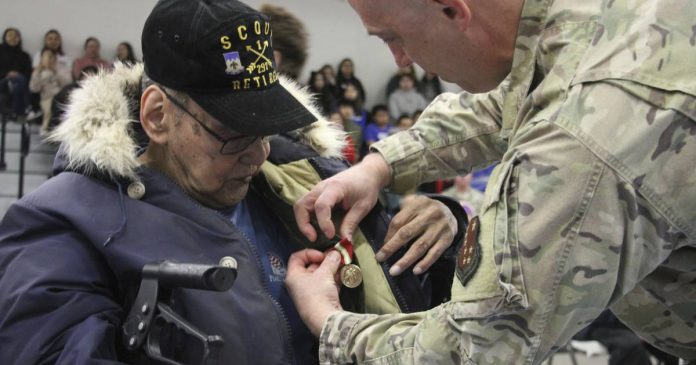
On Tuesday, the guardsmen were honored with Alaska Heroism Medals, giving the Alaska Native men the recognition that wasn’t available 67 years ago. Boolowon, then a corporal, is the sole survivor, and family members of the other 15 received the medals on their behalf.

Maj. Gen. Torrence Saxe, the adjutant general of the Alaska National Guard, not only approved the medals for the men, he personally handed them out at the ceremony held with a driving snow outside. Residents filled the gym at John Apangalook School in Gambell, home to the King Polar Bears — or Qughsatkut in Siberian Yupik— sports teams. Family members receiving medals sat in honored seats on the gym floor, and Saxe posed for photos with each after presenting the medals and a certificate. A community luncheon followed.

“I’m glad we’re going to get recognized a little bit for saving the crewmembers,” Boolowon said.

Shortly after the June 22, 1955, rescue, two of the guardsmen, MSgt. Willis Walunga and SSgt. Clifford Iknokinok, received honorific letters and certificates from the Navy and National Guard. They were taken to Washington, D.C., and presented “Wings of Gold” with the Honorary Naval Aviator Program designation. They were only the second and third persons so honored after the program started in 1949.

The other 14 only received letters. “I don’t know why they didn’t include us,” Boolowon said of the Navy designation.

There were no other medals available to the men for their deeds because it wasn’t a combat mission, and the rescue was considered a peacetime affair.

“The families felt like that the members should have received a better award than a letter of appreciation,” said Verdie Bowen, the director of the state Office of Veterans Affairs. “The best one that we could find that fit this feat of valor was the state of Alaska’s Heroism Award,” he said. It honors Alaska National Guard members who distinguish themselves by heroism, meritorious achievement or going beyond the call of duty.

Boolowon was with Iknokinok, Walunga and others in the first boat to arrive at the crash site, where they found the men.

He said they weren’t scared it was a Soviet aircraft because they were familiar with the U.S. plane from its frequent maritime patrols out of Naval Air Station Kodiak. On this mission, the plane was looking for icebergs and navigational aids in the Bering Strait. The wreckage of the plane still sits 8 miles (12.9 kilometers) from the village.

Boolowon and two other men from the first boat went to Gambell to get medical supplies, stretchers and more help. Another boat arrived, and the guardsmen eventually took the men to the village for treatment by a local nurse at a clinic and a church until a transport plane arrived about 12 hours later to take them to Anchorage. Seven of the injured were later flown to California to recuperate.

The June 22, 1955, attack was labeled a possible “mistake” by embarrassed Soviet leaders and came at a problematic time for the Soviet Union. A summit to de-escalate Cold War tensions was planned the following month in Geneva with President Dwight Eisenhower, Soviet Premier Nikolai Bulganin and the prime ministers of Great Britain and France.

After learning the plane was shot down, Eisenhower directed Secretary of State John Foster Dulles to meet with Soviet Foreign Minister Vyacheslav M. Molotov during the 10th anniversary meeting of the United Nations in San Francisco.

Molotov was unaware of the incident but promised an investigation. The Kremlin wired Molotov his instructions, which included presenting Dulles “with a conciliatory note that admitted the incident could have been ‘due to a mistake,’” David Winkler, the historian at the Naval Historical Foundation, wrote in his 2017 book “Incidents at Sea: American Confrontation and Cooperation with Russia and China, 1945-2016.”

It was the first time the Soviets both ever expressed regret and paid reparations, Winkler told the AP last summer, and the summit went on as planned. The Soviets agreed to compensate the U.S. for the plane, sending just over $35,000 (about $400,000 today) in reparations. The money was split among the crewmen.

In the early 1990s, Assard travelled to Gambell to thank them and presented the village with a bronze plaque.

Daywatch

Weekdays

Start your morning with today’s local news

“We were very fortunate in landing on an American island and being found by American Eskimos,” Assard, the flight navigator who is now deceased, told the Anchorage newspaper in 2015. “They couldn’t have been more gracious.”

This March 28, 2023, photo shows JoAnn Kulukhon posing with two Alaska Heroism Medals presented posthumously to her uncles, Pvts. Luke and Leroy Kulukhon, during a ceremony in Gambell, Alaska. Sixteen Alaska National Guard members were honored for helping rescue the 11 crewmembers of a Navy plane that was shot down in 1955 by Soviet jet fighters and crash-landed about 8 miles from Gambell, on St. Lawrence Island, and 15 medals were presented posthumously.

The other 13 guardsmen posthumously awarded medals were Pfcs. Holden Apatiki, Lane Iyakitan, Woodrow Malewotkuk, Roger Slwooko, Vernon Slwooko and Donald Ungott; Sfc. Herbert Apassingok; Sgt. Ralph Apatiki Sr.; Cpls. Victor Campbell, Ned Koozaata and Joseph Slwooko, and Pvts. Luke Kulukhon and Leroy Kulukhon.

JoAnn Kulukhon accepted medals on behalf of her two uncles and plans to prominently display them in her home. “I’m so proud of them,” she said. “I know they’re happy.”

As for receiving his own medal, Boolowon said the recognition is simply for work well done.

“I’m glad we did our duty as a guardsman,” he said.

___

AP Investigative Researcher Randy Herschaft in New York contributed to this report.

US Marine’s adoption of Afghan war orphan voided – Daily Press

0

CHARLOTTESVILLE, Va. — In a highly unusual ruling, a state court judge on Thursday voided a U.S. Marine’s adoption of an Afghan war orphan, more than a year after he took the little girl away from the Afghan couple raising her. But her future remains uncertain.

For now, the child will stay with Marine Maj. Joshua Mast and his wife, Stephanie, under a temporary custody order they obtained before the adoption. The Masts will have to re-prove to the court that they should be granted a permanent adoption.

Despite the uncertainty, the ruling was a welcome move for the Afghan couple, who had been identified by the Afghan government as the child’s relatives in February 2020 and raised her for 18 months. They dropped to their knees in prayer outside the courthouse. As they held each other, the young man wiped the tears from both their eyes with his wife’s headscarf.

The Masts quickly left the courthouse after Thursday’s hearing, flanked by their attorneys. The parties are forbidden from commenting by a gag order.

The dispute raised alarms at the highest levels of government, from the White House to the Taliban, after an Associated Press investigation in October revealed how Mast became determined to rescue the baby and bring her home as an act of Christian faith. But until now, the adoption order has remained in place.

“There’s never, ever been a case like this,” said Judge Claude V. Worrell Jr. on Thursday.

The girl, who will turn 4 this summer, was an infant when she was found injured in the rubble after a U.S.-Afghan military raid in a rural part of the country in September 2019. She spent more than five months in a U.S. military hospital before the Afghan government and International Committee of the Red Cross determined she had living relatives, and united her with them.

Unbeknownst to them, Mast learned about the baby while she was hospitalized, and decided that he and his wife should be her parents. The Masts told Virginia Circuit Court Judge Richard Moore that she was the daughter of transient terrorists who died in the fight, and thus a stateless orphan. He claimed that the Afghan government was prepared to waive jurisdiction over her, though it never did. Moore granted him the adoption.

Daywatch

Weekdays

Start your morning with today’s local news

The Masts contacted the couple in Afghanistan, offering to help with her medical treatment. After the U.S. military withdrew and Afghanistan fell to the Taliban in 2021, the Masts helped them evacuate to the United States. Once they arrived, Mast used the adoption order to take the child, and the Afghan couple have not seen her since.

The Masts claim in court filings that they legally adopted the child, and that the Afghan couple’s accusations that they kidnapped her are “outrageous” and “unmerited.” They have repeatedly declined to comment to the AP.

Judge Worrell, who took over the case after Judge Moore retired in November, said the Afghan couple “were the de facto parents when they arrived in the U.S.” and their due process was violated. Worrell also said from the bench that the Masts knew things that they never told the court, particularly about what was happening in Afghanistan at the same time the judge in Virginia was granting the adoption. He said he wasn’t sure it was intentional, but “the fact of the matter is that the court did not have all the information known to (the Masts) at the time the order was entered.”

The ruling is one more twist in what is already a standout case.

“Once an adoption is final, it is extremely difficult and rare for it to be overturned,” said Virginia attorney Stanton Phillips.

“This is really, really unusual,” said adoption attorney Barbara Jones. “You just don’t hear about this happening.”

A Defense Department spokesperson said Thursday it was aware of the ruling and referred the AP to the Justice Department, which declined to comment. Another hearing is scheduled for June.

Gov. Youngkin appoints new leader of Virginia National Guard, defense force – Daily Press

0

Gov. Glenn Youngkin announced Friday the appointment of Virginia’s 29th adjutant general, who will lead the Virginia Department of Military Affairs.

Brig. Gen. James W. Ring’s appointment as the chief administrative officer of the state’s Defense Force and Army and Air national guards will be effective June 3. Ring currently serves as the Virginia National Guard’s director of the joint staff, a position he has held since May 2018.

“I am incredibly honored and humbled by Governor Youngkin selecting me to lead the more than 9,000 Virginia National Guard Soldiers and Airmen and members of the Virginia Defense Force,” Ring said.

Ring is a 1988 Distinguished Military Graduate of Virginia Military Institute. He commanded at the company, battalion, brigade and general officer task force levels and has served in key leader operational assignments from the state to national levels. His deployments include Operation New Horizons in U.S. Southern Command; Operation Joint Forge in Bosnia-Herzegovina; Operation Iraqi Freedom in Southwest Asia; and Operation Jump Start on the U.S. Southwest Border.

“Brig. Gen. Ring is a proven leader who has served in key command and staff positions at the state and national level as well as in combat, and I am confident in his abilities to lead the Virginia National Guard and Virginia Defense Force,” Youngkin said.

Ring will take the helm from Major General Timothy Williams. Williams has held the position for three terms spanning 2014 to 2023.

“Being assigned as the 28th Adjutant General of Virginia has been a singular honor and privilege to serve the men and women of the Virginia National Guard and Virginia Defense Force over the last nine years,” Williams said. “I could not be prouder of these men and women who have displayed such dedication and professionalism. No matter what the challenge we faced, they always accomplished the mission in spectacular fashion.”

Caitlyn Burchett, [email protected]

USS Montana sailor died by suicide, medical examiner says – Daily Press

0

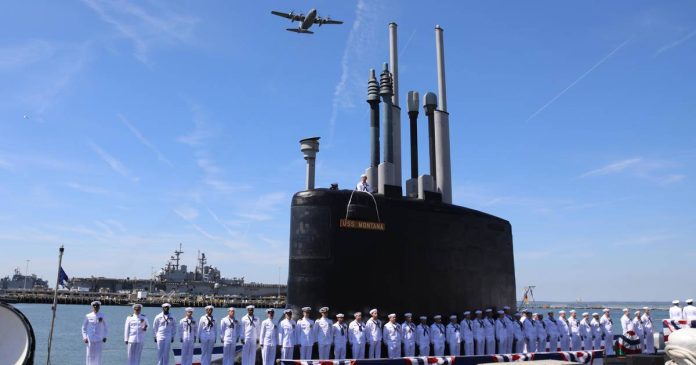
A USS Montana sailor who was found Monday at Newport News Shipbuilding died by suicide, the Tidewater Medical Examiner confirmed.

Devon Jeffrey Faehnrich was found on the pier adjacent to the fast-attack submarine by another crew member. He was taken to Riverside Regional Medical Center, where he was pronounced dead.

Faehnrich, an electronics technician navigation third class, reported to the USS Montana on March 30, 2022. The submarine was commissioned in June 2022 and is undergoing a post-shakedown availability at the Newport News shipyard.

“We deeply mourn the loss of our shipmate, and our thoughts and prayers are with the Sailor’s family, friends and coworkers during this difficult time,” said Cmdr. Paul Macapagal, spokesperson for Submarine Force Atlantic.

Faehnrich’s death is the second suicide of a Hampton Roads-based sailor reported in 2023. The first was Lucian Johan Woods, a boatswain’s mate seaman aboard the drydocked USS George Washington. Woods died Jan. 23 at a private residence in Newport News.

Grief counseling services and support are being provided to Montana shipmates through the chain of command and the command chaplain, Macapagal said.

Resources for service members and veterans struggling with mental health, including 24-hour crisis hotlines:

  • The Military Crisis Line: call 1-800-273-8255, ext. 1; or text “273Talk” to 839863
  • Military OneSource: 1-800-342-9647
  • National Suicide Prevention Lifeline: 988 — call or text

Caitlyn Burchett, [email protected]

US Navy deploys more chaplains for suicide prevention. In Norfolk, ‘mental health permeates every aspect’ of operations. – Daily Press

0

NAVAL STATION NORFOLK — On Navy ships docked at this vast base, hundreds of sailors in below-deck mazes of windowless passageways perform intense, often monotonous manual labor. It’s necessary work before a ship deploys, but hard to adjust to for many already challenged by the stresses plaguing young adults nationwide.

Growing mental health distress in the ranks carries such grave implications that the U.S. chief of naval operations, Adm. Michael Gilday, answered “suicides” when asked earlier this year what in the security environment kept him up at night.

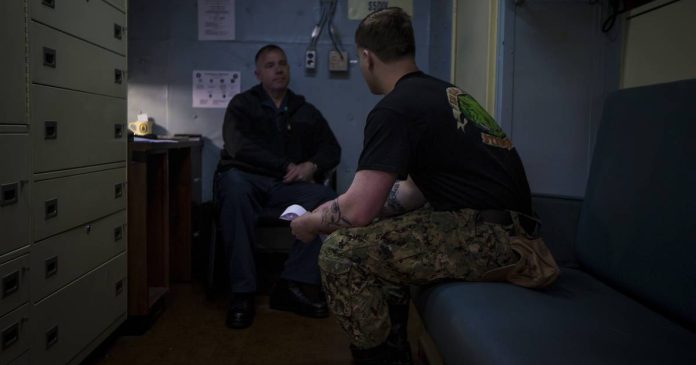
One recently embraced prevention strategy is to deploy chaplains as regular members of the crew on more ships. The goal is for the clergy to connect with sailors, believers and non-believers alike, in complete confidentiality — something that has allowed several to talk sailors out of suicidal crises.

“That makes us accessible as a relief valve,” said Capt. David Thames, an Episcopal priest who’s responsible for chaplains for the Navy’s surface fleet in the Atlantic, covering dozens of ships from the East Coast to Bahrain.

The families of two young men who killed themselves in Norfolk said chaplains could be effective as part of a larger effort to facilitate access to mental health care without stigma or retaliation. But they also insist on accountability and a chain of command committed to eliminating bullying and engaging younger generations.

“A chaplain could help, but it wouldn’t matter if you don’t empower them,” said Patrick Caserta, a former Navy recruiter. His son Brandon was 21 when he killed himself in 2018, after struggling with depression and being “told to suck it up and go back to work.”

Mental health problems, especially among enlisted men under 29, mirror concerns in schools and colleges, which are also increasingly tapping campus ministry for counseling. The isolation of the COVID-19 pandemic has exacerbated depression and anxiety for many.

But chaplains, civilian counselors, families of suicide victims, and sailors from commodores to the newly enlisted say these struggles pose unique challenges and security implications in the military, where suicides have risen for most of the past decade and took the lives of 519 service members in 2021, per the latest Department of Defense data.

“Adjustment disorder” is the most common mental health diagnosis among sailors, Gilday said Wednesday at a budget hearing of the House Appropriations Committee’s defense subcommittee. He asked to invest in chaplains and others onboard who can help “separate life stress from mental illness” and get sailors “at the tactical edge” the right care.

“Mental health permeates every aspect of our operations,” Capt. Blair Guy, commodore for one of the destroyer squadrons based in Norfolk, said via email. “Enhancing spiritual readiness enhances operations, it is not an either or discussion.”

His squadron’s lead chaplain, Lt. Cmdr. Madison Carter, is working on recruiting others for the three ships still without permanent chaplains. In the next two years, leaders hope to have 47 chaplains on ships based in Norfolk, up from 37 today. Previously, chaplains — who are both naval officers and clergy from various denominations — were routinely deployed only on the largest aircraft carriers that have up to 5,000 personnel.

Carter, a Baptist pastor, said most of his talks with sailors involve not faith but life struggles that can make them feel unfulfilled and lose focus.

“How do I make sure that you have mind, body and soul all locked in?” is the question that drives his mission.

The very real prospect of killing or being killed in combat provokes “God-sized questions,” in Thames’ words. He joined the Navy after 9/11 and served three tours in Iraq and Afghanistan.

Sailors can carry the routine angst of teens and young adults, from political polarization to breakups to broken homes, which some enlist to escape. But onboard, disconnected from their real and virtual networks, they lack the usual coping mechanisms, said Jochebed Swilley, a civilian social worker who collaborates with chaplains and medical staff aboard the USS Bataan, an amphibious assault ship.

Most communications are off-limits at sea for security — lest a Russian frigate show up while you’re texting mom, Thames said he explains to digital-native sailors.

“Eighteen to 21-year-olds don’t know life without smartphones,” said Kayla Arestivo, a counselor and advocate for service members and veterans whose nonprofit serves more than 100 of them each week on her horse farm near Norfolk. “If you remove a sense of connection, mental health plummets.”

Chief Legalman Florian Morrison, who’s served on the Bataan for more than two years tackling mental health cases at the ship’s legal office and as a lay leader for other Christian sailors, said faith is what helped him “recenter” after losing three shipmates to suicide.

“It can be overwhelming… if you feel alone and you’ve nobody to reach out to,” Morrison said in the chapel set up in the ship’s bow. “You’ve got to catch it before you start going down that path. A streamlined pathway to mental health would help.”

Petty Officer 3rd Class Benjamin Dumas, 21, who’s served for two months on the USS Gravely, a destroyer, hopes to become a nondenominational Christian lay leader to help the ship’s more than 300 other sailors navigate anxiety and depression.

“I’ve seen a lot of brokenness,” he said.

Even docked, ships are far from stress-free, as sailors constantly navigate steep ladderwells and pressurized, hulking doors under the glare of fluorescent lights and the constant hum of machinery.

Berths can be stacked four people high and pieces of gear protrude ubiquitously. Space is so tight and regimented that a challenge across the fleet is where to squeeze in offices for new chaplains, said Cmdr. Hunter Washburn, the Gravely’s commanding officer.

His crew looks forward to getting a permanent chaplain later this year who can interact “eyeball to eyeball, to check in and see how they’re doing,” Washburn said.

A Navy chaplain’s role is akin to a life coach, helping young sailors find their footing as adults in an environment that looks far more different from the civilian world than it did in previous generations.

“A lot haven’t found that grounding yet. They’re looking,” said Lt. Greg Johnson, a Baptist chaplain who joined the Bataan in December. “A lot of people have resiliency. They just don’t know how to tap into it.”

In the Navy, clergy need to engage with people of different or even no faith who might be initially turned off by the cross or other religious symbols on their uniforms — something that new chaplains need to be ready for if the effort to place more of them on ships is to succeed.

“I want the people who can be uncomfortable and still be the bearers of God’s presence,” Carter said.

Sailors call them “deck-plating chaps” — chaplains striking up a conversation with their shipmates in the mess decks or during night watches, in addition to keeping an open-door policy at all hours.

“They’re accustomed to me making the rounds,” said Thames. “I’m going to find them when they’re eating meals, or it’s 3 a.m. and we’re making a high-risk transit through Hormuz,” a geopolitically crucial strait in the Middle East.

Lt. Cmdr. Nathan Rice, a Pentecostal chaplain serving a destroyer squadron at Norfolk, estimates he did 7,000 hours of counseling over 12 years. Long lines of sailors waiting to talk often formed outside his door.

“They’re grinding on a ship or serving food on a mess line, that’s not what they expected. So we help to find their meaning and purpose,” Rice said. “When their life is not going the way they think it should be going, I’ll be blunt and ask, ‘Why haven’t you killed yourself?’”

Focusing on the answers — the “anchors” to the sailors’ will to survive — has helped Rice talk some down from the ledge, including one sailor who knocked on his door crying that he wanted to live and a corpsman who, while discussing suicide dreams, suddenly cocked his weapon and told Rice, “I could do it right now.”

Lt. Cmdr. Ben Garrett has also diffused several suicide situations in the more than a decade he’s been a Catholic chaplain, for the past eight months on the Bataan, which when underway carries 1,000 sailors, 1,600 Marines and three other chaplains. But last fall, he officiated the memorial for a suicide victim.

“There were sailors in the rafters,” he recalled. “It affects the whole crew.”

Robert Decker displays photographs to honor the U.S. Navy service of both of his sons, Kyle and Kody, at his home in Norfolk on Tuesday, March 14, 2023. Decker's youngest son, Kody, committed suicide in October 2022 while stationed at Norfolk Naval Station. (AP Photo/John C. Clark)

Daywatch

Weekdays

Start your morning with today’s local news

Most profoundly, suicide impacts surviving families. Kody Decker was 22 and a new father when he killed himself at a maintenance facility in Norfolk, where he was transferred after struggling with depression on the Bataan, according to his father, Robert Decker.

“He wanted to give to his country,” the father said at his home a dozen miles from the base. Pictures of Kody, his older brother and their grandfather — all in their Navy uniforms — rest on the mantelpiece next to the folded flag from Kody’s funeral.

Robert Decker, a high school teacher and football coach, believes Kody might still be alive if he had better access to mental health care instead of being put on limited duty and deprived of his sense of purpose while assigned menial tasks.

He’s not sure if talking to a chaplain would have made a difference with Kody, though speedy implementation of the Brandon Act might have. The bill, named after the Casertas’ son, aims to improve the process for mental health evaluations for service members.

But Decker hasn’t given up on either the Navy or God.

“My whole fight is about not having other families like us,” he said as a tear rolled down his cheek. “I pray to God every night, for help, for healing, for strength. I’m not a quitter. But it’s hard.”

The national suicide and crisis lifeline is available by calling or texting 988. There is also an online chat at 988lifeline.org.

Navy identifies USS Montana sailor who died after being found at Newport News Shipbuilding – Daily Press

0

The Navy identified the USS Montana sailor who died Monday after being found at Newport News Shipbuilding.

Devon Jeffrey Faehnrich, an electronics technician navigation third class, was found unresponsive on the pier adjacent to the fast-attack submarine by another crew member. Faehnrich was taken to Riverside Regional Medical Center, where he was pronounced dead.

Faehnrich, who is from Colorado, enlisted April 20, 2021. He spent his first year of service attending training schools in Illinois and Connecticut before reporting to the USS Montana.

Faehnrich reported to the USS Montana on March 30, 2022. The submarine was commissioned in June 2022 and is undergoing a post-shakedown availability at the Newport News shipyard.

“We deeply mourn the loss of our shipmate, and our thoughts and prayers are with the Sailor’s family, friends and coworkers during this difficult time,” said Cmdr. Paul Macapagal, spokesperson for Submarine Force Atlantic.

Grief counseling services and support are being provided to shipmates through the chain of command and the command chaplain, Macapagal said.

Faehnrich’s death is being investigated by the Naval Criminal Investigative Service.

Caitlyn Burchett, [email protected]

Army quickly plans new ads for NCAA games after Jonathan Majors’ arrest – Daily Press

0

WASHINGTON — The Army is working to quickly pull together some new recruiting ads to air during the NCAA’s Final Four basketball games this weekend, after being forced to yank commercials that featured actor Jonathan Majors, in the wake of his arrest last Saturday.

Army leaders had been excited to feature Majors in the ads, as a key part of their new campaign aimed at reviving the service’s struggling recruiting numbers — which fell far short of their enlistment goal last year. They believed the ads would capitalize on Majors’ popularity coming off his recently movies “Creed III” and “Ant-Man and The Wasp: Quantumania” — hoping it would help them reach the youth audience.

Last weekend, however, they pulled the ads off the air when Majors was arrested in New York on charges of strangulation, assault and harassment. New York City police said the actor was involved in a domestic dispute with a 30-year-old woman. But a lawyer for Majors, Priya Chaudhry, has said there is evidence clearing Majors and that the actor “is probably the victim of an altercation with a woman he knows.”

Maj. Gen. Alex Fink, head of Army marketing, told The Associated Press Tuesday that in the past week the Army was able to avoid any loss of of the planned $70 million advertising buy, either by postponing ads or replacing them with other pre-existing commercials that were quickly updated.

The ads were set to appear on television, online on places such as Facebook, Twitter and Instagram, and on digital and physical billboards, including on buses. That ad purchase was the main portion of the campaign, which had a total cost of $117 million.

“We are absolutely able to utilize a majority of what we have invested,” Fink said in an interview. “We think that we’ll have some brand new creative ads in time for the Women’s Final Four on Friday.”

He said that the Army gathered “an enormous amount” of content and footage for the two commercials — titled “Overcoming Obstacles” and “Pushing Tomorrow” — that featured Majors as the narrator.

Daywatch

Weekdays

Start your morning with today’s local news

“A majority of that content did not contain our main narrator. … So we have a ton of content to go back to, to create basically new commercials new ads, if we need to,” Fink said. “The campaign is full steam ahead.”

The Army launched a new ad campaign earlier this month with a big event at the National Press Club as part of the plan to revive the Army’s popular “Be All You Can Be” slogan, which dominated its recruiting ads for two decades starting in 1981. The two new ads highlighted the history of the Army and some of the many professions that recruits can pursue. They ran from March 12 until they were pulled from the air by the Army on the 25th.

Last year was the Army’s worst recruiting year in recent history, falling 25% short of its goal to enlist 60,000 recruits.

Lawmakers on Capitol Hill Tuesday raised the advertising issue and peppered Army Secretary Christine Wormuth and Gen. James McConville, the Army’s chief of staff, with questions about how the service intends to fix the recruiting problems.

“I see you had a bit of bad luck on your ‘Be All You Can Be’ commercial,” said Rep. Ken Calvert, R-Calif., the chairman of the House Appropriations defense subcommittee. “Hopefully you’re cutting a new commercial and getting it online as quickly as possible.”

Wormuth said the Army has a number of new programs, including bonuses, referral initiatives and a future soldier prep course that gives underperforming recruits a chance to take an academic or fitness course to try and meet enlistment standards.

“We’re trying to do everything we can think of because this is really a fundamental thing that the Army has got to solve if we’re going to continue to be the world’s greatest army,” she said.

Army recruits get 2nd chance with extra academic, fitness instruction – Daily Press

0

WASHINGTON — Last August, Daysia Holiday decided to try one more time to join the Army.

She’d taken the academic test and failed three times. So, when she was offered a slot in a new Army prep course to help improve her scores and qualify for basic training, she jumped at the chance.

Seven months later, Pvt. 2nd Class Holiday is a proud graduate of Army basic training, and is finishing her advanced instruction at Fort Lee, Virginia, to become a power generation specialist who will maintain engines and other equipment for the service.

Holiday is an early beneficiary of the new program, which gives lower-performing recruits up to 90 days of academic or fitness instruction to help them meet military standards. In place for only eight months, it is already making a significant difference for both the Army and those who want to serve in it.

So far, 5,400 soldiers have made it through the prep course since it started in August at Fort Jackson, South Carolina. That’s an important boost since the Army fell dramatically short of its recruiting goals last year, due to low unemployment and general wariness about military service. And at least one other military service, the Navy, took notice and is setting up a similar course.

For those who make it through the program, it can be life-changing. Holiday, 23, said many of her peers in her hometown of Baton Rouge, Louisiana, didn’t make it out of high school, with some “dead or in jail.” Sitting outside the class building in her Army fatigues last summer, she talked about trying to pass the academic test for two years with no success.

She said she wanted to set an example, especially for her younger siblings. The prep course gave her a second chance. She raised her academic score by more than 20 points.

The course, she said, was like “basic training without the yelling.” It also allowed her to bond with fellow students. “We helped each other out throughout basic training, so it was easy,” she said. “All of us actually passed, so it was a good experience. And we all keep in touch.”

Army leaders say the program — it involves classroom instruction and training ranging from how to wear the uniform and properly make a bed to fitness and discipline — gives recruits like Holiday an advantage.

“I think an interesting thing we’ve seen is that the kids coming out of that course, who go into basic, actually seem to have a little bit of a leg up,” said Army Secretary Christine Wormuth. “During basic training, certain young individuals who show a little bit more leadership skills than others get selected to have leadership positions. And what we’re seeing is the kids coming out of the prep course are often the ones who are being chosen for that.”

As of March 17, nearly 8,400 people had been admitted to the prep course and more than 5,400 had graduated and gone on to basic training. Army Lt. Col. Randy Ready, spokesman for the Army Center for Initial Military Training, said about 6% of those recruits don’t make it through basic and advanced individual training, about the same attrition rate as for those who don’t go through the prep course.

Ready said almost 4,000 of the graduates were in the academic track and about 1,400 were in the fitness track. Students in the academic program increased their test scores by an average of 19 points, he said.

“It has been largely very, very successful,” said Maj. Gen. Johnny Davis, head of Army Recruiting Command, adding that students who go through the prep course come out more prepared. “It instills a level of positively and confidence in those future soldiers.”

Gen. James McConville, Army chief of staff, told a House committee on Tuesday that students in the program are improving their academic scores and losing 4% to 6% of their body fat.

“We’re really giving them discipline,” he said. “They’re getting in shape. We’re giving them a head start. So when going into initial military training, where they were at the lowest category, they’re actually excelling and in some ways exceeding the standards — becoming the student leaders.”

Once in the program, recruits are tested every week. And every three weeks they can move into basic training if they pass the military’s academic test — the Armed Services Voluntary Aptitude Battery — or if they meet the physical standards. If they don’t pass or meet the standards after the first three weeks, they can stay on and keep testing for up to 90 days, but they have to leave the Army if they haven’t succeeded by then.

Army leaders initially thought they might open as many as four locations for the prep course, but they haven’t seen the need. Instead, they doubled the capacity at Fort Jackson and created a smaller, similar program at Fort Benning, Georgia, which gives young soldiers a chance to raise their academic scores if they want to qualify for higher-skilled jobs or bonuses.

Daywatch

Weekdays

Start your morning with today’s local news

The program got the Navy’s attention. Late last November, Navy Capt. Frank Brown and several others visited Fort Jackson, and as a result will open a new sailor fitness prep course next month. Brown said recruits who are 6% above the body composition requirements will take a three-week fitness course, and can repeat it for up to 90 days to meet the standards and go on to boot camp.

Brown, the director of operations for training at Naval Station Great Lakes in Illinois, said 60 to 80 recruits will start the course on April 10. He said the Navy is also planning a pilot program for an academic course, likely this summer, to allow lower-scoring recruits to improve so they can qualify for higher-skilled jobs.

Air Force officials said they haven’t ruled out doing a prep program, but are currently using other ways to boost recruiting.

“We are focusing our efforts on eliminating unnecessary or outdated policy barriers to recruiting, adapting our outreach strategy, and adjusting our recruiting approach” to better reach potential recruits, said Maj. Gen. Ed Thomas, commander of the Air Force Recruiting Service.

As for Holiday, when she graduates Wednesday she will head to her first post, in Fort Carson, Colorado. “I’m very much glad that I did it,” she said. “It’s been a good journey for me.”

And she’s got bigger ambitions.

“I still want to try to do the Green Beret (course),” she said. “And, I want to do other courses — airborne and stuff like that. And I want to also try to become an officer as well.”

Sailors take advantage of Navy’s ‘Do It Herself’ auto class – Daily Press

0

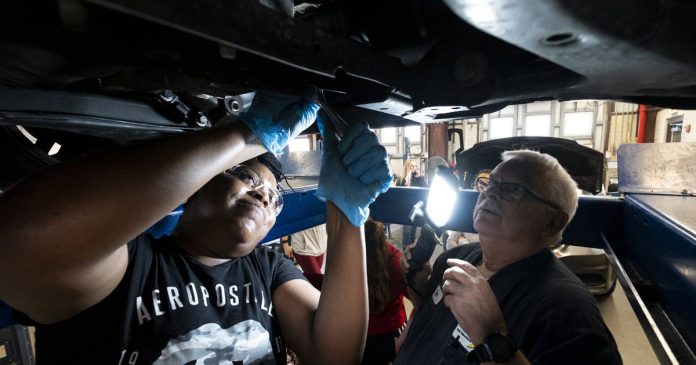
Alliyah Moore used a torque wrench to tighten the last of the screws under her Land Rover as she wrapped up changing its oil.

An aviation boatswain’s mate in the Navy, she typically uses torque wrenches when doing maintenance on a very different piece of machinery — aircraft carrier catapults.

“I have experience with tools and catapults, but not cars,” Moore said with a laugh.

Moore was one of three sailors who gathered Friday at Naval Station Norfolk’s Auto Skills Center to learn how to change oil, rotate tires and check air filters on a vehicle. Donning safety glasses and gloves, the women spent the better part of two hours crouching to peak under Moore’s vehicle, lifted around 5 feet in the air, taking turns peppering the instructor with questions.

Twice a month, the class — coined “Do It Herself” — draws a handful of women to the garage at Naval Station Norfolk’s Auto Skills Center as part of Hampton Roads Morale, Welfare & Recreation Program.

The class motto, which dates back to the 80s, graces its webpage — “Anything he can do, she can do better” — a throwback to a duet from a 1946 Broadway musical. But this program is less about competitiveness and more about creating a space in which female service members and spouses feel comfortable learning how to “DIY” basic car maintenance.

Even now, there are a lot of guys in here, but having a class for females makes you feel less alone. You aren’t the only girl in here, asking questions, trying to figure things out,” said Danielle Cuello, a hospital corpsman, as she looked around at the groups of men working on vehicles at neighboring bays.

Cuello said she was drawn to the Do It Herself class because it is available exclusively for women. Cuello initially brought her car to the auto skills center with a friend in tow, someone she said had more experience working with vehicles. But she didn’t want to let self-consciousness stand in the way of learning how to take care of her car.

The Auto Skills Center is strictly a do-it-yourself shop. It has several bays and is fully equipped with vehicle lifts and tools necessary for general vehicle maintenance.

A lot of guys come in here and they don’t know what they are doing … But the Do It Herself program is designed to get the women in here, too,” said Tim Daubert, manager of the center. “The ladies need to know what is going on with their car — whether they are traveling or if their husband is out to sea — they need to know what to do if something goes wrong.”

The shop, he said, can be a vital cost-saving resource for service members and military-adjacent family members who have no one to turn to for affordable vehicle maintenance or guidance in fixing something themselves.

“I had a lady officer in the class who said her dad traveled all the way up here from Pensacola to get her car right for a state inspection,” Daubert said. “She got flagged for a few simple things that we could have walked her through here.”

Alliyah Moore tightens a screw while changing oil in her car at the Naval Station Norfolk Auto Skills building in Norfolk, Virginia on March 24, 2023.

Daywatch

Weekdays

Start your morning with today’s local news

Because the auto skills center is set up as a do-it-yourself garage, the technicians cannot do car maintenance for a vehicle owner.

Daubert, who has been teaching the class since it began, said while the class focuses on oil changes and tire rotations, technicians are also on hand to guide people through changing brakes and replacing shocks and struts.

“We are just here to answer questions. But the ladies have to get their hands dirty — that is the best way to learn,” Daubert said.

Isabella Loszynski, a Norfolk-based sailor from New Jersey, said the hands-on learning experience is exactly why she wanted to participate in the class. As a culinary specialist, she said she has little to no experience working with vehicles or machinery. She plans to make the drive home in the coming weeks and is leery of travel woes.

“I am not very good with cars. Today, I am learning something so if I get stuck on the side of the road — you know, like a flat tire — I can fix it myself,” Loszynski said.

The class is open to women — service members or dependents — with base access. Those interested in participating in future Do it Herself classes can register by calling 757-444-3046.

Caitlyn Burchett, [email protected]

Oceana air show returns in September, honoring women trailblazers – Daily Press

0

Naval Air Station Oceana’s annual air show will return in September, with a theme of honoring women in naval aviation.

The 2023 show will be held at the Virginia Beach base Sept. 16-17.

“Our theme this year pays tribute to the Navy’s women trailblazers, from ‘The First Six’ to earn their Wings of Gold, to the exemplary leaders who have since chosen to serve their nation in the skies,” said Capt. Steve Djunaedi, NAS Oceana commanding officer, during an announcement Tuesday at the base.

The lineup will feature the Navy’s flight demonstration team, the Blue Angels; the F-35C II Lightning Demonstration Team; and the F-22 Raptor Demonstration Team. The performance schedule will be announced as the event nears.

The Fleet Logistics Support Squadron hangar at the airfield will also be open during the air show, hosting a variety of science, technology, engineering and math (STEM) activities throughout the weekend.

NAS Oceana’s annual air show typically draws 250,000 to 300,000 visitors. The event is open to the public, and admission and parking are free.

The show started in 1953 and has been held nearly every year since 1962, only missing two years during the pandemic before returning last September.

“As a military community, Virginia Beach will always have a special kinship with those who fight to defend our freedoms,” said Bobby Dyer, mayor of Virginia Beach.

Caitlyn Burchett, [email protected]