Home Blog Page 195

Navy officials expediting medical evaluations for sailors amid concerns about mental health care – Daily Press

0

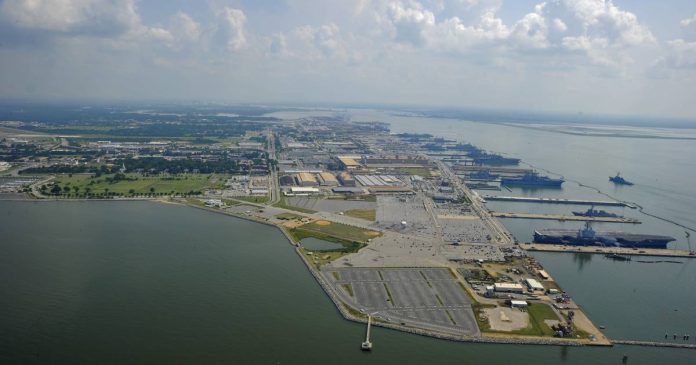
Top Navy officials said the service is working to expedite medical evaluations for sailors placed on limited duty following a string of suicides at Norfolk’s Mid-Atlantic Regional Maintenance Center.

The remarks came from Secretary of the Navy Carlos Del Toro and Chief of Naval Operations Michael Gilday during a Senate Armed Services Committee hearing last Tuesday as Sen. Tim Kaine pressed the two on service member mental health.

According to Kaine, an issue at the Norfolk’s Mid-Atlantic Regional Maintenance Center, where four sailors on limited duty were assigned at the time of their deaths, was a policy that allowed for a 60% increase in assignment of personnel who were on limited duty or pregnancy/postpartum. This resulted in the a need for more in-unit medical resources.

“The first thing that we’re doing is making a faster determination of what path they ought to be on,” Gilday said. “Are they on light duty for a period of two weeks because they have a sprained ankle? Or do we need to move them off the ship on a more permanent basis?”

In accelerating the rate sailors get medical treatment and evaluations, Gilday said the Navy can avoid putting sailors on limited duty.

Sailors may be put on limited duty and temporarily reassigned to a new command for wide-ranging physical, mental or circumstantial conditions, including pregnancy, nearing retirement, recovering from surgery, or even diagnosis with a terminal illness. Exactly how long the temporary assignment lasts depends on how long it takes a sailor to go through the necessary medical evaluations.

To address that issue, Gilday said, the Navy is working to get service members on limited duty those medical evaluations “at a much faster pace.”

And the Navy is reducing the ratio of limited duty sailors at a command “so that we don’t have another MARMC,” Gilday said.

The exchange was in response to another high year of sailor deaths by suicide, which topped out at 70. The count represents roughly an 18% increase from 60 in 2021 and a 7% increase from 2020. The highest tally in recent years was 73 in 2019.

Daywatch

Weekdays

Start your morning with today’s local news

Seven of the sailors who died by suicide in 2022 were assigned to Hampton Roads-based installations — three assigned to the drydocked USS George Washington and four assigned to the maintenance center.

Kaine also asked Del Toro and Gilday about the implementation of the Brandon Act, which was signed into law by President Joe Biden in 2021 but has yet to take effect. The Brandon Act would allow service members to confidentially seek mental-health care outside military medical providers. The act also would provide a confidential channel for service members to report mental health struggles.

“I’m pushing the Department of Defense to implement the bill as quickly as possible — and working to secure additional mental health resources for our armed forces through this year’s annual defense funding bill — so we can get service members the mental health services they need,” Kaine said.

The details of how best to implement the act, Del Toro told Kaine last Tuesday, are being reviewed by the Undersecretary of Defense for Personnel Readiness.

“I hope that over the course of the next several months, we’ll actually have a path forward on how best to execute it. It’s extremely important to bring every tool in the toolkit in order to solve this or try to help solve this very, very tragic situation with regard to not just suicides in the Navy, but suicides in the nation,” Del Toro said.

Resources for service members and veterans struggling with mental health, including 24-hour crisis hotlines, can be found below:

  • The Military Crisis Line: call 1-800-273-8255, ext. 1; or text “273Talk” to 839863
  • Military OneSource: 1-800-342-9647
  • National Suicide Prevention Lifeline: 988 — call or text

Caitlyn Burchett, [email protected]
Thousands welcome home sailors of the USS George H.W. Bush – Daily Press

0

Just after daybreak, sailors below the deck of the USS George H.W. Bush buzzed with anticipation, seeming to rush from place to place as they tried to sneak a glimpse at the barely visible Virginia Beach coast.

“There it is,” said one sailor to another, as they peered out a roped-off doorway.

The warship made its way back to Naval Station Norfolk early Sunday morning following a near nine-month deployment. A Virginian-Pilot photographer and reporter flew out to the carrier before it pulled into port.

As they approached the coast around 7 a.m., Rear Admiral Dennis Velez announced that sailors could use their cell phones in the hangar bay — an exception to a rule that typically requires sailors turn their cell phones off when pulling into ports.

“They’re excited, they’re proud of what they accomplished. The right to talk to their families and friends was kind of a little gift, a homecoming gift for all of them and really for their families,” Velez said.

Hundreds of sailors took him up on it. It had been about a month since they last had cell phone reception.

During the roughly 250-day cruise, the strike group traveled more than 63,000 nautical miles and completed over 12,100 sorties and 25,000 flight hours. The strike group trained and operated with more than 26 allies and partners participated in NATO-led vigilance activity Neptune Strike and Juniper Oak 23-2, the largest bilateral U.S.-Israeli exercise in history.

The long-awaited homecoming of the 5,000 sea-going sailors was delayed by about two weeks as the Bush was postured March 31 to bolster the capabilities of CENTCOM (U.S. Central Command) in the Middle East after a series of attacks in Syria.

“They (the sailors) understood why we needed to be in the position for a little more time. Because if our presence there prevents escalation or saves even one American life, it is worth it and they understood that,” Velez said.

As the carrier passed past the Cape Henry Lighthouse and turned into the Chesapeake Bay, the battle flag was hoisted — the blue of the flag nearly matching that of the sky. About an hour later, at 9:20, some 200 sailors in their dress whites manned the rails as leadership played Bruce Springsteen’s “Born in the USA” over the intercom and tugboats guided the warship with musical horns and 360-degree spins.

“Looking sharp, sailors,” said Capt. Dave Pollard, commanding officer of the Bush, his voice booming over the intercom. “Welcome home.”

The cheers of the thousands of onlookers could be heard as the Bush did a starboard twist, pulling next to its sister ship, the USS Dwight D. Eisenhower, and prepared to shift the colors to its fantail.

As the ship pulled closer to the pier, the homemade signs and American flags frantically waved by loved ones slowly became distinguishable.

A group of 26 male sailors gathered just outside the “Bomb Farm” below deck where a brow was to be lowered. They were less than an hour from not just being reunited with their families — they were all fathers who would be meeting a baby for the first time.

“I am very nervous. I am coming back to a whole new person,” said 20-year-old aviation ordnanceman Spencer Fetterhoff just minutes before disembarking.

He’s only seen his 7-month-old daughter, Leilani, in pictures and videos.

Daywatch

Weekdays

Start your morning with today’s local news

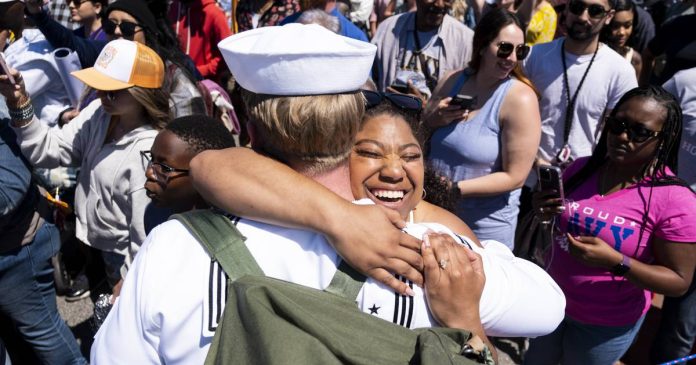
Around noon, leadership climbed down the metal grated steps into the arms of loved ones. Shortly after, sailors, all in dress whites, disembarked in droves.

Beatrice Anima, an aviation ordnanceman, eagerly awaited the arrival of her mother, Monica, and her uncle, James. The pair were driving to Norfolk on Sunday from Alexandria to welcome the 22-year-old home from her first deployment.

“It was a lot of ups and down, but I really enjoyed the time. I learned a lot about myself, others and the world,” Anima said. “But I am ready to see my mom, for sure. That is the hardest part. This is the longest I have been away.”

Anima is bringing home memories of re-enlisting on a helicopter, exotic Grecian cuisine, and dreams of where she hopes the Navy will take her next.

“It was hard, missing holidays, but it was worth it. And holidays missed just means there is more to celebrate now,” Anima said with a laugh.

Eager to find her family, Anima — lugging a hefty bag on her back — trekked down the pier to the mass of families cheering at the security gate, eventually disappearing into a sea of sailors.

Caitlyn Burchett, [email protected]

Fighter squadrons return to NAS Oceana after 8-month deployment – Daily Press

0

The jets had not yet broken the sound barrier when the V-shaped formation came into view against the blue sky.

About a dozen families erupted in cheers at the sight, eager to welcome home the fliers. Minutes later, loved ones laid eyes on their sailors for the first time in more than eight months.

Fighter squadrons from Carrier Airwing 7 returned Friday to Naval Air Station Oceana following an extended deployment with the George H.W. Bush Strike Group. The “Pukin’ Dogs” of Strike Fighter Squadron (VFA) 143 were the first of two fighter squadrons to touch down.

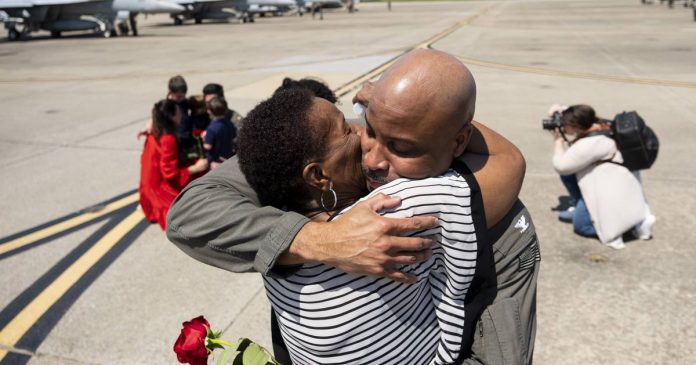
As the pilots began walking to their families waiting near the hangar, 13-year-old Rhea Hampton, dressed in a red jumpsuit, sprinted to her father. Her feet lifted off the ground as Capt. Alex Hampton wrapped her in a hug.

“I am just feeling pride, so much pride, for the work they have done,” said Yvaal Hampton, Alex Hampton’s wife, a smile stretched across her face.

Carrier Airwing 7, which included eight squadrons of fighter jets, Greyhound cargo planes and Seahawk helicopters, deployed in August with the USS George H.W. Bush. While parts of the strike group returned nearly three weeks ago, the return of carrier was delayed after a series of Iranian attacks in Syria.

Erin Giesler, wife of Lt. Cmdr. Jeffery Giesler, said the news of the extension was “like a gut punch.”

Daywatch

Weekdays

Start your morning with today’s local news

“But it went quickly. Luckily, it wasn’t as long as I thought it might be. And now its over,” said Erin Giesler, wiping a tear from her eye as she watched her husband hold their 3-year-old son, Zack.

Jack Giesler, 3, laughs while being held by his father Lt. Commander Jeff Giesler. The Pukin’ Dogs of Strike Fighter Squadron 143 returned home from Carrier Strike Group 10 to Naval Air Station Oceana in Virginia Beach, Virginia, on April 21, 2023.

The remainder of the air wing will return Friday and Saturday. The George H.W. Bush and guided-missile cruiser Leyte Gulf will return Sunday to Naval Station Norfolk.

During the approximately 250-day cruise, the strike group participated in NATO-led vigilance activity Neptune Strike and Juniper Oak 23-2, the largest bilateral U.S.-Israeli exercise in history. The strike group completed over 12,100 sorties and 24,000 flight hours during deployment.

Standing alongside his F/A-18E Super Hornet, Capt. Alex Hampton corralled his family — his wife, 16-year-old son Zane, 13-year-old daughter Rhea, his mother, and two sisters — in front of a camera for a family photo. While the anticipation of waiting wore off, the tears and the hugs never stopped.

“The being away is the most challenging part. The distance can make you feel disconnected. But they were on a mission. The mission was accomplished and now everyone is ready to be with family,” said Yvaal Hampton.

Caitlyn Burchett, [email protected]

Report of person with gun causes lockdown at Oceana Naval Air Station – Daily Press

0

Oceana Naval Air Station was briefly put under lockdown this morning after a person was reported as having a gun.

The lockdown was lifted around 11:20 a.m. Navy officials said a person was seen openly carrying a weapon in Building 513 at the base, and officials directed visitors into a nearby hangar.

No other details were available.

The air wing of the USS George H.W. Bush aircraft carrier is scheduled to return to Oceana later today.

George H.W. Bush carrier strike group to return Sunday – Daily Press

0

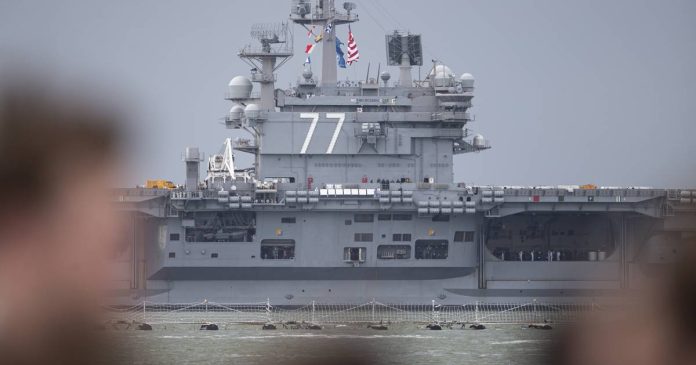
The George H.W. Bush will return Sunday, as the carrier moors at Naval Station Norfolk following an eight-month deployment.

The flagship of the strike group, departed Norfolk on Aug. 10 for what was supposed to be a seven-month deployment. It was supported by Carrier Air Wing 7, Destroyer Squadron 26, the Information Warfare Commander, and the Ticonderoga-class guided-missile cruiser USS Leyte Gulf.

Near the end of the strike group’s deployment, the Bush was postured March 31 to bolster the capabilities of CENTCOM (U.S. Central Command) in the Middle East after a series of attacks in Syria, delaying the homecoming of around 5,000 sailors.

“Since taking command before deployment, I have had the privilege and honor to serve with the finest warriors, teachers, leaders, and ambassadors in the U.S. Navy,” said Capt. Dave Pollard, commanding officer of the Bush, in a press release. “Our Sailors serve our great nation honorably, exemplifying the service, grit, humility and resilience our namesake, President George Herbert Walker Bush, displayed throughout his life of service to family and country.”

While deployed, the strike group participated in NATO-led vigilance activity Neptune Strike and Juniper Oak 23-2, the largest bilateral U.S.-Israeli exercise in history.

The ship also hosted Top Gun star Tom Cruise, Hannah Waddingham of the Apple TV series Ted Lasso, and hit maker Blanco Brown.

Caitlyn Burchett, [email protected]

Massachusetts National Guard member who leaked highly classified military documents makes court appearance – Daily Press

0

BOSTON — The Massachusetts Air National Guardsman charged with leaking highly classified military documents made a brief court appearance Wednesday, as a hearing to determine whether he should remain jailed while awaiting trial was delayed to give the defense more time to prepare.

Jack Teixeira, 21, had been scheduled for a detention hearing in Boston’s federal court, but the judge canceled it after Teixeira’s lawyer filed a motion requesting that it be delayed for about two weeks. The defense said it “requires more time to address the issues presented by the government’s request for detention.” A new date has not yet been set.

On Wednesday morning, Teixeira was brought to the courtroom in handcuffs and orange jail garb as he waived his right to a preliminary hearing. He said nothing beyond answering yes and no to questions about whether he understood his rights and the proceeding.

Teixeira was charged last week under the Espionage Act with unauthorized retention and transmission of classified national defense information. During his first court appearance last Friday, a magistrate judge ordered him to remain in custody until his detention hearing.

He has not yet entered a plea. His federal public defender didn’t respond to an email last week from The Associated Press and didn’t speak to reporters at the courthouse.

Teixeira is accused of sharing highly classified military documents about Russia’s war in Ukraine and other top national security issues in a chat room on Discord, a social media platform that started as a hangout for gamers. The stunning breach exposing closely held intelligence has sparked international concern and raised fresh questions about America’s ability to safeguard its secrets.

Air Force leaders said Tuesday they were investigating how a lone airman could access and distribute possibly hundreds of highly classified documents. The Air Force has also taken away the intelligence mission from the Air National Guard 102nd Intelligence Wing based in Cape Cod, where Teixeira served, pending further review.

Court records unsealed last week revealed how billing records the FBI obtained from Discord and interviews with social media comrades led authorities to Teixeira.

Investigators believe he was the leader of an online private chat group on Discord called Thug Shaker Central, which drew roughly two dozen enthusiasts who talked about their favorite types of guns and shared memes and jokes. The group also held a running discussion on wars that included talk of Russia’s invasion of Ukraine.

A Discord user familiar with Teixeira’s online posts told the FBI that a username linked to Teixeira began posting what appeared to be classified information roughly in December. The person provided the FBI with basic identifying information about Teixeira, including that he called himself “Jack,” claimed to be part of the Air National Guard and appeared to live in Massachusetts, according to the court records.

The person also told the FBI that Teixeira switched from typing out documents in his possession to taking them home and photographing them because he “had become concerned that he may be discovered making the transcriptions of text in the workplace.”

Daywatch

Weekdays

Start your morning with today’s local news

That’s different from what posters have told The Associated Press and other media outlets — that the user they would call “the O.G.” started posting images of documents because he was annoyed other users weren’t taking him seriously.

The prosecution affidavit alleges Teixeira was detected on April 6 – the day The New York Times first published a story about the breach of documents – searching for the word “leak” in a classified system. The FBI says that was reason to believe Teixeira was trying to find information about the investigation into who was responsible for the leaks.

The classified documents range from briefing slides mapping out Ukrainian military positions to assessments of international support for Ukraine and other sensitive topics, including under what circumstances Russian President Vladimir Putin might use nuclear weapons.

Authorities have not revealed an alleged motive. But members of the Discord group described Teixeira as someone looking to show off, rather than being motivated by a desire to inform the public about U.S. military operations or to influence American policy.

The Biden administration has scrambled to contain the potential diplomatic and military fallout from the leaks since they were first reported, moving to reassure allies and assess the scope of damage. There has been no clear answer on how many documents were leaked. The Associated Press has viewed approximately 50 documents; some estimates put the total number in the hundreds.

_____

Associated Press reporter Mary Clare Jalonick contributed from Washington.

50 years later, the last Vietnam POW to be released reflects on Williamsburg homecoming – Daily Press

0

It’s been 50 years this month since Robert T. White, the last Vietnam prisoner of war released, came home.

Part of his homecoming was a celebration on April 19, 1973, in Williamsburg, where his wife lived. Festivities were held on Market Square Green with a militia muster complete with a review of the troops. The mayor even gave him a key to the city.

Today, 50 years later, White will have no special celebration.

“Every day is a celebration,” he said in a recent telephone interview from his Denver home. Recalling his 3 1/2 years of imprisonment, the retired Army major explained, “I had — was in — a bad situation. Freedom is important to me. Other people may take it for granted, but I don’t. Every day, I appreciate life and appreciate being able to enjoy it.”

Stationed at nearby Fort Eustis before departing for his second Vietnam tour of duty in 1969, White — then a captain — listed his home of record as Newport News, where he lived with his then-wife, Judith. Until the announcement of his release, she did not even know he was alive and had survived the downing of his Army helicopter on Nov. 15, 1969.

White’s name was never on any POW-MIA (prisoner of war-missing in action) list.

“I had no communication and assumed (my family) didn’t know I had survived. There were no other POWs with me.”

When White got to his third prison camp, he listened, by chance, to a Radio Hanoi broadcast and heard about the conditions of peace. “All POWs were to be repatriated in 60 days. But nothing happened for me. I guess the Viet Cong headquarters forgot I was still there.”

Suddenly, there was a hurried release for him. After “the last POWs were released,” White came home “three days after everyone else had left,” he said.

While on his way home, White briefly stopped in the Philippines, where he was treated for malaria and malnutrition. Then, it was on to the Army’s Valley Forge General Hospital in Phoenixville, Pennsylvania, where on April 4 he was reunited with his wife, mother and brother.

He left the hospital on April 14 for a month-long convalescent leave in Williamsburg, where his wife had moved in September to begin her studies at William & Mary. Then, five days later, his adopted city held a special homecoming for him.

Former POW Army Capt. Robert T. White. (Daily Press Archives)

The ceremony on Market Square Green resembled a welcome for a lifelong citizen, even though White was a new resident.

Speaking to a crowd of nearly 3,000, then-Mayor Vernon M. Geddy Jr. said, according to newspaper accounts, it was “particularly fitting that we here in this city should pause and reflect upon the service rendered by Capt. White.”

“In the midst of our seemingly hedonistic society where the goal of so many is the immediate gratification of every selfish drive, let us be reminded,” Geddy said, “that courage, loyalty, honor, duty and sacrifice are neither hollow or hackneyed words, but represent standards of conduct which afford us the best hope of passing on to our heirs the liberties which we enjoy in such abundance.”

Fifty years later, White said he “definitely” recalls “the full muster of the colonial militia. I was told it was the only one since (Gen.) Omar Bradley got one” in May 1968.

“Oh, the key to the city I received is hanging on the wall right now,” he added. “And I really appreciated that.”

All in all, White recounted “there was a pass in review by the militia. I was very honored. It was quite a spectacle.”

Although in the city only a few days, White told the crowd, “Every place I go — in the shops and on the streets, people say, ‘Welcome home.’ I am sincerely proud to be a resident of the city of Williamsburg.”

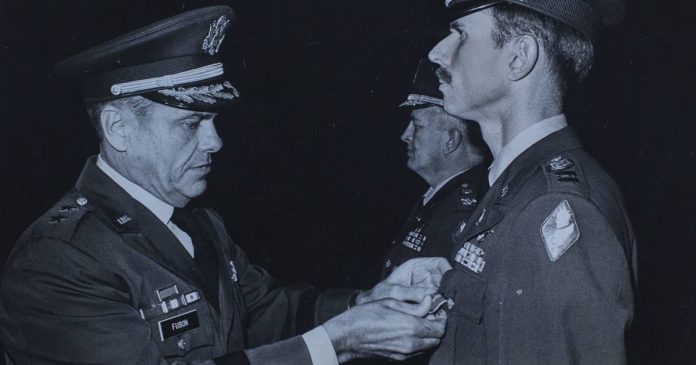
On the reviewing stand with White was Maj. Gen. Jack G. Fuson, commanding general of the Army Transportation Center and Fort Eustis, where White resumed his active Army career. He and his wife remained in Williamsburg until she got her bachelor’s degree from William & Mary three years later.

White said he was amazed at the quantity of mail he received after he returned. He also was sent a number of POW-MIA bracelets. “I remember receiving one letter that was simply addressed: Capt. White, Virginia.”

Today, White doesn’t have any problem recalling his POW captivity because the arthritis and the peripheral neuropathy he brought back with him “is simply much worse … and exposure to Agent Orange led to prostate cancer that I have now.”

At one point, he didn’t think he would live to be 82.

It was just about a month after he returned for his second Vietnam tour in October 1969 that White was shot down and captured by the Viet Cong, the communist troops in South Vietnam.

After being assigned to the 1st Aviation Brigade, he was flying a visual reconnaissance mission in an OV-1 Mohawk helicopter when the craft was hit by enemy ground fire. The chopper caught fire, he ejected and was subsequently captured.

At the time, there was only one other American with him. After January 1970, he saw no other Americans and hadn’t heard English being spoken until he was released on April 1, 1973.

During his confinement, White was in three camps in the Delta area. He was forced to live in a cage built of mangrove limbs. It was 4 feet wide, 6.5 feet long and 4 feet high — so he could lie down but not fully stand up. “I spent 19 months in the cage and one like it. I was fed twice a day and was in the cage, often shackled for 23 1/2 hours a day,” he explained.

Daywatch

Weekdays

Start your morning with today’s local news

He lost weight and was often extremely sick, he added.

In several Army interviews after he got home, White said that early in his captivity, “there was a point when I fully expected to lose my mind. I was physically sick and extremely weak.” In the recent Gazette interview, he said he survived “by taking it one day at a time, and that’s how I live today.”

White’s last 12 years in the Army involved a variety of activities. He participated in a college degree completion program at Embry-Riddle Aeronautical University and then flew different Army aircraft until he retired in 1985.

Afterward, he explored a number of opportunities, trying to find a new profession. Using the G.I. Bill, he enrolled in a watch and clock repair class. “I did that full time for about three years, but I didn’t get real good at it. When my instructor retired, I took his place and taught clock repair for 12 years, repairing clocks on the side. I was never good at repairing watches.”

Robert T. White, who now lives in Denver, was the last Vietnam prisoner of war released in 1973. Courtesy of Cliff Lawson Photography

After he spent some months in semi-retirement, Congress in 2003 passed a bill — Combat-Related Special Compensation — for which he ultimately qualified. “With that financial assistance, I didn’t need to work anymore,” White said.

Eight weeks ago, he married his longtime love Barbara, and White said he is “pretty optimistic” and “feels good” about the future. He enjoys riding a three-wheel cycle “about 60 miles a week in good weather. I’m looking forward to life!”

Wilford Kale covered the return of the POWs in 1973 for the Richmond Times-Dispatch, including White’s arrival at the Army’s hospital outside Valley Forge, Pennsylvania, and his subsequent welcome home celebration in Williamsburg.

#Reviewing Cinema and the Cultural Cold War

0

The existential stakes of the Cold War provided movie screenwriters with ample material to draw in audiences. Major T.J. “King” Kong rides an atomic bomb down towards a Soviet target as he gleefully waves his cowboy hat.[1] During a period of détente, James Bond works with KGB agent Triple X to prevent Karl Stromberg from starting a nuclear war.[2] Jed and Matt Eckert and their “Wolverines” fight to liberate their small Colorado town after a shock communist invasion.[3] David Lightman teaches a computer that the only way to win a game is not to play and saves the world.[4] The high stakes of the Cold War put the real and imagined battlefields of the period on the silver screen for mass consumption. However the battlefield extended beyond the screen, as the Cold War also touched every aspect of film production from the funding and writing to the theaters they played at.

Sangjoon Lee explores this battlefield in Cinema and the Cultural Cold War: U.S. Diplomacy and the Origins of the Asian Cinema Network. The book primarily examines how during the first two decades of the Cold War, the Asia Foundation utilized funding from the Central Intelligence Agency to support the work of, and establish connections between, anti-communist filmmakers throughout East Asia. Program directors sought to model the Asia Foundation’s work on that of the Committee for a Free Europe which achieved success with Radio Free Europe and the “Crusade for Freedom.”[5] Unlike its European counterpart though, the Asian Foundation would find success elusive, and its cultural programs would not find large audiences or become an effective ideological weapon in the Cold War in Asia.

Cinema and the Cultural Cold War shows how the Asia Foundation invested heavily in the movie industry in several east Asian nations, including Japan, South Korea, Taiwan, the Philippines, as well as the British colony of Hong Kong. Its initial efforts included providing the budget for locally produced films that emphasized traditional stories and anti-communist messages. Its first film, The People Win Through, was written by Burma’s prime minister and its low production values, poor editing, and bad acting unsurprisingly led to the movie failing at the box office.[6] Productions with Hong Kong’s Asia Pictures similarly failed to find mass audiences and the studio failed to become a large counterweight to communist-friendly rivals.[7] Lee then follows how the Asia Foundation ceased directly funding individual movie projects and instead sought to support friendly producers in other ways. Support included initiatives to bring in Hollywood screenwriting and technical expertise, sponsorship of film festivals, and providing access to modern filmmaking equipment. These initiatives also failed to garner preferred movies a popular reception and the Asia Foundation’s favored directors and producers were often surpassed by peers who received no support from the group.[8]

The book shines in exploring the reasons behind these failures. Lee argues the Asia Foundation’s managers lacked the regional expertise to match their anti-communist zeal. This lack of understanding manifested in several ways. The “political instability [and] an intensifying nationalism” in the region led to an underestimation of how historic rivalries between nations would prevent success for a country’s films outside its home market.[9] Japan stands out, and Lee shows how other nations viewed its films as a continuation of “Japan’s unfulfilled imperial adventure” rather than coming from a “reformed colonizer” as Japanese producers hoped.[10] At other moments, film festivals became inextricable from local political concerns, as when the South Korean members of the awards jury for the 1966 Asian Film Festival had to appear in court for violating the nation’s anticommunist laws after awarding the best director prize to a Japanese director with communist sympathies.[11] The Asia Foundation also failed to recognize the difficulties inherent in operating with multiple currencies and navigating different national frameworks surrounding import and export. This made the purchase of raw materials and equipment difficult and contributed to cost overruns.[12]

Perhaps most importantly, Lee shows how the foundation’s partners were poorly chosen. Local producers’ “blatant ideological stances often compromised the commercial values necessary to attract local audiences” ensuring the anti-communist films played to empty seats.[13] The Asia Foundation’s lack of local expertise and desire to subsume local issues into a broader Cold War story left it pushing stories that did not resonate. In this regard its partnership with figures like Chang Kuo-Sin in Hong Kong and Masaichi Nagata in Japan resembles U.S. policy makers favoring leaders like South Vietnam’s Ngo Dinh Diem and South Korea’s Syngman Rhee. Both the producers and dictators benefitted by ingratiating themselves with like-minded Americans but had little to offer their domestic audiences.

The book could do more to exploit those similarities and tie Lee’s “Asian Cinematic Network” more clearly into the broader Cold War. McCarthyism in Hollywood elicits an occasional reference, but more direct examination would be useful. Doing so would help Lee better demonstrate that the ideological battle over cinema was a global concern and something seen by many policymakers as critical to the broader Cold War. One example is the presence of formerly blacklisted director Edward Dmytryk as a juror at the San Francisco International Film Festival.[14] Lee notes it was an unimportant regional event, but one supported by the Asia Foundation, which suggests his attendance was part of Dmytryk showing he remained reformed after his Saturday Evening Post confessional of being a communist and Ronald Reagan’s declaration it showed others that they “too can be free men again.”[15]

Norfolk couple have a passion for volunteerism ignited by military service – Daily Press

0

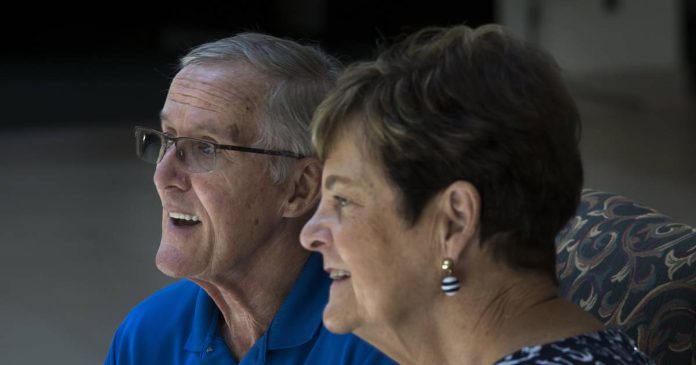
John and Martha Gorman are not average retirees.

The Norfolk couple, both 71, prefer traveling cross-country to rip out rotten drywall following a hurricane or restocking supplies at a migrant safe house in Texas.

“But we are nothing special. We are just able-bodied people, who have the time and the health,” Martha said.

John and Martha’s volunteering started in earnest when the Gorman family, including their two children, was stationed in Ecuador from May 1996 to July 1999.

John, a now-retired Navy captain, served as a Naval attaché in the South American country, coordinating Navy-affiliated humanitarian efforts as part of Project Handclasp. The Department of Defense program has service members distribute basic necessities and educational and medical materials to communities in need when moored in foreign ports.

“We tried to turn sow’s ears into silk purses with what was available — and just the appreciation that the local residents had there in Ecuador…,” John said as he shook his head.

Martha was involved in the local villages through the Diplomatic Corps and contacts made through John. Martha volunteered her time in schools, orphanages, hospitals and group homes for disabled adults.

“We rolled into a little village south of Quito. People were running alongside the car because they recognized the vehicle. They knew that when I stopped and the doors opened the big navy blue Bronco was full of stuff for them,” Martha said.

The Gormans’ experiences in Ecuador ignited a passion in them, lighting a flame they fed as often as they could over the years.

John retired from the Navy in 2003 after a 30-year career, only to start a new one as a middle school science teacher at Norfolk Christian Academy. Martha began serving as the director of a small faith-based nonprofit in Ghent for more than a decade, before retiring in 2014.

John retired in 2016, allowing the pair to dive headfirst into volunteer work.

In teaming up with Operation Blessing, headquartered in Virginia Beach, the couple have traveled to Florida, Louisiana and Texas for hurricane or natural disaster relief efforts. They pack up their RV camper each year on the heels of hurricane season to “go where the need is,” often spending several weeks clearing debris and gutting flooded homes.

“There is no difference between them and us, except they have just experienced a disaster. We are all subject to being homeless, in a dire financial strait, because of a natural disaster, and it is only by the grace of God that we weren’t,” Martha said.

But they don’t have to look far to see need in the Hampton Roads community. The pair volunteer locally, participating in clean-ups following severe flooding and organizing cold shelters for the homeless population.

The Gormans’ ongoing volunteerism is not limited to natural disasters. They have also traveled to border towns in Texas to help migrants seeking asylum get established in the U.S.

John credits his military career with preparing him for the challenges he and Martha face as humanitarian volunteers.

“I appreciate my military career. I have done so many different kinds of things — been to over 40 different countries from very rich to extreme poverty. It gave me a wider perspective on the world, general needs, the processes of other countries and how to find and coordinate resources,” John said.

Martha’s experience as a budget counselor with the Navy and Marine Corps Relief Society also prepared her for volunteerism, as she uses the skills she learned as a budget counselor to help families, both local and foreign, recover from financial crises.

“The military gave me that opportunity, and it was same thing I wound up doing at a volunteer position at a nonprofit at a church in Washington, D.C., which led to my coming on as the executive director of a nonprofit here in Norfolk,” Martha said.

John and Martha use their experiences to guide two families they were connected with through the Tabernacle Church of Norfolk. One family fled from Afghanistan in 2021 when the U.S. withdrew. The second is a Honduran family who escaped violence, famine and inadequate health care.

Martha said they act as “navigators,” guiding the families, both of which settled in Hampton Roads, with finding affordable housing and employment, getting them set up with health insurance and adjusting to U.S. requirements and processes.

“It is a lot of staff work, you know on the computer or the phone searching for the resources they need,” John said.

Gaining the trust of the families, Martha said, can be a daily commitment and helping them navigate the demanding U.S. processes is often challenging.

Daywatch

Weekdays

Start your morning with today’s local news

“But God placed us in a position to field that phone call or that request,” Martha began.

“And we have the education, the experience, the particular giftings to help,” John said. “That is not to say we don’t have to take time during the day to ask for the Lord’s help, to ask for patience or forgiveness for losing my temper.”

One such instance was when they guided an Afghan man through the process of seeking asylum in the U.S. only for the man to enter the country illegally. He was subsequently detained and is at risk of being deported. Meanwhile, John and Martha are trying to connect him with the right resources.

But the work, no matter how demanding, John said, is worth the effort.

“At the end of the day, did we change the world? No. But did the world change us? Yes,” John said.

Those interested in volunteering with Operation Blessing, whether it be for a day or for a lifetime, can sign up to be notified of volunteer opportunities at ob.org.

Caitlyn Burchett, [email protected]

#Reviewing Autumn of Our Discontent

0

In Autumn of Our Discontent, John Curatola contends the Soviet creation of an atomic bomb was not the single determinant for the United State’s 1949 decision to establish a large defense structure. Rather, the almost simultaneous confluence of several events during Autumn of 1949 “sowed the seeds for a review of national security policy.”[1] A principal military historian at the National World War II Museum, Curatola highlights the key game changers as the implementation of George Kennan’s containment policy, the loss of mainland China to communism, the release of the China White Paper, arguments on the ethics of creating a thermonuclear bomb, and the very public rivalry between the U.S. military services. Because each occurred so closely in time, he skillfully asserts, the effect they had on the country’s perspective toward national security “was greater than the sum of their parts.”[2] 

Curatola’s title appears to be a salute to the opening speech in William Shakespeare’s Richard III, where Richard of Gloucester declares, “Now is the winter of our discontent, made glorious summer by this sun of York,” revealing the victory of the House of York after years of conflict.[3] Similarly, Curatola reflects on the time of bleak discouragement in U.S. foreign affairs during the autumn of 1949 that led to NSC-68 and its recommended creation of a national security state to defend against the threat of communism.

The book is divided chronologically. Curatola begins his tome with the riveting story of U.S. Air Force intelligence crews uncovering evidence of the first Soviet nuclear test. The rest of the introduction examines other key defense and foreign policy events that occurred immediately following World War II. The essential core of the book, however, the critical events of 1949, are separately explored in two long chapters of 78 and 99 pages, respectively titled “Summer” and “Autumn.” These are followed by a 29-page conclusion, appropriately named “Winter,” covering the related changes in national policy and illuminating the legacy of those changes.

Curatola brilliantly guides the reader through detailed accounts of lesser-known conflicts and debates of the time. He delves into the bitter fight between the Air Force and Navy over roles and missions, revealing the political drama that ensued both publicly and in Congressional hearings. He unveils the muted debates over how to best help the anti-Communist Kuomintang fight in China without supporting their corruption and exploitation of peasants. He also highlights the disconnect between the Atomic Energy Commission and Strategic Air Command over atomic weapon requirements. He reveals the ethical and moral struggles over whether to create a super nuclear fusion bomb or to rely solely on the fission weapons developed at the time.