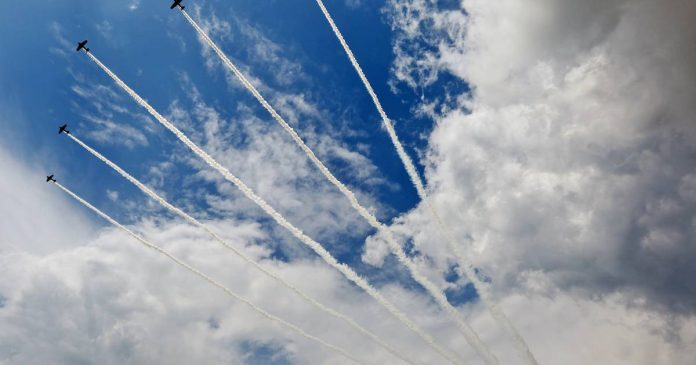
For the first time in four years, Joint Base Langley-Eustis’ Air Power over Hampton Roads will return this weekend.
Aerial performers will take flight Saturday and Sunday at the Hampton base.
The U.S. Air Force Thunderbirds will headline the show. Langley’s F-22 Raptor and F-35 demonstration teams are also slated to perform.
One major change for this year’s air show is that attendees, including those with Department of Defense ID cards, must pre-register for parking. The free parking will be in various locations, both on and off base. Transportation will be provided from the parking lots, except for some of the locations on base that are within walking distance.
For attendees who receive an on-base parking pass, the Armistead and Lasalle gates will open at 9 a.m. on both days. For attendees who receive off base parking, transportation from those lots will begin at 8:45 a.m. on both days.
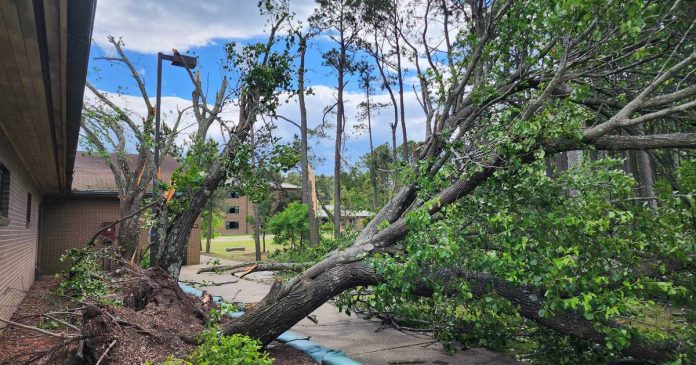
Joint Expeditionary Base Fort Story sustained an estimated $3 million in damage from Sunday’s tornado, which ripped the roof off a barracks building, downed approximately 100 trees and left the entire base without power for about 18 hours.
“And that list could grow,” said Capt. Michael Witherspoon, the commanding officer.
After touching down Sunday evening in the Great Neck area of Virginia Beach, the tornado went northeast, crossed Broad Bay and took aim at the joint military base. Meteorologists at the National Weather Service office in Wakefield confirmed Monday morning that the cyclone was an EF-3 tornado, which carries winds between 136 and 165 mph.
According to Witherspoon, the tornado hit the base’s training section first and moved to the water’s edge by the historic Cape Henry house. Witherspoon was in his home next door to the Cape Henry house when the tornado came through.
(Caitlyn Burchett)
“The whole house vibrated for a minute and a half … It was just a roaring sound. I could feel the house moving,” Witherspoon said. “It was a fierce storm, and it was quick.”
The tornado took out power for the entire base for around 18 hours, with around 95% of power being restored by 10 a.m. Monday. According to Witherspoon, Dominion Energy and Navy facility and emergency management teams worked around the clock.
“You can imagine that was quite a bit of work — to get power lines and transformers replaced. And we had to run new wiring for a lot of the electrical grid,” Witherspoon said.
Get updates on the coronavirus pandemic and other news as it happens with our free breaking news email alerts.
A chain-link fence surrounding the vacant Cape Henry house was mangled, and a pump house next to the historic home was totally demolished, with bricks and debris strewn about the property.
Other parts of the base were littered with downed trees. The entrance of Operations Building 863 was nearly impassible with a large tree totally uprooted across a walkway, blocking the door. And a slender tree branch was embedded in the adjacent concrete building.
Across the way, the roof of a barracks building was crumpled. The damage to the roof resulted in the displacement of 56 service members. But Witherspoon said the service members were promptly moved to a neighboring building.
“We are lucky no one was injured. We can recover from the debris cleanup and the removal of trees and just restoring the installation,” Witherspoon said.
Witherspoon expects Fort Story will have recovered from the storm within two weeks. But there are some repairs that may take longer, such as to the damaged barracks, as the base uses the opportunity to make upgrades.
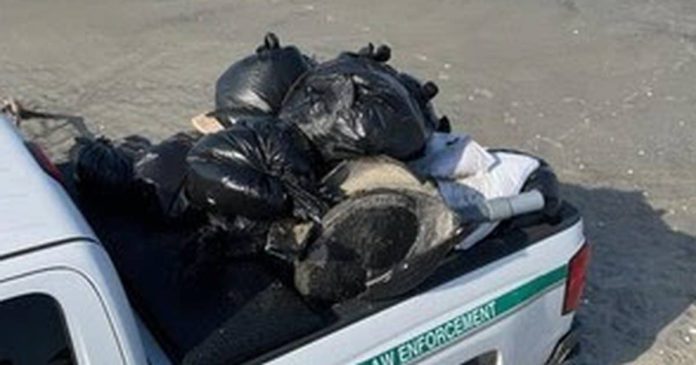
Authorities believe debris washing up along Outer Banks beaches over the last few days came from a U.S. Navy vessel nearby.
The debris, including plastic, metal, paper and textile fabric, started appearing Thursday and has been spotted from Nags Head south to the villages of Rodanthe, Waves and Salvo on Hatteras Island, the National Park Service said in a news release.
“The nature of the debris suggest it may have come from a U.S. Navy vessel located near the northeastern coast of North Carolina,” the release said.
Staff from Cape Hatteras National Seashore, Pea Island National Wildlife Refuge, the U.S. Coast Guard, the Navy and the town of Nags Head have been removing debris over the last 72 hours and plan to continue in coming days.
The U.S. Navy is investigating, the park service said.
A Virginia Beach metal-detecting hobbyist was scouring the woods of Suffolk for Civil War relics in March. Instead, he solved a mystery.
It was not gold. Or money. Or a rare relic.
It was a mud-crusted Dockers wallet seemingly held together by roots that had grown between the folds found near Lake Kilby.
“It was maybe 8 inches down, mostly covered by 25 years worth of foliage falling on it,” said Greg Stoeger.
Inside was a Department of Defense access card issued to active-duty service members. The only indicator of how long the wallet had been lost in the woods was the card’s expiration date: July 4, 1999.
“But it was not just the wallet. It was finding the story behind the wallet,” Stoeger said.
Stoeger decided to try to locate the owner. He shared his find in Facebook groups, and it was only a matter of days before he was connected with 25-year-old Shaelynn Heffernan, the daughter of the wallet’s owner.
“I thought it was a scam. I immediately thought — you know, this is not real. There was a picture attached to it, but the picture was blurred out because when someone sends you a message and they aren’t your friend, it blurs the images. I was scared to click on the image,” Heffernan said.
Stoeger had sent Heffernan a picture of the DoD-issued and state-issued identification cards in the wallet. When she clicked on the image, unblurring it, Shaelynn said she immediately recognized the man on the ID cards as her father.
She sent the message to her parents — Robert and Nelly Heffernan — who were in disbelief.
“It was like it brought me back to 25 years ago. Boom, I was there and I just couldn’t believe it. I got back all the memories of that time and what we were going through,” Nelly said.
In 1998, the family was going through an anxious time.
Robert Heffernan was 23 when he was medically separated from the U.S. Marine Corps.
Robert was a 23-year-old Marine. He and Nelly, who was pregnant at the time, were stationed at Marine Corps Air Station Cherry Point in North Carolina when Robert was diagnosed with late-stage testicular cancer.
“It was already all the way up into my lungs and my abdomen when they caught it,” Robert said.
He was scheduled for surgery. But the day before, Shaelynn was born about six weeks premature.
“I saw my daughter get born and that night I had to leave to drive up to Norfolk to the Naval Medical Center for major surgery. They cut me all the way down the middle and sat there for about 15 hours and just picked all the cancer out,” Robert said.
Robert needed continued care following the surgery, treatment he was unable to receive in North Carolina. So the Marine Corps transferred Robert and his family to Hampton Roads, assigning him to work at Portsmouth Naval Hospital as an assistant chaplain for 18 months while he was medically separated.
“We were young,” Nelly said. “Our whole family was in New York, so we didn’t have any support in the Virginia area. The military was all we had — that was our identity, our safety net — and we couldn’t count on that to take care of us in the long term.”
To make ends meet and brace for his medical separation, Robert took a job with Chanello’s, delivering pizzas in the evenings. That’s how he found himself at the wrong end of a shotgun barrel one night in Suffolk.
Robert Heffernan holds the contents of his lost wallet, which was unearthed by Greg Stroeger, a Virginia Beach man, 25 years after Heffernan was held at gunpoint and robbed. (Nelly Heffernan)
“It was a very traumatizing experience. Three young men, teenagers, came with shotguns held at my head. Detectives told us that I was pretty lucky not to have been killed because there were gang initiations going on,” Robert said.
The three robbers took his wallet, a gold crucifix and two supreme pizzas.
“We lived in fear knowing someone had our address. We slept with a chair under the door,” Nelly said.
A month later, the family moved to Greenville, North Carolina, so Nelly could study at East Carolina University.
When the Heffernans were contacted about the wallet, Nelly said it brought back all the uncertainty and helplessness she felt 25 years ago.
“We were young, had already faced cancer, a premature baby and another move after he had to end his military career. Life seemed so full of twists and turns and the path was not exactly clear,” Nelly said, adding, “But it also made me so thankful about how everything turned out.”
These days, the Heffernans are preparing for Shaelynn’s wedding, which will take place in Italy this May. They also have a 15-year-old son, Keaghan.
“We are so grateful to Greg Stoeger for returning (Robert’s) lost IDs and allowing us to go back in time for a moment,” Nelly said in a Facebook post. “We are thankful for all the trial and smile, the tears and the fears, the friends and the lessons, our family and our father.”
Stoeger, a member of the Tidewater Coin and Relic Club, said he has found many unique and cool items over the past three years that he has been metal detecting. His finds include a 1735 King George II half-penny, 1912-18 City of Norfolk train token, and countless three-ring .59 caliber Civil War bullets.
But the wallet, Stoeger said, will remain his most memorable find.
“Say I find a .59-caliber this week, and in a couple months, I will find five more. And one looks just like the other,” he said. “But how many wallets will I find that has this story to go with it?”
JUNEAU, Alaska — The U.S. Army has grounded aviation units for training after 12 soldiers died within the last month in helicopter crashes in Alaska and Kentucky, the military branch announced Friday.
The suspension of air operations was effective immediately, with units grounded until they complete the training, said Lt. Col. Terence Kelley, an Army spokesperson. For active-duty units, the training is to take place between May 1 and 5. Army National Guard and Reserve units will have until May 31 to complete the training.
“The move grounds all Army aviators, except those participating in critical missions, until they complete the required training,” the Army said in a statement.
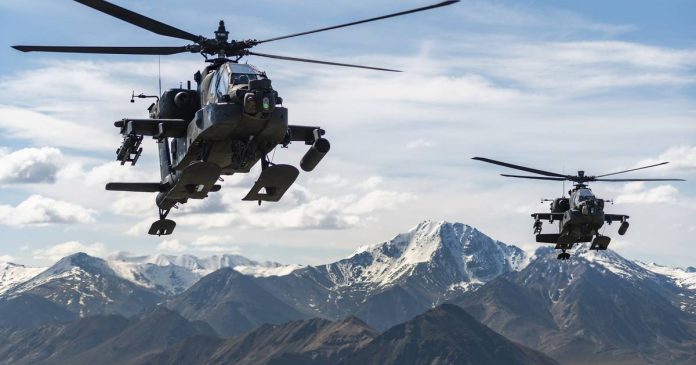
On Thursday, two Army helicopters collided near Healy, Alaska, killing three soldiers and injuring a fourth. The aircraft from the 1st Attack Battalion, 25th Aviation Regiment at Fort Wainwright, near Fairbanks, were returning from training at the time of the crash, according to the Army. The unit is part of the 11th Airborne Division, which is nicknamed the “Arctic Angels.”
Military investigators were making their way to Alaska’s interior, with a team from Fort Novosel, Alabama, expected to arrive at the crash site by Saturday, said John Pennell, a spokesperson for the U.S. Army Alaska. Little new information about the crash was released Friday.
The Army on Thursday said two of the soldiers died at the site and the third on the way to a hospital in Fairbanks. The injured fourth soldier was taken to a hospital and was in stable condition Friday, Pennell said. The names of those who were killed were not immediately released.
“The safety of our aviators is our top priority, and this stand down is an important step to make certain we are doing everything possible to prevent accidents and protect our personnel,” Army Chief of Staff James McConville said of the decision to ground flight units for training.
Daywatch
Weekdays
Start your morning with today’s local news
The crash is the second accident involving military helicopters in Alaska this year.
The Army said that while Thursday’s crash and the one in Kentucky remain under investigation, “there is no indication of any pattern between the two mishaps.”
Healy is home to about 1,000 people roughly 10 miles (16 kilometers) north of Denali National Park and Preserve, or about 250 miles (400 kilometers) north of Anchorage.
Located on the Parks Highway, the community is a popular place for people to spend the night while visiting Denali Park, which is home to the continent’s tallest mountain.
Healy is also famous for being the town closest to the former bus that had been abandoned in the backcountry and was popularized by the book “Into the Wild” and the movie of the same name. The bus was removed and taken to Fairbanks in 2020.
Fawn Weaver, who runs what became one of the fastest-growing whiskey brands in the United States, is on a nationwide tour to personally thank some of her best customers for their support and service — military members.
Weaver, chief executive officer of Uncle Nearest Premium Whiskey in Tennessee, was in Hampton Roads Tuesday through Thursday. She held a happy hour at a Newport News restaurant, signed bottles at a Coast Guard Exchange, and met Capt. Janet Days, commanding officer at Naval Station Norfolk and the first Black woman to hold the position.
“I want America to see all of the amazing things the military has to offer and why we are the No. 1 military in the world,” Weaver said, “the strongest military in the world.”
Weaver founded Uncle Nearest almost six years ago to honor Nathan “Nearest” Green, the first known African American master distiller. He was born enslaved in Maryland and was moved to Lynchburg, Tennessee. Green was hired out to Dan Call, a distiller and preacher in Lincoln County, to work on his farm making whiskey.
Jasper Newton “Jack” Daniel, who in 1866 established Jack Daniel’s Distillery, first started working at the farm as a young boy. Green taught him the technique of making the spirit. Daniel started his own company after the abolition of slavery and hired Green, who was known as Uncle Nearest, as the first master distiller for his company.
Weaver had never heard the story about Uncle Nearest until she read a New York Times article. She wanted to keep his legacy alive.
“If someone doesn’t firmly prove it and make sure it’s in the history books, then it just continues to be sort of whispers,” she said.
She read “Jack Daniel’s Legacy,” a biography that quotes Daniel as saying Uncle Nearest was the best whiskey maker he knew. Weaver researched and interviewed Green’s descendants. She purchased 313 acres in the hills of Lynchburg where Daniel grew up and where Green operated the original Distillery No. 7.
Daywatch
Weekdays
Start your morning with today’s local news
The company has won several industry awards since its 2017 launch and in 2018-19 was one of the country’s top five fastest growing whiskeys, by volume growth, according to IWSR, an international drinks-market analysis firm.
The CEO Thank You Tour began April 11 at MacDill Air Force Base in Tampa, Florida. The 2021 and 2022 tours focused on restaurants, bars and liquor stores; in her 16-week tour this year, Weaver will visit more than 35 military installations.
She has dined with service members in Tampa, sat in a helicopter used during Hurricane Katrina rescues in Clearwater, Florida, and lifted weights like a strong woman with soldiers at Fort Knox, Kentucky.
Weaver hosts 18:56 Happy Hours — a tribute to Uncle Nearest’s 1856 — at 1856 hours, 6:56 p.m., with a toast to the armed forces. She had one Tuesday at Steak and Tonic in Newport News.
She showcases the behind-the-scenes look of her tour on social media. Details, unclenearest.com
Rekaya Gibson, [email protected], 757-295-8809, on Twitter, @gibsonrekaya
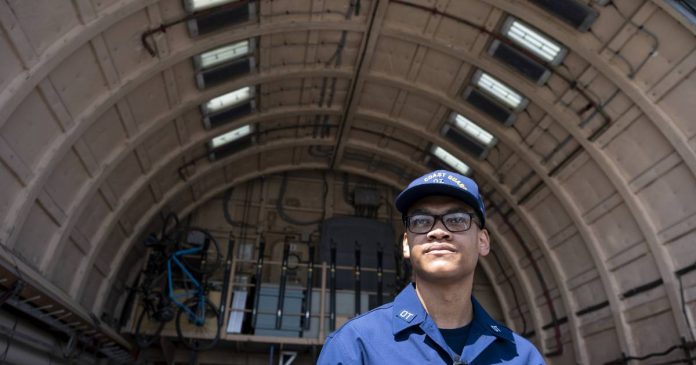
Christopher Key saluted the flag hanging on the stern of Coast Guard Cutter Seneca. The sun glinted off the metal “OT” insignia on his hat as he walked across the brow to board the 270-foot ship.
The marketing major’s classroom on Thursday was very different from most other Hampton University students.
The Coast Guard partners with historically Black universities and minority serving institutions to offer a two-year scholarship to full-time students as part of a pre-commissioning officer mentorship program. Local participating universities include HU, Norfolk State University and Elizabeth City State University.
Students can apply to the College Student Pre-Commissioning Initiative as a sophomore or junior. If accepted into the program, the student is enlisted under a four-year contract and ships off to boot camp their first summer with the rank of “officer trainee.” Officer trainees receive the benefits of an E-3 pay grade, including salary and health care.
The Coast Guard pays up to two years of tuition, books and other educational fees. For HU students, this is equal to around $29,000 per semester.
“Being accepted into this program meant my family and I did not have to stress over how we were going to pay for me to finish school,” Key said.
The program, which is designed to work around the academic school year, requires the student participate in four hours of duty each week. This can include reporting to a local recruiting office or visiting units in the area.
To fulfill his four hours, Key reported to the Seneca. He was met pierside by Ensign Chandler Robinson, who would guide him through the day. Having gone through boot camp together in July 2021, the two greeted each other with warm smiles, a salute and a hug.
Officer Trainee Christopher Key, 22, shadows Ensign Chandler Robinson aboard the Coast Guard Cutter Seneca in Portsmouth, Virginia, on April 20, 2023. Key is a member of CSPI while attending Hampton University. (Billy Schuerman/The Virginian-Pilot)
“I am here, no matter the question or just for moral support, I want to help him and any of the other OTs I have kept in contact with in any way I can,” Robinson said.
Robinson, also a CSPI program graduate, participated in one year of the program while completing his senior year at Mississippi Valley State University. He graduated with a bachelor’s degree in sports medicine in May 2022.
“I had a football scholarship, so money was not the issue. For me it was about job security, having a career ready for me when I graduated,” Robinson said.
Robinson, who graduated from officer candidate school in November, was the first from his university to become a commissioned officer. He has been attached to the Seneca as an electrical materials officer for four months.
“When he goes underway as an officer, having that CSPI experience of already having been underway, he will already have the basic knowledge of what to do and how to do it,” Robinson said of how Key will be able to apply what he is learning in the program to his responsibilities as a commissioned officer.
The tour on the Seneca served as a refresher, Key said, reminding him about the ins and the outs of boat life. Last summer, Key’s temporary orders landed him aboard a cutter off the coast of Alaska for two months.
“That was the last place I ever expected to travel to with the Coast Guard. I was thinking it would be Florida or New York, but no — I got Alaska,” Key said with a laugh.
The Alaskan experience was part of the program. During longer academic breaks, officer trainees receive temporary orders to train with Coast Guard units for anywhere from one week to three months. The idea is to expose officer trainees to “any and all opportunities” offered by the Coast Guard so they are better equipped to choose a career path once they become a commissioned officer, said Officer Recruiter Tia Grandville.
The assignment took Key to Kodiak, Alaska, and the Dutch Harbor at the Island of Unalaska.
“I loved the opportunity to really experience cutter life and what it is like being underway,” Key said.
But among the most challenging aspects, he said, are the night watches, during which a crew member will monitor the boat’s movements and the weather from the bridge while the rest of the crew sleep.
“You are up in the middle of the night looking out at the black, open water. It put me in a weird headspace,” Key said.
Officer Trainee Christopher Key, 22, left, shadows Ensign Chandler Robinson as they view nautical maps of Key West, Florida to San Juan, Puerto Rico on the Bridge of the Coast Guard Cutter Seneca in Portsmouth, Virginia, on April 20, 2023. Key is a member of College Student Pre-Commissioning Initiative scholarship program while attending Hampton University. Members become an active-duty Coast Guard member with the rank of Officer Trainee and receive military benefits. (Billy Schuerman/The Virginian-Pilot)
During the tour aboard the Seneca, Key and Robinson reflected on seagoing experiences, how to approach his first assignment and how to confront new challenges.
Daywatch
Weekdays
Start your morning with today’s local news
“In the Coast Guard, everyone is always willing to share their experiences. Every time I have asked, ‘will you teach me,’ I have never had anyone deny me. So, don’t be afraid to ask for help,” Robinson told Key, as the pair looked out the panoramic windows of the bridge.
Key is slated to graduate in May from HU. He will attend the 17-week Officer Candidate School in July, after which “trainee” will be dropped from his title. Students have a three-year active-duty commitment as an officer after graduating from Officer Candidate School.
Once commissioned, Key will become the 24th HU student to have gone on to become a commissioned officer. Another eight Norfolk State students and 17 from Elizabeth City State have completed the program.
By the fall, Key should know where his first assignment will take him.
“Honestly, I’m not too picky on where my first choice is. If anything, I’m just seeking for right now to stay somewhere more so on the East Coast,” Key said.
Whether he is assigned to a small station, Sector Virginia in Portsmouth, or an afloat unit, Key had one thing to say, giving a nod to the service’s motto: “Always ready.”
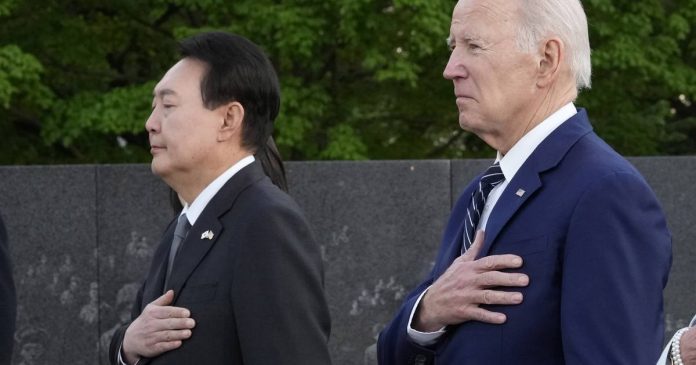
WASHINGTON — Presidents Joe Biden and Yoon Suk Yeol on Wednesday will sign an agreement that includes plans to have U.S. nuclear-armed submarines dock in South Korea for the first time in more than 40 years, a conspicuous show of support to Seoul amid growing concern about nuclear threats by North Korea, according to senior Biden administration officials.
The planned dock visits are a key element of what’s being dubbed the “Washington Declaration,” aimed at deterring North Korea from carrying out an attack on its neighbor. It is being unveiled as Biden is hosting Yoon for a state visit during a moment of heightened anxiety for both leaders over an increased pace of ballistic missile tests by North Korea over the last several months.
The three senior Biden administration officials, who briefed reporters on the condition of anonymity ahead of the official announcement, said that Biden and Yoon aides have been working on details of the plan for months and agreed that “occasional” and “very clear demonstrations of the strength” of U.S. extended deterrence capabilities needed to be an essential aspect of the agreement.
The agreement seeks to allay South Korean fears over the North’s aggressive nuclear weapons program and to ward off the country from restarting its own nuclear program, which it gave up nearly 50 years ago when it signed the Nuclear Non-Proliferation Treaty. The U.S. and South Korea also would coordinate more deeply on nuclear response strategy in the event of the North attacking the South — but operational control of such weapons would remain in U.S. control, and no nuclear weapons are being deployed onto South Korean shores.
The agreement also calls for the U.S. and South Korean militaries to strengthen joint training and better integrate South Korean military assets into the joint strategic deterrence effort. As part of the declaration, South Korea will reaffirm its commitment to the Nuclear Non-Proliferation Treaty, an agreement signed by several major nuclear and non-nuclear powers that pledged their cooperation to stem the spread of nuclear technology, the officials said.
As a candidate for the presidency last year, Yoon said he would call for the increased deployment of U.S. bombers, aircraft carriers and nuclear submarines to South Korea as he looked to offer a firmer response to the North’s threats than his predecessor Moon Jae-in.
In the midst of the Cold War in the late 1970s, U.S. nuclear-armed ballistic missile submarines made frequent port visits to South Korea, sometimes two to three visits per month, according to the Federation of American Scientists. It was a period when the U.S. had hundreds of nuclear warheads located in South Korea.
But in 1991, the United States withdrew all of its nuclear weapons from the Korean Peninsula, and the following year Seoul and Pyongyang signed a joint declaration pledging that neither would “test, manufacture, produce, receive, possess, store, deploy or use nuclear weapons.” But as the North has repeatedly violated the joint declaration over the years, there’s been increased support in South Korea for the United States to return nuclear weapons to the country.
One Biden administration official cautioned it is “crystal clear” that there are no plans by the administration for “returning tactical or any other kind of nuclear weapon to the Korean Peninsula.” Instead, administration officials said they envision that the visit of ballistic missile submarines will be followed by the U.S. military more regularly deploying assets such as bombers or aircraft carriers to South Korea.
North Korea’s increasing nuclear threats, along with concerns about China’s military and economic assertiveness in the region, have pushed the Biden administration to expand its Asian alliance. To that end, Biden has thrown plenty of attention at Yoon as well as Japanese Prime Minister Fumio Kishida. Next week, Biden will host Philippine President Ferdinand Marcos Jr. for Oval Office talks.
Daywatch
Weekdays
Start your morning with today’s local news
In the past year, North Korea has been steadily expanding its nuclear arsenal, while China and Russia repeatedly block U.S.-led efforts to toughen sanctions on the North over its barrage of banned missile tests.
The stepped-up testing by North Korea includes the flight-testing of a solid-fuel intercontinental ballistic missile for the first time earlier this month. The recent test is seen as a possible breakthrough in the North’s efforts to acquire a more powerful, harder-to-detect weapon targeting the continental United States.
Besides nuclear deterrence, Biden and Yoon, and their aides, also are expected to discuss Russia’s ongoing war in Ukraine. The Biden administration has praised South Korea for sending some $230 million in humanitarian aid to Kyiv, but Biden would welcome Seoul taking an even bigger role in helping the Ukrainians repel Russia.
Yoon’s visit comes just weeks after the leaks of scores of highly classified documents that have complicated relations with allies, including South Korea. The papers viewed by The Associated Press indicate that South Korea’s National Security Council “grappled” with the U.S. in early March over an American request to provide artillery ammunition to Ukraine.
The documents, which cited a signals intelligence report, said then-NSC Director Kim Sung-han suggested the possibility of selling the 330,000 rounds of 155 mm munitions to Poland, since getting the ammunition to Ukraine quickly was the United States’ ultimate goal.
One Biden administration official said that Biden planned to talk to Yoon about “what it means for all like-minded allies to continue to support Ukraine” and ask the South Korean leader “what the future of their support might look like.”
Besides their talks on Wednesday, Biden and Yoon are scheduled to host a joint news conference. In the evening, Biden and first lady Jill Biden will honor Yoon and his wife, Kim Keon Hee, for a state dinner at the White House.
[1] Even professional historians often could not escape this intellectual paradigm, see: Jonathan M House, A Military History of the Cold War, 1944–1962 (University of Oklahoma Press, 2014). Jonathan M House, A Military History of the Cold War, 1962–1991 (University of Oklahoma Press, 2020).
[2] Michael D Mahler, Tales from the Cold War: The U.S. Army in West Germany 1960-1975 (Dahlonega, Georgia: University Press of North Georgia, 2021), Table of Contents.
[3] Ingo Trauschweizer, The Cold War U.S. Army: Building Deterrence for Limited War, Modern War Studies (Lawrence, Kansas: University Press of Kansas, 2008).
[4] Mahler, Tales from the Cold War, xiii. Andrew J Bacevich, The Pentomic Era: The U. S. Army between Korea and Vietnam (Washington, DC: National Defense University Press, 1986).
[5] Mahler, Tales from the Cold War, chapter 13. John Romjue, The Army of Excellence: The Development of the 1980s Army (Washington D.C.: Office of the Command Historian, United States Army Training and Doctrine Command, 1997).
[6] Deye Li, “Soldiers, the City, and the State: The Berlin Problem and the US Military, 1960-1965” (Undergraduate Honor Thesis, 2022). For a glimpse of the surging tension between deterrence and limited war following the Vietnam War, see: Eric Michael Burke, “Ignoring Failure General DePuy and the Dangers of Interwar Escapism,” Military Review, 2023, 42-57.
[7] The consensus in contemporary philosophy of history is that historical understanding is impossible without a process of creative interpretation. Hayden V White, Metahistory: The Historical Imagination in Nineteenth-Century Europe (Baltimore, MD: Johns Hopkins University Press, 2015). Bruce Kuklick, Blind Oracles: Intellectuals and War from Kennan to Kissinger (Princeton, N.J.: Princeton University Press, 2007), 156-9. Marc Trachtenberg, The Craft of International History: A Guide to Method (Princeton, NJ: Princeton University Press, 2006), chapter 1, 3.
[8] Mahler, Tales from the Cold War, 45.
[9] Ibid.
[10] Ibid, 72.
[11] Ibid, 88.
[12] Ibid, 155.
[13] Ingo Trauschweizer, The Cold War U.S. Army.
[14] FM 3-0 Operations (Washington, DC: Headquarters, Department of the Army, 2022), 3–6.
[15] Mahler, Tales from the Cold War, x, 157.
[16] Ibid, 87-96.
[17] Ibid, 132-33.
[18] Ibid, 133, 144-45.
[19] Jasen J Castillo, Endurance and War: The National Sources of Military Cohesion (Stanford, CA: Stanford University Press, 2014), chapter 2. Edward A. Shils and Morris Janowitz, “Cohesion and Disintegration in the Wehrmacht in World War II,” Public Opinion Quarterly 12, no. 2 (1948): 280, https://doi.org/10.1086/265951.
[20] Mahler, Tales from the Cold War, 149. This also contributes to the study of gender equality and military effectiveness from the lens of familial relations.
[21] Ibid.
[22] Ibid, 139.
[23] Rex Childers, “Cold Warriors, Good Neighbors, Smart Power: US Army, Berlin, 1961-1994” (Ph.D. dissertation, 2015), 6.
[24] Mahler, Tales from the Cold War, 97-98.
[25] Ibid, 153.
[26] Ibid, 118-20.
[27] Ibid, 116.
[28] Ibid, xii.
[29] Brian McAllister Linn, Elvis’s Army: Cold War GIs and the Atomic Battlefield (Harvard University Press, 2016), 158-59.
[30] Stephen Morillo and Michael F Pavkovic, What Is Military History?, Third Edition (Cambridge, UK: Cambridge Polity Press, 2018), 39–44.
Sometimes you go against the advice of the well-known saying and choose a book by its cover. A design draws you in through color or shock; a title intrigues you. Heat + Pressure: Poems from War by Ben Weakley delivers on the initial interest brought about by its unique title that sits in bold letters over the melted green army figure on the cover. Heat + Pressure shows how today’s warriors can become poets and help veterans synthesize war and their reintegration into society. As this review argues, reintegration after war is a formative process fraught with difficult acknowledgements, depths of disillusionment, and realizing one’s own strength for creating something instead of destroying it. It also provides welcome space for reflection amongst the veteran community.
Consider the title for a moment: Heat + Pressure. Two words that cause reflection. Does one read them as “heat and pressure” or as “heat plus pressure”? The title could be the first poem of the book. This wordplay sets the tone for the rest of the collection, including the section titles. Five sections divide the book: “Heat,” “Pressure,” “Blast,” “Debris,” and “Fragmentation.” Peruse the section titles and the poems seem to tell a story of a soldier shaped, formed, and fractured—in the literal sense—by an improvised explosive device. But that’s not the whole story. Instead, a retired soldier grapples with the war-games of his youth, the boredom and chaos of his service, and the struggle to find common ground with angry citizens bent on destruction.
The first section, “Heat,” seems to be an autobiographical account of the author’s journey from child to soldier. Part of this journey involves poems about his grandparents who never talked about their wars, his own shenanigan-filled childhood, and what seems to be his father’s disappointment with his son’s immaturity. The first section ends with a familiar notion: that young people take on the narratives of their citizens calling for war and vengeance. After reading “America Calls Him,” the reader may think back to the exhortations of Paul Baumer’s schoolmaster in All Quiet on the Western Front.[1] That might be the point.
The second, third, and fourth chapters—”Pressure,” “Blast,” and “Debris”—toss away glamorous views of war. These chapters capture the boredom of 4 a.m. range days and the shock of having the meaning of the word obliterated when bombs destroy lives and material alike. Sometimes the dead are soldiers, and other times the dead are children; all are tragic and wasteful. It is in these sections that the poems introduce Musar Afghanistan, an imaginary Afghan warlord and elder who torments the poet with doublespeak during war and peace. The boring and mundane intermix with chaos and insanity. A busy nighttime patrol encounters gunshots and an opportunity for voyeurism on an Iraqi couple. A war wound turns out to be from a fall into a hole while walking with night vision devices. Such embarrassing moments are the unspoken anecdotes of combat, and convey the absurdity and vulnerability of such moments.
“Fragmentation” is perhaps the most difficult chapter. The poems speak of U.S. callousness towards migrants, the moral injury caused by the January 6, 2021, insurrection at the U.S. Capitol Building, and the destabilizing feelings of re-integration. The latter feelings are a constant theme in war poetry. Veterans have struggled to come back to their homes and find everything changed. What is unique about Weakley’s work is his social commentary on the lack of humanity from our fellow citizens, when he was the one supposedly managing violence on our behalf. He finds the behavior of angry insurrectionists reprehensible and sees parallels to his nemesis Musar Afghanistan, who has followed him to create battlefields on the homefront.[2]
Which brings us back to the cover of the book. The green army figurine on the front at first looks to be melted into pavement. An alternative perspective shows itself after reading Weakley’s poems; the figurine was softened by the heat of war, thrown amongst debris by many blasts, and trampled by his fellow citizens after his return home. I could not help but think of the assumptions civilians make about veterans, whether by carelessness, ignorance, or anger.



:quality(70)/cloudfront-us-east-1.images.arcpublishing.com/tronc/CT5F5MPXH5AIVDSECNPCZMGZYA.jpeg)

:quality(70)/cloudfront-us-east-1.images.arcpublishing.com/tronc/ZPJITSSI6RB4DAS53SMX7M37LE.JPG)