Recently, I was honored to offer remarks at the commissioning ceremony for 20 cadets from the Temple University Army Reserve Officer Training Corps “Red Diamond” Battalion. This was a truly inspiring event (and not only because it was held at Lincoln Field where the Philadelphia Eagles play). Rather, as the years of Army service add up, it’s easy to forget professional milestones and personal achievement moments like these. It was a joy to see these men and women complete their cadet journeys and begin their service as officers.
I’ve posted my remarks below, which focus on two areas: People and Competence. You can view the entire ceremony on Facebook at this link and I hope that many of you (not just new officers) will find these thoughts helpful.
Ladies and gentlemen, distinguished guests, Temple University and ROTC alumni, family, friends, and fellow service members…thank you for allowing me and my family to join you in celebrating this group of 20 soon-to-be officers as they begin their journey of service.
Before I proceed with my best twelve minutes of inspiration and advice – which may very well be forgotten the second you see those gold bars on your epaulets – allow me to recognize the group of people seated in the stands who helped make this moment possible. I’m talking about the parents, siblings, loved ones, instructors, and mentors who planted seed after seed into these men and women, year after year, in hopes that they would one day reach the level of achievement we are about to witness. Thank you for that selfless investment in them, as well as the persistent faith in what they could achieve. Cadets, please join me in a round of applause for those who helped you get here.
Chances are, you’ve never heard of Gouverneur K. Warren. And that’s ok. Perhaps some of the history lovers in the audience might recognize his name. Gouverneur K. Warren was born on January 8, 1830 and began a journey of service that 33 years later, put him on top of a large rock 4 miles south of Gettysburg, Pennsylvania at a crucial moment in American history. His actions that day in fact turned the tide of American history and relate to the two key concepts I’d like you to consider today: People and Competence.
People
In case you haven’t spent time in the Army messaging stream recently, the United States Army’s number one priority is…people. Now, why would the Army publicly and officially state that People are a higher priority than Readiness, Modernization, Training, and many other options? Because people are the heart of everything we do. Our profession is organized around the fundamental principle that we can achieve any mission when competent individuals trust one another and then work together to form cohesive teams. Not only can we achieve any mission…this is the pathway to achieving EVERY mission.
The strength of our Army comes from the diverse backgrounds, unique talents, and individual personalities that each and every one of you bring to the team. Despite what is portrayed in most military movies, the goal of military training is not to strip away the civilian self and replace it with a new, disciplined, hard-nosed military identity.
The goal of the training you have just completed…and the goal of your continuing leader development in the Army…is to weave your exceptional attributes into the profession while preparing to win the next fight.
This means that your gender, ethnicity, religious beliefs, sexual orientation…your childhood experiences, personality quirks, skeptical point of view, your sense of humor…these aspects of your authentic self are not at odds with the institution, they make the institution stronger, and they will add value to those you will serve with throughout your career.
This People Lens, if you will, is the first lens through which we view our service, our operations, and our leadership. This is the mindset you must have as you step into officership. As an Army leader, when you step in front of a team, you should see people first.
Competence
The second concept I’d like you to consider today is competence…because an Army of cohesive teams who can’t fight won’t get us very far, will it? Beginning in just a few moments…your job…is war. The United States has given us the exclusive authority to apply discriminant violence in its defense. No other profession has this responsibility. And the American people…these American people sitting in the audience…trust us to be ready for any fight.
As company grade officers, you must become experts on your weapon systems and the doctrine used to employ them. Whether that weapon is a rifle, a tank, an aircraft, a trauma cart, or a stack of policies and regulations…we are counting on you to know them, cold. I’m not talking about a loose working knowledge. You must have an active expertise, a passion for understanding the inner workings of the tools you use and the formations you lead.
History has shown that we do a poor job of predicting where the next fight will take place…so you must be ready to win in any environment, in the worst conditions, day and night. The Non-Commissioned Officers you will soon lead have been doing this for years. They will help you, but you have the responsibility to match their level of competence and then lead them in any fight.
As junior officers, your job is the fundamentals. Do the basics, over and over and over again, until you reach reflexive competency. Then make the conditions harder and do it again. Do this for yourself and your platoon, staff section, or whatever team you’re on. Lead from out front, by personal example, while upholding the standards and discipline set forth. We are counting on you to do this. We are counting on you to be competent and ready.
Trust and Competence at Gettysburg
Gouverneur K. Warren was a Brigadier General in the Union Army on July 2, 1863. He was a staff officer, the chief engineer for the Army of the Potomac. As Confederates from General Longstreet’s Corps attacked the Union left flank south of Gettysburg, Warren positioned himself on a rocky outcrop to assess the situation. Finding Little Round Top unmanned, he immediately recognized the extreme risk to the entire Union line.
As the Confederates approached, Warren rushed down from the hill to try and convince formations from Sykes’ V Corps to divert from their line of march and defend the key terrain at Little Round Top. Imagine this…here we have the Union Staff Engineer trying to tell sitting brigade commanders to change their mission and follow his orders. Who thinks that would go well? What kind of trust would have to be in place for them to listen to Warren?
Well, the commanders took the Engineer’s recommendation and turned to the southeast. Warren then personally emplaced two Infantry brigades and an artillery battery to hastily defend Little Round Top. Warren stayed through the fighting despite being shot in the neck, witnessing the 20th Maine counterattack with bayonets as a last resort. Ultimately, the Confederates were unable to flank the Union left and halted their advance.
Though a staff officer by position, Warren acted and led with the decisiveness and authority of a senior commander. He was competent enough to recognize the danger to the Union line, and had previously earned the trust of his fellow officers, such that they followed his orders at the decisive point of the battle. People and Competence. Gouverneur K. Warren’s actions that day were instrumental in preventing a catastrophic attack, which turned the tide at Gettysburg and ultimately the entire Civil War.
You, soon to be Second Lieutenants in the Army of the United States, will face similar challenges where your competence and the trust you’ve earned as a leader may prove decisive. We know you will be ready.
Our Oath
Now, you have the honor of taking the Oath of the Commissioned Officer, which I will reaffirm alongside you. I’d like to highlight the fact that our Oath is unique among militaries because we do not make our commitment to a person, or a political party, or a government agency. We make our promise to support and defend a document…the Constitution of the United States…the origin of our democracy. This means that when the winds of political drama, bureaucratic wrangling, and societal upheaval color the American landscape…the foundation of your service is clear. Your loyalty is first, and always, to the Constitution. And that is a privilege we celebrate here today.
Thank you again for inviting me and my family to join you on this special occasion. I congratulate you for earning your undergraduate degree and for volunteering to join the profession of arms. We have full confidence in you. Lead well.
VIRGINIA BEACH — Dozens of current and former service members parachuted onto the sands of the Virginia Beach Oceanfront on Saturday after jumping thousands of feet from a plane.
Skydive Suffolk partnered with several nonprofits to host its first “Land in the Sand” Veterans Day event, allowing veterans and service members to experience the thrill for free. Nonprofits that sponsored tandem jumps included United Service Organizations, Naval Special Operations Foundation, Operation Enduring Warrior, Veterans United and Arne Aviation.
Mike Manthey, who owns Skydive Suffolk with wife Laura, said his company has participated in similar events, but this year marks the first they’ve hosted for Veterans Day. The goal was to provide jumps for 40-50 veterans and service members who loaded the plane at the Military Aviation Museum’s airfield, about 25 minutes from where they landed.
“Hey, it’s an accomplishment. They got over a fear,” Manthey said. “A couple of the guys today, they’re like, ‘I just jumped out of an airplane. There’s nothing else I can’t do.’ So just seeing that kind of motivation or that kind of attitude in people makes it worth it.”
Savita Curtis of Hopewell lands on the on the beach near 11th Street in Virginia Beach at the end of her tandem skydive with Blaine Theriot Saturday afternoon, Nov. 12, 2022. Curtis served in the Army for 21 years. Skydiving Suffolk provided free skydiving to veterans in an event called “Land in the Sand 2022.” (Bill Tiernan/The Virginian-Pilot)
Army veteran Jamie Curtis, 28, experienced skydiving for the first time as a civilian. He’s the assistant program manager for the skydiving program at Operation Enduring Warrior.
Daywatch
Weekdays
Start your morning with today’s local news
The former paratrooper also invited Nick Fields, who’s still in the Army, to Saturday’s event. Curtis said as soon as the plane’s door opened, he was reminded of sitting behind gunners with Fields while deployed in Turkey.
“It’s good to just free your mind out here a little bit, let go and have fun,” Fields said.
“And it’s OK to smile,” Curtis added.
Veterans got the chance experience tandem skydiving Saturday, Nov.12,2022 in an event called “Land in the Sand 2022 with Skydiving Suffolk. They landed on the sand at the oceanfront in Virginia Beach near 11th St. (Bill Tiernan/The Virginian-Pilot)
Fields, who’s stationed near Washington D.C., said he enjoys the adrenaline rush in the seconds before landing. It’s different than jumping as a paratrooper because they typically use static lines. And since the parachute in a tandem jump is smaller, jumpers come in faster when landing, he said.
“There’s always that tiny little bit of nervousness no matter how many times you do it,” Fields said. “But it’s also a relaxing experience. The fall is super smooth.”
Richard Herrera, 42, said it was his second time skydiving. The Navy veteran said this was better — he was less nervous and could take in more of the experience. His said his favorite part was the freefall before the parachute is deployed.
[2] Asked their preferences for “unification,” “the status quo,” or “independence,” nearly 90 percent of Taiwan’s population supports maintaining the status quo with variation across timeline, e.g., “indefinitely” versus “decide at a later date”. (Yvonne Chiu, “Taiwan free to decide, under duress,” Taipei Times, Aug. 26, 2022.)
[3] Shortly after the KMT retreated to Taiwan in 1949, U.S. Secretary of State Dean Acheson’s “perimeter speech” (Jan. 12, 1950) ceded Asian affairs outside of a “perimeter” that he drew around Japan and Philippines but which excluded Korea and Taiwan, signalling that the U.S. would no longer support the KMT. When North Korea invaded South Korea on June 25, 1950, however, President Harry S. Truman decided to defend South Korea (and Taiwan).
[4] The massive waves of Chinese immigration to Taiwan from 1945–1956 as a result of the Chinese Civil War is estimated to around 1 million, which constituted only 15% of Taiwan’s population at the time, and their surviving members and descendents number around 10% now. [Executive Yuan, Republic of China (Taiwan), The Republic of China Yearbook 2014, p. 48. Dominic Meng-Hsuan Yang, The Great Exodus from China, Cambridge University Press 2021, pp. 63–65. Ko-hua Yap, “Reassessing Number of Mainland Chinese Immigrants with Declassified Archival Data,” Taiwan Historical Research 28(3) Sept 2021: 211–229. 徐富珍 、 陳信木(2004)。︁蕃薯+芋頭=臺灣土豆?:臺灣當前族群認同狀況 比較分析。︁在臺灣人口學會主辦、人口、家庭與國民健康政策回顧與展望 研討會、台北市。︁]
Since at least 2008, opinion polls about Taiwanese identity consistently show that the majority of people consider themselves to be solely “Taiwanese,” as opposed to “Chinese” or both, and that portion of the population has only grown over time to between 64 and 85 percent now, depending on the poll. (Since these surveys began in 1992, there has never been a majority or even a plurality that identified solely as “Chinese”; prior to 2008, the prevailing identification was “both.”) This is reflected in post-dictatorship policy changes; for example, Taiwanese language is officially permitted and recent educational reforms include Taiwan history in the curriculum and place less emphasis on Chinese history. (Election Study Center, National Chengchi University, “Changes in Taiwanese/Chinese Identity of Taiwanese as Tracked in Surveys 1992–2022 June,” July 12, 2022. Taiwanese Public Opinion Foundation, “April 2022 Public Opinion Poll – English Excerpt,” April 26, 2022.)
[5] The foundation of Taiwan’s constitution of the Republic of China’s 1947 constitution, which the KMT adopted when it still governed China. The now vestigial-references above originally date from 1991 additional articles before Taiwan fully democratized.
[6] Lev Nachman and Brian Hioe, “No, Taiwan’s President Isn’t ‘Pro-Independence,’” The Diplomat (online), April 23, 2020. 畢翔 、《務實台獨工作者》賴清德:台灣名字叫中華民國 不必另宣布獨立”、 上報Up Media (online), March 22, 2019。︁
[7] Thomas J. Christensen, M. Taylor Fravel, Bonnie S. Glaser, Andrew J. Nathan, Jessica Chen Weiss, “How to Avoid a War Over Taiwan,” Foreign Affairs (online), Oct. 13, 2022. Task Force on U.S.-China Policy, Policy Brief: Avoiding War Over Taiwan (online), Oct. 12, 2022 (Asia Society – Center on U.S.-China Relations and UC San Diego School of Global Policy and Strategy – 21st Century China Center).
[8] Edward Wong and Amy Qin, “China’s Push to Isolate Taiwan Demands U.S. Action, Report Says,” The New York Times, Mar. 24, 2022. Stu Woo, “China Makes Sure Everyone Write Taiwan’s Name Just So—Even a Colorado High School,” The Wall Street Journal, Sept. 10, 2021. “Taiwan opens representative office in Lithuania,” Deutsche Welle, Nov. 18, 2021. Andrew Higgins, “In an Uneven Fight with China, a Tiny Country’s Brand Becomes Toxic,” The New York Times, Feb. 21, 2022.
[10] Former government officials speaking on background have reinforced this interpretation of U.S. strategy.
[11] U.S. Public Law 96-8, Taiwan Relations Act, April 10, 1979. Currently, a proposed Taiwan Policy Act of 2022 (S. 4428 – 117th Congress) has been introduced to the U.S. Senate, to attempt to update U.S.-Taiwan relations.
[12] Peter Baker and Zolan Kanno-Youngs, “Biden to Begin New Asia-Pacific Economic Bloc With a Dozen Allies,” The New York Times, May 23, 2022 (updated May 31, 2022). Ana Swanson, “Biden Administration Begins Trade Dialogue With Taiwan,” The New York Times, June 1, 2022.
[13] E.g., all Taiwan’s diplomatic relations, plus Lithuania and the Czech Republic, recently.
No matter the service branch, specialty, or duty location, one question is common to every servicemember: “When should I leave the military?” This question pops up during deployments, following the release of promotion lists, and on nearly every date night.
Pursuing an answer often devolves into a winding conversational journey of assessing the present, voicing struggles, affirming individual and family priorities, anticipating future career opportunities, and evaluating one’s potential to reach those opportunities. Sometimes a family crisis or significant event crystalizes the road ahead, but often the decision to continuing serving or leave remains an ill-formed collection of feelings, variables, and uncertainties.
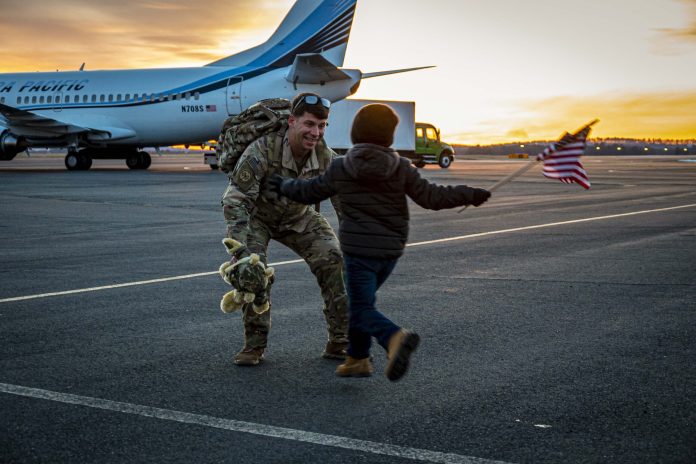
A Soldier assigned to the Connecticut National Guard’s 1-102nd Infantry Regiment prepares to hug his son after returning home from a nearly year long deployment at the Army Aviation Support Facility in Windsor Locks, Connecticut Jan. 22, 2022. The 1-102nd was deployed to the Horn of Africa in support of Operation Enduring Freedom. DoD photo.
A Model of Your Service
It may be helpful, however, to view this evolving conversation as the tension between the notions of service and sacrifice, and that the decision to leave the military lies at the intersection of the two. Visualize it in this graph, with time in service plotted against some relative value that represents service and sacrifice.
Service starts high. You’ve embarked on a long sought-after career that began with patriotic, tempered idealism. You’re in uniform and finally getting to do the things you saw in recruiting videos. Your motivation is fueled by a strong sense of duty, personal ambition, and curiosity about the opportunities and challenges that await you.
Inevitably, though, the romanticism wanes as the profession morphs into a series of daily tasks and taxing interactions. Despite periods of inspiration like command opportunities, duty may start to feel like a job. The “why” you started with is no longer sufficient and the service line declines.
The sacrifice line, however, starts low. You will bear almost any burden for the opportunity to realize your potential and chase the goals that lay ahead. At some point, sacrifice becomes evident when the reality of the profession doesn’t match expectations – the experience doesn’t match the recruiting videos. Typical culprits include late nights spent building slides, multiple deployments, weekend time spent responding to serious incidents, and the incessant churn of bureaucracy.
Sacrifice takes new form when family comes into the picture, for the military profession has a worthy challenger when it’s forced to compete with the magical moments that children bring. Miss too many of those moments and the feeling of sacrifice builds momentum.
At some point the lines cross. When this happens, when sacrifice exceeds your concept of service, it’s time to recalibrate why you serve so that you can continue in uniform…or make a career change.
Here are some thoughts to consider.
Choose a model.
Even if the above model doesn’t fit your perspective or experience, the worse outcome is to have no model at all. That is, to let the sacrifices accumulate without evaluation or objective appraisal. Professional demands have a way of holding primacy over home life and family. Left unchecked, those demands can erode relationships and cause lasting harm and regret. You need a way for you and your family to assess the impact.
Redefine service.
It will be worthwhile to redefine your notion of service at regular intervals and at major career and family milestones. As personal and professional situations evolve, evaluate how these changes interact and compete with one another to affect your attention, energy, time, motivation, goals, etc. You must continually answer, “Why do I do this?” Simply serving your country might have been sufficient in years past but may no longer justify successive deployments or a two-year geo-bachelor tour.
What will?
I’ve heard leaders say, “The world is becoming more complex and volatile, I am staying in to help build the best military possible”…and, “I’m doing this so that my children will have a better Army to serve in if they choose to”…and, “It’s not about my career, it’s about the Soldier on the line and putting them in the best position to win the next fight.” A more recent catalyst for service might be, “Russia started a war in Ukraine and there is no telling what will come next. It’s no time to leave, no matter what the sacrifices are.”
Know what your answer is. Know why you serve.
Unconditional service.
Don’t tie your concept of service to your promotion potential or relative success. Service must not require validation. Eventually, there is nothing left to provide that validation…no more titles, no more accolades, no more promotions or paychecks. You must be content in sacrificing for a worthy cause apart from what it gets you. Ultimately, that cause may be the people you have impacted along the way, which is a worthy cause indeed.
The lines continue.
As you consider career decisions, it’s helpful to know what sacrifice is still to come. If all goes “according to plan,” what will future jobs demand from you and your family? What are the opportunity costs of continuing on the current path? Similarly, what type of dedication and commitment…fueled by a renewed concept of service…will that path demand? Can you live with that?
Augment your perspective.
You may feel that you can’t have this conversation in public or with your bosses. Nevertheless, you need to have this conversation with an experienced leader or mentor who can ask though-provoking questions, challenge your assumptions, help you assess your potential, and describe both the service and the sacrifice that may await you in years to come. Good mentors know that every servicemember experiences this tension and will empathetically guide your understanding.
Finally, it is common to feel like you owe the Service for the opportunities and experiences you’ve had (i.e., “I was given this command, so I should stay in a few more years.”) Be careful, this guilt can blindly commit you to continued service long after surpassing an acceptable level of sacrifice. What you owe is your remaining service obligation and your dedication to do your full duty. Nothing more.
Questions for Leaders
Do you relate to the service and sacrifice model? If not, what does your model look like?
Does work hold primacy over your home life? If so, how does that manifest in those you care about?
In what ways does your perception of sacrifice differ from your family’s?
“My name is Ozymandias, King of Kings; Look on my Works, ye Mighty and despair!” Nothing beside remains. Round the Decay Of that colossal Wreck, boundless and bare The lone and level sands stretch far away.[1]
The ancient Greeks looked east and saw barbarians lapping at the shores of civilization.[2] Chinese emperors of antiquity assumed that, in keeping with the “all under heaven” framework, all the world belonged to them, Chinese or not.[3] Suleiman the Magnificent aspired to a universal monarchy, and for a time it seemed likely.[4] In each case, the powerful looked at a map of their dominion, all their dominion to be, and saw only a reflection of themselves. There springs a narcissism from becoming a great power. In his treatise on nationalism’s roots, Benedict Anderson describes this phenomenon: “All the great classical communities conceived of themselves in as cosmically central.”[5] Their aspirations overshadowed those of the governed, conquered, or even of friendly states. At times, this could lead to exaggerated sense of power and influence.
When strategists can live in the skin of another through the means of storytelling, they can better calibrate policy that is feasible within the limits of state power.
The United States shares in this tradition of great power narcissism. That said, while the disease has no cure it is not fatal. In fact, it is probably an unavoidable, and perhaps even necessary condition for policy makers, but one that must be balanced with a heavy dose of empathetic analysis of adversaries and allies alike. The route to a more authentic understanding of the aims and likely reactions of other states, is through narrative appreciation. When strategists can live in the skin of another through the means of storytelling, they can better calibrate policy that is feasible within the limits of state power. The interests of the state must remain front and center, but informed by a deeply felt understanding of the fears and hopes of one’s friends and foes with a mind towards avoiding unintended provocation and building deeper trust with partner nations.
Miscalculation Between Narcissistic Powers
Moreover, when lingual and cultural differences run particularly deep, it increases the difficulty of anticipating an adversary’s intentions.
Current thought and literature about adversary states like Russia and China emphasizes fears about miscalculation leading to direct great power confrontation that neither party desires. The Thucydides Trap, China threat theory, and Russian nuclear blackmail are on the tongues of policy experts and strategists.[6] These concerns are legitimate, especially in view of the potential consequences of a miscalculation between nuclear-armed powers. Yet there are risks that exaggerated emphasis on a threat like China will become a self-fulfilling prophecy.[7] Moreover, when lingual and cultural differences run particularly deep, it increases the difficulty of anticipating an adversary’s intentions. Psychologists have found evidence that language and culture create measurable distinctions in thought patterns.[8] Psychologist Richard Nisbett concludes that “human cognition is not everywhere the same.”[9] But there does seem to be at least one universal human means of expression that could shed light on the ambitions and fears of very different states. Humans tell stories, and through them make sense of their past and signal intentions for their future.
The Functions of Narratives
The most distinctive feature of the human species—one that no other creature replicates—is the impulse to tell stories as a way of understanding its world and seeking to control it.[10] These narratives constitute a vessel into which citizens or subjects organize the facts that define their world—they add meaning to both the story and the audience. Individuals and nations press stories into service for a variety of projects, because they tap into some primordial need. As individuals, humans are prone to place themselves at the center of a story about them and use the narrative form to give meaning to the events unfolding around them.[11] Likewise, when one’s country is the protagonist in a story told about the world, it sets the terms of the discourse surrounding policy development and strategy. Because a people’s sense of belonging and identity have become intertwined with national stories and myths, their very happiness is connected to the foreign policy decisions of the state.[12]
Narratives can provide cohesion for domestic audiences, grist for grand strategy, and guardrails for decision-making.
States also employ narratives to change the thinking of others. With a suitably resonant story, states believe they can gain advantage over a competitor by shifting norms and expectations.[13] Such a contest of narrative flares up anytime the U.S. 7th Fleet passes a ship through the Taiwan Strait. Undergirding China’s heavy investment in the developing world, is the narrative that China offers an anti-colonialist alternative for foreign engagement and regional leadership. This simultaneously strikes at the West’s exploitative history with Africa and hopes to lay the groundwork for power projection beyond Chinese borders.
But state narratives must maintain a modicum of verisimilitude.[14] If, for instance, the plot of the state’s narrative emphatically denied a state of war existed, but battlefield reverses in a “special military operation” required major reinforcements, then a sudden surge in mobilization would seriously undermine the story being told to audiences at home or abroad.[15] It might pose real danger to regimes who, in their hubris, have grown dependent on flawed narratives to help preserve themselves. Thus narratives can provide cohesion for domestic audiences, grist for grand strategy, and guardrails for decision-making.
Escape from Narcissistic Strategy
If policymakers can become trapped within their own state-centered narratives, what is to be done to avoid catastrophic hubris? I propose that constructing narratives from the perspective of other states offers a solution. Because of a story’s ability to transport an audience outside their own reality, they enable a strategist to visualize a probable reaction to unfolding events from the perspective of another. Research by Michael Jones and Mark McBeth demonstrates that narratives are more persuasive—and more able to mobilize a people—than analytical arguments because they manage to transport the audience into a receptive state of mind.[16] This goes beyond red teaming. While useful in spotting holes in one’s own plans, red teaming does not transport the strategists because it lacks the deep context created by the narrative form.[17] That is the power of strategic storytelling. It removes the familiar trappings of one’s own perspective in a way that permits a more authentic visualization of a potential future. It alerts the strategist to the myriad of actors with choices available to them. The dangerously narcissistic state lacks imagination to anticipate how less powerful actors legitimately pursuing their own interests may spoil the best laid plans of great powers.
Adversary Narratives: The Case of China
Given the human predilection to accept stories as true, it is understandable and expected that adversary states, especially those with authoritarian rulers, traffic in narratives to preserve their regimes and influence external actors. Manjari Chatterjee Miller makes a convincing case that economic resources and military might alone are insufficient to become a great power. State elites must employ a narrative the domestic audience at least tacitly endorses and which theorizes the achievement of great power.[18] Certain narrative forms are more persuasive and compelling than others. States often employ themes of victimization coupled with “overcoming the monster” archetypes.[19] Chinese elites mobilize and nourish nationalist sentiment with the “century of humiliation” narrative. A range of subplots, such as “the backward will be beaten” and “National rejuvenation” fit within this larger narrative and help legitimate Chinese Communist Party aspirations.[20] Feng Zhang writes, “Scholars sometimes wonder whether the century of humiliation, which forms such a big part of China’s national psyche, is a myth constructed by twentieth-century nationalists or a political narrative used by the Party to legitimize its rule. Myth or not, it has exercised a powerful hold on Chinese conceptions of international order.”[21] More than that, it has inculcated in younger generations of Chinese a craving for a more muscular form of Chinese nationalism.[22]
Ruling elites might advance their state into a later stage of the story more quickly than some audiences expect or even modify the plot.
It is important to remember that these strategic narratives do not remain fixed.[23] Ruling elites might advance their state into a later stage of the story more quickly than some audiences expect or even modify the plot. China’s narrative of patience under Deng has not necessarily vanished. Xi Jinping believes China has reached the part of their story where they must become more assertive and seize what is rightfully theirs. As Shin Kawashima puts it, “China believes the tides are in its favor.”[24] Xi’s legacy, a point at which Taiwan’s defenses will make a forceful annexation too costly, and a rising nationalism are all plot devices in this strategic narrative contributing to a sense that China is nearing an event horizon with Taiwan.
Friends Like These—Understanding Allies Through Narratives
If appreciation of the enemy’s story is valuable, appreciation of allied or partnered state’s narratives might be indispensable. The current crisis in Eastern Europe ought to remove any doubt of that. Ukraine’s strategic narrative that it is a culturally distinct nation from Russia that serves as a bulwark against authoritarian aggression has skillfully undermined Putin’s claims as a pan-Slavic liberator. President Zelensky’s career as a performer seems to have served him well. He has helped construct and give life to a credible and legitimate narrative that has animated determined resistance and defied all expectations. In the Pacific region, where Chinese and American narrative visions of the future compete, it would be easy to dismiss or marginalize the strategic narrative of neutral states or potential allies. Recent scholarship suggests that these states already worry about being forced to choose and have well-founded fears of loss of autonomy or abandonment.[25]
While some wring their hands at the apparent non-alignment of India, Manjari Miller’s explanation for Indian hesitancy carries the sting of truth.[26] India’s strategic narrative prioritizes complete autonomy and the perception of equality with partners. The U.S. has never been “perceived as an empathetic friend who would understand India’s security imperatives.”[27] With the deeper context and more authentic perspective offered by narrative analysis, U.S. policymakers could better calibrate policy to meet a partner where they are and regain their trust.
Strategic Narcissism in Action
Perhaps an example of failure to think outside one’s own narrative framework can illustrate the problem and suggest a solution. The 9-11 attacks created the conditions for understandably outraged elected officials to view the world from only the perspective of an unjustly attacked benevolent superpower. At this moment, the U.S. enjoyed considerable international goodwill and a domestic audience eager for a persuasive narrative that could mobilize resources towards ends that would serve U.S. interests abroad. But the righteous anger of George W. Bush and many in his cabinet blinded policymakers to the limits of American power and the unconsidered reactions of regional actors.
The failure to anticipate the reaction of thousands of lower-level Baathists to loss of status and employment or to see how a hostile Iran might fear for its own regime and seek opportunities to bog down the U.S. in Iraq seems quite foolish in retrospect.
The obsession with removing Saddam Hussein from power, which began without any clear evidence of weapons of mass destruction or of support to Bin Laden while apparently a positive step for the Iraqi people was only a short chapter in a longer story that included a variety of regional actors with interests of their own. The failure to anticipate the reaction of thousands of lower-level Baathists to loss of status and employment or to see how a hostile Iran might fear for its own regime and seek opportunities to bog down the U.S. in Iraq seems quite foolish in retrospect.
In the months and years that followed the 9-11 attacks, policy elites constructed a narrative of delivering a benighted place into the hand of western-liberal democracy. With such a persuasive, yet flawed story guiding the actions of policy elites and much of the voting population, the U.S. lurched from one part of the Middle East to another without advancing its vital interests and, even worse, destroying the unipolar moment and all possibilities to sustain its unchallenged global leadership in the process. Some 20 years later, that narrative is usually a punchline in a bad joke, but few are likely to admit how they had been transported by its allure in 2003.[28]
Conclusion
I do not assert that narratives alone provide sufficient predictive power on which to base foreign policy decisions. Philip Tetlock’s work convincingly points to limitations of a strictly narrative approach to strategic forecasting.[29] Likewise immutable facts of topography and limitations of resources and, of course, unknowable contingencies conspire to subdue human aspiration.[30] Yet without reference to human desires, fears, and values neither do they tell us much about how a nation or a people will interact with them.[31]
What I propose here is that U.S. strategists give greater respect to narratives in foreign policy formulation. They serve as both tools of states and analytical approaches and once they have learned how other societies construct them, strategists can more effectively influence others. Policy can then direct diplomacy in a direction more mutually acceptable to all parties. They might see how fears of overcommitting to the current superpower could seem imprudent, given the history of reversals in the foreign policies of democratic states. Narratives enable sense-making not just of a lived present, but of a possible future. It is for this purpose that a strategist must pursue the skill of storytelling to temper Oxymandias’ “sneer of cold command.”
Wesley Moerbe is an officer in the U.S. Army and a graduate of the School of Advanced Military Studies. He has experience as a planner at the tactical and operational level and his writing has appeared in several professional journals. The views expressed are the author’s alone and do not reflect those of the U.S. Army, the Department of Defense, or the U.S. Government.
The Strategy Bridge is read, respected, and referenced across the worldwide national security community—in conversation, education, and professional and academic discourse.
Thank you for being a part of The Strategy Bridge community. Together, we can #BuildTheBridge.
Header Image: Ramses II, Musée d’Art et d’Histoire Genève, Genève, Switzerland, 2019 (Daniela Turcanu).
Notes:
[1] Percy Bysshe Shelley, The Major Works: Including poetry, prose, and drama, (Oxford University Press, Oxford), 198.
[2] John V. A Fine, The Ancient Greeks : A Critical History, (Cambridge, MA: Harvard University Press, 1983), 93 and 438.
[3] Gill Bates, Daring to Struggle : China’s Global Ambitions Under Xi Jinping, (New York NY: Oxford University Press, 2022), 49; John Keay, China: A History, (New York: Basic Books, 2009), 139.
[4] Andre Clot, Suleiman the Magnificent: The Man, His Life, His Epoch, (London: Saqi Books, 2012), 297-298.
[5] Benedict Anderson, Imagined Communities : Reflections on the Origin and Spread of Nationalism, (London: Verso, 2016), 13
[6] Graham T Allison, Destined for War : Can America and China Escape Thucydides’s Trap? (Boston: Houghton Mifflin Harcourt, 2017), viii-ix; Emma V. Broomfield, “Perceptions of Danger: The China Threat Theory,” Journal of Contemporary China 12, no. 35 (2003): 265-284, 265; Beverly Loke, “China’s Rise and U.S. Hegemony: Navigating Great-Power Management in East Asia,” Asia Policy, Vol 14, Number 3 July 2019, pp. 41-60, 56.
[13] Emile Simpson, War From the Ground Up: Twenty-First-Century Combat as Politics (New York: Oxford University Press, 2013), 179.
[14] Lawrence Freedman, Strategy: A History, (New York: Oxford University Press, 2015), 621.
[15] Jack Detsch, “Putin’s Lies About the War Hobble Russia’s Offensive,” Foreign Policy, June 14, 2022.
[16] Elizabeth A Shanahan, Michael D. Jones, Mark K. McBeth, and Claudio M. Radaelli. “The narrative policy framework.” In Theories of the policy process, pp. 173-213. (Routledge, 2018), 343.
[17] Micah Zenko, Red Team : How to Succeed by Thinking Like the Enemy, (New York: Basic Books, 2015), xxi-xxiv.
[18] Manjari Chatterjee Miller, Why Nations Rise: Narratives and the Path to Great Power, (New York NY: Oxford University Press, 2021), 149.
[19] Christopher Booker, The Seven Basic Plots : Why We Tell Stories, (London: Bloomsbury Continuum Publishing, 2004), 584.
[20] Yi Wang, “‘The Backward Will Be Beaten’: Historical Lesson, Security, and Nationalism in China.” Journal of Contemporary China 29, no. 126 (2020): 887-900, 893-896.
[21] Feng Zhang, “The Xi Jinping Doctrine of China’s International Relations,” Asia Policy, Volume 14, Number 3, July 2019, pp. 7-23, 14.
[22] Jessica Chen Weiss, “How hawkish is the Chinese public? Another look at “rising nationalism” and Chinese foreign policy.” Journal of Contemporary China 28, no. 119 (2019): 679-695, 690.
[23] Miller, Why Nations Rise, 150.
[24] Shin Kawashima, “Xi Jinping’s diplomatic philosophy and vision for international order: Continuity and change from the Hu Jintao era.” Asia-Pacific Review 26, no. 1 (2019): 121-145, 138.
[25] Jessica Chen Weiss, “The China Trap,” Foreign Affairs, Sep/Oct 2022, Vol. 101 Issue 5, p40-58.; Evan S Medeiros, Keith Crane, Eric Heginbotham, Norman D. Levin, Julia F. Lowell, Angel Rabasa, and Somi Seong, Pacific Currents: The Responses of U.S. Allies and Security Partners in East Asia to China’s Rise, (Santa Monica, CA: RAND Corporation, 2008), https://www.rand.org/pubs/monographs/MG736.html, 246.
[26] Miller, Why Nations Rise, 140.
[27] Ibid.
[28] Gordon, Losing the Long Game, 142-143. ; Gordon, Cobra II : the Inside Story of the Invasion and Occupation of Iraq, 19-26.
[29] Peter Scoblic and Philip E. Tetlock. “A Better Crystal Ball: The right way to think about the future.” Foreign Affairs, 99 (2020): 10.
[30] Jakub J. Grygiel, Great Powers and Geopolitical Change (Baltimore: Johns Hopkins University Press, 2006), 21-26.
Military doctrine often proposes a whole-of-government approach to overcome what could be a fragmented strategic process. But this approach is elusive and ill-defined. Somehow, a lot of people from different government agencies work collaboratively and with single-minded purpose to devise a strategy. Joint Publication 3-08, for example, states that whole of government effort “involves the integration of U.S. Government efforts through interagency planning that set forth detailed concepts and operations.”[1] But it goes little beyond describing planning efforts in abstract terms. And it admits significant difficulties. For example, civilian departments and agencies have “different cultures and capacities,” and many do not even conduct operational planning.[2] These are indeed obstacles.
The utility of a coherent whole-of-government strategic approach is even more questionable when any strategy involves the use of economic statecraft as an instrument of power. For reasons described below, the mental model of a unified government “orchestrating” the economic instrument of power is fundamentally misleading. Rather, the more appropriate “mental model” to describe the milieu of the economic instrument is as a network of a variety of entities, and even more specifically to describe that milieu as a complex adaptive system. Behaviors in such a system are inherently decentering– no single node in the system predominates. Understanding how the economic instrument can operate in this system also requires understanding the rest of the elements and their interconnected interdependencies.
What Makes the Economic Instrument of Power Different–and Therefore Problematic When Attempting a Whole of Government Approach
There are three fundamental, structural reasons that make the economic instrument of power different from other instruments and therefore difficult to apply as part of a whole of government strategic approach. The first reason involves an understanding of the government’s provision of services. The U.S. government typically provides two types. One is a “direct” service—a service that the government directly supplies to perform a function. The two exemplary “direct services” that the U.S. government provides are the U.S. postal service and the U.S. military. Both are directed by, and under the control of, the executive branch. Both the postal service and the U.S. military are internally directed by a unified, hierarchical leadership structure within the executive. Far more prevalent in the U.S. government are “indirect” services. These services stabilize, monitor, and overwatch key societal functions, albeit not via direct intervention and action. They are provided via legislation and regulation, and via monitoring and inspecting any number of activities, and they are dispersed across any number of entities. It is evident that it is far easier to “orchestrate” a strategy for something over which one has direct control than for something over which one only has indirect control.[3]
The U.S. government specifically conducts economic policymaking via two methods: via fiscal policy, which deals with the raising of taxes and revenues; and via monetary policy, which involves the distribution and control of the monetary supply.
The second reason that makes the economic instrument of power so different is because the U.S. government specifically conducts economic policymaking via two methods: via fiscal policy, which deals with the raising of taxes and revenues; and via monetary policy, which involves the distribution and control of the monetary supply. Neither of these policymaking approaches are directly controlled by the executive branch. By constitutional separation of powers, the legislative branch has primacy over fiscal methods: it raises taxes and spends provides for the government’s budget. By legislation, the U.S. Federal Reserve is essentially independent of the executive and legislative branches and has primacy over monetary policy. Simply put, the agencies primarily responsible for the two most significant policymaking aspects of the economic instrument are not even in the same branches of government as the military instrument.[4]
The third reason that makes the economic instrument different is that the United States is not only, per constitutional arrangement, purposefully divided as stated above it is, to use the terminology of economic and policy historian Chalmers Johnson, a “market rational” state.[5] As opposed to “plan rational” states such as many East Asian nations, (to include China) the United States Government as a rule avoids overt industrial policy. This includes the avoidance of practices such as picking industrial national champions, aiding or subsidizing wide industrial sectors (though the government makes exceptions for defense and agriculture) or setting broad price and wage controls. Unmistakably, the U.S. government has done these things in the past, though almost always during national emergencies and wartime—and often with significant controversy and resistance (sometimes within the U.S. government itself).[6]
The Economic Instrument Within a Network and a Complex Adaptive System
These reasons render a mental model of the economic instrument of national power being orchestrated collectively with other national power instruments in a unified whole of government approach deeply problematic. The more appropriate model to describe the milieu of the economic instrument is as a network of a variety of entities.
What is a network? A standard dictionary definition of a network is a “large system consisting of many similar parts that are connected together to allow movement or communication between or along the parts, or between the parts and a control centre.”[7] This definition, minus the notion of a “control centre,” aptly describes the overall network within which U.S. governmental economic entities operate. A network is any number of parts, connected, not in command-and-control relationships, but through any number of ties that link them together. The entities are not monolithically unified. They are not under a single conductor that orchestrates them as a U.S. government instrument of power.
Often the changes created by the behavior create a total change greater than the sum of changes to individual parts.
This network contains various U.S. governmental entities—the U.S. Congress (and its committees and subcommittees), the Federal Reserve, and various executive agencies (i.e., Departments of Commerce and Treasury, the U.S. Trade Representative Office, the National Economic Council, and the U.S. Agency for International Development, and numerous others). They exist in this network, along with domestic, international, and supranational entities.
The network itself is a complex adaptive system. A complex adaptive system is a network whose behavior is non-linear, emergent, and unpredictable. Non-linear behavior moves in multiple directions at once. Such behavior is variable. Often the changes created by the behavior create a total change greater than the sum of changes to individual parts. Emergence indicates that the system exhibits large-scale patterns that are not found in individual parts and that can lead to new, unpredictable patterns and behaviors.[8] Economic systems are frequently described as complex adaptive systems, as are “living organisms, immune systems, ecologies, societies, … political systems, communications networks (including their users’ behaviors), military organizations, and war itself.”[9]
The idea that U.S. economic entities exist in a complex adaptive system is especially important to policymakers. Given the unpredictability in the system, it becomes apparent that efforts at mastery or control are illusory.
Crucial to understanding complex adaptive systems are the concepts of positive and negative feedback. Certain feedback stabilizes the system and brings it toward equilibrium or homeostasis. Positivefeedback, on the other hand, takes a system away from its “desired equilibrium” and creates “runaway processes of change.”[10] Given the nature of a complex adaptive system, positive feedback is a very real and oft-occurring phenomenon, and it is this feedback that generates disproportionately influential outcomes.
The idea that U.S. economic entities exist in a complex adaptive system is especially important to policymakers. Given the unpredictability in the system, it becomes apparent that efforts at mastery or control are illusory. The very nature of this environment obviously constrains action: realizing one operates in such a system may mitigate the temptation to commit grandiose error. At the same time, understanding this system reveals possibilities, because unpredictability cuts two ways. It could also present opportunities that allow for a competitor or adversary to make mistakes.[11]
Mapping the System
An interpretation of the system can be visualized by mapping it, though there should be full recognition that a full and complete mapping of such an open-ended system is not achievable, but always a work in progress.[12] Examples abound of networks that consist of nodes, clusters of nodes, and connecting linkages. This process involves identifying U.S. governmental entities, understanding their functions, and then mapping their connections to other entities throughout the system, domestically and internationally. Collectively, they illustrate many facets of the system.
Stratagems over Strategy
Mapping the system is a necessary step, but calling and depicting something a network or a complex adaptive system, as Richard Rumelt points out, does nothing, because doing so is not strategy, but simply model creation.[13] Nonetheless, viewing U.S. economic entities as operating in a complex adaptive system provides for the possibility not necessarily of grandiose strategies, but of stratagems—smaller scale actions that take advantage of understanding the system and where negative and positive feedback generates effects.
The Chinese Belt and Road Initiative (BRI) is a version of a complex adaptive system.
In their recent book, Danger Zone: The Coming Conflict with China, Hal Brands and Michael Beckley propose efforts that the United States could undertake while competing with China. They include “[b]ait-and bleed strategies that “don’t risk war but do trigger the type of blustery overreaction through which Beijing isolates itself” and they call for a “network based structure that allows members [of a US-led economic alliance] to create flexible, issue-based partnerships.”[14] Such ideas can be further developed by being mapped out within an economic complex adaptive system to reveal nodes and connections and relationships between various entities.
The Chinese Belt and Road Initiative (BRI) is a version of a complex adaptive system. It spans a myriad of Chinese government agencies, state-owned enterprises, and provincial and national banks—not to mention the innumerable public and private entities in the 165 countries where the BRI is extant.
More effective than a grandiose and infeasible counterstrategy to offer some large-scale BRI alternative, understanding and mapping the BRI as a complex adaptive system—to include the relationship of U.S. governmental entities within that system–could be far more effective. Some of this work is currently being done. The William and Mary University affiliated research lab AidData is tracking the BRI and its various feedbacks. For example, it denotes resultant environmental degradation and native health problems that have occurred because of certain BRI projects. Tracking that “feedback” — and then taking calibrated, appropriate actions by U.S. entities—highlighting bad results of BRI projects, and, conversely, possibly collaborating multilaterally in possibly good results—could have cascading effects far more consequential than larger strategic efforts.[15]
A New Way of Economic Strategic Thinking
Reframing U.S. economic statecraft as operating a complex adaptive system does not mean ending efforts to work with other U.S. governmental instruments of power. To do so would be absurd: economic actions often are taken to achieve non-economic (e.g., diplomatic or even military) ends.[16] But it reconfigures strategic thinking in two ways. First, it shows that the capacity of the U.S. government’s economic instrument of power is structurally limited. Secondly, it shows that operating within a complex adaptive system opens unnoticed possibilities that could further U.S. interests. Indeed, within such a system, because it is non-linear, emergent, and unpredictable, those possibilities are endlessly varied.
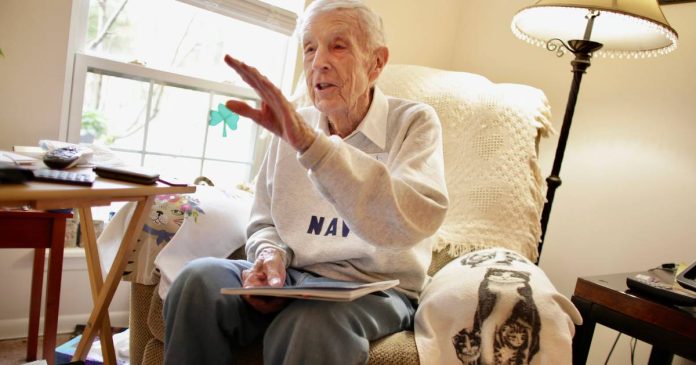
VIRGINIA BEACH — Charles “Obie” O’Brien perched a dozen black and white photographs on his knees as his aged fingers flipped through the memories.
At 94, O’Brien’s face is lined with experience, but his eyes still sparkled as he recalled some 64 years flying above the clouds.
“I will tell you I would do it all again in a heartbeat,” O’Brien said as a smile tugged at the corner of his mouth.
O’Brien has become known in Hampton Roads military and veteran communities as “the Corsairs guy” — in reference to the plane he flew during the Korean and Vietnam wars. Over his 30-year Navy career, he amassed over 1,100 hours of flight time, including 70 hours of combat.
O’Brien’s sky-bound military career began in 1946. But his dreams of becoming a pilot were ignited years earlier.
“My mom said when I was coming home from the hospital where I was born, an airplane flew over and I poked my head up to look,” O’Brien said with a laugh.
O’Brien took his first plane ride in a Ford Tri-Motor in 1937 in Ocean City, New Jersey. The 15-minute plane ride cost $2.50. Then just 9, O’Brien came up short and talked the pilot into taking $1.75 he saved as a paper boy — managing to secure a seat in the co-pilot’s chair in the process.
“When I got in that airplane, I wanted to be a pilot. But when I got out of that airplane, I knew I was going to be a pilot,” O’Brien said.
The 15-minute flight was all the direction he needed. O’Brien joined the Navy on July 18, 1946. World War II had ended two years before that.
“So I was out of luck as far as wars go,” O’Brien said with a sly grin. “But I was going to be a pilot whether there was a war going on or not.”
A photograph from 2012 of Charles “Obie” O’Brien flying the very same plane — a Corsair F4U — he flew combat missions in during the Korean War.
(Stephen Katz/The Virginian-Pilot)
O’Brien saw combat for the first time on June 13, 1953, toward the end of the Korean War. He was attached to an air wing aboard the USS Lake Champlain.
The mission was to strike a river railway target guarded by anti-aircraft artillery gunners. O’Brien recalled he was a 25-year-old hot-to-trot invincible bachelor, ready to go out and break something.
“Although I was concentrating on my bomb site, I was well aware of the ground fire coming up at me. It looked like a line of pink baseballs and I could hear and feel the ‘whoop’ as each round passed by my aircraft,” O’Brien said.
On his first pass, he dropped a 1,000-pound bomb from 2,000 feet before climbing back to altitude. He made two more passes, and each time the firepower against him intensified. But after nearly four hours, he safely returned to the carrier.
“When you come back, you feel good. You are full of adrenaline. But the adrenaline wears off and you realize you have 37-millimeter holes in your plane from being shot at by people with evil intent,” O’Brien said.
While he was not shot down, O’Brien said every combat mission was “a close call.”
“You can’t get shot at without it being a close call,” O’Brien said.
One of the scores of articles Charles “Obie” O’Brien has saved over the years during his long Navy career. (Stephen Katz/The Virginian-Pilot)
O’Brien’s flights were not all behind enemy lines. In 1959, he flew a F-8 Crusader into the eye of Hurricane Gracie, a category 4 storm, to take photographs for U.S Navy Hurricane Hunters as part of storm research. He and another pilot flew to 45,000 feet above the eye, then down into the center of the storm.
“It was like a sunny day inside the eye. But the crusader is a single-engine plane, and on the way out I was thinking, ‘If this engine craps out, I am in big trouble.’ I had a plan that I would eject, float down into the eye, open my little rubber raft and wait for the wall of the hurricane to hit,” O’Brien said. “Of course, nothing like that happened.”
A photograph O’Brien captured on that flight was published on the back cover of Life Magazine.
“The credits said, ‘U.S. Navy official photo’ — which was OK with me,” O’Brien said with a laugh.
In 1955, O’Brien married the love of his life, Barbara; the couple had three children.
“She sat through two deployments before we got married. I wanted her to know I was going to be a Navy pilot and what it entailed — time away from home,” O’Brien said. “If anybody deserves any medals, it is the Navy wife for holding the family together during deployments.”
Daywatch
Weekdays
Start your morning with today’s local news
O’Brien’s military career spanned 30 years but he continued to fly long after he retired from the Navy. He joined Skytypers, an aerobatic team that performed at airshows around the United States using World War II-era planes, and later volunteered to fly for the Military Aviation Museum in Virginia Beach.
O’Brien’s last flight was in April 2014 — 64 years after the first flight of his professional career. He was 86.
“And then I came home and sulked,” O’Brien sighed.
O’Brien’s Virginia Beach apartment is decorated with model airplanes he flew and photographs from his time in the service. His olive green flight jacket still hangs off the back of a chair.
While his feet have been planted firmly on the ground for the past eight years, O’Brien’s head is still in the clouds.
“I felt like I was complete when I was flying. I had peace, tranquility — all my problems on the ground stayed on the ground. If I could say it in one word, it would be ‘fulfillment’,” O’Brien said.
Concerned about catching the flu? We are all at risk for getting and spreading the flu. Learn how to fight the flu – it starts with you!
What is the flu?
Influenza is a viral infection that attacks your respiratory system – your nose, throat, and lungs. Influenza is commonly called the flu, but it’s not the same as the stomach “flu” viruses that cause diarrhea and vomiting.
How does the flu spread?
Influenza viruses travel through the air in droplets when someone with the infection coughs, sneezes, or talks. You can inhale the droplets directly, or you can pick up the germs from an object- such as a doorknob or table – and then transfer the viruses to your eyes, nose, or mouth. Flu germs can linger on surfaces for up to 8 hours.
What are symptoms of the flu?
Common signs and symptoms of the flu include:
* Fever
* Body aches
* Chills and sweats
* Headache
* Sore throat
* Coughing
* Runny or stuffy nose
* Extreme fatigue
* Eye pain
Most people who get the flu recover completely in one to two weeks, but some people develop serious and potentially life-threating medical complications, such as pneumonia.
What’s the difference between a cold and flu?
The common cold and flu are both contagious viral infections of the respiratory tract. Although the symptoms can be similar, flu is much worse. Colds usually develop slowly, whereas the flu tends to come on suddenly. With the flu, you are likely to run a fever for several days and have body aches, fatigue, and exhaustion, symptoms that are rarely caused by simple colds.
Why should I get vaccinated against the flu?
The Centers for Disease Control and Prevention recommends annual vaccination for everyone age 6 months or older as the best way to protect against the flu.
“A flu vaccine will not provide 100% protection from getting the flu but can reduce the amount of time you’re sick and the severity of your illness or the potential for hospitalizations,” said Lt. Col. Michael Renkas, AFMC Command Public Health Officer. “To be truly effective, it can take several days to a couple weeks for your body to elicit a more extensive immune response from a flu vaccine.”
Renkas advises individuals to get a flu vaccination well in advance of the upcoming Thanksgiving Holiday to protect themselves, their family and peers upon returning to the workplace.
Can flu shots cause the flu?
The flu shot is made from dead viruses and cannot “give” you the flu. However, the vaccine can trigger an immune response from your body, so you may have a few mild symptoms, like achy muscles or a low-grade fever.
Where can I get a flu vaccine?
Influenza vaccinations for all military members are a mandatory requirement, and available through each installation’s Medical Group or at any participating TRICARE eligible pharmacies. TRICARE beneficiaries are also eligible for flu shots through immunization clinics on base, or at no cost at TRICARE eligible pharmacies. For the civilian workforce, all Federal Employee Health Benefit plans cover flu shots at no cost for members and are available at local retail pharmacies. You can find a flu vaccine location through vaccines.gov.
* Select “Find Flu Vaccines” at the top of the page
* Enter your 5-digit zip code
* Check your “Vaccine Options”
* Select “Search for Flu Vaccines” to find a preferred location
[Click on the location for further details and contact information]
What are everyday healthy habits to help protect against the flu?
1. Wash your hands often with soap and water. If soap and water are not available, use an alcohol-based rub.
2. Avoid touching your eyes, nose, or mouth. Germs can be spread when a person touches something that is contaminated with germs and touches his/her eyes, nose, or mouth.
3. Cover your mouth and nose with a tissue when coughing or sneezing. It may prevent those around you from getting sick. Flu viruses spread mainly by droplets made when people with flu cough, sneeze, or talk.
4. Avoid close contact with people who are sick. When you are sick, keep your distance from others to protect them from getting sick too.
5. Clean and disinfect frequently touched surfaces and objects that may be contaminated with viruses that cause the flu at home and work.
6. Avoid large crowds. If you’re able to limit contact with people during flu season, you can reduce your risk of getting an infection.
7. Strengthen your immune system. A strong immune system helps your body fight off infections. To build your immunity, sleep at least 7-9 hours per night. Also, maintain a regular physical activity routine-at least 30 minutes, three times a week. In addition, follow a healthy, nutrient-rich eating plan. Limit sugar, junk foods, and fatty foods. Instead, eat a variety of fruits and vegetables, which are full of vitamins and antioxidants, to promote good health.
For more information on preventing the flu, visit USAFwellness.com or contact your local Civilian Health Promotion Services team. Comprehensive information on healthy habits to prevent the flu can be found at the Centers for Disease Control and Prevention website at cdc.gov.
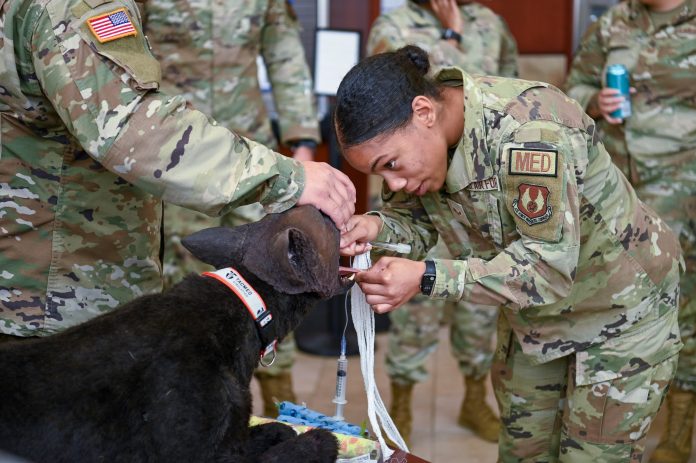
Tactical Combat Casualty Care training is not unique to the active-duty nurses and medical technicians from the 72nd Medical Group however, what is unique is training in Canine Tactical Combat Casualty Care Training.
This week, technicians and nurses received cTCCC training from a veterinary medical officer and a veterinary technician from the Tinker Air Force Base Veterinary Treatment Facility.
“One of our Medical Technicians’ Comprehensive Medical Readiness Program requirements is clinical management of the military working dog, said 72nd MDG Chief Nurse, Lt. Col. Andrea Whitney. “In contingency situations where veterinary staff may not be available or the MWD handler is unable to provide emergency medical care, Air Force medics and nurses receive the training to provide that care.”
The training consisted of two stations: station one was working with Critical Care Jerry on bandaging various locations and injuries and cardiopulmonary resuscitation. Station two was working with the Diesel Advanced Canine Medical Trainer, better known as Diesel Dog. This dog allowed the teams to train on tracheal intubation, tracheotomy, intravenous catheter placement and needle decompression. “Those are emergency procedures that can help save a dog’s life after common combat injuries such as explosions, gunshots, and other penetrating wounds such as shrapnel,” said Tinker VTF, Dr. Heather Cameron, Veterinary Medical Officer.
Diesel Dog is a full body simulator that simulates breathing (adjustable from slow to panting), bleeding, palpable pulses, audio (barking or whimpering). Critical Care Jerry is engineered as a complete emergency room veterinary training mannikin. It simulates trauma and features jugular and vascular access.
Also brought into the training was a military working dog, This (pronounced Dees) and his handler, Senior Airman Jasmin Ramirez from the 72nd Security Forces Squadron. Specialist Baldemar Gonzalez, veterinary technician with the Tinker VTF demonstrated landmarks on This’ leg and where to insert an intravenous catheter. The students did not actually insert the catheter into This’ leg, but instead practiced inserting catheters on a gauze roll that was made to simulate a canine leg.
This and Ramirez were also on hand at the training to help technicians and nurses get a better understanding of what the military working dogs and their handlers do.





:quality(70)/cloudfront-us-east-1.images.arcpublishing.com/tronc/53MKVYTKDFB7VGSPEEKJA2NB5M.JPG)





:quality(70)/cloudfront-us-east-1.images.arcpublishing.com/tronc/3YBHUFWRZREQZI7HUOZNZRG46Q.jpg)