Home Blog Page 193

Army sergeant who fatally shot BLM protester in Texas sentenced to 25 years – Daily Press

0

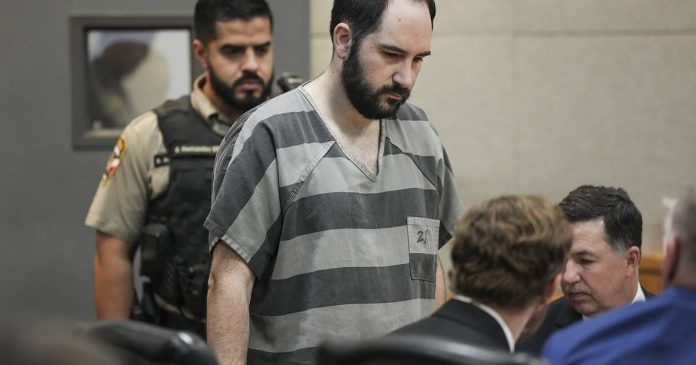
AUSTIN, Texas — A U.S. Army sergeant was sentenced to 25 years in prison Wednesday for fatally shot an armed man during a Black Lives Matter protest in Texas.

Daniel Perry, 36, was convicted of murder in April for killing Garrett Foster during the downtown Austin protest in July 2020. Prosecutors said during sentencing that his history of racist and provocative texts and social media posts expose a threat of violence likely to resurface.

On Tuesday, prosecutors submitted into evidence dozens of texts and social media posts Perry wrote, shared or liked, including some shockingly racist images. They had been excluded from Perry’s trial, but were publicly released after his conviction and allowed into the sentencing phase by District Judge Clifford Brown.

Prosecutor Guillermo Gonzalez had urged Brown to issue a sentence of at least 25 years. The sentencing range for the murder conviction is five years to life in prison.

“This man is a loaded gun, ready to go off at any perceived threat,” Gonzalez said. “He’s going to do it again.”

Perry said he acted in self-defense. His lawyers asked the judge to consider his more than a decadelong military career and hand down a sentence of no more than 10 years.

Perry is assigned to Fort Wainwright, Alaska, but has been classified as in “civilian confinement” and is pending separation from the military, Army spokesman Bryce Dubee said.

Perry, who is white, was working as a ride-share driver in downtown Austin on July 25, 2020, when he shot and killed 28-year-old Foster, an Air Force veteran. Foster, who was also white, was legally carrying an AK-47 rifle as he participated in the demonstration against police killings and racial injustice, following the killing of George Floyd, a Black man, by a white Minneapolis police officer.

Among Perry’s statements introduced Tuesday, he wrote on Facebook a month before the shooting: “It is official I am a racist because I do not agree with people acting like animals at the zoo.”

Floyd was killed on May 25, 2020. A few days later as protests erupted, Perry sent a text message to an acquaintance: “I might go to Dallas to shoot looters.”

Daywatch

Weekdays

Start your morning with today’s local news

Perry attorney Douglas O’Connell argued that the texts and posts were presented by prosecutors out of context, and that Perry has a right to free speech.

“Some of those social media posts are frankly repugnant,” O’Connell said, while classifying others as “dark humor.”

Forensic psychologist Greg Hupp testified that he believed Perry has post-traumatic stress disorder from his deployment to Afghanistan and being bullied as a child. Perry’s mother, Rachel Perry, testified that he was ostracized as a child because of a speech impediment.

Perry’s conviction prompted outrage from prominent conservatives, and Texas Republican Gov. Greg Abbott has said he will sign a pardon once a recommendation from the Texas Board of Pardons and Paroles — stacked with Abbott appointees — hits his desk

The board is reviewing Perry’s case on the governor’s orders, but it is unclear when it will reach a decision.

Perry was stationed at Fort Hood, about 70 miles (110 kilometers) north of Austin, when the shooting happened. He had just dropped off a ride-share customer and turned onto a street filled with protesters.

Perry said he was trying to get past the crowd and fired his pistol when Foster pointed a rifle at him. Witnesses testified that they did not see Foster raise his weapon, and prosecutors argued that Perry could have driven away without shooting.

#Reviewing Fighting the Fleet

0

Complicating finding and engaging enemy fleets is the fact that navies must carry their ordnance and fuel over great distances. They must also be able to replenish effectively before and after combat, a task that might have to be accomplished while remaining at sea. To break down this daunting problem, Cares and Cowden propose reconceptualizing maneuver in the three phases of Fiske’s day. In the authors’ reconception, properly integrating logistical considerations into our thinking on naval power means planning operations in terms of cruising, approach, and attack, corresponding to strategic, operational, and tactical levels and terms, respectively. In portraying how logistics must be handled at each stage of this process, Fighting the Fleet asserts that combat, maneuver, and logistics are inseparable concepts that must be planned in concert with one another.

With these concepts in mind, Cares and Cowden ultimately turn to four functions of fleets derived from J.C. Wylie: strike, scout, screen, and base. Building on their discussion of Hughes and Fiske, the authors argue that these three theories “are the fleet commander’s tools for controlling the pattern of tactical events in a naval campaign…fleet commanders can wield the four functions to achieve, sustain, and leverage control at sea for victory.”[5]

Interestingly, Fighting the Fleet only briefly addresses why the ideas of Fiske, Wylie, and Hughes have largely been forgotten:

Indeed, as it is presented today at the Naval War College, naval operational art is joint operational art, which is at its core Army operational art. It is as if Wylie and Fiske never existed. Today a “joint sailor” is not someone who thinks like a sailor at all but one who thinks almost entirely like a 1980s-vintage Army planner.

This is harsh criticism but not unwarranted. The services play their own unique roles within the context of a joint campaign. Universal, Army-derived joint language is twice insufficient: it is too generic for services’ use in planning their idiosyncratic missions, and it fails to give the joint planner a complete understanding of how the unique parts fit into a complex whole.[6]

While joint doctrine is problematic for the reasons laid out throughout the book, Cares and Cowden argue the Navy’s principal problem is that it has no way of expressing its own doctrine to itself before translating it into joint language. Rediscovering that vernacular is, ultimately, the mission of this work. This is an important argument which is only briefly outlined in the introduction. An earlier presentation of some of these details would have made the impact even more powerful.

With the common use of drone surveillance and attacks in Ukraine, it appears the world may very well be moving from what Fighting the Fleet calls the “Missile Age” to the “Robotics Age.” Rather than obviating the lessons the authors seek to teach, Cares and Cowden instead assert that in all likelihood the previously discussed concepts will continue to be important:

[B]uoyancy, power, search, surveillance, movement, logistics, and control will all continue to operate in their same, uniquely naval ways in the robotic future. The fundamental difference—a difference of degree, not of character—will be the extent to which future naval forces become even more controllable, versatile, adaptive, and survivable as these new technologies are perfected and embraced. This is simply a step further along a continuum in the evolution of naval combat theory.”[7]

#Reviewing A Short History of War

0

Through forty short chapters, the author examines diverse case studies representing, chronologically, various aspects of war at different times and in different areas around the world. The scope of the book is expansive in terms of time and space, going from ancient times to the 2020s and exploring the variety of warfare in the Middle East, China, India, the Greek and Roman Empires, Japan, Africa, Australasia, Oceania, and the Americas. As the title suggests, the book is an introduction to the history of war and warfare. But, more precisely, it is a military history of the practice of war. Black focuses largely, but not only, on strategies, tactics, fortifications, armaments, naval power, artillery, cavalry, technologies, the use of massive resources, as well as the geography of battlefields. The last two chapters and the conclusion move away from historical analysis to offer some reflective remarks. There the author claims the necessity for a “less western-centric military history” as well as an extensive use of a cultural approaches in analyzing the military past to fully understand the global evolution of war. Black concludes with short comments on the future of war arguing that this phenomenon and its terrible consequences on human conditions are not only elements of the past, but still very present today and will continue to influence international affairs in the coming years.

The book does a fine job providing a global perspective by including multiple areas, cultures, and groups of people, showing that the phenomenon of war is far from being limited to the Western world. The central argument made by Black—that war transcends human societies worldwide for thousands of years—is quite convincing. His approach, however, is confusing at certain points. Although the author’s comprehensive global and long-time history of war is impressive, the structure of the book suffers from a certain lack of clarity. It is only in the short conclusion that the author details his objectives and arguments. A short introduction would have been useful to better understand existing debates on war and the contribution of this book.

Throughout the chapters, the focus is on the practice of war rather than on a larger discussion of the importance of war and different warfare in societies over time. This emphasis on solely military aspects neglects other dimensions also important in armed conflicts, such as legal and moral debates, diplomacy, philosophical thinking, psychological impact, economics, and human conditions. For instance, the influence of social movements, race, gender, class struggles, nationalism, capitalism, globalization and neo-imperialism on the practice of war are not considered in Black’s analysis. Current armed conflicts around the world show that warfare remains interconnected with multiple factors that go beyond military understanding. In terms of structure, the book features numerous brief chapters moving from one aspect to another, seemingly unconnected except for chronology, and each chapter covers various spaces and long periods of time. Consequently, the contribution of this book to larger debates is difficult to fully grasp.

…the influence of social movements, race, gender, class struggles, nationalism, capitalism, globalization and neo-imperialism on the practice of war are not considered in Black’s analysis.

In addition, the book is, at times, short of reflection about the definition and conceptualization of war and warfare, especially on non-military dimensions such as beliefs, emotions, bodies, identities, mentalities, behaviors, and representations. A rich scholarship has developed on the history of war showing that experience, practice, and representation of armed conflicts nuance the “traditional” military perspectives, extending the war beyond the battlefield.[2] For instance, the evolution of the phenomenon of war over time involved larger mobilization of people and resources including women and children. Those aspects have notably contributed to blurring the frontier between combatants and non-combatants as well as expanding the consequences of war on societies. The meaning of concepts such as battle and battlefield have also evolved over centuries according to the character of warfare. Meanwhile, wars have contributed to transnational discussions on humanity, refugees, international humanitarian law, human rights, ethical and moral debates on non-conventional warfare, as well as peace movements. Finally, directly connected to warfare is the complex transition from war to peace. After the official end of combat, war continues to have major impacts on societies in terms of political, social, and cultural changes. Among the numerous examples showing the blurred demarcation between war and peace are displaced people, the return to civil life for soldiers, the wounded and their families, the destruction (and reconstruction) of infrastructure, institutions and human lives, the trauma of war, the mourning of death, the memory of violence, national and international reconciliation, and testimonies of war. Those aspects also impacted the practice of war as well.[3]

Military given deadline to implement Brandon Act, aiming to help service members seek mental health care – Daily Press

0

The Department of Defense released implementation guidelines Friday for the Brandon Act, legislation that will allow service members to seek mental health treatment confidentially.

The policy directs the services to establish policy, assign responsibilities, and provide procedures for service members to request a referral for a mental health evaluation through a commanding officer or supervisor. The process allows service members to seek help confidentially for any reason, at any time, and in any environment — in the hope that would prevent the stigma associated with seeking such treatment.

Each service has 45 days to implement the policy for active-duty members. There will be a longer process for non-active-duty members.

The signing of the Brandon Act marks a milestone in a three-year battle by Patrick and Teri Caserta. The couple championed the act after their son, Brandon Caserta, died by suicide in 2018.

The Petty Officer 3rd Class was serving a helicopter sea combat unit when he died in June 2018 at Naval Station Norfolk. In letters to his parents and to his friends, Caserta said he was constantly hazed and bullied in the Navy, and saw no other way out.

President Joe Biden signed the Brandon Act into law as part of the 2022 National Defense Authorization Act. But enforcement and implementation requirements were not included in the bill, leaving it up to the Department of Defense to work the legislation into its policies at its leisure.

“We cannot believe it took this long to pass and implement a bill that will saves lives. We watched the suicide numbers go up every year since Brandon’s death in 2018 which was extremely hard knowing the devastation of each family it affected,” Teri Caserta said in an emailed statement.

Daywatch

Weekdays

Start your morning with today’s local news

There was renewed push for the implementation of the Brandon Act after Hampton Roads-based Navy installations reported seven sailors died by suicide last year, contributing to 328 active-duty suicides total.

The local deaths include three sailors linked to the USS George Washington, who died by suicide within a week in April while the carrier was undergoing an overhaul at Newport News Shipbuilding. A Navy report issued in December concluded that the deaths were not connected. Less than eight months later, between Oct. 30 and Nov. 26, four sailors assigned to Norfolk’s Mid-Atlantic Regional Maintenance Center died by apparent suicide. And since the start of the year, two more Norfolk-based sailors have died by suicide.

The death of 22-year-old Kody Decker, a Virginia Beach native, was the first to be confirmed by the MARMC command. An electronics technician, Decker served aboard the USS Bataan from Dec. 2019 to Aug. 2022 before he was diagnosed with adjustment disorder and reported to MARMC on limited duty. He died by suicide Oct. 29, just two months later.

“This is sad but wonderful in the same breath. I am very happy that it is finally being implemented and I pray it will benefit those that need it,” said Robert Decker, Kody’s father, in a text message. “Like I said before, it prevents more families from living this nightmare. “It is sad because I can’t help but think that if this had already been in play (implemented), my son, ET3 Kody Lee Decker, could possibly still be here with us.”

Said Melissa Decker, Kody’s mother: “Nothing will ever bring my son back, but hopefully this will help save more lives of those who have so bravely volunteered to serve our country.”

Resources for service members and veterans struggling with mental health, including 24-hour crisis hotlines:

  • The Military Crisis Line: call 1-800-273-8255, ext. 1; or text “273Talk” to 839863
  • Military OneSource: 1-800-342-9647
  • National Suicide Prevention Lifeline: 988 — call or text

Caitlyn Burchett, [email protected]

Poquoson teacher selected as ‘Hometown Hero’ to fly with Thunderbirds ahead of Langley air show – Daily Press

0

Becky Morrison is now part of the “9G Club.”

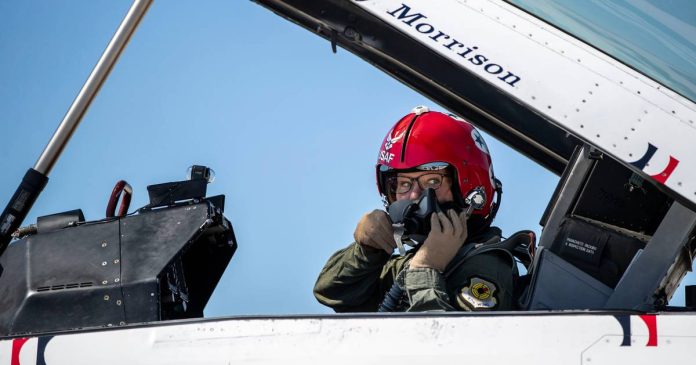
Morrison, a 30-year Poquoson High School teacher, was selected by Joint Base Langley-Eustis and the U.S. Air Force Thunderbirds as the 2023 “Hometown Hero.” She spent Friday flying in the back seat of an F-16 as the aerial performers practiced for this weekend’s Air Power Over Hampton Roads air show.

Morrison, an 11th grade history teacher, beat out roughly 50 other nominees. Her work to connect the community with veterans set her apart.

“I have always had a heart for the military, especially in our community of Poquoson. … I really want the veterans and the military to know how much we appreciate them,” Morrison said.

Morrison created the “Poquoson Veterans Project” at the start of the 2017-18 school year. The project paired Morrison’s Advanced Placement history students with a local veteran. The students interview the veterans, creating a history of the individual’s service, and the pair go on group field trips to war memorials.

Since its inception, the project has expanded to include AP students in other classes as well as more veterans across more eras of military service. To date, Morrison estimated the project has included hundreds of veteran participants. She will speak at a conference in Washington this summer in hopes other teachers will implement the project in their school districts.

“The goal is to connect students with the veterans and also to make sure veterans know we appreciate you, that we have not forgotten about you. And we appreciate the sacrifice that you’ve made for our country. And to pass that on to the new generation of students,” Morrison said.

In past years, Morrison also launched “Cookies Because We Care,” which donated an estimated 200,000 cookies this past Christmas to the Langley Officer Spouses Club for service members who can’t be home for the holidays.

“Even though I didn’t serve, it is so important to honor those who did,” Morrison said.

Before the flight, Major Jeffrey Downie spent an hour going over everything Morrison could experience.

“This is our chance to give back to you for all that you have done for veterans,” Downie said to Morrison.

With Downie at the controls, Morrison experienced 9.3G’s — which is the equivalent to around 2,000 pounds of pressure on the body — and traveled 764 mph, just shy of supersonic.

“This was one of the absolute best experiences of my life,” Morrison said.

Waiting on the ground when Morrison returned was a dozen family and friends, including the man who nominated her.

”Becky is a true hometown hero,” said retired Navy Capt. James Smith.

Smith served as active duty Navy for four years from 1966-70, deploying to Vietnam. The Poquoson resident also worked as a York County judge.

Smith said Morrison eventually persuaded him to participate in the Poquoson Veterans Project. It was through the project that Smith saw the Vietnam Wall in Washington and found the names of two fellow crew members killed in action.

Daywatch

Weekdays

Start your morning with today’s local news

”We found the two names — they are right next to each other because they were killed at the same time. She walked over put her hand on my shoulder. She knew it would be hard for me,” Smith said.

The Poquoson Veterans Project also helped Smith see a change in the community, “a total 180″ from the welcome home he got when returning from Vietnam.

”It was bad — bar fights and people spitting in your face. … When we came back from Vietnam, we just wanted to disappear,” Smith said.

Smith participated in a coin toss during a Poquoson High School football game.

”Coming off the field, to hear everyone clapping and cheering for us veterans …” Smith began, a smile stretched across his face. “Becky made that possible. She is just a jewel.”

The Langley air show is returning this weekend for the first time in four years. The U.S. Air Force Thunderbirds will headline the show. Langley’s F-22 Raptor and F-35 demonstration teams are also slated to perform.

Caitlyn Burchett, [email protected]

Major Jeff Downie takes a selfie with Becky Morrison in front of the F-16 Thunderbird he and Morrison will be flying in.

USS George Washington will move to Japan in 2024 – Daily Press

0

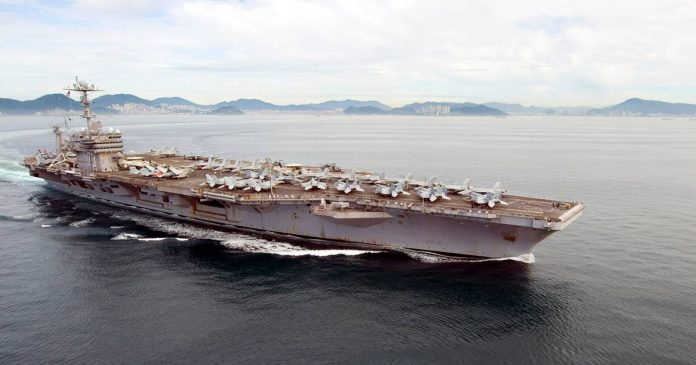
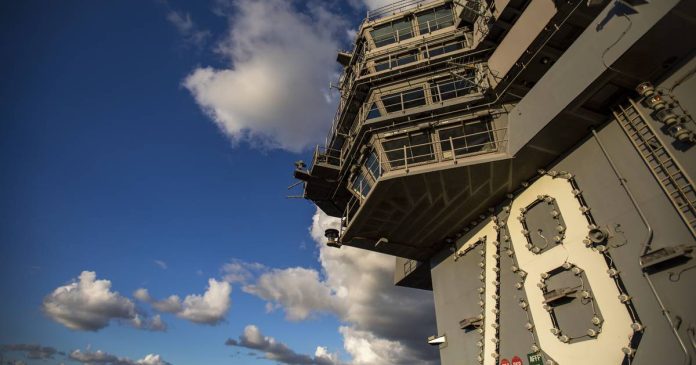
The carrier USS George Washington will shift homeports in 2024, replacing the USS Ronald Reagan in Yokosuka, Japan.

The shift was announced April 28 by Commander Naval Air Forces as the Washington nears the end of its mid-life refueling and complex overhaul at HII’s Newport News Shipbuilding division, where the carrier has been a fixture since 2017.

This will mark the second time the Washington has been homeported in Japan, having arrived in 2008 as the first nuclear aircraft carrier to be deployed to Japan before it was relieved by the Reagan in 2015.

“The United States values Japan’s contributions to the peace, security and stability of the Indo-Asia-Pacific and its long-term commitment and hospitality in hosting forward-deployed U.S. forces. These forces, along with their counterparts in the Japan Self-Defense Forces, make up the core capabilities needed by the alliance to meet our common strategic objectives,” the Naval Air Force command said in a press release.

According to HII’s 2022 fourth quarter report released in February 2023, the Washington’s mid-life overhaul was approximately 98% complete. The refueling and complex overhaul of an aircraft carrier is a multi-year project performed only once during a carrier’s 50-year service life that includes refueling the ship’s two nuclear reactors, as well as significant repairs, upgrades and modernization.

The overhaul was scheduled to be complete in 2021, but pandemic-related supply chain issues strained the program. From April 2022 to January 2023, four sailors assigned to the Washington died by apparent suicide. A Navy report issued in December concluded three of the deaths, all of which occurred in April 2022, were not connected.

A redelivery date for the Washington is expected later this year, according to Chris Kastner, HII’s president.

The USS Ronald Reagan, the flagship of Carrier Strike Group 5, is currently forward deployed to the U.S. Navy’s 7th Fleet area of operations. The warship is slated to relocate to Bremerton, Washington, to conduct a scheduled docking planned incremental availability period at Puget Sound Naval Shipyard & Intermediate Maintenance Facility.

Commander Naval Air Forces said more details will be announced closer to the movement of the carriers.

Caitlyn Burchett, [email protected]

#Reviewing Air Power in the Falklands Conflict

0

The line between celebrating heritage and creating a fully rounded history can be a fine one in many institutional histories. Appreciating this tendency, Royal Air Force-insider John Shields reassesses the 1982 Falklands Conflict, seeking to explode multiple myths while also providing a better assessment of the air campaign by focusing on the operational rather than the tactical level of war. Shields served thousands of hours navigating on the Tornado F3 and earned a Ph.D. from King’s College London. He also has a deep interest in professional military education; he currently teaches at the U.S. Air War College. These areas of expertise and passion shine through in this work, making it particularly valuable to any Western military planner or operator. In short, Shields wrote a case study about the Falklands War that can be read more broadly as enlightening air operators about air campaigns.

Shields contends that previous scholars have placed too much emphasis on the “tactical level outputs of the campaign” such as sorties flown rather than the actual effect of weapons, particularly regarding how weapon employment affected the “ability of each side to strike the decisive blow against their opponent.”[1] As such, he stresses identifying the British centers of gravity and how they changed during the conflict. U.S. Department of Defense doctrine defines a center of gravity as “the source of power that provides moral or physical strength, freedom of action, or will to act.”[2] Shields explains how initially the British aircraft carriers served as the center of gravity due to their ability to control the air through their Harriers. However, air control only functions as an enabler; thus, over time the center of gravity shifted, because the key to victory required taking and controlling Stanley, the capital city of the islands. As a result, the second and third centers of gravity were troops on the ground: first the amphibious assault force and finally the British land forces moving toward Stanley.

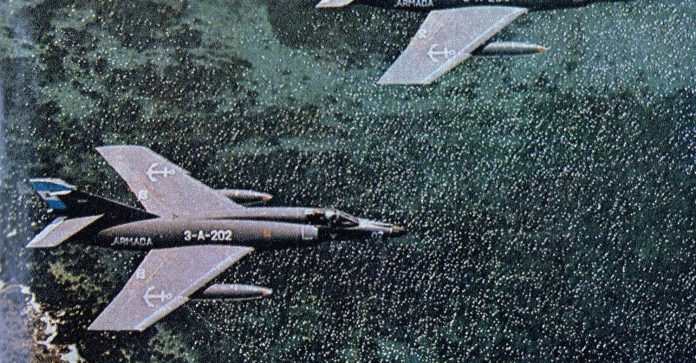
Shields shows little partiality for his own institution, seeking to provide an objective account. Indeed, he argues the conflict’s “outcome was a function of Argentine failings rather than British successes.”[3] Neither side, importantly, had adequately prepared for this conflict. He even suggests Argentina may have lost the war twenty years before the conflict began by doctrinally deciding to prioritize air support for the ground, thereby choosing to fund immediate needs over the pursuit of a more balanced long-term strategy to develop a force for an unknown future.[4] Of course the U.S. and multiple other nations have done the same, such as in the Global War on Terror, when Secretary of Defense Robert Gates cut F-22 production to focus on capabilities needed for counterinsurgency.

Despite inadequate preparation, both forces had an opportunity to adapt.[5] Shields notes, however, that interservice rivalry significantly undermined the air campaigns of both sides.[6] The Argentinian Air Force also made critical apportionment errors, increasingly using its aircraft for ground attack when it had yet to secure enough control of the air.[7]

As a result, Shields repeatedly shows how Argentinian aircraft struggled to employ their weapons effectively. In the first phase of the war, between May 1 and May 19, in which airpower predominated, for example, they planned to employ 206 weapons. Aircraft carrying 170 weapons managed to reach the Falkland islands, with aircraft carrying 107 weapons subsequently evading British combat air patrols. Aircraft, however, only managed to employ 15 weapons against the British fleet. With only one weapon detonating successfully, Argentina had a success rate of .005 percent. This low rate owes much to the challenge that the Argentine Air Force had in locating the British, having not adequately organized and developed its intelligence, surveillance, and reconnaissance capabilities prior to the conflict to support joint operations. Shields effectively supports this information with helpful and clear infographics.[8]

The second phase of the war was Operation Sutton, in which the British offered up a decisive target for the Argentines as its amphibious force approached and landed on the Falklands. Because Argentina lacked effective intelligence, surveillance, and reconnaissance capabilities, however, the British successfully approached the islands and began landing their troops and equipment 28 hours before Argentina detected the landing.[9] As a result, they “doomed themselves to a reactive strategy dictated by British decisions for the remainder of the campaign—all for the sake of a useful intelligence gathering capability.”[10]

They also failed to adapt mentally, not realizing that focusing on striking British carriers was not the most effective use of their weapons at this phase in the war, or so Shields asserts.[11] Whether he is correct is unknowable, however, given that human behavior is unpredictable; the sinking of a British carrier at any phase in the war could possibly have caused British civilian leadership to disengage from the conflict.

USS Gerald R. Ford leaving today on 1st warfighting deployment – Daily Press

0

The USS Gerald R. Ford and the strike group bearing its name will depart later today from Naval Station Norfolk on the carrier’s first warfighting deployment.

In early April, the Ford completed a month-long training exercise off the East Coast, making the Ford a certified combat-deployable warship. The Navy wasted no time deploying its newest and most technologically advanced aircraft carrier.

“The sailors of Gerald R. Ford are ready and able to perform because of the strenuous training they have put in to get this ship ready to deploy and also, in large part, because of the support of their families and friends,” said Capt. Rick Burgess, Ford’s commanding officer. “This ship and crew are actively reshaping the face of our Navy’s capabilities and strengthening the future of naval aviation.”

The 1,106-foot carrier’s new electromagnetic-powered aircraft launch system (EMALS) and the advanced arresting gear are two of the much-touted technologies unique to Ford-class carriers. EMALS uses stored kinetic energy and solid-state electrical power conversion to propel an aircraft along a track and off the carrier, while the arresting gear is a turbo-electric system designed for more controlled deceleration of aircraft. The technology, the Navy said, means the air-wing can get into the air — and return to the battle after rearming and refueling — faster than with the traditional steam-and-hydraulics systems that have been the mainstay for decades.

In total, the strike group will deploy with more than 6,000 sailors across all platforms.

The strike group includes Carrier Strike Group (CSG) 12 staff, Gerald R. Ford, Carrier Air Wing (CVW) 8, Destroyer Squadron (DESRON) 2 staff and units, Ticonderoga-class guided-missile cruiser USS Normandy (CG 60) and an information warfare commander.

The ships of DESRON 2 are the Arleigh Burke-class guided-missile destroyers USS Ramage, USS McFaul and USS Thomas Hudner, which are scheduled to depart their homeports of Naval Station Norfolk and Naval Station Mayport respectively, Tuesday.

The squadrons of CVW-8 embarked aboard Gerald R. Ford are the “Tridents” of Helicopter Sea Combat Squadron (HSC) 9, the “Bear Aces” of Airborne Command and Control Squadron (VAW) 124, the “Rawhides” of Fleet Logistics Support Squadron (VRC) 40 located in Norfolk.

The “Ragin’ Bulls” of Strike Fighter Squadron (VFA) 37, the “Blacklions” a of Strike Fighter Squadron (VFA) 213, the “Golden Warriors” of Strike Fighter Squadron (VFA) 87, the “Tomcatters” of Strike Fighter Squadron (VFA) 31, all of Virginia Beach, will deploy with the airwing, as well as the “Gray Wolves” of Electronic Attack Squadron (VAQ) 142 located in Whidbey Island, Wash., and the “Spartans” of Helicopter Maritime Strike Squadron (HSM) 70 located in Mayport, Fla.

Caitlyn Burchett, [email protected]

#Reviewing Rise of the Rocket Girls

0

Holt organized the book’s twelve chapters by decade, starting with the 1940s and coming up to  the present. While describing the work the women mathematicians were doing for the different missions JPL conducted, Holt also explores how changing technology shaped the computers’ work. In particular, when JPL introduced manual calculators and bulky IBM computers, the women had to learn new skills. By the time NASA started work on the Apollo Moon program, the women were keeping pace by taking classes at nearby Caltech to learn the newest programming languages, like FORTRAN. Holt notes that as the space program grew more sophisticated, so did the skills of the women whose stories she tells. Although they were hired as computers, the arrival of electronic computing technology did not diminish their value to JPL. In fact, women computers became the programmers for these new machines (as seen in Hidden Figures when Dorothy Vaughn programmed the Langley computers). These women were essential in making sure the male engineers’ designs were successful. Holt points out that by the 1960s, the women’s titles changed as well—from computers to engineers.

Holt is breaking relatively new ground in The Rise of the Rocket Girls. While the history of women scientists (including those in mathematics) is not new, it seems that part of the reason the computers at JPL are still less well-known lies in the nature of the laboratory’s work. Historically, JPL’s mission has largely focused on the development and launch of probes and satellites, such as the Ranger and Pioneer programs that sent robotic vehicles to the Moon so NASA could scout possible safe landing sites for the Apollo crews. While their work was essential to the success of the human spaceflight program, it was neither sexy nor patriotic in the same way that putting astronauts into space was for the American public. JPL’s mission and its computers have historically been more focused on exploration of the Solar System than on human spaceflight. Consequently, their stories have remained largely unknown even though they have one of the longest histories, going back to the 1930s. Holt’s book makes an important contribution to changing that narrative.

One of the valuable contributions that Holt’s book makes is that the narrative was built upon oral histories with many of the women highlighted in the book. While still grounded in archival research, Holt’s book includes the personal stories and experiences of these women that cannot be found in an archive. Holt’s book creates tension when launches or missions went awry; readers will feel the joy and excitement when the women witnessed the culmination of their work end in a successful mission. But readers will also see the ups and downs of working women in this era: weddings, births, the death of a newborn, and divorces. Holt constantly reminds the readers that these women, while talented and highly skilled in their jobs, were living regular lives when they left the office.

If the book has a weakness, it is that the science behind the missions these women helped make possible is often only given a cursory explanation, is not always clear, and, occasionally, is inaccurate. For example, the Galileo mission, which sent a spacecraft into orbit around Jupiter, had to be reworked after the space shuttle Challenger disaster because the original trajectory calculations were for a launch date that fell to the wayside as NASA recovered from the accident. In discussing the changes, Holt said, “The original upper-stage rocket selected to carry Galileo and the space shuttle crew into space was now deemed too dangerous.”[3] But that is not how the system worked. The Galileo spacecraft was launched from Kennedy Space Center in the cargo bay of the space shuttle Atlantis. Once in orbit, the shuttle crew deployed the Galileo spacecraft. It was only then that the upper-stage rocket sent Galileo on its way toward Jupiter; the space shuttle crew was not directly affected nor transported by Galileo’s upper-stage rocket. Admittedly, these are minor issues and do not affect the significance of the story Holt is telling. The limited scientific discussion does mean that the book as a whole is accessible to a large audience since a deeper familiarity of scientific and aerospace terminology and understanding is not necessary.

In short, Nathalia Holt’s book on the women of JPL and their contributions to the United States’ history in space is a welcome addition. JPL is only one of twenty NASA centers. The women and their contributions at each NASA center deserve attention and recognition. What Nathalia Holt has done with this book is remind readers that women’s work for NASA did propel us to the Moon and Mars.

Sen. Kaine introduces national version of state anti-housing discrimination law for veterans, low-income families – Daily Press

0

Sen. Tim Kaine reintroduced a 2018 bill meant to stop housing discrimination against veterans and low income families by amending the Fair Housing Act of 1968.

The bill would make it illegal to not allow an individual to rent a property based on source of income or veteran status. In 2020, a similar bill — which barred discrimination against a potential renter based on source of income, with several caveats such as for landlords with less than four rental dwellings — passed the General Assembly with bipartisan support, was signed into law and took effect on July 1 of that year.

Kaine said the original 2018 federal bill he co-sponsored with Utah Republican Sen. Orrin Hatch was the result of what he had seen as a housing lawyer in Richmond: landlords not accepting housing vouchers or homeless veterans.

“Which means here’s somebody who qualifies for housing and they have good income that they can use through the voucher to pay for rent, but big chunks of the rental market are closed off to them,” Kaine said.

Over a dozen Senate Democrats have signed on to the bill and a Democrat in the House of Representatives has introduced companion legislation in that chamber, according to a joint press release from Kaine’s office.

Daywatch

Weekdays

Start your morning with today’s local news

States such as Utah and North Dakota have measures banning discrimination based on source of income or public assistance, according to Kaine and respective state websites.

The 2018 bill would “put an end to the immoral housing discrimination against veterans and others who rely on veterans’ benefits, social security disability, or other non-wage legal income.” Hatch said in a 2018 press release. “This bill will address the fact that source of income is not a protected class under the Federal Fair Housing Act, thereby helping to remove an unnecessary barrier facing Utah families and veterans on the path to self-reliance.”

Kaine said there is appetite for a federal housing bill on the Senate Banking, Housing, and Urban Affairs Committee, where fellow Virginia Democrat Mark Warner sits. “I think the time is such that the committee wants to do a housing bill this year and I want to get my bill added as part of it,” Kaine said.

Kaine said in his over two decades in Virginia politics, the issue of housing has risen from a top 10 issue across the state to a top three issue everywhere in the commonwealth he visits. Additionally, he hopes discussion around the bill will help to continue to spread the word that it is now illegal to decline an individual, with some exceptions, based on source of income. Kaine said his office is still hearing anecdotally that the 2020 law is not being followed.

“It’s still not widely known out there,” Kaine said. “When a law changes, it takes a while for people to realize that and so there are still people who get told ‘Hey, we’re not going to take a voucher’ (and) they don’t know it’s illegal.”

In 2021, there was almost 9% more fair housing complaints, over 31,000 total, filed than the previous year, according to the 2022 report by the National Fair Housing Alliance.

Ian Munro, 757-447-4097, [email protected]