Home Blog Page 5

Paradox and Prose: Lessons in Nuclear Strategy

0

This is not an easy conclusion to stomach, nor should it be. In fact, as the following section seeks to demonstrate, one of the most dangerous things a nuclear strategist can do is to desensitize themselves to their discipline’s contradictions. Like pebbles in a shoe, the paradoxes of nuclear strategy should make themselves felt in every step the strategist takes. Not only is this deeply unsatisfying, it can also be personally painful at times. Small wonder, perhaps, that the essay in which Fitzgerald extolled the virtue of self-contradiction was titled “The Crack-Up.”

George Orwell on the Danger of Internalizing Contradiction

George Orwell wrote of the ability “to hold simultaneously two opinions which cancelled out, knowing them to be contradictory and believing in both of them.” Fitzgerald would likely call this the mark of a first-rate intelligence.[5] But this quote from Orwell’s novel 1984 refers to something far more sinister: doublethink. In Orwell’s dystopian vision of England-turned-surveillance-state, doublethink represents the internalization and weaponization of paradox. As explained in the novel, doublethink means:

To know and not to know, to be conscious of complete truthfulness while telling carefully constructed lies…to use logic against logic, to repudiate morality while laying claim to it, to believe that democracy was impossible and that the Party was the guardian of democracy, to forget whatever it was necessary to forget, then to draw it back into memory again at the moment when it was needed, and then promptly to forget it again: and above all, to apply the same process to the process itself—that was the ultimate subtlety: consciously to induce unconsciousness, and then, once again, to become unconscious of the act of hypnosis you had just performed. Even to understand the word “doublethink” involved the use of doublethink.[6]

Some of these features of doublethink—“to use logic against logic, to repudiate morality while laying claim to it”—can be leveled as critiques of nuclear strategy, whose practitioners contemplate the mass murder of millions and do so in the name of peace. Consider the fact that Strategic Air Command (SAC), which operates U.S. nuclear bombers and ICBMs, has for its motto, “Peace is Our Profession.” Though Strategic Air Command arrived at a variant of this motto three years before 1984 was published, it is hard not to see it as an homage to Orwell’s fictional state, in which “[t]he Ministry of Peace concerns itself with war, the Ministry of Truth with lies, the Ministry of Love with torture and the Ministry of Plenty with starvation.”[7] One could also point to the most sophisticated Cold War-era U.S. ICBM, the MX missile, which was capable of carrying up to 12 independently targeted, 300-kiloton thermonuclear warheads—enough to replicate the destruction of Hiroshima more than 276 times over.[8] The MX’s more popular name? The Peacekeeper. As Orwell might argue, “These contradictions are not accidental, nor do they result from ordinary hypocrisy; they are deliberate exercises in doublethink.”[9]

One may be tempted to dismiss the significance of this so-called doublethink; slogans and nicknames are, after all, only words. But this is to miss the core of Orwell’s argument that the language we use shapes the way we think. The implications this has for nuclear strategy were captured in vivid detail by Carol Cohn in her landmark article “Sex and Death in the Rational World of Defense Intellectuals.” In it, Cohn describes her immersion in the world and the language of nuclear planners, and how it began to change the very way she thought:

Like the White Queen [of Lewis Carroll’s Through the Looking Glass], I began to believe six impossible things before breakfast. Not because I consciously believed, for instance, that a “surgically clean counterforce strike” was really possible, but instead because some elaborate piece of doctrinal reasoning I used was already predicated on the possibility of those strikes, as well as on a host of other impossible things.[10]
White man will stand trial for shooting Black teen Ralph Yarl, who went to wrong house, judge rules – Daily Press

0

By HEATHER HOLLINGSWORTH (Associated Press)

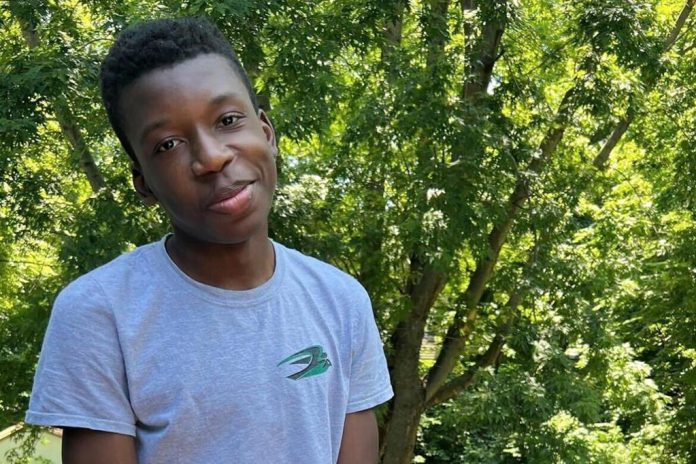
KANSAS CITY, Mo. (AP) — A Missouri judge ruled Thursday that the 84-year-old white homeowner who shot a Black teenager after he mistakenly went to the man’s house must stand trial.

Clay County Judge Louis Angles issued the ruling after a dozen witnesses spoke at a preliminary hearing, including Ralph Yarl, the teenager who was shot by Andrew Lester on April 13 when Yarl went to the wrong house to pick up his younger brothers.

Lester, a retired aircraft mechanic, is charged with first-degree assault and armed criminal action. He previously pleaded not guilty in the shooting that shocked the country and renewed national debates about gun policies and race in America. His next court date is an arraignment, scheduled for Sept. 20.

Yarl spoke softly as he testified that he was sent to pick up his twin siblings but had no phone — he’d lost it at school. The house he intended to go to was just blocks from his own home, but he had the street wrong.

Yarl said he rang the bell and the wait for someone to answer for what seemed “longer than normal.”

As the inner door opened, Yarl said he reached out to grab the storm door.

“I assume these are my brothers’ friends’ parents,” he said.

Instead, it was Lester, who told him, “Don’t come here ever again,” Yarl recalled. He said he was shot in the head, the impact knocking him to the ground, and was then shot in the arm.

Lester’s attorney, Steve Salmon, said in closing arguments that Lester was acting in self-defense, terrified by the stranger who knocked on his door as he settled into bed for the night.

“With his age and physical infirmity, he is unable to defend himself,” Salmon said, describing Lester as distraught after the shooting.

“A terrible event occurred, but it is not criminal,” Salmon said.

To make the self-defense case, Salmon focused heavily on the teen grabbing for the storm door, questioning the fact that Yarl initially said he hadn’t. Yarl responded that the first interview with law enforcement happened on the same day he underwent neurological surgery.

The shot to his head left a bullet embedded in his skull, testified Dr. Jo Ling Goh, a pediatric neurosurgeon who treated Yarl. It did not penetrate his brain, however.

District Attorney Zachary Thompson said although Missouri law offers protections for people defending themselves, “You do not have the right to shoot an unarmed kid through a door.”

Kansas City Officer Larry Dunaway described Lester as “an elderly guy who was scared” after the shooting. Another officer, James Gale, said Lester was clearly worried.

“He said he hoped he didn’t kill anybody,” Gale testified.

He said surveillance cameras would have allowed Lester to see Yarl pull up to his house. Crime scene workers testified surveillance cameras broadcast views from the front door and driveway onto monitors in Lester’s bedroom, although the footage wasn’t recorded.

Salmon told reporters after the hearing that he doesn’t think Lester watched the monitors, although he said he never asked him.

A handful of people wearing shirts that said “Justice for Ralph” were in the courtroom. Others wore shirts that read: “Ringing a doorbell is not a crime.”

Yarl continues to heal from the traumatic brain injury he suffered but was able to complete an engineering internship this summer and just started his senior year in high school. The 17-year-old is planning to major in engineering when he graduates, with several college visits planned for the fall.

Lester told authorities he shot Yarl through the door without warning because he was “scared to death” he was about to be robbed.

Initially turned away while seeking help at neighboring homes, Yarl stumbled to the street. Neighbor Carol Conrad testified that she was offering words of comfort through her window — a dispatcher had warned neighbors should stay inside. At one point, he yelled, “I’ve been shot.”

When Yarl crumpled to the ground, three neighbors rushed to help. Jodi Dovel testified there was a trail of blood, which pooled under his head. But Yarl was able to talk, telling her he went to ring the doorbell and was shot.

“I thought. ‘Oh no, he went to the wrong house,’” Dovel said.

Lester also called 911. On the recording played in court, he could be heard telling a dispatcher, “I shot him. He was at my door trying to get in and I shot him.”

Missouri is one of about 30 states with “stand your ground” laws that allow people to respond with physical force when they are threatened.

Salmon has said Lester’s home was egged and spray-painted after the shooting. He said Lester has sought law enforcement assistance when traveling, and his wife had to be moved from her nursing home.

Yarl’s father, Paul Yarl, said during a break that he was moved hearing the neighbors testify. Some of the details were new to him. He said his son has mainly recovered physically but still struggles psychologically. He relives the night and has bad dreams.

“It was horrible. Blood. Shooting. Nobody wanted to come until police arrived,” he said.

He said he was not frustrated with the bystanders.

“I’m more frustrated with the shooter,” Paul Yarl said. “He started it. He didn’t want to talk to the boy. He just shot the boy. And now he tries to play the fear card and he’s afraid. He should be afraid, he is going to kill somebody. Come on, now.”

Race was discussed little at the hearing, other than one neighbor saying Yarl didn’t have a history of making racist remarks. Thompson, the prosecutor, said simply that he is focused on proving what is required by the law and that doesn’t involve a racial component.

But Faith Spoonmore, Yarl’s aunt, looked into the afternoon sun when asked if race was an element of the shooting. “Is it sunny outside?” she asked.

Support for Yarl and his family poured in over the past few months. A GoFundMe set up on the family’s behalf raised nearly $3.5 million.

___

AP journalists Nick Ingram in Kansas City, Missouri, and Jim Salter in O’Fallon, Missouri, contributed to this report.

Two ex-Proud Boys leaders get some of longest sentences in Jan. 6 Capitol attack – Daily Press

0

By MICHAEL KUNZELMAN and LINDSAY WHITEHURST (Associated Press)

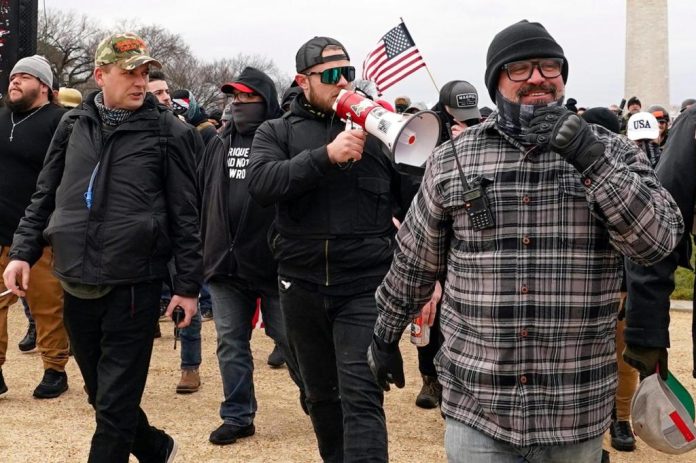
WASHINGTON (AP) — Two former leaders of the far-right Proud Boys extremist group were sentenced to more than a decade each in prison Thursday for spearheading an attack on the U.S. Capitol to try to prevent the peaceful transfer of power from Donald Trump to Joe Biden after the 2020 presidential election.

The 17-year prison term for organizer Joseph Biggs and 15-year sentence for leader Zachary Rehl were the second and third longest sentences handed down yet in the Jan. 6, 2021, attack.

They were the first Proud Boys to be sentenced by U.S. District Judge Timothy Kelly, who will separately preside over similar hearings of three others who were convicted by a jury in May after a four-month trial in Washington that laid bare far-right extremists’ embrace of lies by Trump, a Republican, that the 2020 election was stolen from him.

Enrique Tarrio, a Miami resident who was the Proud Boys’ national chairman and top leader, is scheduled to be sentenced Tuesday. His sentencing was moved from Wednesday to next week because U.S. District Kelly was sick.

Tarrio wasn’t in Washington on Jan. 6. He had been arrested two days before the Capitol riot on charges that he defaced a Black Lives Matter banner during an earlier rally in the nation’s capital, and he complied with a judge’s order to leave the city after his arrest. He picked Biggs and Proud Boys chapter president Ethan Nordean to be the group’s leaders on the ground in his absence, prosecutors said.

Rehl, Biggs, Tarrio and Nordean were convicted of charges including seditious conspiracy, a rarely brought Civil War-era offense. A fifth Proud Boys member, Dominic Pezzola, was acquitted of seditious conspiracy but convicted of other serious charges.

Federal prosecutors had recommended a 33-year prison sentence for Biggs, who helped lead dozens of Proud Boys members and associates in marching to the U.S. Capitol on Jan. 6. Biggs and other Proud Boys joined the mob that broke through police lines and forced lawmakers to flee, disrupting the joint session of Congress for certifying the electoral victory by Biden, a Democrat.

Kelly said the Jan. 6 attack trampled on an “important American custom,” certifying the Electoral College vote.

“That day broke our tradition of peacefully transferring power, which is among the most precious things that we had as Americans,” the judge said, emphasizing that he was using the past tense in light of how Jan. 6 affected the process.

Defense attorneys argued that the Justice Department was unfairly holding their clients responsible for the violent actions of others in the crowd of Trump supporters at the Capitol.

Biggs, of Ormond Beach, Florida, acknowledged that he “messed up” on Jan. 6, but he blamed being “seduced by the crowd” of Trump supporters outside the Capitol and said he’s not a violent person or “a terrorist.”

“My curiosity got the better of me, and I’ll have to live with that for the rest of my life,” he said, claiming he didn’t have “hate in my heart” and didn’t want to hurt people.

During the trial, jurors saw a trove of messages that Proud Boys leaders privately exchanged in the weeks leading up to the Capitol riot, including Biggs encouraging Tarrio to “get radical and get real men” after Trump announced plans for a rally on Jan. 6.

That day, dozens of Proud Boys leaders, members and associates were among the first rioters to breach the Capitol. Before the first breach, Biggs used a megaphone to lead rioters in chants of “Whose Capitol? Our Capitol!”

Biggs “acted as the tip of the spear” during the attack, prosecutors said in a court filing. He tore down a fence and charged up scaffolding before entering the Capitol. He left the Capitol but reentered the building and went to the Senate chamber.

“There is a reason why we will hold our collective breath as we approach future elections,” prosecutor Jason McCullough said. “We never gave it a second thought before January 6th.”

For Rehl, who also helped lead Proud Boys, prosecutors asked for a 30-year prison sentence. He was seen on video spraying a chemical irritant at law enforcement officers outside the Capitol on Jan. 6, but he repeatedly lied about that assault while he testified at his trial, said prosecutor Erik Kenerson. “He tried to craft a narrative to fit the evidence and he was caught,” Kenerson said.

Rehl also led at least three other men into the Capitol and into a senator’s office, where he smoked and posed for pictures while flashing the Proud Boys’ hand gesture, prosecutors said in court documents.

“Rehl led an army to attempt to stop the certification proceeding, was proud that they got as close as they did, and his only regret in the immediate aftermath was that they did not go further,” they wrote in a court filing.

Kelly read from some of the “chilling” messages Rehl sent after Jan. 6, including one, the judge said, that read, “Everyone should have showed up armed and taken the country back the right way.” The judge shook his head and said, “I mean, my God.”

Rehl sobbed as he told the judge he deeply regretted being at the Capitol that day. “I’m done with all of it, done peddling lies for other people who don’t care about me,” Rehl said. “Politicians started spreading lies about the election, and I fell for it hook, line and sinker.”

Defense attorney Norman Pattis, who represents Biggs and Rehl, said they are “misguided patriots,” not terrorists, and said long sentences would fuel division.

Rehl and others who rioted at the Capitol that day were following Trump’s urging, and genuinely believed that something was fundamentally wrong with the election when they took to the streets, he said. “What they’re guilty of is believing the president who said the election was stolen from him,” Pattis said.

Kelly acknowledged that was a factor, but a “very modest one.”

Prosecutors have also recommended prison sentences of 33 years for Tarrio, 27 years for Nordean and 20 years for Pezzola. Nordean and Pezzola are scheduled to be sentenced Friday.

More than 1,100 people have been charged with Capitol riot-related federal crimes. Over 600 of them have been convicted and sentenced.

The 18-year prison sentence for Oath Keepers founder Stewart Rhodes is the harshest punishment for a Jan. 6 so far. Six members of the anti-government Oath Keepers also were convicted of seditious conspiracy after a separate trial last year.

Shooting near Virginia Beach high school football game shows how gun violence infects our communities – Daily Press

0

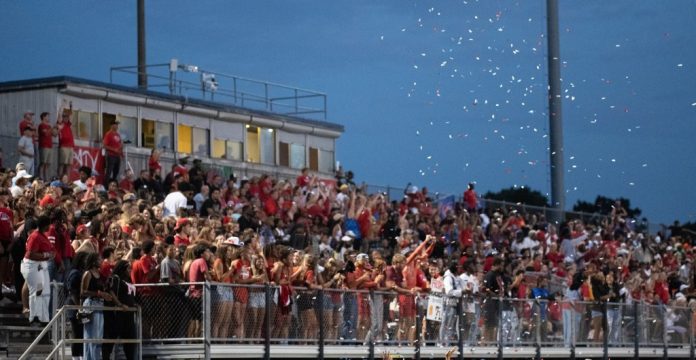
Green Run High School in Virginia Beach was leading its football game against Kempsville High School last week when gunfire in a nearby neighborhood sent players, coaches and fans scurrying for cover. The game was suspended, then prematurely concluded, in the interest of safety.

The story is as terrifying and infuriating as it is commonplace in this country, a nation awash with guns. It is the predictable manifestation of our stubborn refusal to limit access to firearms or to treat gun violence as the public health crisis it so evidently is.

It would be reassuring to think that Thursday night’s events at Kempsville high were an outlier, a rare instance in which violence from the community spills over into a school setting. It differs from the sort of planned attack witnessed in countless schools across the nation in the last 25 years.

The shooting didn’t take place on school grounds, but rather in the neighborhood adjacent to the campus. Authorities said three people — ages 16, 19 and 19 — were wounded on John Smith Court though they did not believe it was connected to the football game.

That’s little comfort for all in attendance — for the players who spent the weeks preceding the game practicing in grueling conditions, the coaches who work so hard to prepare their young men to achieve, and for the families and spectators whose night at the stadium descended into fear and terror.

“It’s very heartbreaking because kids on both teams worked so hard to get to this point,” Green Run coach Brandon Williams told sports columnist Larry Rubama. “And to have someone take it away from them that wasn’t involved in the game, you know, that’s a hard thing to take.”

It’s also heartbreaking how gun violence affects the whole community. Many of those in attendance on Thursday night will be traumatized by the experience, even though students knew what to do given their lifetime of active shooter drills and shelter-in-place experience.

And that’s to say nothing of those involved in the shooting itself — those harmed and those responsible, along with their families and friends. Lives will be inexorably changed, and some ruined, by what happened that evening.

Even more tragic is the fact that Virginia Beach wasn’t the only community where violence, or its threat, transpired during the first weekend of high school football.

In Choctaw, Oklahoma, on Friday night, a 16-year-old boy was killed and four others were injured during a shooting at a high school football game. KOCO News in Oklahoma City reported that three people were shot on the visitor’s side of the stadium; two other students were injured trying to flee.

In Stafford County, also on Friday night, social media posts threatening violence prompted the cancellation of Stafford High School’s football game against James Monroe High School. Stafford was forced to forfeit and the contest is not expected to be rescheduled.

Then on Monday, only a week into a new semester, a graduate student at the University of North Carolina at Chapel Hill shot and killed an associate professor in the applied physical sciences department, sending the campus into lockdown. Panicked students traded fearful text messages and even jumped from second-floor windows to escape.

Have we grown so numb to gun violence that episodes such as this prompt no community reflection, no collective outrage and no resolve to take action? Surely our children deserve better than to have their high school years marred by gunshots and lockdown drills.

We sentence them to that fate when we fail to adopt strong laws that keep firearms away from the dangerous and policies that treat gun violence as a public health issue. This will continue, and worsen, for as long as we allow it.

We can choose a future in which the play on a high school football field and the joy in the stands, rather than the terror of gunshots, are what people take home with them at night. This can be the moment, if we seize it.

Judge rules white man will stand trial for shooting Black teen Ralph Yarl, who went to wrong house – Daily Press

0

By HEATHER HOLLINGSWORTH (Associated Press)

KANSAS CITY, Mo. (AP) — A Missouri judge ruled Thursday that the 84-year-old white homeowner who shot a Black teenager after he mistakenly went to the man’s house must stand trial.

Clay County Judge Louis Angles issued the ruling after hearing from several witnesses at a preliminary hearing, including Ralph Yarl, the teenager who was shot by Andrew Lester on April 13 when Yarl went to the wrong house to pick up his younger brothers.

Lester, a retired aircraft mechanic, is charged with first-degree assault and armed criminal action. He previously pleaded not guilty in the shooting that shocked the country and renewed national debates about gun policies and race in America. His next court date is an arraignment, scheduled for Sept. 20.

Yarl spoke softly as he testified that he was sent to pick up his twin siblings but had no phone — he’d lost it at school. The house he intended to go to was just blocks from his own home, but he had the street wrong.

Yarl said he rang the bell and the wait for someone to answer seemed “longer than normal,” he said.

As the inner door opened, Yarl said he reached out to grab the storm door.

“I assume these are my brothers’ friends’ parents,” he said.

Instead, it was Lester who told Yarl, “Don’t come here ever again,” Yarl recalled. He said he was shot in the head, the impact knocking him to the ground and was then shot in the arm.

Lester’s attorney, Steve Salmon, said in closing arguments that Lester was acting in self-defense, terrified by the stranger who knocked on his door as he settled into bed for the night.

“With his age and physical infirmity, he is unable to defend himself,” Salmon said, describing Lester as distraught after the shooting.

“A terrible event occurred, but it is not criminal,” Salmon said.

District Attorney Zachary Thompson said that although Missouri law offers protections for people defending themselves, “You do not have the right to shoot an unarmed kid through a door.”

Kansas City Officer Larry Dunaway described Lester as “an elderly guy who was scared” after the shooting. Another officer, James Gale, said Lester was clearly worried.

“He said he hoped he didn’t kill anybody,” Gale testified.

A handful of people wearing shirts that said “Justice for Ralph” were in the courtroom. Others wore shirts that read: “Ringing a doorbell is not a crime.”

Yarl continues to heal from the traumatic brain injury he suffered but was able to complete an engineering internship this summer and just started his senior year in high school. The 17-year-old is planning to major in engineering when he graduates, with several college visits planned for the fall.

Yarl was supposed to pick up his younger brothers but went to the wrong block and mistakenly ended up at Lester’s house. Lester told authorities that he shot Yarl through the door without warning because he was “scared to death” he was about to be robbed.

Initially turned away while seeking help at neighboring homes, Yarl stumbled to the street. Neighbor Carol Conrad testified that she was offering words of comfort through her window — a dispatcher had warned that neighbors should stay inside. At one point, he yelled, “I’ve been shot.”

When Yarl crumpled to the ground, three neighbors rushed to help. Jodi Dovel testified that there was a trail of blood, which pooled under his head. But Yarl was able to talk, telling her he went to ring the doorbell and was shot.

“I thought. ‘Oh no, he went to the wrong house,’” Dovel said.

Lester also called 911. On the recording played in court he could be heard telling a dispatcher, “I shot him. He was at my door trying to get in and I shot him.”

Missouri is one of about 30 states with “stand your ground” laws that allow people to respond with physical force when they are threatened.

Salmon has said that Lester’s home was egged and spray-painted after the shooting. He said Lester has sought law enforcement assistance when traveling, and his wife had to be moved from her nursing home.

Yarl’s father, Paul Yarl, said after the hearing that he was moved hearing the neighbors testify. Some of the details were new to him. He said his son has mainly recovered physically but still struggles psychologically. He relives the night and has bad dreams.

“It was horrible. Blood. Shooting. Nobody wanted to come until police arrived,” he said.

He said he was not frustrated with the bystanders.

“I’m more frustrated with the shooter,” Paul Yarl said. “He started it. He didn’t want to talk to the boy. He just shot the boy. And now he tries to play the fear card and he’s afraid. He should be afraid he is going to kill somebody. Come on, now.”

Support for Yarl and his family poured in over the past few months. A GoFundMe set up on the family’s behalf raised nearly $3.5 million.

___

AP journalists Nick Ingram in Kansas City, Missouri, and Jim Salter in O’Fallon, Missouri, contributed to this report.

Portsmouth man found guilty of trying to hire hitman to kill witnesses set to testify against him – Daily Press

0

PORTSMOUTH — A Portsmouth man was found guilty Wednesday of trying to hire a hitman to kill two witnesses set to testify against him in another case.

Nicholas Louis Ortiz, 42, was found guilty of two counts each of soliciting murder for hire and obstructing justice, according to a release from the Portsmouth Commonwealth’s Attorney’s Office. Ortiz will be sentenced Nov. 20 and faces the possibility of decades in prison.

Ortiz was being held in the Portsmouth City Jail on abduction and robbery charges in October when he spoke by jail phone with someone he thought was a hitman but was actually an undercover police detective, according to the release. Ortiz told the detective he wanted to have two people scheduled to testify against him killed, the release said.

Ortiz gave the detective “intimate details about the potential victims to help orchestrate their murders,” the release said.

Solicitation of murder is a felony punishable by up to 40 years in prison in Virginia, while felony obstruction of justice carries a maximum penalty of 10 years.

Jane Harper, [email protected]

Police stop Nebraska man for bucking the law with a bull riding shotgun in his car – Daily Press

0

By JOSH FUNK (Associated Press)

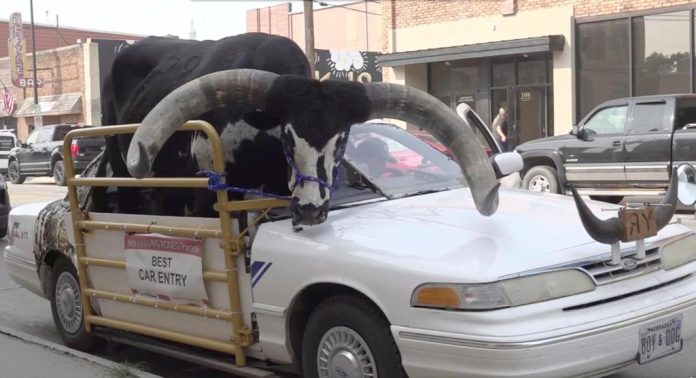
A 911 call about a car driving with a cow inside it in one of northeast Nebraska’s biggest cities was no bull.

Norfolk Police Capt. Chad Reiman said it didn’t take long for officers to track down the modified Ford Crown Victoria sedan with a bull riding shotgun on the main highway entering the city of roughly 24,000 Wednesday morning.

“We didn’t have a full understanding of it until we saw it,” Reiman said.

The car that Lee Meyer has driven in parades across the area for years has half the windshield and roof removed to make room for his bull, named Howdy Doody, to ride along. A yellow metal cattle gate serves as the passenger side door — allowing for the Watusi bull to be tied up — and a set of longhorns serves as a hood ornament.

“It wouldn’t go far without being noticed for sure,” Reiman said.

A video of the traffic stop shot by News Channel Nebraska spread quickly online.

A sign on the side of Meyer’s car from a parade in Burwell late last month declared that Howdy Doody’s eye-catching ride was judged the Best Car Entry in Nebraska’s Big Rodeo Parade.

Reiman said Meyer told him that when he went to that parade, he drove Howdy Doody in a proper trailer, so it wasn’t clear why he decided to load the bull into his car Wednesday and drive the 36 miles from his home in Neligh to Norfolk.

Reiman said Meyer wasn’t headed to a parade Wednesday. Meyer didn’t answer his home phone Thursday morning so he couldn’t be reached immediately for an explanation.

But his wife, Rhonda, told the Norfolk radio station that shot video of the traffic stop that Howdy Doody has been Meyer’s “friend and buddy” ever since he got him eight or nine years ago.

Videos of Lee Meyer driving Howdy Doody around can readily be found online from 2017 and 2019.

Rhonda Meyer told US92 that “Lee thinks he’s a movie star” after the video of his traffic stop went viral, but that he’s also a little shy.

Meyer said Howdy Doody is like a member of the family now, but she wasn’t always wild about how much her husband spent on the bull over the years.

“The amount of money that he’s spent on this whole darn project between the car and the bull I could’ve had a brand new kitchen,” Rhonda Meyer said.

Reiman said there were clearly some traffic violations related to Meyer’s car, but the officer let him off with a warning as long as he turned around and took Howdy Doody home.

“We’ve never dealt with anything quite like that before.” Reiman said.

Trump pleads not guilty in Georgia election subversion case and seeks to sever his case from others – Daily Press

0

By KATE BRUMBACK (Associated Press)

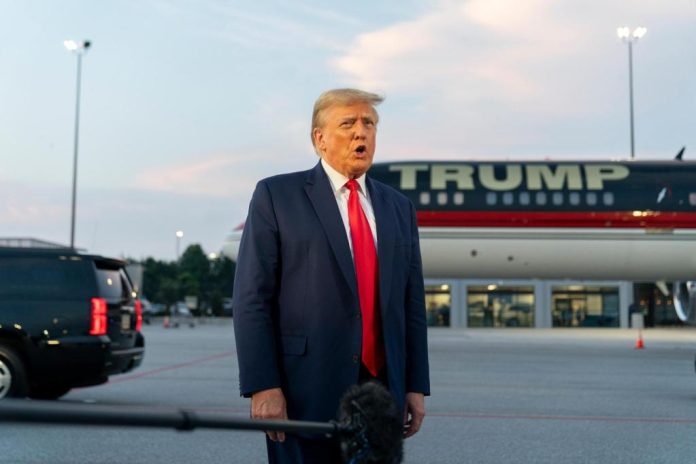
ATLANTA (AP) — Former President Donald Trump pleaded not guilty on Thursday and sought to sever his case from other defendants who are accused along with him of illegally trying to overturn the results of the 2020 election in Georgia.

Fulton County Superior Court Judge Scott McAfee had set arraignment hearings for Trump and the 18 others charged in the case for Sept. 6. A court filing waiving arraignment means Trump won’t have to show up for that.

The decision to skip an in-person appearance averts the dramatic arraignments that have accompanied the three other criminal cases Trump faces, in which the Republican former president has been forced amid tight security into a courtroom and entered “not guilty” pleas before crowds of spectators. Georgia courts have fairly permissive rules on news cameras in the courtroom, and this step means Trump won’t have to enter a plea on television.

An attorney for Trump also asked McAfee on Thursday to separate his case from those of defendants who have asked for an expedited trial that is scheduled to start on Oct. 23. Giving the former president less than two months to prepare a defense against a 98-page indictment would “violate President Trump’s federal and state constitutional rights to a fair trial and due process of law,” attorney Steve Sadow said in a court filing.

Fulton County District Attorney Fani Willis has said she wants all of the defendants tried together, and she has asked the judge to set an Oct. 23 trial date for everyone.

The motion adds to the pre-trial legal jousting that has dominated the two weeks since the indictment was brought, underscoring the complexities inherent in attempting to bring 19 defendants to trial at once and foreshadowing the delays ahead as judges sift through competing arguments from the defendants.

Trump and 18 others were charged earlier this month in a 41-count indictment that outlines an alleged scheme to subvert the will of Georgia voters who had chosen Democrat Joe Biden over the Republican incumbent in the presidential election.

Several other people charged in the indictment had already waived arraignment in filings with the court, saving them a trip to the courthouse in downtown Atlanta. Trump previously traveled to Georgia on Aug. 24 to turn himself in at the Fulton County Jail, where he became the first former president to have a mug shot taken.

The case, filed under Georgia’s Racketeer Influenced and Corrupt Organizations Act, or RICO, is sprawling, and the logistics of bringing it to trial are likely to be complicated. Legal maneuvering in the case has already begun.

At least two defendants have filed demands for a speedy trial and have asked to be tried separately from others in the case. The judge has set an Oct. 23 trial date for one of them, Kenneth Chesebro, a lawyer who worked on the coordination and execution of a plan to have 16 Georgia Republicans sign a certificate falsely stating that Trump won the state and declaring themselves the state’s “duly elected and qualified” electors.

Some of the others charged are trying to move their cases to federal court. A judge on Monday heard arguments on such a request by former White House chief of staff Mark Meadows, but the judge did not immediately rule.

Trump, the front-runner in the 2024 Republican presidential primary, has criticized the cases against him as part of a politically motivated attempt to keep him from winning back the White House.

___

Associated Press writers Sudhin Thanawala in Atlanta and Eric Tucker in Washington contributed to this report.

Texas high court allows law banning gender-affirming care for transgender minors to take effect – Daily Press

0

AUSTIN, Texas (AP) — The Texas Supreme Court will allow the new state law banning gender-affirming care for minors to take effect on Friday, setting up Texas to be the most populous state with such restrictions on transgender children.

Legal advocates who sued on behalf of the families and doctors, including the American Civil Liberties Union, called the law and the high court’s decision “cruel.“

“Transgender youth and their families are forced to confront the start of the school year fearful of what awaits them. But let us be clear: The fight is far from over,” the advocacy groups said Thursday in a joint statement.

Last week, a state district judge ruled the pending law violated the rights of transgender children and their families to seek appropriate medical care. The judge issued a temporary injunction to block the law.

State officials immediately appealed to the state’s highest court for civil cases.

The Supreme Court order allowing the law to take effect did not explain the decision. The order did not address whether the law is unconstitutional, and a full hearing is expected.

More than 20 states have adopted laws to ban some gender-affirming care for minors, although some are not yet in effect or have been put on hold by courts.

The Texas law would prevent transgender minors from accessing hormone therapies, puberty blockers and transition surgeries, even though medical experts say such surgical procedures are rarely performed on children. Children who already started the medications being banned are required to be weaned off in a “medically appropriate” manner, the law said.

The Texas Supreme Court is all Republican.

The lawsuit argued the Texas law will have devastating consequences for transgender teens if they are unable to obtain critical treatment recommended by their physicians and parents.

Several doctors who treat transgender children said they worry their patients will suffer deteriorating mental health, which could possibly lead to suicide, if they are denied safe and effective treatment.

The Texas ban was signed into law in June by Republican Gov. Greg Abbott, who was the first governor to order the investigation of families of transgender minors who receive gender-affirming care.

Is Gen Z the generation that knows how to make the most out of travel? – Daily Press

0

By Holly D. Johnson, Bankrate

It’s easy to see why Generation Z (anyone born after 1997 according to Pew Research Center) has a different worldview than those in Generation X and even millennials (those born between 1981 and 1996). The young people who make up Gen Z have never known a world without the internet, phones that tether you to the wall or rapid technological disruptions and discoveries taking place every few years.

Gen Z also tends to be more open-minded and understanding of social change, and they seem to think anything is possible because it is. Those in the younger generation seem more inclined to want to get out and explore — even though their parents and grandparents may not have had the same opportunities.

In fact, a new Bankrate survey released in July 2023 showed that, this year, younger generations are more likely to travel just for fun than their older counterparts. Specifically, survey results showed 68% of Gen Z respondents planned to travel for leisure this year, along with 69% of millennials.

The impact of affordability on Gen Z’s travel plans

Recent data underscores the fact that Gen Z travelers want to get out and explore, and that they’re willing to do so even if their finances aren’t exactly squared away. That said, the increased costs of travel may be pushing trips out of reach for some Gen Z adults who have high expenses or incomes on the lower end.

Consider:

  • 24% of Gen Z travelers planned to spend less on trips this year compared to last year due to economic concerns (Bankrate)
  • 47% of Gen Z individuals who aren’t taking a summer vacation this year said it is because they can’t afford it (Bankrate)
  • 61% of Gen Zers who took three or more leisure trips over the previous 12 months come from households with earnings below $50,000 annually (Morning Consult Pro)
  • More than half (52%) of Gen Z adults are considered frequent travelers, meaning they take at least three leisure trips over the previous year (Morning Consult Pro)
  • 43% of Gen Zers taking a summer vacation this year said they would visit the beach, while 32% said they would take a staycation (Bankrate)

Post-pandemic, Gen Z is ready to travel

The COVID-19 pandemic that started in early 2023 may be mostly behind us, but the overall increase in travel demand it caused is definitely not. Research shows Gen Z adults may be more eager than ever to go somewhere new, especially since most pandemic-related travel restrictions are now a thing of the past.

For example, according to Bankrate data, 31% of Gen Z adults have taken an overnight trip outside of their local area for leisure in 2023, while 49% plan on taking one before the end of the year. Further questions revealed that 30% of Gen Zers are more excited about travel than they were before the pandemic, compared to 25% of millennials and 18% of Generation X.

While traveling more, Gen Z is spending less

Inflation is definitely playing a role in how much Americans can spend on trips, and that includes Generation Z. Bankrate data shows that, across all generations and age groups, 29% of summer travelers report choosing less expensive accommodations, 28% are engaging in cheaper activities and 26% are driving instead of flying to help cope with surging prices.

Gen Zers may also be especially frugal when it comes to getting the most bang for their buck for their travel plans. A 2023 travel study from Student Universe showed that nearly two-thirds of Gen Z travelers search for the cheapest accommodations, flights and more, and nearly half (46%) said they rely on financial help from parents to cover the costs of trips.

Then again, new research from ICF Travel also shows that having shared values with a travel brand is twice as important for Gen Zers than for Baby Boomers. This suggests Gen Zers may be willing to spend more on travel and experiences that align with their personal values.

And even though Gen Z is more excited for leisure travel than other generations post-pandemic, they’re not necessarily planning on spending more. For example, only 21% of Gen Z travelers say they will spend more on leisure travel in 2023 than 2022, while 27% of millennials, 29% of Gen X and 33% of Boomers said the same thing.

How Gen Z is paying for travel

How likely are you to spend $1,000 or more on leisure travel this year?

According to Bankrate data, only 8% of Gen Z travelers are willing to go into debt — or add to their existing debt — for leisure travel this year. So how, then, are they planning to pay for travel?

According to a recent eMarketer survey, Gen Z adults and Millennials are the most likely generation to cash in points and miles to cover part of their travel expenses. Further, Gen Z and other younger travelers appear to care more about loyalty programs than other generations, and these travelers may place a premium on programs that have flexibility and choice built in when it comes to their redemption options.

Some facts:

  • 52% of frequent Gen Z travelers said they’ll go to a national park in the next year and another 55% plan to visit a theme park, suggesting that they favor longer trips, but not necessarily pricier ones (Morning Consult Pro)
  • 33% of Gen Zers who are likely to take at least one summer vacation this year are selecting less expensive accommodations and/or destinations due to inflation (Bankrate)
  • 21% of Gen Z adults plan to use credit card rewards to pay for some travel in the future, alongside 21% of millennials and 20% of Gen X (Bankrate)
  • Generation Z carries an average credit card debt amount of $2,282, compared to $4,576 among millennials and $7,070 among Generation X — they may be cashing in their points and miles for travel, but they aren’t using credit cards to rack up as much debt as other generations (Bankrate)

The bottom line

Gen Z is full of savvy travelers who love getting a good deal on airfare, flights and vacation packages, and they prefer to take longer trips when they can. Travelers in this generation also seem more comfortable spreading their wings and seeing the world than previous generations, which makes sense considering the way the internet expanded our collective knowledge just before they were born.

If you’re part of Gen Z and looking for ways to pay less for travel this year, know that savvy planning, budgeting, searching for deals and signing up for travel credit cards can all help defray costs. Travel may be expensive right now, but you don’t have to let prices and demand hold you back.

___

©2023 Bankrate online. Visit Bankrate online at bankrate.com. Distributed by Tribune Content Agency, LLC.