Home Blog Page 210

At sea with the Navy’s newest carrier

0

“USS Gerald R. Ford: The Biggest and Baddest” reads a T-shirt in the store aboard the Navy’s newest aircraft carrier. The slogan appeared again on a poster not far from the galley. And it was repeated by the ship’s captain as he overlooked the flight deck from the bridge.

Since the early 2000s, the Navy has marketed the Ford as the future of American warships. The ship — 1,106 feet in length — is jam-packed with 23 never-before-seen technologies meant to “carry the Navy into the 21st century.”

“This will be the most powerful warship our Navy has put to sea — probably any Navy ever,” said Paul Lanzilotta, commander of the Ford.

But supporters of the Ford say its $13 billion price tag gave it a bad name, with the cost overshadowing the Ford’s capabilities.

At $4 billion over budget, the ship is the costliest single item on the Department of Defense’s shopping list — a stigma the Navy has struggled to shake while working to differentiate it from Nimitz-class carriers, which come at a fraction of the price.

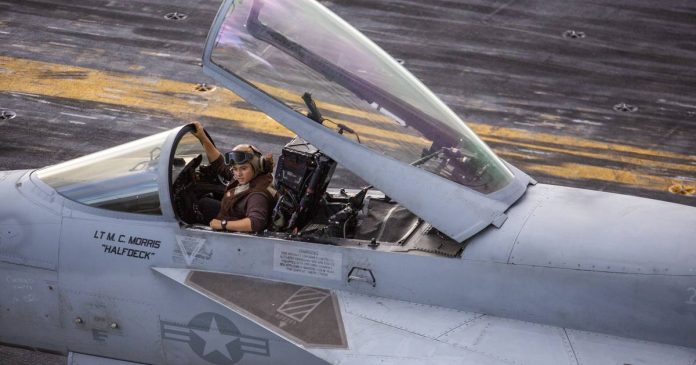
Dozens of sailors — each donning a helmet, goggles and hearing protection — scurry around the flight deck in choreographed chaos. They step almost without looking over ropes, chains and cords, quickly resetting the arresting gear, directing a taxiing aircraft to the launch area or fueling a waiting aircraft. Only hand signals are used to relay information as heavy ear protection muffles sound from the outside world.

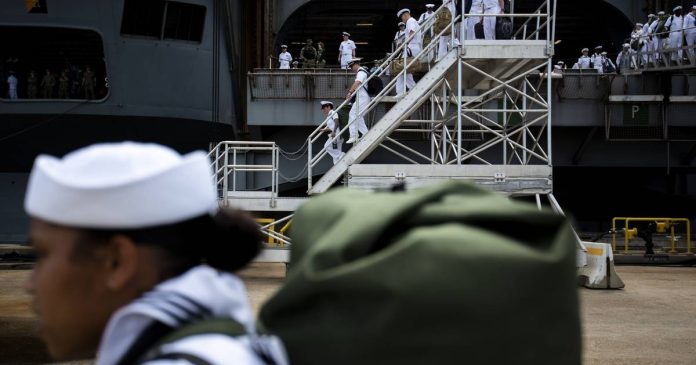
But it can’t block out the chest-rattling noise of fighter jets launching from or landing atop the carrier as it cruised the Atlantic in October. The Ford completed a 53-day deployment last month, during which the Navy invited reporters aboard to see some of the technology in action.

The carrier’s new electromagnetic-powered aircraft launch system (EMALS) and the advanced arresting gear are two of the much-touted technologies unique to Ford-class carriers. EMALS uses stored kinetic energy and solid-state electrical power conversion to propel an aircraft along a track and off the carrier, while the arresting gear is a turbo-electric system designed for more controlled deceleration of aircraft. The technology, the Navy said, means the air-wing can get into the air — and return to the battle after rearming and refueling — faster than with the traditional steam-and-hydraulics systems that have been the mainstay for decades.

“It does feel a little different, the acceleration on Nimitz (when being catapulted off the ship) is kind of a punch all at once. This (a Ford catapult launch), you will feel a more graduated acceleration as you go down the (catapult). It’s a little easier on your neck. When you trap (land) on Nimitz, everything tends to get thrown forward in cockpit. (The arresting gear wire) does feel played a little differently (on the Ford),” said Cmdr. John Peterson, the Ford’s air officer.

To adapt to the needs of the new system, the Ford’s crew has more electricians and fewer traditional mechanics, compared to the Nimitz, contributing to a reduction of personnel by around 500 sailors.

While the Ford’s EMALS and advanced arresting gear have been widely promoted by the Navy as a selling point, the move away from steam was criticized by President Donald Trump, U.S. Naval Institute News reported in 2017, who said the automation of the system was “no good” technology that cost millions more than the steam system.

“It’s very complicated — you have to be Albert Einstein to figure it out,” Trump said.

And in 2021, an annual report from the Pentagon’s top weapons tester doubted the Ford could meet its sortie generation rate requirement and achieve a self-defense requirement.

“Poor reliability of key systems that support sortie generation on CVN-78 could cause a cascading series of delays during flight operations that would likely negatively affect CVN-78′s ability to generate sorties. The reliability of these critical subsystems represents the most risk to the successful completion of CVN-78,” the report from the director, operational test and evaluation said.

But the ship’s chief engineer, Cmdr. Homer Hensy, said the move from steam to electromagnetics was a “necessary” investment — necessary to save money, necessary to reduce downtime during maintenance cycles and necessary for the Navy to maintain its edge.

“I think a lot of people have been staring at the dollar signs. … There were a lot of decisions made to put advanced technology on the Ford instead of spreading it out across two or three aircraft carriers because it is what we needed now,” said Hensy, as he stood in a hangar bay of the Ford while it cruised the Atlantic.

The cutting edge technology was the driving force behind the warship’s growing costs. The technology, previously unproven, pushed the Ford’s first deployment back by four years after on-shore testing revealed unexpected problems that delayed the installation of key components of the ship and required hundreds of millions of dollars to fix.

“The advanced weapons elevator — there’s no lab for that. The Navy just dreamt it up and bought it … I understand it is not a cheap technology, but it’s the price of freedom,” Hensy said.

The Government Accountability Office reported the arresting gear cost $149 million — nearly double its original estimate of $75 million. And the cost of the electromagnetic catapult system climbed from $318 million to $664 million.

According a Congressional Research Service report dated Aug. 26, 2022, by Ronald O’Rourke, the Navy struggled to control the Ford’s costs “for years,” which he stated in his report was fueled by “an unrealistically low” $10 billion estimate provided back in 2008.

The original number, O’Rourke’s report reads, “might have reflected an underestimate of the intrinsic challenges of building the then-new Ford-class design compared to those of building the previous and well understood Nimitz-class design.”

The warship’s 11 advanced weapons elevators were among the most problematic of the new technologies, which were delivered more than a decade late.

“But it was worth it,” said Lanzilotta, who was assigned commander of the Ford when just six of the elevators were fully functioning.

Below the flight deck, a weapons elevator effortlessly glided down to the hangar bay as Chief Warrant Officer 2 Jeff Towry demonstrated how the system hoists bombs and armament from the Ford’s magazines to the flight deck, to be loaded onto aircraft. Like the catapults, the elevators are electromagnetic — replacing a cable-driven system — and now operate through WiFi.

“This platform is ultimately floating in the air when it is in transit. The magnetics pull it up and down,” Towry said.

Seven of the elevators operate in the ship’s lower stages in the main magazine areas, with three in the upper stages and one utility elevator that serves the hangar bay and flight deck. The system features two ballistic hatches, protecting the rest of the ship from the magazine where all ammunition is stored, which Towry said would not be possible unless it was a wireless system.

Cmdr. Jim Fish, weapons officer for the Ford, said the elevators are also stronger and faster than those on Nimitz-class carriers. Increased strength and speed, he said, equal reduced vulnerability.

“When we do combat reloads and routine operations, that’s where the real critical value comes with these elevators. All the technology we brought into it allows redundancy, allows for reliability, survivability, all these ‘ilities’ that are very important to us to be combat ready,” Fish said.

While the system development took longer than expected, the elevators ran as advertised during the ship’s two-month deployment, operators and officials said.

Defense analyst Bryan McGrath said the Ford’s challenge in joining the fleet is not unique to the advanced warship. And he predicts future Ford-class carriers — John F. Kennedy, Enterprise, and Doris Miller, which are in production — will be delivered quicker and without breaking the bank.

“To some extent, it is the nature of the beast when you’re trying to do something that’s incredibly complex. And to some extent, it’s a function of an acquisition and construction system that could use some optimization and some work,” said McGrath, who is the director of Ferry Bridge Group, a defense and national security consultancy.

TheKennedy was procured in Fiscal year 2013. The Navy estimates it will cost around $12.7 billion.

“The ship is being built with an improved shipyard fabrication and assembly process that incorporates lessons learned from the construction of CVN-78 (USS Gerald R. Ford),” O’Rourke said in the August report.

Among the lessons learned is the dual band radar, a new flush-mounted, two-phased array radar meant to replace the spinning radar on the older class carriers, that crew members said was powerful — maybe even too powerful.

Daywatch

Daywatch

Weekdays

Start your morning with today’s local news

“If I have a threat, (the dual band radar) can identify (and keep) a precision track on threats and never lose contact wherever the track goes. I would say it probably is more powerful than you need to do with carrier missions we had done in the past,” said Cmdr. Tom Pilkerton, combat systems officer for the Ford.

U.S. Naval Institute reported the Navy scrapped the radar in 2015 in an effort to cut costs. Rear Adm. Thomas Moore, program executive officer for aircraft carriers, stated at the time that analysis showed the carrier didn’t need all the system’s capabilities. Instead, future Ford carriers will be outfitted with the Raytheon-designed air and missile defense radar, now officially named AN/SPY-6, which the Congressional Research Service reports will save around $180 million.

McGrath said future costs will also be lessened by the Navy’s block buy purchase of future carriers Enterprise (CVN-80) and Doris Miller (CVN-81), a contract awarded to Huntington Ingalls Industries in 2019. Buying the carriers two-at-a-time, McGrath said, stabilized the industrial base and will ultimately save around $4 billion.

“That is a significant savings because you are buying at scale — the steel, the parts,” McGrath said.

According to O’Rourke’s Congressional Research Service report, the Enterprise and Doris Miller are estimated to cost $12.8 billion and $12.9 billion respectively before factoring in the $4 billion savings.

“But it’s worth every penny … The acquisition costs — I understand, it gets people’s attention. But the bottom line is that the USS Ford will get people’s attention for 50 years and we can’t lose sight of that,” McGrath said.

Caitlyn Burchett, 727-267-6059, [email protected]

Army soldier charged with murdering sergeant on Georgia base – Daily Press

0

FORT STEWART, Ga. — The Army has charged a 28-year-old soldier with murder in the fatal shooting of a sergeant at a Georgia base.

Officials at Fort Stewart identified the suspected gunman Friday as Spc. Shay A. Wilson of Cambria Heights, New York. He has been charged in a military court in the Monday killing of 30-year-old Sgt. Nathan Hillman of Plum, Pennsylvania.

Both soldiers served in the 2nd Brigade Combat Team of the 3rd Infantry Division. Fort Stewart officials said in a statement that Wilson used a privately owned gun to shoot Hillman at the 2nd Brigade’s building complex, and that fellow soldiers subdued the gunman and held him for authorities.

No other details have been released. Wilson remains in Army custody and it was not immediately known if he had an attorney who could speak for him.

Fort Stewart, located about 40 miles (65 kilometers) southwest of Savannah, is the largest Army post east of the Mississippi River.

Biden urges veterans to seek health benefits under new law – Daily Press

0

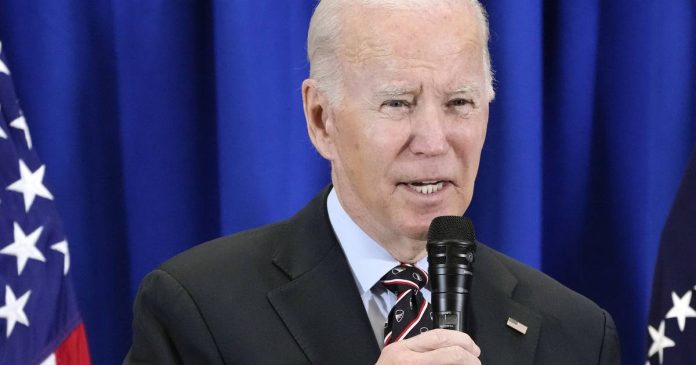
NEW CASTLE, Del. — President Joe Biden urged military veterans on Friday to take advantage of new healthcare opportunities under legislation that he signed in August. He promoted the aid as he visited a Delaware National Guard facility named for his late son, Beau.

“It’s one of the most significant laws in our history to help millions of our veterans who are exposed to toxic substances during their military service,” he said.

The law, known as the PACT Act, helps veterans get screened for exposure to things like Agent Orange, which was used for deforestation during the Vietnam War, and burn pits, where trash was destroyed on military bases in Iraq and Afghanistan.

The administration has been hosting scores of events around the country to draw attention to the new benefits. More than 730,000 veterans have already received screenings, according to the White House.

Beau Biden, the president’s elder son, served as a major in the Delaware National Guard. He died of brain cancer in 2015, and the president has suggested that exposure to burn pits on his base in Iraq may have been the cause.

“I’m no doctor but it’s pretty clear a lot of guys and women are getting sick,” Biden said.

One time, he said, “I remember Beau calling and saying I collapsed on a run.”

Biden said every time he passes the National Guard facility, he gets “a little bit of a lump in my throat.”

As he started his speech, the president said his wife, first Lady Jill Biden, warned him, “Joe, don’t get emotional.”

“Not that I ever get emotional,” joked Biden, who is known for wearing his heart on his sleeve.

The legislation, the Honoring our Promise to Address Comprehensive Toxics Act, was passed by Congress after years of advocacy by veterans.

Daywatch

Daywatch

Weekdays

Start your morning with today’s local news

It became the source of controversy in July when Republicans blocked its advance in the Senate, leading to demonstrations on Capitol Hill.

Biden said he made it clear to Congress that “if they didn’t pass this damn burn pit bill, I was going to go on a holy war, not a joke.”

In addition to the screenings, the law directs the Department of Veterans Affairs to assume that some respiratory illnesses and cancers are connected to burn pits. This allows veterans to receive disability benefits without needing to prove direct causation.

Before the law, about three-quarters of disability claims involving burn pit exposure were denied by the government.

“Why should the burden be on the victim?” Biden said.

Biden was introduced by Sen. Tom Carper, D-Del. He’s the last Vietnam-era veteran in the Senate, having served as a naval flight officer in Southeast Asia.

“To put it bluntly, this bill is going to save lives,” Carper said. “A lot of them.”

Fighter jet pilot ejects in failed landing at Navy air base in Texas – Daily Press

0

FORT WORTH, Texas — A pilot safely ejected from a plane Thursday after a failed landing that was caught on video at a North Texas military base, officials said.

The Marine Corps variant of a fighter jet, known as a F-35B, took a nose dive and spiraled after its wheels briefly touched down on the shared runway at Naval Air Station Joint Reserve Base in Fort Worth. Video taken by people who were watching the plane come in show it slowly descending in a straight line as smoke appears in the rear of the aircraft before the nose digs into the runway and the jet spins to a stop.

The F-35B has special modifications that allow it to take off and land vertically like a helicopter.

At the Pentagon, a spokesman said that the aircraft was being flown at the time of the crash by a U.S. government pilot, although it had not been transferred to the military yet by manufacturer Lockheed Martin.

The pilot safely ejected from the airplane, according to Pentagon spokesman Air Force Gen. Pat Ryder. The condition of the pilot is not known.

About a dozen local officers responded to the base, where first responders and base personnel were already on site following the incident, said Chris Cook, police chief for the nearby city of White Settlement. Officers helped keep away a growing crowd of people who had stopped on a roadway or walked over after the plane went down.

“You never want to get that call that there is an aircraft down,” Cook said. “We have a very fond spot in our community for the military. White Settlement is a military community.”

A spokesman for the Navy referred all questions to Lockheed Martin, the aerospace and defense company that manufactures the plane involved.

Officials from Lockheed Martin said in a statement that they were aware of the crash and were under the impression the pilot was safe.

“Safety is our priority, and we will follow appropriate investigation protocol,” the company said in the statement.

The failed landing came just over a month after two historic military aircraft collided during an airshow 40 miles (64 kilometers) away at the Dallas Executive Airport, killing six people. A report from the National Transportation Safety Board said there had been no coordination of altitudes in briefings before the flight or while the planes were in the air.

How the proposed US defense spending bill will impact Hampton Roads – Daily Press

0

From submarine piers to child care centers — a $250 million chunk of the annual defense spending bill would be funneled into Hampton Roads military installations if approved by Congress this week.

Language in the $858 billion National Defense Authorization Act directs money to construction projects at Portsmouth Naval Shipyard, Naval Station Norfolk, Dam Neck Naval Base, Naval Air Station Oceana, Langley Air Force Base and Naval Support Activity of Hampton Roads.

The bill also covers a 4.6% pay raise for military service members and the Department of Defense civilian workforce, fully funds the Ford-class carrier program, and directs a review of how the Navy prevents and responds to suicides following a rash of deaths in Hampton Roads.

The bill, which is jam packed with provisions secured or supported by Virginia’s Democratic Sens. Tim Kaine and Mark Warner, was approved by the House of Representatives on Thursday. It must now clear the Senate, which both senators said they expect will happen between today and Friday.

“This is a very strong defense bill — a strong defense bill to protect our country,” Kaine said Monday during the 2022 Senatorial Forum hosted by the Hampton Roads Chamber.

Kaine highlighted funding for local construction projects, which would include the following:

  • $125 million for Submarine Pier 3 at Naval Station Norfolk.
  • $47.72 million for a Dry Dock Saltwater System for CVN-78 at Portsmouth Naval Shipyard.
  • $26.6 million for a special operations forces building addition at Dam Neck.
  • $19 million for a primary distribution substation at Naval Support Activity Hampton Roads.
  • $16.86 million for submarine logistics support facilities at Naval Station Norfolk.
  • $10.5 million for Langley Air Force Base for Air Force Reserve construction and land acquisition projects.
  • $10.4 million for Ground/Air Task Oriented Radar support facilities at Dam Neck.
  • $3.4 million for backup power generation at Naval Support Activity Hampton Roads.
  • $2.3 million for child development center planning and development at Naval Station Norfolk.
  • $1.2 million for child development center planning and development at Naval Air Station Oceana.

The bill doesn’t stop there. It will direct $32.6 billion in funding for the procurement of 11 battle force ships, including full funding for the Ford-class carrier program, CVN refueling and complex overhaul, and Virginia-class and Columbia-class submarine programs, supporting the shipbuilding workforce at Huntington Ingalls Industries in Newport News.

The legislation, Kaine said, will bolster military readiness and support critical Virginia jobs.

Meanwhile, Warner said his priority is tackling the needs of military families.

Warner touted language in the legislation that would direct the Department of Defense to reevaluate methodologies for calculating the basic allowance for housing to better reflect service members’ needs. The language would also require the Secretary of Defense to implement health-related recommendations made by the Department’s Inspector General related to privatized military housing.

“Our members in the service defending our country should be able to live in housing that doesn’t have mold or rodents in it,” Warner said.

Another provision Warner highlighted would overhaul how the military collects data and analyzes rates of food insecurity among service members and their families. Warner would also like to see the expansion of eligibility for the new “basic needs allowance,” which was passed by Congress in December 2021. The monthly, taxable allowance is for active duty military families whose gross income falls below 130% of the federal poverty line. The first payments will go out in January.

Daywatch

Daywatch

Weekdays

Start your morning with today’s local news

“If you are deployed and you have a spouse and kids back at home and they can’t put food on the table, that is wrong,” Warner said. “This defense bill helps us solve that.”

While a provision addressing mental health is not specific to Hampton Roads, Warner said Tuesday he hopes it will help address a rash of suicides linked to Norfolk’s Mid-Atlantic Regional Maintenance Center and the USS George Washington.

The Navy is currently investigating the apparent suicides of four sailors assigned to the Norfolk naval maintenance center which occurred in the span of a month, with the most recent occurring Nov. 26. The recent string of suicides comes eight months after three sailors assigned to the Norfolk-based USS George Washington took their own lives within the span of a week.

“We have not fully cracked the code both on the availability of mental health services within the DoD and (the Department of) Veterans Affairs, but also breaking down the stigma that too often exists within the military that makes a young soldier or sailor reluctant to use mental health services,” Warner said.

Stigma surrounding seeking mental health treatment is not an issue that is unique to the military, Warner said.

“But it is exacerbated with young men and women who are oftentimes separated from their families under high-stress jobs,” Warner said.

Caitlyn Burchett, [email protected]

USNS Comfort suspends care in Haiti after 19 overboard

0

JEREMIE, Haiti — A U.S. Navy hospital ship docked in southwest Haiti has temporarily suspended medical services after 19 people with the mission fell overboard amid a heavy swell hitting the Caribbean region, officials said Tuesday.

It happened Monday night and involved 12 military personnel and seven civilians with the USNS Comfort who were returning to the ship after caring for patients on land, said Lewis Preddy, a U.S. Navy spokesman.

All 19 were pulled back onto the small boat, which was then lifted by a crane onto the ship. He said the usual process is for personnel to use a water taxi and step onto a ladder to board the ship, but that the heavy surf made that impossible.

He said two people were injured but are expected to recover.

Preddy said officials are figuring out how to continue the mission while ensuring people’s safety. The heavy swell is expected to last until at least the weekend, according to meteorologists.

Rear Adm. James Aiken, commander of the U.S. Naval Forces Southern Command-U.S. 4th Fleet, told The Associated Press that officials are working hard to bring the mission in Haiti back online after it began on Monday.

“The need is extremely great, and we’re so excited to be able to provide some care,” he said in a phone interview.

Officials said they did not immediately have the number of patients that have been treated so far.

On Tuesday, several hundred Haitians protested the ship’s presence in the coastal town of Jeremie, yelling, “Down with the American people! We don’t want them here!”

Some demanded that the U.S. government instead visit certain areas in the capital of Port-au-Prince to free neighborhoods from the control of powerful gangs.

Daywatch

Daywatch

Weekdays

Start your morning with today’s local news

In early October, Haiti’s government requested the deployment of foreign troops to fight gangs and help end a fuel blockade that has since lifted after one of the country’s most powerful gangs allowed trucks to access a fuel terminal. No international troops have been deployed, but the U.S. and Canada have announced a flurry of sanctions.

Aiken brushed off the small protest in Jeremie on Tuesday, saying he is focused on the positive.

“There are hundreds of thousands if not millions of people who want us there,” he said.

The USNS Comfort has visited Haiti several times in the past decade as the country struggles with a broken health system hit by severe power outages and fuel shortages. The floating hospital has tended to people with ailments ranging from diabetes to cholera, with an ongoing outbreak killing more than 280 people and infecting more than 14,100 others.

On Monday, Haiti received more than 1.17 million of oral cholera vaccines with help from the Pan American Health Organization.

___

Coto reported from San Juan, Puerto Rico.

Defense bill rolls back military vaccine mandate, but lawmakers haggling over reinstatement for discharged service members – Daily Press

0

The COVID-19 vaccine mandate for the military could be rescinded under the annual must-pass defense bill. If enacted, what happens to the 8,000 service members who were booted out for refusing to get the shot?

The $858 billion National Defense Authorization Act, which was approved by the House of Representatives on Thursday, included an 11th-hour provision that would roll back the vaccine mandate “no later than 30 days” after the enactment of the bill.

Language in the bill, which must now clear the Senate, leaves it up to each military branch to determine if they will reinstate anyone separated for refusal to take the vaccine.

While Democrats agreed to Republican demands to end the vaccination requirement in order to win bipartisan support for the defense bill, it’s unclear whether the issue of reinstatement also has enough support to be included in the Senate version.

A group of Republican lawmakers want to see the discharged service members reinstated and given back pay, citing below-target recruitment and training costs.

“The United States simply cannot afford to discharge our brave men and women in uniform and lose the investments we have made into each and every one of them due to an inept bureaucratic policy,” reads a letter signed by 13 U.S. senators.

When asked if those discharged for not getting the vaccine should be allowed to reenlist if the mandate is rolled back, both of Virginia’s Democratic senators expressed opposition.

“I, frankly, don’t think the discharges were wrong to do when we were facing a pandemic that killed more people than any disaster in the history of the United States,” Sen. Tim Kaine told The Virginian-Pilot Monday following the 2022 Senatorial Forum hosted by the Hampton Roads Chamber.

The Department of Defense enacted the mandate in August 2021. It directed the secretaries of the military branches to immediately begin full vaccination of all members, whether active duty or in the National Guard or reserves.

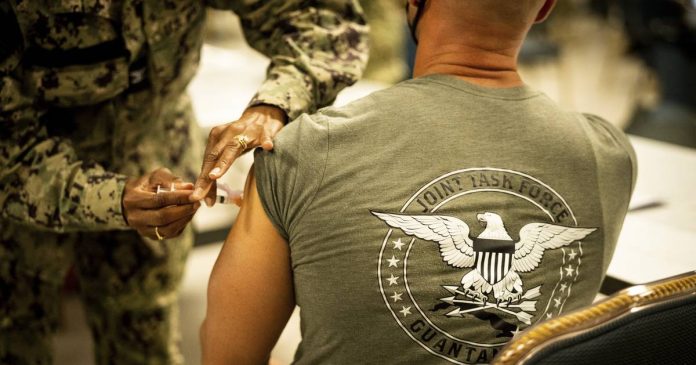
The Associated Press reported that, as of early this month, about 99% of the active-duty troops in the Navy, Air Force and Marine Corps had been vaccinated, and 98% of the Army. Service members who are not vaccinated are not allowed to deploy, particularly sailors or Marines on ships.

But, more than 8,000 active duty service members were discharged for failure to obey a lawful order when they refused the vaccine.

“A change in policy now reflects the evolution of the pandemic, but it does not retroactively negate the fact that orders were defied,” Sen. Mark Warner said in a statement Monday.

Daywatch

Daywatch

Weekdays

Start your morning with today’s local news

According to Associated Press, the Marine Corps had discharged 3,717 personnel as of early this month. The Army — the largest service — has discharged more than 1,800, while more than 1,600 were forced out by the Navy and 834 by the Air Force. The Air Force numbers include the Space Force.

“I don’t think there was anything wrong with the COVID vaccine mandate. I think it was really important for the readiness of a unit that you not be exposing your colleagues to illness,” Kaine said.

Vaccine mandates are not new for service members. There are a total of 17 vaccines that service members can be required to take depending if they are deploying or are assigned to a ship.

The National Defense Authorization Act was passed by the House Thursday and is expected to be voted on in the Senate this week.

While Kaine said he “is not happy” with the potential lifting of the vaccine mandate for service members, “it doesn’t make me want to vote against the bill.”

The bill, he said, has a lot of good in it, including: a 4.6% pay raise for both military service members and the DOD civilian workforce; approximately $250 million in construction projects at Hampton Roads military installations; and a study on the mental health care services provided under TRICARE.

Caitlyn Burchett, [email protected]

A Year in #Reviewing

0

Ralph Waldo Emerson is said to have observed, “I cannot remember the books I’ve read any more than the meals I have eaten; even so, they have made me.” As we do each year at The Strategy Bridge, we pause to reflect on our #Reviewing series, the books and movies and other work we’ve consumed as a community—the intellectual meal we’ve shared—and consider what they have helped us to make of ourselves, what they’ve helped us become.

Has the intellectual feast of the past year made us more aware of the interaction between changing technologies in war and the psychology of those who fight in war? Has it opened us to a better understanding of why humans fight these things we call wars, a clearer idea of the enduring nature and changing character of what it means to win in war, a sobering reflection on what fighting and not winning wars can do to a military? Has it opened a window through which we can view our own history and the history of others, making us more thoughtful in our approach to war, strategy, and each other? Has it given us a less prosaic language to express who we were, who we are, and who we will become? Perhaps our intellectual feast of the past year has done all this and more.

Looking forward to the coming year, we confront the beautiful reality that who we were and who we are perhaps matter less than who we will be. What matters is not what has been made but what we will make, not having become but becoming. And just as the books we have read made us, so the books we will read will transform us.

We look forward to working with all of you in making ourselves and each other—our Strategy Bridge community—stronger and broader and better in the coming year.

#TheBridgeReads

NATO representatives gather in Norfolk to talk Ukraine war, addition of 2 new members – Daily Press

0

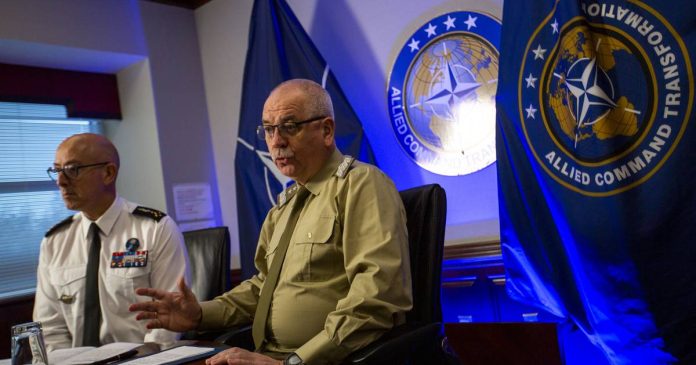
North Atlantic Treaty Organization representatives gathered this week at the alliance’s headquarters in Norfolk to assess international security trends and the implications of two new members amid the ongoing Russian war against Ukraine.

“The Russian invasion of Ukraine is something that changes not only the security of Europe,” said General Janusz Adamczak, Director General International Military Staff. “But it impacts the security of the world.”

Adamczak, as well as French Air Force General Philippe Lavigne, Supreme Allied Commander Transformation, participated in a media roundtable Wednesday, offering insight in how the addition of Finland and Sweden would empower the alliance’s collective defenses.

“The initial assumption — at least by (Vladimir) Putin and Russia — was to end the war within two or three days,” Adamczak said. “This was has been lasting for more than nine months now.”

While Finland and Sweden are not yet members of NATO, ornaments bearing the countries’ flags were nestled amongst those adorning a Christmas tree at the alliance’s headquarters in Norfolk.

“They are not members yet, but are strong partners,” said Jay Paxton, spokesperson for NATO’s Strategic Command.

Finland and Sweden simultaneously handed their official letters of application to join NATO on May 18, abandoning longtime policies of military nonalignment and Nordic neutrality. To date, 28 of NATO’s 30 members have approved the countries’ applications to join NATO. However, the latecomers will not become official members of the alliance until Hungary and Turkey ratify the requests. Unanimous approval is required.

Finland and Sweden will bring experience in dealing with hostilities from Russia to NATO — history, the generals said, the countries have not forgotten.

“We need their expertise. They already know the Russians — how they are doing the job, how they are thinking,” Lavigne said.

Lavigne praised Finland’s defense industry and “total defense” conscription as some of the warfare capabilities the country would bring to the table.

A NATO that includes the two Nordic states, the generals said, would bolster deterrence efforts in the Baltic Sea and Arctic Ocean — potentially giving NATO superiority in a strategically important region. The new members would also crowd NATO against Russia’s western board for more than 800 additional miles.

“That is part of the game here,” Adamczak said. “Finland itself is very well prepared to face the threat of this battle, and with the support of the allied nations, I think (Finland) will be even more effective.”

Daywatch

Daywatch

Weekdays

Start your morning with today’s local news

In the past two years, Adamczak said, NATO has strengthened forces on the eastern flank. Following Russia’s invasion of Ukraine in February, the allies established four new multinational battlegroups in Bulgaria, Hungary, Romania and Slovakia, which doubled the number of troops on the ground and extended NATO’s forward presence along the Alliance’s eastern flank – from the Baltic Sea in the north to the Black Sea in the south.

The troops, more than 10,000-strong as of November, are ready to respond should there be an attack on an allied NATO member.

”We need to be prepared if the situation deteriorates and we have to increase the posture — the number of troops — within a short period of time,” Adamczak said. “That is how we are prepared for that. We are training, we are thinking, we are developing our concept to be able to quickly increase our presence.”

Once Hungary and Turkey ratify Finland and Sweden’s requests, the ratification instruments must be deposited with the United States government.

“With 30 nations — soon 32 — I know that our unity is the alliance’s center of gravity. That unity is based on the values we all share: freedom, democracy, human rights, the rule of law and the shared goal of defending our values,” Lavigne said.

Caitlyn Burchett, [email protected]

Congress set to rescind COVID-19 vaccine mandate for troops – Daily Press

0

WASHINGTON — The COVID-19 vaccine mandate for members of the U.S. military would be rescinded under the annual defense bill heading for a vote this week in Congress, ending a directive that helped ensure the vast majority of troops were vaccinated but also raised concerns that it harmed recruitment and retention.

Republicans, emboldened by their new House majority next year, pushed the effort, which was confirmed Tuesday night when the bill was unveiled. House GOP leader Kevin McCarthy personally lobbied President Joe Biden in a meeting last week to roll back the mandate.

Rep. Mike Rogers of Alabama, the ranking Republican on the House Armed Services Committee, said the removal of the vaccination requirement was essential for the defense policy bill to move forward.

“We have real recruitment and retention problems across all services. This was gas on the fire exacerbating our existing problem,” Rogers said. “And the president said, you know, the pandemic is over. It’s time for us to recognize that and remove this unnecessary policy.”

White House press secretary Karine Jean-Pierre said Monday that Biden told McCarthy he would consider lifting the mandate but Defense Secretary Lloyd Austin had recommended it be kept.

“I would remind all of you that the Pentagon has a range of vaccines it has long required,” Jean-Pierre said Monday. “So this is nothing new.”

The vaccine provision is one of the more acrimonious differences in the annual defense bill that the House is looking to wrap up this week and send to the Senate. It sets policy and provides a roadmap for future investments. It’s one of the final bills Congress is expected to approve before adjourning, so lawmakers are eager to attach their top priorities to it.

Service members and the Defense Department’s civilian workforce would get a 4.6% pay increase, according to a summary of the bill released Tuesday night. The legislation also requires a review of the rate of suicide in the Armed Forces since Sept. 11, 2001, broken down by service, occupational specialty and grade. It also requires the defense secretary to rescind the COVID-19 vaccination mandate.

Military leaders acknowledge that the vaccine requirement is one of several factors contributing to their recruiting struggles. It may dissuade some young people from enlisting, but officials don’t know how many. This year the Army missed its recruiting goal by about 25%, while the other services scraped by.

The reasons, however, are complex. Two years of the pandemic shut off recruiters’ access to schools and events where they find prospects, and online recruiting was only marginally successful. Finding recruits is made more difficult by the ongoing nationwide labor shortage and the fact that only about 23% of young people can meet the military’s fitness, educational and moral requirements — with many disqualified for medical issues, criminal records, tattoos and other things.

A congressional aide familiar with the negotiations but not authorized to speak publicly said lawmakers supportive of the vaccine mandate concluded that it had accomplished what it was intended to do by achieving a high rate of vaccination throughout the service branches, and that meeting the Republican demands to rescind it would allow other priorities to advance.

The mandate was enacted through an August 2021 memorandum from Austin. It directed the secretaries of the various military branches to begin full vaccination of all members of the Armed Forces on active duty or in the National Guard or Reserve. They have not been required to also receive boosters.

Asked about the matter over the weekend, Austin told reporters he still supports the vaccine for U.S. troops.

“We lost a million people to this virus,” Austin said. “A million people died in the United States of America. We lost hundreds in DoD. So this mandate has kept people healthy.”

As of early this month, about 99% of the active-duty troops in the Navy, Air Force and Marine Corps had been vaccinated, and 98% of the Army. Service members who are not vaccinated are not allowed to deploy, particularly sailors or Marines on ships. There may be a few exceptions to that, based on religious or other exemptions and the duties of the service member.

The vaccination numbers for the Guard and Reserve are lower, but generally all are more than 90%.

More than 8,000 active-duty service members were discharged for failure to obey a lawful order when they refused the vaccine.

The Marine Corps, which is much smaller than the Army, Navy and Air Force, vastly outpaces them in the number of troops discharged, with 3,717 as of early this month. The Army — the largest service — has discharged more than 1,800, while more than 1,600 were forced out by the Navy and 834 by the Air Force. The Air Force numbers include the Space Force.

The military services came under fire over the past year for approving only a limited number of religious exemptions to the vaccine requirement.

Military leaders have argued that troops for decades have been required to get as many as 17 vaccines in order to maintain the health of the force, particularly those deploying overseas. Recruits arriving at the military academies or at basic training get a regimen of shots on their first day — such as measles, mumps and rubella — if they aren’t already vaccinated. And they routinely get flu shots in the fall.

Service leaders have said that the number of troops who requested religious or other exemptions to any of those required vaccines — prior to the COVID pandemic — has been negligible.

The politicization of the COVID-19 vaccine, however, triggered an onslaught of exemption requests from troops. As many as 16,000 religious exemptions have been or are still pending, and only about 190 have been approved. Small numbers of temporary and permanent medical exemptions have also been granted.

Daywatch

Daywatch

Weekdays

Start your morning with today’s local news

House Majority Leader Steny Hoyer, D-Md., said the Defense Department made a rational decision in requiring a vaccine because “vaccines are the way you keep a community safe.” But at the end of the day, the bill needs to have bipartisan support to pass.

“It seems to be very controversial among Republicans in particular. I’m not sure exactly why. Maybe it’s just because the government is telling them that you need to do this,” Hoyer said.

“Obviously,” he added, “the more people you have well at any given time, the better off you are in responding immediately, but there’s substantial sentiment on the other side of the aisle, which we need in the Senate, that believes differently, so we may have to compromise.”

McCarthy said that while he applauded the end of the mandate, the Biden administration must do more. He said the Biden administration “must correct service records” and not stand in the way of reenlisting any service member discharged for not taking the COVID vaccine.

The defense bill will support up to about $858 billion in spending. Within this topline, the legislation authorizes nearly $817 billion for the Department of Defense and more than $30 billion for national security programs within the Department of Energy.

The bill provides funding that’s about $45 billion above the president’s budget request to address the effects of inflation, provide additional security assistance to Ukraine and accelerate other DoD priorities.

Associated Press staff writer Seung Min Kim contributed to this report.