“Myths and legends have been written and spoken about the Vietnam era. And oftentimes, I think back on those days in Vietnam, about how much we did, what we didn’t do and what we could have done.”
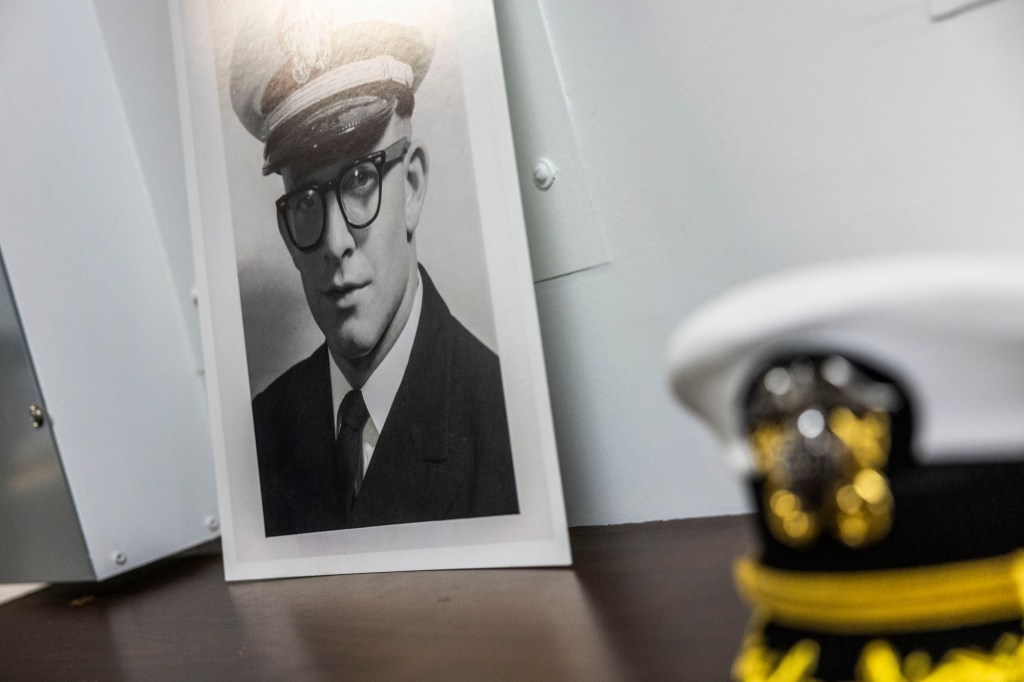
Loved ones sniffled and wiped away tears as the poignant words of the late Lt. j.g. William “Bill” Collins Jr. filled an auditorium Friday at Joint Expeditionary Base Little Creek-Fort Story. The Vietnam veteran, who died in 2017, was posthumously awarded the Bronze Star for his military service. Rear Adm. Brad Andros, commander of Navy Expeditionary Combat Command, presented the medal to the Collins family, who accepted the award on behalf of William.
“He would always say to me, the Navy provided him with the best years of his life,” said Jacqueline Collins Kilduff, William’s daughter.
William, a native of Waverly, Virginia, joined the Navy in 1964 when he was a junior at William & Mary. He did so as “an afterthought,” rather than according to any particular plan.
“At the behest of the Army — he got a draft notice — dad joined the Navy. Back at William & Mary, he had passed the test for OCS (Officer Candidate School), and for some damn reason he thought joining the Navy would mean he would be home more often than his army captain father,” Killduff said, adding with a laugh. “I’m going to chalk that idea up to youthful delusion.”
Three years later, then 26-year-old William was sent to Vietnam, serving as the officer-in-charge of Patrol Craft Fast, Coastal Division Eleven from November 1967 through July 1968.
“I had folks tell me that my dad was in the Brown Water Navy. I had never heard that term before, but later he explained that he spent many days on patrol ‘up some damn river or other,’” Killduff said.
William was part of Operation Game Warden, and the mission was to deny Vietcong access to resources in the Mekong River Delta. Because water travel was the primary means of transportation and communication, control of the delta — which wound through 15,000 square miles of Vietnam — was considered crucial.


Rows of nipa palm trees crowded the banks of the narrow rivers and canals. The broad leaves of the palms grew to 30 feet high, allowing enemies to move virtually undetected.
The Navy used patrol boats to check cargo and identify papers of boaters plying the waterways, set up night ambushes at suspected enemy crossing points, transport and support allied forces, and enforce curfews.
Skirmishes and bloodshed were commonplace.
In the seven months he was in the jungle, William conducted 120 combat patrols in shallow and hazardous waters and was involved in 38 firefights.
“I lost no sailor to any action, for which I am particularly proud,” William said in an interview with the Navy Memorial Archive.
Following his service, William returned to Virginia. He worked as the Vice President of Administrative Services for Farm Credit System for 25 years before moving to Sussex County and beginning a third career as an auctioneer and real estate agent for Briggs Real Estate.
William kept his Vietnam stories to himself for decades, his daughter said. It was only after a family trip to Ireland, when William used his Navy training to fix their broken down tour bus, that Kilduff began to see her dad in a new light.
“There he was in his standard Vietnam veteran khaki pants and golf shirt, under the bus on the ground. And when he yelled ‘Go,’ the Irish bus driver cranked that bus up. … Suddenly after years of being dubious about my dad — the churchgoing, Lions Clubs suburban barbecue king — I realized he was a pretty cool guy, a real hero,” Kilduff said.
William died March 15, 2017, at 75 years of age.
“Everyone who ever met my dad knows he loved singing and enjoyed eating peanuts, oysters, very rare steaks, and drinking cold beer out of the frosty mug, which is another habit cultivated on a certain boat somewhere in murky brown water far from home,” Kilduff said.
William is part of the history of swift boat sailors and an inspiration for future riverine sailors, said Command Master Chief Clayton Alec-Finkelman of Maritime Expeditionary Security Group Two.
“We have a great responsibility to honor the past because it is an important part of who we are today,” Alec-Finkelman said.
Alec-Finkelman was a riverine sailor — a modern day Brown Water Navy sailor — deploying to the rivers in Iraq, Tigris and Euphrates from 2006-07.
“When I walk around in my uniform or if I am just picking up milk from the store, a lot of people thank me for my service. Sometimes I feel not worthy of that. What did I do today, except go to work? Or pick up milk?,” Alec-Finkelman said.
“They are really thanking me because of people like Lt. j.g. Collins. They don’t know anything about me, but they know those stories — the stories of the Navy and the people that came before us who accomplished great deeds.”
Caitlyn Burchett, [email protected]