Home Blog Page 65

The shocking costs of the new Alzheimer’s drug, most of which will fall to taxpayers – Daily Press

0

The first drug purporting to slow the advance of Alzheimer’s disease is likely to cost the U.S. health care system billions annually even as it remains out of reach for many of the lower-income seniors most likely to suffer from dementia.

Medicare and Medicaid patients will make up 92% of the market for lecanemab, according to Eisai Co., which sells the drug under the brand name Leqembi. In addition to the company’s $26,500 annual price tag for the drug, treatment could cost U.S. taxpayers $82,500 per patient per year, on average, for genetic tests and frequent brain scans, safety monitoring, and other care, according to estimates from the Institute for Clinical and Economic Review, or ICER. The FDA gave the drug full approval July 6. About 1 million Alzheimer’s patients in the U.S. could qualify to use it.

Patients with early Alzheimer’s disease who took lecanemab in a major clinical trial declined an average of five months slower than other subjects over an 18-month period, but many suffered brain swelling and bleeding. Although those side effects usually resolved without obvious harm, they apparently caused three deaths. The great expense of the drug and its treatment raises questions about how it will be paid for, and who will benefit.

“In the history of science, it’s a significant achievement to slightly slow down progression of dementia,” said John Mafi, a researcher and associate professor of medicine at the David Geffen School of Medicine at UCLA. “But the actual practical benefits to patients are very marginal, and there is a real risk and a real cost.”

To qualify for Leqembi, patients must undergo a PET scan that looks for amyloid plaques, the protein clumps that clog the brains of many Alzheimer’s patients. About 1 in 5 patients who took Leqembi in the major clinical test of the drug developed brain hemorrhaging or swelling, a risk that requires those taking the drug to undergo frequent medical checkups and brain scans called MRIs.

In anticipation of additional costs from the Leqembi drug class, the Centers for Medicare & Medicaid Services in 2021 increased monthly premiums for Medicare patients by 15%, and premiums may rise again in 2024 after a slight decline this year.

Such increases can be a significant burden for many of the 62 million Medicare subscribers who live on fixed incomes. “Real people will be affected,” Mafi said. He contributed to a study that estimated lecanemab and related care would cost Medicare $2 billion to $5 billion a year, making it one of the most expensive taxpayer-funded treatments.

In its analysis, ICER suggested that Leqembi could be cost-effective at an annual price of $8,900 to $21,500. In an interview, David Rind, ICER’s chief medical officer, said $10,000 to $15,000 a year would be reasonable. “Above that range doesn’t seem like a good place,” he said.

Whatever its price, patients may be delayed getting access to Leqembi because of the relative shortage of specialists capable of managing the drug, which will require genetic and neuropsychological testing as well as the PET scan to confirm a patient’s eligibility. A similar drug, Eli Lilly’s donanemab, is likely to win FDA approval this year.

Already there are long waits for the testing needed to assess dementia, Mafi said, noting that one of his patients with mild cognitive impairment had to wait eight months for an evaluation.

Such testing is not readily at hand because of the paucity of effective treatment for Alzheimer’s, which has helped to make geriatrics a relatively unappealing specialty. The United States has about a third as many dementia specialists per capita as Germany, and about half as many as Italy.

“Time is of the essence” for the neuropsychological testing, Mafi said, because once a patient’s cognitive ability declines below a certain threshold, they become ineligible for treatment with the drug, which was tested only in patients in the earliest stages of the disease.

Mafi’s study estimates that patients without supplemental Medicare coverage will have to pay about $6,600 out-of-pocket for each year of treatment. That could put it out of reach for many of the 1 in 7 “dual eligible” Medicare beneficiaries whose income is low enough to simultaneously qualify them for state Medicaid programs. Those programs are responsible for about 20% of physician bills for drug infusions, but they don’t always cover the full amount.

Some practitioners, such as cancer centers, cover their Medicaid losses by receiving higher rates for privately insured patients. But since almost all lecanemab patients are likely to be on government insurance, that “cross-subsidization” is less of an option, said Soeren Mattke, director of the Center for Improving Chronic Illness Care at the University of Southern California.

This poses a serious health equity issue because “dual eligibles are low-income patients with limited opportunities and education, and at higher risk of chronic illnesses including dementia,” Mattke said in an interview. Yet many doctors may not be willing to treat them, he said. “The idea of denying access to this group is just appalling.”

Eisai spokesperson Libby Holman said the company was reaching out to specialists and primary care physicians to make them aware of the drug, and that reimbursement options were improving. Eisai will provide the drug at no cost to patients in financial need, she said, and its “patient navigators” can help lock down insurance coverage.

“A lot of clinicians are excited about the drug, and patients are hearing about it,” said David Moss, chief financial officer of INmune Bio, a company that has another Alzheimer’s drug in development. “It’s a money center for infusion centers and MRI operators. It provides reasons for patients to come into the office, which is a billing thing.”

Outstanding doubts about Leqembi and related drug s have given urgency to efforts to monitor patient experiences. CMS is requiring Leqembi patients to be entered into a registry that tracks their outcomes. The agency has established a registry, but the Alzheimer’s Association, the leading advocacy group for dementia patients, is funding its own database to track those being treated, offering physician practices $2,500 to join it and up to $300 per patient visit.

In a letter to CMS on July 27, a group of policy experts said CMS should ensure that any and all Leqembi registries create and share data detailed enough for researchers and FDA safety teams to obtain a clear picture of the drug’s real-world profile.

The anti-amyloid drugs like lecanemab have created a polarized environment in medicine between those who think the drugs are a dangerous waste of money and those who believe they are a brilliant first step to a cure, said ICER’s Rind, who thinks lecanemab has modest benefits.

“People are as dug in on this as almost anything I’ve ever seen in medicine,” he said. “I don’t think it’s healthy.”

Norfolk residents celebrate connection at National Night Out – Daily Press

0

NORFOLK — It takes a village to keep neighborhoods safe, city leadership said at the Tuesday’s National Night Out event.

Residents from across Norfolk gathered on the city’s southside at Berkley Park to learn and promote violence prevention and public safety. In the neighborhood and surrounding the park, dance music echoed from the park’s stage ascommunity members bopped together.

National Night Out is a movement that began in the western suburbs of Philadelphia in 1984 and aims to build police-community partnerships and neighborhood camaraderie. Through a network of police departments, the first annual National Night Out involved 2.5 million neighbors across 400 communities in 23 states. The event, scheduled for the first Tuesday in August (or October, in select communities), is now hosted in all fifty states, U.S. territories and military bases across the world.

“National Night Out is all about how we treat each other when we come together,” Norfolk Police Chief Mark Talbot said. “The essence of this night is about building our connections with each other: first, resident-to-resident. A great city is created when residents are connected to each other and then are connected to police.”

This year, 162 communities pledged to hold National Night Out events in the commonwealth, including cities in Hampton Roads. According to the National Night Out official website, the events bring together an estimated 38 million people across 17,000 communities nationwide. At Berkley park, attendees were greeted by representatives from entities across the city and Hampton Roads — from the Commonwealth’s Attorney’s office and sheriff’s office to the Community Emergency Response Team and violence prevention organizations. The police department’s COPsicle truck passed out icy treats as children played basketball on the park’s court.

Danica Royster, representative of Superward 7, said that a “village mindset” is necessary for violence prevention.

“This is what community is about,” Royster said. “This is how we take back the block. We look out for one another. We express interest in one another.”

Bilal Muhammad, community activist and a leader of the Stop the Violence Team, said community members must also hold themselves responsible by working with investigations if they are to see anything suspicious or dangerous in their neighborhoods. Silence, he said, perpetuates violence.

“We just lost our son to gun violence, Ali Kareem Muhammad,” he said. “It’s been 31 days now, and it took a lot for us to be out here today, but my wife and I, we talked about it, and we decided to be here with the community and with family. We must be very vigilant. When you see something, say something. I found out that criminals, murderers, they plan their move and create friction, so that you may leave the scene. When you leave a scene, then they execute. We’ve got to learn how to stay on the scene. We have to learn how to dial 911. We’ve got to learn how to stay right there so the violence does not take place. I’m telling you what I know … It happens all the time. We’ve got to be the policemen for our brothers and our sisters.”

Eliza Noe, [email protected]

Some hospitals welcome RV living for patients and workers – Daily Press

0

Jim Weaver has had two major surgeries in the past decade: one to remove cancerous tumors from his bladder and another to clear a blocked artery.

Weaver, 70, knew that after he emerged from surgery, he’d want privacy. But because he and his wife drove more than 150 miles from Bend, Oregon, to Oregon Health & Science University Hospital in Portland, immediately returning home was not an option.

So, the couple brought their Escape 19 camping trailer, a small but comfortable home on wheels, and parked it in one of the hospital’s 17 on-site RV parking spaces.

“Leaving that hospital with the bandage, the scar, and the rest of it, there’s no way I wanted to be in a hotel,” he said. “Being able to go down and stay in the trailer there, jeez, it was so huge.”

Weaver was fortunate. OHSU Hospital, one of two Level I trauma centers in the state, is one of several medical centers in the United States that maintain parking spaces specifically for RVs, electric hookups included. The hospital has offered the free amenity to patients since 2009.

Medical and RV industry professionals say hospitals that offer RV parking are easing access to health care for some patients who drive long distances for care, like many rural residents.

Monika Geraci, a spokesperson for the RV Industry Association, said she could understand the appeal to patients who travel with campers. “It’s your home away from home on wheels,” she said. “You’re able to bring all of your creature comforts. It’s your bed, it’s your sheets, it’s your bathroom, it’s your kitchen.”

Many patients drive eight to 10 hours to receive care at OHSU Hospital, said Brett Dodson, who oversees the facility’s parking and transportation services.

“They’ve seen the rural clinics and they need to come to that next level,” he said. “When they do, I think they’re more comfortable with an RV than they are trying to find a hotel.”

The average stay for a patient in the RV spaces is about seven days, and the limit is 30 days at a time. If a patient depends on the hospital for a recurring treatment like kidney dialysis, they’ll stay every few months. Recently, spots were occupied by transplant patients and a family with a baby in the intensive care unit, Dodson said.

The spots help patients keep close to their medical providers and avoid paying for hotels. If patients don’t have access to an RV or would rather stay in a hotel, Dodson’s team refers them to the on-site lodging that OHSU runs in partnership with the local chapter of Ronald McDonald House Charities or a nearby hotel that gives patients a discounted rate.

In addition to improving patient comfort, Dodson said, the RV spaces set the hospital up to provide better care. People who previously would have driven through the night to get to Portland for a morning surgery can now arrive the night before, he said. “They can get a good night’s sleep, they’d be ready for a surgery, and they’re there on time.”

Accommodations hospitals offer RV travelers vary widely and many aren’t part of an official policy. Among those that do offer overnight RV spaces, not all offer designated spaces or utility hookups like OHSU Hospital.

In Montana, patients have been parking their campers at Bozeman Health Deaconess Regional Medical Center for years. It started informally, when tourists got hurt while adventuring or sick while passing through the mountain city of 56,000 people. This spring, Bozeman Health created a short-term RV parking program at the hospital, which so far has largely been used by Montana patients traveling for care they couldn’t receive closer to home.

Bozeman Health worked for years to turn itself into a medical hub in southwestern Montana, expanding into specialty services such as intensive care for infants and cancer treatment. Simultaneously, hotel prices in the destination town, one of the gateways to Yellowstone National Park, have skyrocketed, and competition to find a place to stay in peak tourist season is high.

“There are towns in Montana that just don’t have hospitals,” said Kallie Kujawa, the chief operating officer at Bozeman Health. “We had a couple who came who could not find anywhere to stay in town. This was the only place they could find to stay. And that was critical for them.”

Patients can reserve a space for free for up to two weeks. Like at the hospital in Oregon, they need to bring their own water and lug their trash out. Bozeman Health has only two RV spaces; though, Kujawa said, the system could expand if demand increases.

Since it isn’t always clear whether a hospital will allow someone to park an RV on its property, publications and forums for RV owners have offered advice on the issue. An article in Family RVing, the Family Motor Coach Association’s magazine, encouraged readers to call ahead and ask for permission. The association does not, however, have specific guidelines for its members about RV parking at hospitals, said Robbin Gould, the magazine’s editor. Still, “from what various FMCA members have reported, hospital officials have granted permission for them to park their RVs on hospital property,” she said.

And it isn’t always patients who are looking to sort out a hospital’s RV parking situation. Staff also have an interest in on-site RV amenities.

In Salida, Colorado, an RV parking lot at Heart of the Rockies Regional Medical Center tends to get more use from hospital staff than from patients. Both patients and staff can stay at the six-spot, full-hookup lot for free.

One RV there recently was home to a new employee who was house hunting. Two nurses tend to use the lot while they work three straight days of 12-hour shifts, allowing them to avoid a commute over the mountains to their hometowns. A part-time general surgeon from Colorado Springs stays in the lot, too. A nurse comes down every week from Denver, a 2½-hour drive away.

“It’s been very popular, to say the least,” said the medical center’s CEO, Bob Morasko. “I just know that it works. And it helps us staff the hospital.”

____

KFF Health News Montana correspondent Katheryn Houghton and Colorado correspondent Rae Ellen Bichell contributed to this report.

____

©2023 KFF Health News. Distributed by Tribune Content Agency, LLC.

District Apizza is ready to bring New Haven-style pizza to Norfolk’s Railroad District – Daily Press

0

Things are really starting to heat up in Norfolk’s Railroad District.

District Apizza, featuring New Haven, Connecticut-style pizza, known for its crispy thin crust, will open in mid-August at 2411 Granby St. Pronounced “ah-beetz,” the business is affectionately called by the name Neapolitan immigrants dubbed the style of pizza before they brought it to the U.S.

The pizzas are baked at 600-700 degrees Fahrenheit in wood-fired ovens imported from Italy that were assembled piece by piece on-site by masons.

In addition to pizza, the menu will include salads and Italian bar food with a tapas twist featuring pasta made on-site, said Matt Albano, one of the owners. The restaurant will also sell beer, wine and cocktails.

“I think the quality of the food will speak for itself,” he said.

Matt Albano, one of the co-owners of District Apizza, readies one of the restaurant’s two wood-fired ovens imported from Italy and assembled piece by piece on-site by masons. (Sandra J. Pennecke/Staff)

When the coronavirus pandemic hit, Albano, like many others, took stock of his professional life. Recruited in 2007 as the campus president for ECPI’s Medical Careers Institute in Virginia Beach, Albano had stayed on board there for seven years before taking a similar position at Fortis College in Norfolk.

“I noticed that regional pizza varieties were becoming more popular in their own right,” he said.

Albano, a Connecticut native, came up with the business idea and partnered with friends Mike Kreider and Rich Coleman in the business. All three live in Chic’s Beach.

Kreider, a Virginia Beach native who lived up north for two and a half years, said he only missed two things since returning south — the pizza and lobster.

“I missed it and I wanted it here,” Kreider said.

For Coleman, owner of HK on the Bay in Chic’s Beach, it was a trip last summer that sold him on the pizza.

“These guys took me up there and we spent a weekend eating pizza,” Coleman said. “You go to pretty much any big city and you can find New Haven-style pizza.”

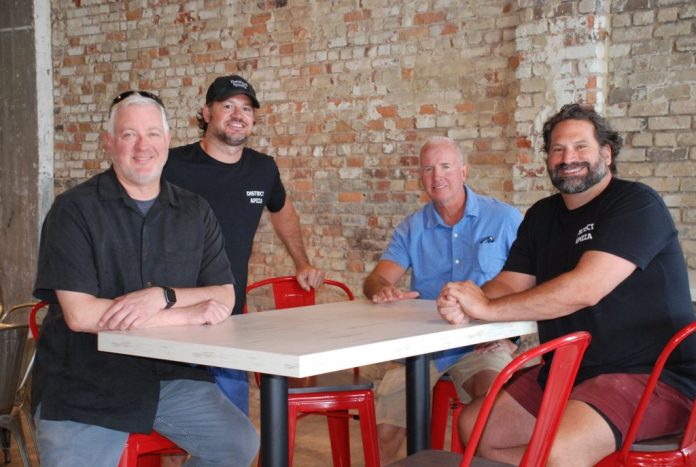
John Williams, general manager, and co-owners Rich Coleman, Mike Kreider and Matt Albano are set to open District Apizza in mid-August in Norfolk's Railroad District. (Sandra J. Pennecke/Staff)
John Williams, general manager, and co-owners Rich Coleman, Mike Kreider and Matt Albano are set to open District Apizza in mid-August in Norfolk’s Railroad District. (Sandra J. Pennecke/Staff)

Gaining popularity, primarily along the East Coast, Albano said he is excited to bring the pizza to the designated historical district that he and his partners see as an up and coming vibrant and energetic area in Hampton Roads.

District Apizza is housed in a former tractor supply building that dates back to circa 1920. It was most recently the site for the nonprofit organization ForKids’ thrift store, Good Mojo.

The trio signed the lease in late June 2022 for the 7,200-square-foot building and began the build-out following the landlord’s work on water lines, gas lines, heating and air conditioning and plumbing.

With an indoor seating capacity of 168, including tables, high tops and bar seating, the space boasts a traditional feel with a mix of original tiles covering its floor and white washed bricks poking through the walls.

John Williams, general manager, said he’s been busy with all different aspects of readying the restaurant for its opening, including hiring and training a team of roughly 50.

In time, the trio wants to invite local bands to bring their talents to the restaurant.

For now, Albano said the pizza will be the star of the show and he’s fired up to introduce it to Hampton Roads.

Sandra J. Pennecke, 757-652-5836, [email protected]

Northwestern hires former Attorney General Loretta Lynch to investigate athletic department – Daily Press

0

By ANDREW SELIGMAN (AP Sports Writer)

Northwestern has hired former U.S. Attorney General Loretta Lynch to lead an investigation into the culture of its athletic department and its anti-hazing procedures following allegations of abusive behavior and racism within the football program and other teams.

Lynch, who served as Attorney General from 2015 to 2017 under former President Barack Obama, will begin her review immediately, the school announced Tuesday. She will seek input from faculty, staff, students and alumni. The university announced no timetable for the investigation but said the results will be made public, unlike those of a previous investigation commissioned by the school.

“Hazing has absolutely no place at Northwestern. Period,” Northwestern President Michael Schill said in a statement. “I am determined that with the help of Attorney General Lynch, we will become a leader in combating the practice of hazing in intercollegiate athletics and a model for other universities. We will provide all of our students with the resources and support they need and do whatever is necessary to protect their safety and ensure that our athletics program remains one we can all be proud of.”

Athletic director Derrick Gragg said his department welcomes the investigation, calling it “a critical tool in identifying the additional steps Northwestern can take to eradicate hazing.”

“By making the results of her review public, we hope our entire community will be better informed and guided as we all work to address this critical issue in college athletics,” he said.

Attorneys representing athletes suing Northwestern blasted it as a publicity stunt and questioned whether the previous investigation that led to longtime football coach Pat Fitzgerald’s firing was thorough enough.

“We have to wonder if this is nothing more than an effort to counteract negative press, and more importantly, the growing number of former Northwestern football players filing lawsuits against the University,” attorneys Ben Crump, Steve Levin and Margaret Battersby Black said. “The University’s top priority should have been, and should be, doing right by the victims of these despicable acts and eradicating hazing from their campus. And they can start by being transparent and releasing the full report from the first investigation to the public.”

Lynch, who works for the law firm Paul, Weiss, Rifkind, Wharton & Garrison, was hired in November by the Boston Bruins to investigate the NHL team’s player-vetting process after it signed prospect Mitchell Miller and then rescinded his contract offer. Miller had his draft rights relinquished by Arizona for bullying a Black classmate with developmental disabilities in middle school.

Lynch is representing the NFL in Brian Flores’ race discrimination lawsuit. She also oversaw the sprawling investigation of international soccer that was unsealed in 2015 and led to the removal of a generation of soccer leaders in North and South America, and Switzerland-based FIFA and UEFA.

Northwestern is facing lawsuits from multiple former football players as well as one from a former volleyball player who says she was physically harmed during a hazing situation and mistreated by coach Shane Davis. Attorneys representing the former Northwestern athletes have said more lawsuits will be filed.

Fitzgerald — the program’s winningest coach and a star linebacker for the Wildcats in the 1990s — was fired by Schill on July 10 after initially being suspended two weeks following an investigation by attorney Maggie Hickey of law firm ArentFox Schiff that found hazing within the program and “significant opportunities” for the coaching staff to know about it. He was replaced an interim basis by David Braun, who was hired as defensive coordinator six months earlier.

Baseball coach Jim Foster was fired July 13 amid allegations of a toxic culture that included bullying and abusive behavior. Assistant Brian Anderson, a former major leaguer who won a World Series ring with the Chicago White Sox in 2005, took over on an interim basis.

Northwestern said following Hickey’s investigation the football team would no longer hold training camp in Kenosha, Wisconsin, as it did for years and would have someone not affiliated with the program monitor the locker room.

The school said at the time it would require annual anti-hazing training for coaches, staff members and athletes with an emphasis on reporting options and the responsibility to report as well as discipline. Other measures include creating an online tool for athletes to report hazing anonymously.

___

AP college football: https://apnews.com/hub/college-football and https://apnews.com/hub/ap-top-25-college-football-poll

ODU linebacker Jason Henderson named to Nagurski Trophy watch list – Daily Press

0

COLLEGE FOOTBALL

Old Dominion linebacker Jason Henderson continues to add to his list of preseason honors after a monster 2022 season.

On Tuesday, he was included on the Bronko Nagurski Trophy watch list, the Football Writers Association of America announced. The trophy has been given annually since 1993 to the top defensive player in the country.

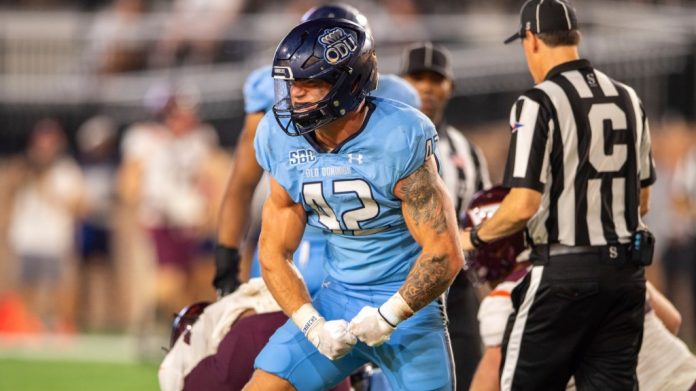
Henderson, a 6-1, 225-pound junior from Dingmans Ferry, Pennsylvania, led the nation with 186 tackles last season. He broke the ODU and Sun Belt Conference single-season records for tackles. That led to five postseason All-America honors for him.

James Madison’s James Carpenter was among five other Sun Belt players to make the Nagurski watch list.

Also on Tuesday, Henderson made College Football Network’s All-Sun Belt preseason first team.

The Monarchs’ Ethan Duane was the Punter of the Year and made the specialists first team.

ODU defensive tackle Denzel Lowry made the second team, while cornerback LaMareon James and kicker Ethan Sanchez were on the third team and center Xavier Black and safety Terry Jones earned honorable mention.

James Madison’s Nick Kidwell was Offensive Lineman of the Year, while teammate Taurus Jones was Linebacker of the Year. They both made the first team along with defensive tackle James Carpenter.

  • Linebacker John Pius was among five William & Mary players to be named to the Stats Perform FCS Preseason All-America Team. Pius was on the first team, while defensive lineman Nate Lynn and running back Bronson Yoder made the second team and cornerback Ryan Poole and long snapper Nick Levy made the third team.
  • Hampton University linebacker Qwahsin Townsend has been named to the Bluebloods’ preseason All-CAA first team. He led the Pirates with 100 tackles last season. William & Mary had six players on the first team: running back Bronson Yoder, offensive lineman Charles Grant, defensive lineman Nate Lynn, linebacker John Pius and defensive backs Ryan Poole and Jalen Jones.
  • James Madison offensive lineman Nick Kidwell and defensive lineman James Carpenter have both been named to the watch list for the Outland Trophy. The award  is presented to college football’s best interior lineman. They are the first JMU players in program history to be named to the award’s watch list.
  • Norfolk State is offering gameday cabanas for home football games this season. It will include game tickets, heavy hors d’oeuvres, beverage tickets, pre-game snacks and an unparalleled atmosphere. They can be purchased by contacting the NSU athletics office at 757-823-8152.

COLLEGE SOCCER

UVA women ranked fifth in poll

The University of Virginia women’s soccer team is ranked fifth in the United Soccer Coaches Associated preseason poll, which was released Tuesday.

The Cavaliers went 16-4-3 and advanced to an NCAA region final last season.

Meanwhile, the UVA men are ranked 15th in the USCA poll. They finished 10-4-5 last season.

In the Division III women’s poll, Virginia Wesleyan is ranked fourth and Christopher Newport is sixth.

CNU is ranked 21st in the Division III men’s poll.

Briefly

  • Pitcher DL Hall is returning to the Norfolk Tides after spending a month in Florida trying to regain his strength after a back injury, according to multiple reports. The left-hander is expected to take a reliever role initially.
  • Kyle Pope has joined the William & Mary men’s basketball staff as director of basketball operations. The former two-sport athlete at Saint Vincent College in Latrobe, Pennsylvania, comes to Williamsburg with coaching experience at the Division II and Division III levels.
  • University of Virginia women’s lacrosse coach Sonia LaMonica has announced the addition of Caylee Waters as an assistant coach. Waters is a U.S. national team member and competes professionally with Athletes Unlimited. She has been a volunteer assistant for UNC and Army.

General Daily Insight for August 02, 2023 – Daily Press

0

General Daily Insight for August 02, 2023

Acting on our impulses can bring us excitement at this time. That said, as the inspired Aquarius Moon riles up revolutionary Uranus, it might be hard to stop once the ball gets rolling! While Luna also opposes status-seeking Venus, we could worry that stepping outside society’s established patterns will hurt our reputations. Sometimes change is necessary, even if it’s uncomfortable in the moment. After the Moon enters contemplative Pisces at 11:05 pm EDT, we can start to make sense of what’s shifted.

Aries

March 21 – April 19

Encouragement from friends could make a risky gamble sound presently enticing. As the impressionable Moon in your group sector goads reckless Uranus in your finance sector, you might be tempted to spend money that wasn’t in the budget on something speculative or just plain fun. Having a good time now and then can be worth making an exception to your rules. Even so, try to keep in mind what you’ll be at peace with after everyone else goes home for the night.

Taurus

April 20 – May 20

The family harmony you seek may need to make room for some discordant notes today. The more effort you put into portraying a polished image, the more tension is likely to erupt as the emotional Moon in your public 10th house clashes against aesthetic Venus in your domestic zone. Feelings aren’t anything to be ashamed of! They’re a vital part of being human. Embracing your quirkiness, and that of your relatives, should give everyone space to relax. You might find that you’re picture-perfect after all!

Gemini

May 21 – June 20

Keeping conversations light may be a challenge for you at the moment. Although you probably don’t want to start a fight with anyone, any little provocation could easily remind you of a divisive issue that’s been occupying your thoughts lately, tempting you to bring it up. Making a plan to do something practical, no matter how small, about the problem that’s bothering you can lower the odds that you’ll impulsively launch into a destructive rant. Better yet, you’ll potentially support a good cause!

Cancer

June 21 – July 22

Keeping your recent finances quiet is likely a wise move. Although you may see how you could spare enough to help someone else, you might not be able to control what happens next as the needy Moon in your 8th House of Sharing reaches out to unpredictable Uranus in your social sector. In most cases, a gift worth giving can wait a few days, so take whatever time you need to figure out how to share an appropriate amount without leaving yourself unprotected.

Leo

July 23 – August 22

Conflict in one of your close relationships could become public today. You may have to decide what’s more important — maintaining a flawless image or genuinely solving the problem. As the volatile Moon in your partnership sector opposes attractive Venus in your sign, you might be able to get away with claiming that the other person is unstable and causing all the trouble. If you know that’s not the whole truth, though, resentment is likely to smolder. Owning your faults can bring transformative results.

Virgo

August 23 – September 22

Putting in effort to tidy up a space no one else ever sees could bring you private satisfaction now. While the perceptive Moon in your responsible 6th house engages with aesthetic Venus in your 12th House of Secrets, your work won’t necessarily result in the thrill of hearing others’ impressed reactions. Remind yourself that it’s still a great opportunity to research and test out a new cleaning or decorating technique that previously seemed too intimidating. You can make any mistakes when no one’s looking!

Libra

September 23 – October 22

Socializing could be a lot of fun for you today. On the other hand, as the impulsive Moon in your playful 5th house provokes rebellious Uranus in your 8th House of Intimacy, staying within comfortable boundaries might be a challenge. You’re positioned exceptionally well to turn your observations of daily life into edgy humor. Under the right circumstances, the whole room may find you hilarious. Remember that some groups aren’t meant for that kind of joke. Know your audience before you let loose.

Scorpio

October 23 – November 21

Your emotional needs may conflict with your pursuit of status at present. Although you might want to live a life that meets society’s expectations in every way, sometimes that’s just not possible! As the sensitive Moon in your 4th House of Protection challenges unusual Uranus in your 7th House of Relationships, you risk blaming someone else for leading you astray. Even if they can tolerate being your scapegoat, think of the bigger picture — ask yourself if totally uncomfortable standards are truly worth upholding.

Sagittarius

November 22 – December 21

A conversation about health matters could turn in an unexpected direction without warning. As the nurturing Moon in your communication sector agitates quirky Uranus in your 6th House of Wellness, it’s not necessarily wrong to try a diet or exercise program that’s outside of the norm. Still, there’s likely to be trouble if someone feels pressured into it against their will — whether that’s you or anyone else. Keep your mind open, but make sure each person’s autonomy is respected, no matter what they choose.

Capricorn

December 22 – January 19

An offer of help from someone else could arrive at any moment, aiding your progress on a major goal of yours. Unfortunately, as the vulnerable Moon in your 2nd House of Resources squares off against independent Uranus in your expressive 5th house, you might also see the potential for your benefactor to restrict your freedom. Even though you may feel like this is your only chance to move forward, it likely isn’t. Get the answers you need to feel comfortable before you commit.

Aquarius

January 20 – February 18

You might take action that surprises someone close to you today — however, the tension has likely been brewing for a while. As the candid Moon in your sign provokes assertive Uranus in your security zone, you may realize that your needs are valid, even if they’re not always convenient for others. Disrupting the peace of your relationship probably hurts you at least as much as it hurts anyone else, but a little current conflict should prevent bigger problems in the future.

Pisces

February 19 – March 20

Taking a break from your duties can be especially refreshing for you at the moment. While the nourishing Moon in your 12th House of Rest opposes relaxed Venus in your reliable 6th house, there’s no shame in acknowledging that some of the stuff on your to-do list isn’t truly urgent. That being said, you’re probably better off telling others as little as possible about any temporary realignment of your priorities — that’s likely to trigger their resentments regarding their own workloads.

Aid efforts for Haitians suffer new blow with kidnapping of American nurse and daughter – Daily Press

0

By EVENS SANON and MEGAN JANETSKY (Associated Press)

PORT-AU-PRINCE, Haiti (AP) — Aid efforts for Haitians enduring the gang violence ravaging their nation suffered a new blow with the kidnapping of an American nurse from New Hampshire and her young daughter, who were still missing Tuesday.

Gang warfare has increasingly plagued Haiti since the 2021 assassination of President Jovenel Moïse. The killing worsened criminal control of Haiti and today the innocent are regularly killed, raped and held for ransom. A local nonprofit has documented 539 kidnappings since January, a significant rise over previous years.

That number is almost certainly underreported in Haiti, where many people fear authorities in addition to the gangs. Hospitals and other aid organizations — often the only institutions in the country’s many lawless areas — have increasingly been criminals’ targets. Many service providers have been forced to close, leaving a growing number of people in this country of 11.45 million without access to healthcare, food, education and other basics.

Haitians, aid providers and outside observers worry that the kidnapping of New Hampshire native Alix Dorsainvil and her daughter will turn more of the nation into a no-go zone for anyone besides gangs and the populations they torment. The Christian organization Dorsainvil works for, El Roi Haiti, has offered medical care, education and other basic services. The organization released a photo of Dorsainvil smiling happily with her arm around her husband but provided no details about the mother and their daughter.

Dorsainvil was providing medical care in El Roi Haiti’s small brick clinic late last week in a gang stronghold of the country’s capital, Port-au-Prince, when armed men burst in and seized her, witnesses told The Associated Press. The captors have demanded $1 million in ransom, a standard practice by the gangs to get money to fund operations.

“(The kidnapping) is definitely going to have a chilling impact on the work that particularly smaller aid groups do in the country,” said Renata Segura, International Crisis Group’s deputy director for Latin America and Caribbean. “People are going to be thinking about it twice before returning to those communities.”

Smaller grassroots organizations like Dorsainvil’s are particularly affected, Segura said, because they have fewer resources to deal with the violence. People in Cite Soleil protested the kidnapping, carrying signs that read, “She is doing good work in the community. free her.” Protesters marched to the medical facility where Dorsainvil was kidnapped. It had closed doors.

Doctors Without Borders last month announced that it was suspending services in one of its hospitals because some 20 armed men had burst into an operating room and snatched a patient.

“There is such contempt for human life among the conflicting parties, and such violence in Port-au-Prince, that even the vulnerable, sick and wounded are not spared,” Mahaman Bachard Iro, the organization’s head of programmes in Haiti, wrote in a statement. “How are we supposed to be able to continue providing care in this environment?

Residents of an adjoining neighborhood, Tabarre, were wondering Tuesday if aid groups’ temporary closures will become permanent.

“People are probably dying without basic services because they cannot afford to go to a private hospital,” 39-year-old bus driver Donald Saintilus said.

Hospitals have told the AP that they now see patients arriving in dire condition due to lack of medical care. The United Nations said in February that violence had “severely hampered” access to health services.

Segura, of the International Crisis Group, said fewer women have given birth in hospitals, which could boosting infant and maternal deaths. She also said that gangs have been trying to provide aid services to the communities they terrorize in an effort to project a sort of Robin Hood image.

The international community has attempted to address Haitian disorder in the past, with some success, and Kenya’s Foreign Ministry said Saturday that it had offered 1,000 police to help train and assist the Haitian National Police “restore normalcy in the country and protect strategic installations.”

State Department spokesman Matthew Miller wouldn’t provide details Monday on what was being done to locate and recover Dorsainvil and her daughter. Haitian authorities have not responded to multiple called and messages from the AP.

“Obviously, the safety and security of American citizens overseas is our highest priority. We are in regular contact with the Haitian authorities. We’ll continue to work with them and our US government interagency partners, but because it’s an ongoing law enforcement investigation, there’s not more detail I can offer,” Miller wrote in a statement Monday.

In a video for the El Roi Haiti website, Alix Dorsainvil describes Haitians as “full of joy, and life and love” and people she was blessed to know.

Dorsainvil graduated from Regis College in Weston, Massachusetts, which has a program to support nursing education in Haiti. Dorsainvil’s father, Steven Comeau, reached in New Hampshire, said he could not talk.

In a blog post Monday, El Roi Haiti said Alix Dorsainvil fell in love with Haiti’s people on a visit after the devastating 2010 earthquake in the Caribbean. It said the organization was working with authorities in both countries to free her and her daughter.

“Please continue to pray with us for the protection and freedom of Alix and her daughter. As our hearts break for this situation, we also continue to pray for the country and people of Haiti and for freedom from the suffering they endure daily.”

___

Janetsky reported from Mexico City. Michael Casey in Boston contributed to this report.

Lawsuit by former dancers accuses Lizzo of sexual harassment and creating a hostile work environment – Daily Press

0

LOS ANGELES (AP) — Lizzo has been sued by three former dancers who accuse the Grammy winner of sexual harassment and allege the singer and her production company created a hostile work environment.

The civil lawsuit filed Tuesday in Los Angeles County Superior Court claims Lizzo pressured the dancers to engage with nude performers at a club in Amsterdam and shamed one of them for her weight gain before firing her.

Plaintiffs Arianna Davis, Crystal Williams and Noelle Rodriguez make numerous charges including sexual, religious and racial harassment, disability discrimination, assault and false imprisonment.

The legal complaint seeks unspecified damages and names Melissa Viviane Jefferson, known professionally as Lizzo, her production company Big Grrrl Big Touring, Inc., and Shirlene Quigley, captain of the performer’s dance team.

Representatives for Lizzo didn’t immediately respond to emails seeking comment on the lawsuit.

The court filing claims that after performing a concert in Amsterdam, Lizzo and her crew attended a sexually themed show at a club in the city’s notorious Red Light District where “Lizzo began inviting cast members to take turns touching the nude performers.” During the show, Lizzo led a chant pressuring Davis to touch the breasts of one of the nude women performing at the club, the filing states.

“Finally, the chorus became overwhelming, and a mortified Ms. Davis acquiesced in an attempt to bring an end to the chants,” the complaint states. “Plaintiffs were aghast with how little regard Lizzo showed for the bodily autonomy of her employees and those around her, especially in the presence of many people whom she employed.”

Lizzo, who routinely champions body positivity, is also accused of calling out Davis for her weight gain after accusing the dancer of not being committed to her role. Davis was fired in May for recording a meeting during which Lizzo had given out notes to dancers about their performances, according to the complaint.

Quigley, who served as a judge on the singer’s reality show “Lizzo’s Watch Out for the Big Grrrls,” is accused in the lawsuit of pushing her Christian beliefs onto dancers. The court filing claims Quigley referred to Davis as a “non-believer” and told co-workers that “No job and no one will stop me from talking about the Lord.”

Earlier this year, Lizzo won the Grammy for record of the year for her hit “About Damn Time.” A global tour supporting her fourth studio album, 2022’s “Special,” wrapped up last month.

#Reviewing Is Remote Warfare Moral

0

In Chapter One, Chapa provides a history of the Predator, and its successor the Reaper, as well as of RPA warfare more generally. Chapter Two explores the concept of “riskless warfare;” asking if a pilot or sensor operator can really be a warrior if they are not exposed to death or injury. Chapa argues the RPA pilots have a warrior ethos that allows them to take life without giving up their humanity; for Chapa they are warriors in the historical sense of the term. They are not only able to take lives but also give their lives in war in return. In Chapter Three, Chapa discusses the morality and psychology of RPA warfare. Critics of RPA warfare have pointed out the distance of RPA pilots from the fight. Although RPA pilots can be as much as eight thousand miles away from the physical location of the target, their vision is only eighteen inches away. This brings up the concept of moral injury as experienced by RPA pilots, who can participate in actions that violate their deeply held views of how human beings should be treated. Furthermore, Chapa concludes that the old adage of a PlayStation mentality and the PTSD narratives for RPA pilots are neither appropriate nor relevant:

“The PlayStation mentality and the PTSD narratives are insufficient to capture the nuances of psychological distance in remote warfare. With some exceptions, the crews are emotionally engaged in their lethal work yet not ravaged by PTSD.”[1]

In Chapter 4, the decision of whom to target and the justification of killing are researched. Chapa advocates that we should decide first whether the target is a threat and second whether the use of force is proportional and necessary to neutralize it. In Chapter Five, the author introduces the role of the Joint Terminal Attack Controller (JTAC) who grants airmen the ability to release a weapon with the consent of the ground force’s commander. RPA pilots and sensor operators can disagree with the JTACs’ decisions, although this may cause an awkward situation for all parties involved. Chapa defines a judgment gap between the parties as “the distance between the point of application of human judgment and the effects of judgment.”[2] To him, RPA pilots and sensor operators make decisions on whom to target and their judgment gap is much smaller than traditional soldiers. Chapter Six addresses whether RPA warfare is cowardly and Chapa argues that both traditional warriors (like infantrymen) and RPA warriors are held to similar standards. Unlike traditional warriors, RPA warriors must respect human dignity to protect themselves from the moral injury of war. Moral injury occurs when a person does, participates in, or witnesses actions that transgress their value system of how human beings should be treated. The future of RPA warfare is addressed in Chapter Seven. Chapa cautions that the United States needs to be careful with the use of artificial intelligence and the proliferation of RPA to other nations. As the RPA battlefield enlarges, so will the need for the evaluation of ethics, which will include necessary training and preparation for decision makers and leadership. Chapa writes:

The restraints inherent in just war theory remain our best hope of preventing the calamities of war in the age of artificial intelligence. In an era in which machines that learn will increasingly perform tasks we once thought suitable only for humans, we might take up the false belief that we can let our ethical guard down, or that we can trust the machines to act as our surrogates in the pursuit of the good. But this would be a mistake. In the looming age of artificial intelligence and war, decision makers from the army private in the field to the combatant command leadership, and even to the elected and appointed civilians who lead and oversee the military will need more training and preparation in ethics, not less.[3]

Is Remote Warfare Moral? is a thoughtful and necessary contribution to the literature on RPA warfare. The book’s biggest contribution is that of a primary source from a seasoned veteran and RPA instructor in the United States Air Force. The book also elucidates some of the ambiguity surrounding RPA warfare. The book is well-sourced and Chapa’s writing style is easy to understand for any audience. However, like any terrific book, there are always a few suggestions for improvement:

Considering that the author has a professional grasp of RPA protocol, it would have been helpful to see policy prescriptions or analysis regarding the role of RPA in foreign policy. Has the United States ethically used RPA in the War on Terror? Does Chapa have any insight on how to better use RPA concerning counterterrorism, reconnaissance, or support? Also, what type of specific ethical considerations does he predict RPA will need in the future? If policy makers and military leaders need more training regarding RPA ethics, what does that look like? What will the future RPA battlefield look like in the estimation of the author?