Johan Dominguez tossed three scoreless innings and combined with five relievers to cool off Norfolk’s offense as the Charlotte Knights defeated the Tides 4-2 on Sunday before 4,638 fans at Harbor Park.
The Knights (41-67, 6-27 in International League’s second half) snapped the Tides’ three-game winning streak. Norfolk (68-39, 20-13) still won the series 5-2, owns the best overall record in the league and is only a half-game behind first-place Lehigh Valley in the second-half standings.
The Tides were coming off a doubleheader sweep Saturday night in which they scored a combined 14 runs.
Charlotte took a 1-0 lead in the top of the first inning on Korey Lee’s RBI single and never relinquished it. Xavier Fernandez added an RBI double in the fifth and Stephen Piscotty’s run-scoring single in the sixth made it 3-0.
Norfolk scored both of its runs in the bottom of the sixth on Connor Norby’s sacrifice fly to right and Kyle Stowers’ RBI triple to center.
The Tides, though, managed only two more baserunners the rest of the way.
Norfolk’s Joey Ortiz went 2 for 4 with a run to increase his batting average to .354 this season. He has hit safely in nine of his past 10 games and has five multi-hit contests in that span.
Tides starter Bruce Zimmermann (3-4) took the loss despite allowing just an unearned run in three innings.
Norfolk is off Monday and will hit the road for the next two weeks. The Tides will visit Jacksonville for six games starting Tuesday and head to Memphis starting Aug. 15 for six more games.
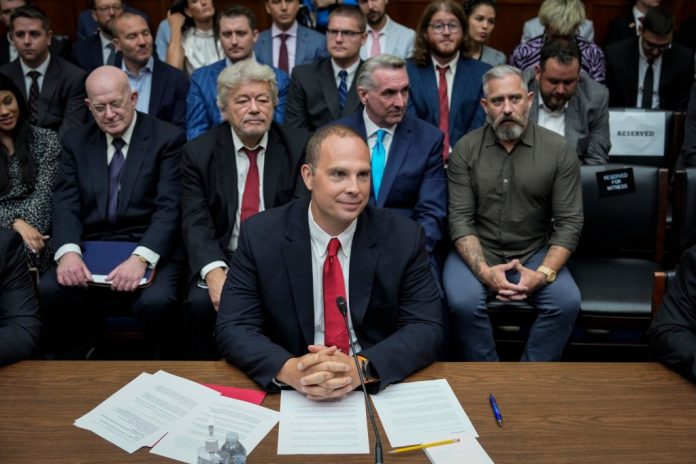
Recent congressional hearings on UAPs, more popularly known as UFOs, were unusual even by the standards of U.S. politics — in both content and style. Not only did members of the military and intelligence community claim, under oath, that truly inexplicable events occur on a regular basis, but members of Congress from both parties treated them with respect.
In all, the proceedings restored my faith in one of my favorite maxims: Sincerity is the most underrated motive in politics. The hearings themselves send the signal that it is OK to talk and even speculate about this topic — and may even help us get closer to the truth.
That is not to say that I believed everything I heard. I do not think that the U.S. government has the remains of alien spacecraft, for example, including some alien bodies, as claimed by retired Air Force Major David Grusch. But the rest of the evidence was presented in a suitably serious and persuasive manner. It is clear, at least to me, that there is no conspiracy, and the U.S. government is itself puzzled by the data about unidentified anomalous phenomena.
The most notable claim from the hearings, including from former F-18 Navy pilot Ryan Graves, is that there have been repeated sightings of highly unusual craft over eight years or more — confirmed by a mix of consistent radar, infrared and eyewitness data. These craft, some of which take the shape of a sphere encompassing a cube, can both hover and move very fast without any visible signs of propulsion.
Of course, there will always be people who lie, suffer from delusions or are otherwise unreliable. But none of these claims is news to those of us who have been following the UAP debate, and it is striking that none of the elected officials in the room challenged the Graves claims. (There was, in contrast, pushback against Grusch’s claims.)
Members of Congress, to the extent they desire, have independent access to military and intelligence sources. They also have political ambitions, if only to be reelected. So the mere fact of their participation in these hearings shows that UFOs/UAPs are now being taken seriously as an issue.
The Pentagon issued a statement claiming it holds no alien bodies, but it did nothing to contradict the statements of Graves (or others with similar claims, outside the hearings). More broadly, there have been no signs of anyone with eyewitness experience asserting that Graves and the other pilots are unreliable.
As is so often the case, the most notable events are those that did not happen. The most serious claims from the hearings survived unscathed: those about inexplicable phenomena and possible national-security threats, not the hypotheses about alien craft or visits.
The U.S. military is a huge bureaucracy that is programmed to respond to potential national-security threats. If so many insiders believe that the U.S. does not control its own airspace, and in the proximity of its own military equipment, that is a crisis of sorts, even if those insiders are misunderstanding the data.
If you listen to the beginning of the hearings, you will hear a good articulation of the position that possible national-security and aviation-safety threats cannot go forever uninvestigated. It is striking how often the discussion turned to national security.
Every now and then, it’s appropriate to take the government literally.
I suspect that, from here on out, this topic will become more popular — and somewhat less respectable. A few years ago, UAPs were an issue on which a few people “in the know” could speculate, secure in the knowledge they weren’t going to receive much publicity or pushback. As the chatter increases, the issue will become more prominent, but at the same time a lot of smart observers will dismiss the whole thing because they heard that someone testified before Congress about seeing dead aliens.
I am well aware that many people may conclude that some U.S. officials, or some parts of the U.S. government, have gone absolutely crazy. But even under that dismissive interpretation, it is likely that there will be further surprises.
Tyler Cowen is a Bloomberg Opinion columnist. He is a professor of economics at George Mason University and writes for the blog Marginal Revolution.
Greta Gerwig should be feeling closer to fine these days. In just three weeks in theaters, “Barbie” is set to sail past $1 billion in global ticket sales, breaking a record for female directors that was previously held by Patty Jenkins, who helmed “Wonder Woman.”
“Barbie,” which Gerwig directed and co-wrote, added another $53 million from 4,178 North American locations this weekend and $74 million internationally, bringing its global total to $1.03 billion, according to studio estimates on Sunday. The Margot Robbie-led and produced film has been comfortably seated in first place for three weeks and it’s hardly finished yet. It crossed $400 million domestic and $500 million internationally faster than any other movie at the studio, including the Harry Potter films.
“As distribution chiefs, we’re not often rendered speechless by a film’s performance, but Barbillion has blown even our most optimistic predictions out of the water,” said Jeff Goldstein and Andrew Cripps, who oversee domestic and international distribution for the studio, in a joint statement.
In modern box office history, just 53 movies have made over $1 billion, not accounting for inflation, and “Barbie” is now the biggest to be directed by one woman, supplanting “Wonder Woman’s” $821.8 million global total. Three movies that were co-directed by women are still ahead of “Barbie,” including “Frozen” ($1.3 billion) and “Frozen 2” ($1.45 billion) both co-directed by Jennifer Lee and “Captain Marvel” ($1.1 billion), co-directed by Anna Boden. But, “Barbie” has passed “Captain Marvel” domestically with $459.4 million (versus $426.8 million), thereby claiming the North American record for live-action movies directed by women.
Warner Bros. co-chairs and CEOs Michael De Luca and Pam Abdy also praised Gerwig in a statement and said the milestone, “is testament to her brilliance and to her commitment to deliver a movie that Barbie fans of every age want to see on the big screen.”
New competition came this weekend in the form of the animated, PG-rated “Teenage Mutant Ninja Turtles: Mutant Mayhem” and the Jason Statham shark sequel, “Meg 2: The Trench,” both of which were neck-in-neck with Christopher Nolan’s “Oppenheimer,” also in its third weekend, for the second-place spot.
“Meg 2” managed to sneak ahead and land in second place. It overcame its abysmal reviews to score a $30 million opening weekend from 3,503 locations. The Warner Bros. release, directed by Ben Wheatley, currently has a 29% critics’ score on Rotten Tomatoes and a B- CinemaScore from audiences. The thriller was released in 3D, which accounted for 22% of its first weekend business.
Third place went to “Oppenheimer,” which added $28.7 million from 3,612 locations in North America, bringing its domestic total to $228.6 million. In just three weeks, the J. Robert Oppenheimer biopic starring Cillian Murphy has become the highest grossing R-rated film of the year (ahead of “John Wick Chapter 4”) and the sixth-biggest of the year overall, surpassing “Ant-Man and the Wasp: Quantumania.”
“Oppenheimer” also celebrated a landmark, crossing $500 million globally in three weeks. Its worldwide tally is currently $552.9 million, which puts it ahead of “Dunkirk,” which clocked out with $527 million in 2017, and has become Nolan’s fifth-biggest movie ever. It’s also now among the four top grossing biographies ever (company includes “Bohemian Rhapsody,” “The Passion of the Christ” and “American Sniper”) and the biggest World War II movie of all time.
Paramount’s “Teenage Mutant Ninja Turtles” was close behind in fourth place with an estimated $28 million from 3,858 theaters in North America. Since opening on Wednesday, the film, which is riding on excellent reviews (96% on Rotten Tomatoes) and audience scores, has earned $43.1 million.
“This is one of those movies that is a multigenerational joy,” said Chris Aronson, Paramount’s president of domestic distribution. “I think the enduring popularity of ‘Turtles’ is showing its true colors. And there hasn’t been an animated film in eight weeks and there won’t be another for eight weeks which is great for us.”
“Turtles” cost $70 million to produce and features a starry voice cast that includes Jackie Chan, Ice Cube, Paul Rudd, Ayo Edebiri and Seth Rogen, who produced and co-wrote the film, which leans into the “teenage” aspect of the turtles.
“Barbie,” “Oppenheimer” and even the surprise, anti-trafficking hit “Sound of Freedom” (now at $163.5 million and ahead of “Mission: Impossible 7”) have helped fuel a boom at the box office, bringing in many millions more than was expected and helping to offset pains caused by some summer disappointments.
“After ‘The Flash,’ ‘Indiana Jones’ and, to a certain extent, ‘Mission: Impossible,’ people were saying the summer was a disappointment. But it’s not over yet,” said Paul Dergarabedian, the senior media analyst for Comscore. “We’re going to have a summer that is going to go out on a high note.”
But the moment of triumph for the industry will likely be short lived if the studios can’t reach an agreement with striking actors and writers soon. The fall release calendar has already gotten slimmer, with some studios pushing films into 2024 instead of trying to promote them without movie stars.
Sony had planned to release its PlayStation-inspired true story “Gran Turismo” in theaters nationwide next Friday, but will now be rolling it out slowly for two weeks before going wide on Aug. 25. The thinking? If movie stars can’t promote the film, maybe audiences can.
“We have to be realistic,” Dergarabedian said. “We’re on this emotional high of movies doing so well, but we have to temper our enthusiasm and optimism with the fact that the strike is creating a lot of uncertainty. The longer it goes on the more profound the issues become. But the audience has spoken and they love going to the movie theater.”
Estimated ticket sales for Friday through Sunday at U.S. and Canadian theaters, according to Comscore. Final domestic figures will be released Monday.
Tajh Boyd, a 19-year-old freshman football player at Liberty University and a former standout lineman at Oscar Smith High in Chesapeake, has died, according to a release from Liberty.
“Tajh joined our Liberty Football family as recently as January and his impact on the program will be felt for years to come,” Liberty coach Jamey Chadwell and athletic director Ian McCaw said in a joint statement.
No cause of death was given.
Boyd, 6-feet-4 and 315 pounds, was rated the No. 7 recruit in Hampton Roads in the Class of 2023. He was also rated the No. 18 senior in the state by both ESPN and Rivals.com and helped the Tigers finish unbeaten in the Southeastern District and 9-2 overall last season.
Boyd was part of back-to-back state championship teams during his sophomore and junior seasons.
“Tajh’s impact went far beyond statistics and accolades,” Oscar Smith coach Chris Scott said Sunday. “Yes, he was a formidable force on the football field, but it was his infectious smile, his positive energy and his ability to uplift others that truly made him larger than life.”
It is with heavy hearts that we share the news of the loss of one of our student-athletes, Tajh Boyd.
We thank God for bringing Tajh into our Liberty Athletics community and we will always remember him as a Flame. Tajh will be missed dearly.
Boyd committed to play for the Flames before his senior season.
“When you come to the Mountain, you immediately become a part of the Liberty University family and something truly special,” Chadwell and McCaw said in the release. “We thank God for bringing Tajh into our Liberty Athletics community and we will always remember him as a Flame. Tajh will be missed dearly.
“Our thoughts and prayers are with Tajh’s family, his teammates and friends, our football coaching staff as well as our entire athletics department and the greater Liberty University community. We grieve together as a family and will seek guidance, comfort and understanding from the Lord during these difficult times.”
Staff writer Larry Rubama contributed to this story.
Ralph Patricelli bought his oceanfront home in Rodanthe in September 2021 knowing it was on borrowed time. Other beachfront homes in the neighborhood had already fallen into the Atlantic Ocean, victims of years of erosion and constant storms sweeping Hatteras Island. Patricelli knew eventually, he’d have to move his second home back from the ocean.
“I felt like the house had been there since the ’80s — it’s survived hurricanes and storms for decades,” Patricelli said. “Is it really going to go anywhere for a few more years?”
Two months after he bought it, before the family had a chance to enjoy its new home even once, a storm damaged the septic system. Patricelli then found himself in a race to save the house, rushing to find the money and expert contractors needed to move it away from the waves.
It already was too late.
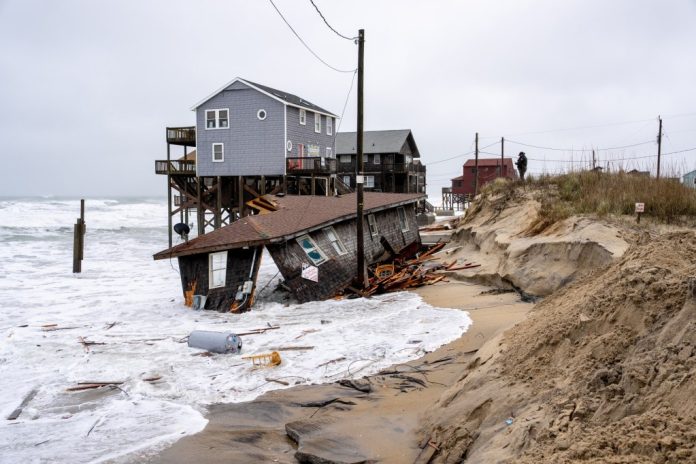
On May 10, 2022, nine months after he bought the 2,600-square-foot home at 24235 Ocean Drive, it crashed into the Atlantic Ocean during a nor’easter. His home was the first of two to fall in the ocean that day.
“It was a shock,” Patricelli said. “We lost 20 feet of beachfront in just a few months. It was incredible how fast it happened.”
Patricelli’s attempt to save his family’s dream home on a strip of sand echoes the larger-scale dilemma facing federal, state and local leaders who have worked for years to the stem the storm damage, relentless sea level rise and erosion eating away at Rodanthe, one of the northern villages of Cape Hatteras National Seashore.
But like Patricelli, will they find it’s too late?
___
Ground zero
Over the past two years, the Outer Banks have become a “ground zero” for the snowballing impact of climate change, with Rodanthe making international headlines as four beach homes have fallen into the ocean since early 2022.
Daniel Pullen/The Virginian-Pilot
Rough seas bring a one-story beach cottage down into the Atlantic Ocean on the Outer Banks Monday, March 13, 2023, the fourth home to collapse into the sea on Hatteras Island in the past year. The stretch of beach in Rodanthe is rapidly eroding, and officials are grappling with how to deal with it.
Erosion on the Outer Banks, and Hatteras Island in particular, is nothing new. It’s a constantly shifting barrier island that acts to protect the mainland from the impact of coastal storms. But over the past decade, the beach along a 1.8-mile section of Rodanthe is eroding at a rapid rate, losing 12 to 20 feet of beachfront each year, according to studies conducted for Dare County. Coupled with sea-rise levels of seven feet over the past two decades, a section of Rodanthe is quickly disappearing.
Kari Pugh
Beach houses along an endangered stetch of Ocean Drive in Rodanthe in the ocean at high tide. (Kari Pugh/staff)
At its July 17 meeting, the Dare County Board of Commissioners approved funding half of a $3 million Corps of Engineers beach nourishment feasibility study commissioned by U.S. Rep. Greg Murphy, who has pledged to come up with federal dollars for the other half.
The study aims to determine if nourishment in Rodanthe is feasible, and if so, how much it would cost. Commissioners also gave themselves an out, asking for a written guarantee from the Corps of Engineers that if at any point, the study finds beach nourishment isn’t feasible, funding will stop.
“At any stage, we could call off the dogs,” Dare County Manager Bobby Outten told the board, which voted unanimously to fund the county’s half of the study.
“The next step is to get this study done and put a price tag on it. We can start working on our state and federal governments, but we’ve got to know what to ask for.”
County officials and the National Park Service say there is no long-term strategy for the vulnerable homes along Ocean Drive, or the rapidly eroding beach, but nourishment would provide respite for perhaps five years at a time. Making it happen even once may be impossible, however.
Kari Pugh
The National Park Service closed a section of beach on Hatteras Island in Mary 2022 after two houses fell into the ocean in one day after a nor’easter. (Kari Pugh/staff)
The park service must get federal approval for such projects and the Federal Emergency Management Agency won’t provide funds for beach nourishment unless the endangered shoreline impacts transit or emergency services. The row of homes along Ocean Drive, private beach homes mostly built in the 1980s, don’t qualify.
“Little roads with houses on them are not going to be a priority,” said David Hallac, superintendent of the Outer Banks National Park sites.
A few days after two vacation homes fell into the Atlantic along Ocean Drive in Rodanthe in May 2022, tons of sand still covers the road.
Dare County officials have estimated that locally funded nourishment projects, done every five or so years, would cost about $30 million to $40 million for the endangered stretch in Rodanthe. Dare County’s beach nourishment funds, which are paid through vacation occupancy taxes, raised $15.7 million in 2022, and that was with record seasonal occupancy, Outten said — not even half the amount needed. In other parts of the Outer Banks, county nourishment funds are supplemented by tax districts, but taxing Rodanthe residents wouldn’t collect enough to make much difference.
“We’re not going to tax our way out of this,” Dare County Board of Commissioners Chair Bob Woodard told property owners at a meeting earlier this year.
For years, sandbags have been one method of holding off the ocean in Rodanthe, home to the famed blue-shuttered cottage from the 2008 film, “Nights in Rodanthe.” Two years after the movie debuted, the cottage, now called the Inn at Rodanthe, also was in danger of falling into the ocean, but was purchased and moved back from the beach.
Now, moving a house is one of the only choices left to owners of oceanfront homes on Ocean Drive. That’s not as easy as it might sound.
Some owners say they have been stymied by 18-month wait lists for companies that move houses. Others have chosen to do nothing since insurance doesn’t pay until the house collapses, county and park service officials said.
“Insurance won’t believe it’s not a rich person’s problem,” Outten said.
As he tried to save his beach house, Patricelli said he first had to find a new lot, line up contractors to move the house and make arrangements with his sister to borrow the $200,000 needed. The work and expense is too much for some owners.
“I’m just an average Joe,” Patricelli said. “I was in way over my head.”
___
‘We need to save Rodanthe’
At an emotionally charged January public meeting, residents and property owners crammed the Rodanthe community center, some begging local officials and the park service to do something to save their village.
Preserving Hatteras Island isn’t just important for tourism dollars. Hundreds of endangered sea turtles nest on Hatteras beaches, and the island is a critical habitat for several species of shorebirds, including threatened American oystercatchers and piping plovers.
“With no beach there will be no visitors, there will be no sea turtles, there will be no shore bird habitat,” said Jett Ferebee, who owns a campground on Hatteras Island. “I just think we need some federal help. Congress has billions and billions of dollars set aside for park service, we’re just looking for $20 to $30 million. We need to save Rodanthe, it’s that simple.”
But is it even possible?
Cape Hatteras National Seashore has been battling sea level rise and erosion for decades, with expensive measures taken to keep the island — which makes up about 25% of Dare County’s total occupancy-tax revenue — open for business. In April 2022, the state opened the Rodanthe Bridge, known locally as the “Jug Handle Bridge,” over the Pamlico Sound, bypassing a narrow stretch of N.C. 12 prone to ocean overwash flooding.
Photo courtesy N.C. Department of Transportation
The Atlantic Ocean washes over the dunes and N.C. 12 on Hatteras Island during a storm in 2019, A new bridge now routes travelers around the trouble spot and over the nearby Pamlico Sound. [Photo courtesy N.C. Department of Transportation.)
Now, nature is taking its course where the road used to be, and some suggest the stretch of Ocean Drive should be left to the same fate.
“In the 1980s we started this discussion about Rodanthe erosion,” Outten said. “People thought then we were just throwing money in the ocean.”
___
The inevitable
In a May study by Western Carolina University, researchers noted that Rodanthe has one of the highest erosion rates on the East Coast, and they questioned if repeated beach nourishment is possible or practical.
Nourishment projects must be done every five years, adding up to a cost of $120 million over 15 years.
“Even with beach nourishment, there will be periods of time between sand placement episodes when the beach will narrow, and the most exposed homes will be in the waves,” wrote Rob Young, director of the Program for the Study of Developed Shorelines at Western Carolina University.
The study estimated that buying out the owners of the most at-risk homes, 80 of them, would cost close to $43 million. Removing the properties would likely give Rodanthe a viable beach for another 15 to 25 years, the study showed.
“Doing nothing has resulted in numerous high-profile incidents of homes collapsing into the sea, while septic tanks are exhumed and broken open,” Young wrote. “These events cause both environmental harm and a risk to public safety and health. Clearly, doing nothing is the worst option.”
Stanley Riggs, a geologist with East Carolina University who has studied the changing North Carolina coastline for decades, says building bridges and beach nourishment projects won’t save the shoreline.
After decades of growth and development, property owners and local leaders want new sand for their beaches to keep the tourism economy churning.
“But the governments are no longer capable of subsidizing this exercise in futility, particularly when the average beach nourishment project in N.C. only lasts between 1.75 and 2.5 years,” Riggs said in an interview with the University of North Carolina Press back in 2011..
Photo courtesy of Sun Realty
The Inn and Rodanthe was the setting for the movie “Nights in Rodanthe” starring Richard Gere and Diane Lane.
”Our coastal tourism bubble is beginning to feel the consequences of long-term change, we have reached the threshold. The cost of ‘holding the line’ is rapidly escalating.”
Riggs, co-author of the book “The Battle for North Carolina’s Coast,” said the time has come to accept the inevitable: a watery future for Rodanthe.
“The forces that are involved at the land-sea-air intersection are greater than our long-term engineering abilities to protect the status quo,” he wrote. “This is both the beauty and power that draws people to the coast. So, let’s get serious and build an economy that is based upon the dynamics of change and learn to live as an equal partner with our awesome coastal system.”
Patricelli’s love of the Outer Banks hasn’t diminished, but he doesn’t think he’ll go back to Rodanthe. The pain of losing the house is too much.
“It’s a magical spot for anyone who’s spent time there,” he said. “I don’t know what the future is for Rodanthe, but I think it’s pretty grim. For our family, it was too late. Just seeing how fast it happened to us, it may be too late overall.”
___
Rodanthe timeline
May 29, 2020: A beach house at 23238 Sea Oats Drive collapses in the waves overnight. Vacationers were staying there at the time; no one was injured.
Feb. 9, 2022: A five-bedroom, three-bath beachfront home at 24183 Ocean Drive falls into the ocean. No one was there, though the home was in a vacation rental program.
March 4, 2022: Dare County officials condemn 11 beachfront homes in Rodanthe in danger of collapse, removing electrical boxes and tagging them uninhabitable.
May 10, 2022: The ocean claims two unoccupied homes within 12 hours during a spring nor’easter, the first at 24235 Ocean Drive that morning and the second at 24265 Ocean Drive that afternoon.
Jan. 8, 2023: Hundreds gather at the Rodanthe community center to hear local, state and National Park Service officials discuss what can be done about the continuing home collapses and rapid erosion along the oceanfront.
March 13, 2023: Another unoccupied house, this one at 23228 East Point Drive, falls into the ocean. The three-bedroom home had been sold to new owners in 2019.
July 17, 2023: The Dare County Board of Commissioners approves funding a Corps of Engineers beach nourishment feasibility study for the 1.8-mile stretch of endangered homes in Rodanthe.
For more than two centuries, sailors off the Virginia shores relied on pillars of light to guide them.
National Lighthouse Day honors these towers of light and their historical significance Monday. In Virginia Beach, the Cape Henry Lighthouses at Fort Story are marking the day with the one-day-only chance to climb the site’s “newer,” active lighthouse.
After all, there are two Cape Henry lighthouses.
The old lighthouse was the first federally funded public works project sanctioned by President George Washington and is made of the same limestone used to construct many of the oldest buildings in Washington. It is near the “first landing” site where English colonizers stopped before heading to Jamestown, and is regularly open to visitors.
The new Cape Henry Lighthouse, built in 1881, is still in service and is usually not open to the public. Visitors can climb the steps of both and take advantage of family activities on the grounds, learn about maritime life from museum staff and pose with Stewie the Seaturtle, the environmental mascot of the Navy. Food will be provided by The Flying Pig Food Truck and the Fort Story Girl Scouts will pouring lemonade.
The lighthouses are on an active military base, Joint Expeditionary Base Little Creek-Fort Story. A shuttle carries visitors from the security gate to the lighthouses. Visit capehenrylighthouse.org to learn more about rules and regulations for visiting the base.
Where: The Cape Henry Lighthouses, the Joint Expeditionary Base Little Creek-Fort Story, Virginia Beach. Park at Gate 8 for the shuttle; the gate is located off Atlantic Avenue just north of its intersection with 89th Street
Tickets: Climbing the newer Cape Henry Lighthouse and family activities are free. Climbing the old lighthouse starts at $8.
In 1946, reporter Marguerite Henry traveled to Chincoteague Island to write about Virginia’s wild ponies and accidentally fell in love with a trembling-legged newborn with a wet nose named Misty.
Her heart jumped into her throat and she “nearly choked,” she wrote later, when she saw the foal, “new as the morning,” lying adorably on the beach “like a slightly rumpled bath mat.” She had to have her.
The love story changed not only Henry’s life but also the culture of the thin, 7 miles of sand on the edge of the Atlantic Ocean that is Chincoteague.
Henry purchased Misty and within a year published her young adult novel “Misty of Chincoteague.” It won the John Newbery Medal and recognition as a seminal work of American children’s literature.
Earlier this year, the living legacy of that story became at risk of being lost.
The aging owners of the Beebe Ranch, where Misty spent most of her life, were forced to consider the unfathomable: selling their remaining 10.3 acres of land to developers, in the face of rising financial demands.
But then a town came together. Its grassroots campaign saved the ranch at the heart of their island — averting an ending to a story begun one afternoon 77 years ago.
Billy Schuerman
Billy Beebe points to a photo in the December 1962 edition of National Geographic that features a photo of his family and Misty at Beebe Ranch in Chincoteague. That year’s Ash Wednesday storm, which threatened the life of a pregnant Misty, had the family bringing her into the kitchen for safety. (Billy Schuerman / The Virginian-Pilot)
First, love
Henry boarded a train in 1946 near her home in Wayne, Illinois, to Chincoteague because of a chance encounter her editor had at a dinner party, according to a 1996 edition of the Eastern Shore News.
A woman at that party described witnessing this most marvelous kind of spectacle, called a “pony penning,” on a recent trip to Virginia. The editor mentioned the anecdote after Henry submitted a story about a horse. Henry wanted to see the penning for herself.
Today, Chincoteague remains synonymous with wild ponies.
Every year, herds of ponies that live on the neighboring Assateague Island are rounded up by saltwater cowboys who drive them through a small span of water to an auction ground on Chincoteague. These days, only a handful of foals are sold, but a legend surrounding the origin of the ponies still holds: They were marooned on Assateague Island after a Spanish galleon shipwrecked centuries ago.
In 1946, Henry watched as Misty’s parents paddled between the islands and later wrote, “We’d watched breathless as they were driven into the sea to swim across the channel…”
When she happened upon the newborn four days later, a palomino with a uniquely patterned coat, she felt a yearning — “I wanted desperately to take her home to write the book about her.” That led her to find Misty’s owner at the Beebe Ranch.
Henry later described meeting Clarence Beebe, who owned the ranch where he lived with his grandchildren Paul and Maureen, in the book “A Pictorial Life Story of Misty.”
She approached him near the beach where he was rounding up the herd. He turned and asked what was on her mind.
“That little mare colt’s on my mind,” she replied, “the gold one with the white map of America on her side.”
The rancher responded, “Right promisn’, ain’t she?”
But Clarence Beebe hesitated to sell her. She was awfully young. Haggling ensued.
Henry agreed to pay $150, wait to take ownership until Misty was weaned off her mother’s milk, and promised to bring Misty back to Chincoteague to be bred and live with her foals.
Four months passed before a telegram from Clarence Beebe reached Henry on — to her surprise — the morning when Misty was scheduled to arrive:
MISTY ARRIVING NOVEMBER EIGHTEEN VIA C & N W TRAIN NUMBER 3 GENEVA ILLINOIS FIVE FORTY FIVE P M
A little panicked, Henry made it to the station in time and saw Misty pull into town inside a homemade crate with a big C, for Chincoteague, painted on its side.
“There was something precious about the very sight of the crate, as if each slat had been nailed on with love and sadness,” she later wrote. “Right then I resolved to capture all that love and return it twofold in my book.
“A small sneeze from within ended my fine thoughts. My heart fell inside me.”
Henry opened the crate, caressed Misty’s muzzle and buried her hands in the pony’s woolly and wild coat. She vowed to pour her heart into nurturing the baby pony.
Billy Schuerman
A reminder, seen through the ears of a taxidermied Misty at the Museum of Chincoteague Island in March. Misty died on Oct. 16, 1972; she was 26. (Billy Schuerman / The Virginian-Pilot)
Famous name
“Misty of Chincoteague” hit bookshelves the next year, a fictional story of a girl named Maureen and her brother Paul who lived with their Grandpa Beebe on Chincoteague.
The brother and sister who love horses learn the value of hard work while earning enough money to buy a wild pony, Phantom. They succeed, but in the end, decide to release Phantom back to the herds of Assateague Island and instead keep her foal named Misty.
The book was a bestseller. It has been reprinted in 60 editions, translated into 20 languages and read by millions of children — growing Chincoteague’s fame with every generation of young readers — who daydream of riding wild ponies on windswept sands.
Many of the readers turned into adults who purchased bus, train or plane tickets to see where the real Misty was born and the book and its sequels were set.
It transformed Chincoteague’s middling tourism industry. Spectators arrived in droves and boarding houses popped up to accommodate them after the 20th Century Fox movie, “Misty,” premiered at the horse’s hometown cinema in 1961. Misty stomped hoof prints into wet cement in front of the cinema after the showing, according to the Eastern Shore News.
While Henry and Misty had their love story, Chincoteague had its own, with acclaim brought by their book.
A bronze statue of Misty frolicking, her tail swinging, was erected next to the island’s Main Street. When she died in 1972, her body was shipped to the same company that prepped Trigger — a horse co-star to Roy Rogers in Hollywood Westerns— for taxidermy, because she too deserved nothing but the best. Misty stands stuffed in a roped-off display at the Museum of Chincoteague Island.
“It’s very, very important to recognize that this means a lot to our economy here on the island,” said Jay Savage, Chincoteague town councilman and president of the museum’s board of directors. “It’s the story and it’s the ranch.
“You can’t disregard the ranch. You can’t throw it aside,” he continued. “It’s just, it’s just so, so, important to us.”
Chincoteague.com boasts, “tens of thousands” of people from all over the world still arrive to watch Pony Penning Day every summer, as they did this year on July 26.
Henry kept her promise and returned Misty to the island in 1957. Billy Beebe, 69, one of two surviving family members who own the ranch, knows the story too well.
He’s led a life saturated by pony lore.
Billy Schuerman
Billy Beebe and Drizzle at Beebe Ranch. (Billy Schuerman / The Virginian-Pilot)
Home on the ranch
Earlier this year, Billy Beebe stood next to his wife, Bonnie, feeding the four horses that live in the small pasture on the ranch that once had 100 acres. His grandfather was Clarence Beebe. Paul and Maureen Beebe were his first cousins.
Billy Beebe moved to the ranch with his mother and siblings when he was 3. The toddler’s job was to fill a large bathtub for the wild ponies to drink.
“I knew they’d be coming when I heard that thunder,” he said of their cantering hooves.
He remembers his mother charging tourists on penning day 10 cents to view Misty. She later rented out the taxidermied body. Misty died in 1972; Henry returned to the ranch for a final visit that year, before her own death in 1997.
Today, two of Misty’s descendants live on the ranch — Angel and her daughter Drizzle — along with a pony, Pearl, who was bought at an auction, and a neighbor’s horse named Mercedes.
When Clarence Beebe and then his wife, Ida, passed away, in 1957 and 1960, the ranch was divided and left to their 10 children, who sold their pieces over the years. Billy Beebe’s parents kept a portion of their land. In addition to a 42-year career at Newport News Shipbuilding, he ran a summertime museum from 1999 to 2010 about wild ponies on his and his sister’s share of the ranch. He’s spoken to tourists from New Zealand, Canada, Mexico, Germany and Japan.
“Misty actually means a piece of childhood,” he said. “We’ve seen grandmothers, mothers and children come to see Misty’s home, and all three generations have read the Misty book. It was dear to each of them, dear to their hearts.”
When Billy and his sister Barbara Gray realized they wanted to sell because of upkeep costs and familial demands, they received one informal offer of about $600,000 from a developer. Cindy Faith, the executive director of Chincoteague’s museum, became determined to stop any private sale. She wanted the Beebes to sell it to the museum.
“It’s a piece of living history that’s integral to Chincoteague,” she said.
Billy Schuerman
Billy Beebe inside a house at Beebe Ranch earlier in the year. Expecting to have to sell, he was moving generations of items from it. (Billy Schuerman / The Virginian-Pilot)
In February, she made a proposal: If the museum raised around $625,000, would the family sell to them? The Beebes said yes. But they wanted the money raised in a matter of a few months.
Faith organized small auctions of wild pony paraphernalia, and, Savage said, local restaurants offered discounts to people who donated to the ranch fund, and businesses put signs in their windows pleading for support. Donations came in from as far as France.
As small donations began pouring in, the Beebes agreed to give the museum more time.
This summer, the museum succeeded in a matching $100,000 grant challenge made by an island resident and philanthropist, David Landsberger, bringing its total fund up to $563,000. From there it soon climbed to $625,000. On June 30, the museum purchased the ranch.
“A lot of the people we’ve spoken to would escape into a Misty book, because sometimes they had horrible childhoods,” Bonnie said. “We’ve been visited by even little ol’ grandmas who never threw away their books.”
Legions have told her about how they used to lie in bed at night pretending to be asleep, reading about Chincoteague under their covers by flashlight.
“Anybody who’s read it loved to read and pretend they were Maureen or Paul, because they had the perfect childhood,” she said.
They come to the Beebe Ranch to relive those dreams, and now, still can.
MELBOURNE, Australia (AP) — The United States played its best game of this Women’s World Cup and it wasn’t good enough to stop the two-time reigning champions from being eliminated in the round of 16.
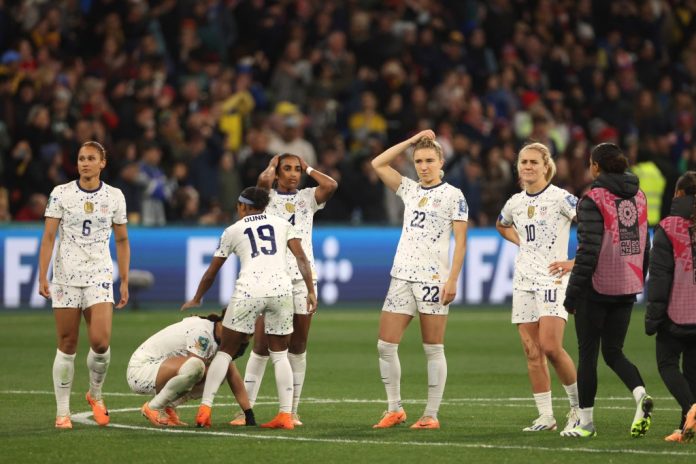
The Americans’ bid to win an unprecedented third consecutive title ended Sunday on penalty kicks. Megan Rapinoe, Sophia Smith and Kelly O’Hara missed with kicks from the penalty spot before Lina Hurtig converted to clinch the shootout 5-4 as Sweden knocked the United States out of the World Cup after a scoreless draw in regulation and extra time.
The Americans controlled the shootout until the trio of misses.
It is the earliest exit in tournament history for the United States, four-time winners of the World Cup.
“I mean, this is like a sick joke. For me personally, this is like dark comedy that I missed a penalty,” Rapinoe said as she blinked back tears. “This is the balance to the beautiful side of the game. I think it can be cruel.”
U.S. goalkeeper Alyssa Naeher fruitlessly argued she had saved Hurtig’s attempt, but it was ruled over the line by VAR. The stadium played Abba’s “Dancing Queen” in the stadium as the Swedes celebrated and the U.S. players sobbed.
“We just lost the World Cup by a millimeter. That’s tough,” said Naeher, who successfully converted her own penalty kick. “I am proud of the fight of the team. We knew we hadn’t done our best in the group stage and we wanted a complete team performance and the team came out and played great.”
She praised Sweden goalkeeper Zecira Musovic, who had 11 saves to deny the U.S. a spot in the quarterfinals. The American’s worst previous finish had been third place, three different times.
“We didn’t put anything in the back of the net,” sobbed Julie Ertz after the loss. “The penalties were tough. It’s just emotional because it’s probably my last game ever. It’s just tough. It obviously sucks. Penalties are the worst.”
The loss was somewhat expected based on the Americans’ listless play through three group-stage matches. But they played their best game of this World Cup against Sweden, only to have it decided by penalties.
“I am proud of the women on the field,” U.S. coach Vlatko Andonovski said. “I know we were criticized for the way we played, and for different moments in the group stage. I think we came out today and showed the grit, the resilience, the fight. The bravery showed we did everything we could to win the game. And, unfortunately, soccer can be cruel sometimes.”
It was the fourth time the Americans went to extra time at the World Cup. All three previous matches went to penalties, including the 2011 final won by Japan. The U.S. won on penalties in a 2011 quarterfinal match against Brazil, and in the 1999 final at the Rose Bowl against China.
Sweden knocked the United States out of the 2016 Olympics in the quarterfinals on penalties.
Sweden goes on to the quarterfinals to play Japan, which beat Norway 3-1 on Saturday night.
Sweden has never won a major global tournament, either the World Cup or the Olympics. The closest the team has come is World Cup runner-up in 2003. They placed third in the 1999, 2011 and 2019 editions, and won silver medals in the last two Olympics.
The result ended the international career of Rapinoe, the Golden Boot winner of the 2019 tournament who is retiring after the World Cup. She had taken on a smaller role in her final tournament and was a substitute in the United States’ first and third games of group play.
She went on in extra time against Sweden and in her final game and few minutes of action, she failed to control a ball played in deep, whiffed on a rebound, hit the side of the net with a corner kick and then missed the penalty that would have put the United States on the verge of victory.
“Just devastated. It feels like a bad dream,” captain Alex Morgan said. “The team put everything out there tonight. I feel like we dominated, but it doesn’t matter. We’re going home and it’s the highs and lows of the sport of soccer. So, yeah, it doesn’t feel great.”
The Americans struggled through group play with just four goals in three matches. They were nearly eliminated last Tuesday by first-timers Portugal, but eked out a 0-0 draw to fall to second in their group for just the second time at a World Cup.
The Americans looked far better against Sweden, dominating possession and outshooting the Swedes 5-1 in the first half. Lindsey Horan’s first-half header hit the crossbar and a second-half blast was saved by goalkeeper Musovic, who had six saves in regulation.
Sweden won all three of their group games, including a 5-0 rout of Italy in its final group match. Coach Peter Gerhardsson made nine lineup changes for the match, resting his starters in anticipation of the United States.
“They will come back for sure, they have so much quality on their team,” Sweden midfielder Kosovare Asllani said of the U.S. team. “This defeat will not take them down. I expect them to be ready for the next World Cup.”
It was tense from the opening whistle.
Naeher punched the ball away from a crowded goal on an early Sweden corner kick. Three of the Swedes’ goals against Italy came on set pieces.
Trinity Rodman’s shot from distance in the 18th minute was easily caught by Musovic, who stopped another chance by Rodman in the 27th.
Horan’s header off Andi Sullivan’s corner in the 34th hit the crossbar and skipped over the goal. Horan was on target in the 53rd minute but Musovic pushed it wide. Horan crouched to the field in frustration while the Sweden keeper was swarmed by her teammates.
“I had a really good feeling before the game,” Musovic said. “Once again, I’m extremely proud of the girls. Many people out there didn’t think that (win) was possible.”
___
More AP Women’s World Cup coverage: https://apnews.com/hub/fifa-womens-world-cup
HOFFMAN ESTATES, Ill. (AP) — Simone Biles spent two years trying to distance herself from those strange days in Tokyo and all the outside noise that came along with it.
She dove into therapy and slowly — very slowly — returned to training even though she wavered on whether she was really up for a third Olympics and all of the pressure and expectations that come with it when you’re considered the greatest of all time.
It wasn’t until mid-spring that she committed to training seriously after talking about it over margaritas with her coaches. It wasn’t until late June that she committed to Saturday night’s U.S. Classic. And it wasn’t until she stepped onto the podium and heard the shrieks of support and the sea of handmade signs that the noise she’d been grappling with for 732 days finally fell silent.
She was back in her safe space. Back in front of a crowd. Back in control. Back to being the Simone Biles — albeit a more mature, married, 26-year-old version — who has spent a decade redefining her sport.
Confidence growing with every rotation, Biles soared to victory in her first meet since the Tokyo Games. Her all-around score of 59.100 was five points better than runner-up Leanne Wong. And made all the more remarkable by the fact she didn’t really pour herself into preparing until after her wedding to Green Bay Packers safety Jonathan Owens in late April.
“I feel really good about where I am right now, mentally and physically,” Biles said. “I still think there are some things to work on in my routines, but for the first meet back, I would say it went pretty well. I’m very shocked. Surprised.”
She posted the best score on three of four events, turning what is typically a tune-up meet for the U.S. Championships into a showcase that she remains — when she’s at or near her best — a singular force in her sport.
The only time she seemed out of place at the NOW Arena was when she was introduced. She scrambled from one side of the floor to the other, unsure of where she was supposed to go.
The moment passed. Minutes later she raised her hands and saluted the judges. Then it was the same as it ever was for the most decorated female gymnast in history.
Rocking a black-and-white bedazzled leotard and a silicone wedding band she bought from Amazon to wear while she competes, Biles electrified a packed house that roared with every spin, every flip, and yes, twist.
While she admitted she is still a little nervous while doing the twisting elements in her routines, she certainly looked comfortable during two hours that offered a taste of what could come in the run-up to Paris next summer.
Wearing No. 231 and sporting — at least before she began competing — a necklace bearing “Owens” in tribute to her husband, she seemed equal parts relaxed and energized.
She began on uneven bars, not far from a sign featuring a goat (a symbol for “Greatest of All Time”) that read “Simone Freaking Biles.” She wasn’t perfect, nearly stalling near the end of her routine. She muscled up and stayed on and when she hit her dismount, she cut her eyes off to the side as if to say “sheesh.”
Her score of 14.000 was the third best of the competition and a signal of things to come. She was as solid and steady as ever on balance beam, where she won a bronze in Tokyo after a week of uncertainty, a medal she’s described as one of the sweetest of her career.
While never officially closing the door on Paris, at one point she was convinced her career was over. She’s spent most of the last 24 months preparing for her wedding and planning the rest of her life.
Still, the lure of the gym tugged at her, though she’s taking a more muted approach to her comeback than in 2018 or in the run-up to Tokyo in 2021.
At the moment, she’s letting her gymnastics do most of the talking. And it spoke loud and clear.
She was dynamic on floor exercise, where her tumbling passes have long been showstoppers. While she and her coaches have tweaked her routines a bit to better take advantage of the sport’s updated Code of Points, she still does some of the most challenging gymnastics in the sport typically with seemingly effortless ease.
Biles kept all three of her tumbling passes on the floor inbounds, something that was a problem at times in 2021. Her score of 14.900 included a start value of 6.8, a massive amount of difficulty. No other athlete, many of whom grew up idolizing her, had a start value higher than 5.9.
She finished with a Yurchenko double-pike vault, a roundoff onto the table followed by two back flips with her hands clasped behind her knees. It’s a vault she toyed with in 2021 hoping to pull off in Tokyo.
It never happened. It still might in Paris. She hopped a little bit after landing as the arena exploded, her 15.400 more than a full point better than any of the other 30-plus athletes managed.
The Classic is considered a warm-up of sorts. The U.S. Championships are later this month, with the world championships coming in October and the Olympics less than a year out.
She’s trying not to get too far ahead. Making it a point to enjoy what she called the “little wins.”
“I knew I could come back and hopefully have a shot,” she said. “It’s just about really taking care of my body right now. So that’s what we’re to. It’s working.”
There is plenty of time to refine things. To expand. To build. Biles’ all-around score Saturday was higher than what she posted at the same meet in 2018. What followed back then was two years of historic dominance.
More may be on the way.
___
AP coverage of the Paris Olympics: https://apnews.com/hub/2024-paris-olympic-games