Is the current rise in COVID-19 hospitalizations really the result of people moving indoors to enjoy air conditioning? Experts and journalists often make this assumption when they’re quoted in the media about the virus’s small summer “waves” or “surges” (which, this year, is really more like a small uptick). Similarly, when there’s a winter surge, it’s usually attributed to people flocking inside to escape the cold.
But whether it’s summer or winter, the explanation falls flat. Because regardless of the season, humans are generally an indoor species. And the virus is still evolving new ways to get around our immunity, most recently spinning off a new omicron subvariant called EG.5.
People live 90% of their lives indoors, said Joseph Allen, director of the healthy buildings program at Harvard School of Public Health. He’d like to see more emphasis on ventilation and filtration of indoor air to protect people from wildfire smoke and pollutants as well as viruses.
Michael Osterholm, an epidemiologist at Center for Infectious Disease Research and Policy, says there’s more to learn about the ecology of viruses — how they interact with each other and with our immune systems. He’s been critical of explanations that attribute all surges to changes in our behavior. Even when waves rose in the winter, they often fell long before the weather changed enough to allow more outdoor activities.
Even weirder is the fact that new viruses can push old ones right out of their seasonal slot. The world saw very little RSV and ordinary influenza during the winter of 2020-2021. Then those infections returned in 2022, but they peaked in the fall instead of the winter.
While some scientists attributed the lack of flu and RSV cases in 2020 and 2021 to mask-wearing, Osterholm is doubtful. For one thing, attempts at universal masking weren’t effective enough to suppress COVID during the surges.
And the same displacement of other viruses happened during the 2009 H1N1 flu pandemic. “If you look RSV, it just literally disappeared, and that carried well into 2010, and we saw no other flu viruses. Why? There were no mitigation strategies going on,” he said. Nobody was masking.
Another new variant might emerge any time, and the current variant, omicron, continues to spin off new sub-variants, the BA series giving way a series of XBB variants, recently giving way to variants called EG.5 and EG.5.1. Osterholm said he is still studying the impact of these new variants, which are on the rise around the world and became dominant in the US this week. The CDC is less equipped than it was last year to monitor new variants, because of a tapering off of efforts to gather genetic sequences of samples.
The rise in cases highlights an uncomfortable reality: We don’t — and have never had — complete control over the pandemic, even though we do have tools to reduce risk for individuals.
Early in the pandemic there was a popular notion that we’re failing a group project, the goal of which would be to conquer the virus. But ending the pandemic before the vaccines were available wasn’t realistic, and the experts led people in too many directions — not all of them helpful. Many people stayed home, disinfecting mail and groceries while railing against beachgoers and images of Swedish people in outdoor cafes. Much of that effort and the outrage was misplaced and not anchored by anything like scientific evidence.
Now that airborne transmission is well understood, people can reduce the risk to elderly friends and relatives by holding weddings and other big gatherings outdoors. People can also reduce their risk of contracting or transmitting COVID-19 (and a lot of other viruses) by wearing a tight-fitting, high-quality mask, staying home if they feel ill and washing their hands a lot. And of course, vaccines can reduce the risk of an illness becoming serious. Booster shots can be important for those at high risk.
Scientists should keep searching for an evidence-based explanation for the rise and fall of virus waves, large and small. It’s an intriguing question and the answer could prove useful. And having a clear answer would be a lot more satisfying than admitting we just don’t know.
F.D. Flam is a Bloomberg Opinion columnist covering science. She is host of the “Follow the Science” podcast.
By CLAIRE RUSH, AUDREY MACAVOY and CHRISTOPHER WEBER (Associated Press)
LAHAINA, Hawaii (AP) — Parishioners mourned the dead and prayed for the missing Sunday in Hawaii churches as communities began looking ahead to a long recovery from last week’s wildfire that demolished a historic Maui town and killed more than 90 people.
Maria Lanakila Church in Lahaina was spared from the flames that wiped out most of the surrounding community, but with search-and-recovery efforts ongoing, its parishioners attended Mass about 10 miles up the road, with the Bishop of Honolulu, the Rev. Clarence “Larry” Silva, presiding.
Taufa Samisani said his uncle, aunt, cousin and the cousin’s 7-year-old son were found dead inside a burned car. Samisani’s wife, Katalina, said the family would draw comfort from Silva’s reference to the Bible story of how Jesus’ disciple Peter walked on water and was saved from drowning.
“If Peter can walk on water, yes we can. We will get to the shore,” she said, her voice quivering.
During the Mass, Silva read a message from Pope Francis, who said he was praying for those who lost loved ones, homes and livelihoods. He also conveyed prayers for first responders.
Silva later told The Associated Press that the community is worried about its children, who have witnessed tragedy and are anxious.
“The more they can be in a normal situation with their peers and learning and having fun, I think the better off they’ll be,” Silva said.
Meanwhile, Hawaii officials urged tourists to avoid traveling to Maui as many hotels prepared to house evacuees and first responders.
About 46,000 residents and visitors have flown out of Kahului Airport in West Maui since the devastation in Lahaina became clear Wednesday, according to the Hawaii Tourism Authority.
“In the weeks ahead, the collective resources and attention of the federal, state and county government, the West Maui community, and the travel industry must be focused on the recovery of residents who were forced to evacuate their homes and businesses,” the agency said in a statement late Saturday. Tourists are encouraged to visit Hawaii’s other islands.
Gov. Josh Green said 500 hotels rooms will be made available for locals who have been displaced. An additional 500 rooms will be set aside for workers from the Federal Emergency Management Agency. Some hotels will carry on with normal business to help preserve jobs and sustain the local economy, Green said.
The state wants to work with Airbnb to make sure that rental homes can be made available for locals. Green hopes that the company will be able to provide three- to nine-month rentals for those who have lost homes.
As the death toll around Lahaina climbed to 93, authorities warned that the effort to find and identify the dead was still in its early stages. The blaze is already the deadliest U.S. wildfire in more than a century.
Crews with cadaver dogs have covered just 3% of the search area, Maui Police Chief John Pelletier said Saturday.
Lylas Kanemoto is awaiting word about the fate of her cousin, Glen Yoshino.
“I’m afraid he is gone because we have not heard from him, and he would’ve found a way to contact family. We are hoping for the best, but preparing for the worst,” Kanemoto said Sunday. Family members will submit DNA to help identify any remains.
The family was grieving the death of four other relatives. The remains of Faaso and Malui Fonua Tone, their daughter, Salote Takafua, and her son, Tony Takafua, were found inside a charred car.
“At least we have closure for them, but the loss and heartbreak is unbearable for many,” Kanemoto said.
As many as 4,500 people are in need of shelter, county officials said on Facebook, citing figures from the Federal Emergency Management Agency and the Pacific Disaster Center.
J.P. Mayoga, a cook at the Westin Maui in Kaanapali, is still making breakfast, lunch and dinner on a daily basis. But instead of serving hotel guests, he’s been feeding the roughly 200 hotel employees and their family members who have been living there since Tuesday’s fire devastated the Lahaina community just south of the resort.
His home and that of his father were spared. But his girlfriend, two young daughters, father and another local are all staying in a hotel room together, as it is safer than Lahaina, which is covered in toxic debris.
Maui water officials warned Lahaina and Kula residents not to drink running water, which may be contaminated even after boiling, and to only take short, lukewarm showers in well-ventilated rooms to avoid possible chemical vapor exposure.
“Everybody has their story, and everybody lost something. So everybody can be there for each other, and they understand what’s going on in each other’s lives,” he said of his co-workers at the hotel.
Hawaii Island Mayor Mitch Roth warned that the recovery effort will be a “marathon not a sprint.” In order to keep the effort “coordinated and thoughtful,” Roth urged Hawaii residents to contribute money to established nonprofits and hold off on donating physical items because there is not yet a reliable distribution system in place.
The latest death toll surpassed that of the 2018 Camp Fire in northern California, which left 85 dead and destroyed the town of Paradise.
The cause of the wildfires is under investigation. The fires are Hawaii’s deadliest natural disaster in decades, surpassing a 1960 tsunami that killed 61 people. An even deadlier tsunami in 1946 killed more than 150 on the Big Island.
Fueled by a dry summer and strong winds from a passing hurricane, the flames on Maui raced through parched brush covering the island.
The most serious blaze swept into Lahaina on Tuesday and destroyed nearly every building in the town of 13,000, leaving a grid of gray rubble wedged between the blue ocean and lush green slopes.
Elsewhere on Maui, at least two other fires have been burning: in south Maui’s Kihei area and in the mountainous, inland communities known as Upcountry. No fatalities have been reported from those blazes.
___
Weber reported from Los Angeles. Associated Press journalists Jennifer Kelleher in Honolulu; Rebecca Boone in Boise, Idaho; Andrew Selsky in Bend, Oregon; Bobby Caina Calvan and Beatrice Dupuy in New York; Ty O’Neil in Lahaina, Hawaii; Pat Eaton-Robb in Hartford, Connecticut; and Lisa J. Adams Wagner in Evans, Georgia, contributed to this report.
___
Associated Press climate and environmental coverage receives support from several private foundations. See more about AP’s climate initiative here. The AP is solely responsible for all content.
After dropping six consecutive games, the Norfolk Tides unleashed some frustration with a 13-7 victory Sunday afternoon over Jacksonville before 2,848 at 121 Financial Ballpark in Florida.
Grassfield High graduate Garrett Stallings (4-4) got the win despite struggling as the Tides (69-44 this season, 21-18 in the International League’s second half) gained their only victory in the six-game series against the Jumbo Shrimp (55-58, 23-16).
Maverick Handley drove in four runs and had three of Norfolk’s 16 hits, including a homer. Mayo, Connor Norby, Joey Ortiz and Lewin Diaz each scored twice and had two hits. Daz Cameron scored twice and drove in two runs.
Norfolk starter Austin Voth struck out six and walked three in three scoreless innings, giving up just one hit. The Tides were ahead 6-0 by the middle of the second inning.
Stallings gave up five earned runs, five walks and eight hits in four innings. He struck out one.
For the Shrimp, Garrett Hampson and Paul McIntosh combined for five hits and five RBIs. Jacksonville manager Daren Brown was ejected from the 3-hour, 37-minute game in the seventh inning.
The Tides are off Monday before traveling to Memphis for a six-game series against the Redbirds. It will start at 7:45 p.m. Tuesday.
Norfolk still has the top record in the IL, though the Pacific Coast League’s Oklahoma City Dodgers (73-38) now have Triple-A’s best record.
Late Saturday
Jumbo Shrimp 8, Tides 0: Edward Cabrera pitched one-hit ball over six innings and Peyton Burdick hit a three-run homer before 5,137 fans. It was only the fifth time Norfolk has been shut out this season.
Cabrera started 17 games for the Miami Marlins this season before being optioned to Jacksonville on Aug. 1 to work on control issues. He had gone 5-6 with a 4.79 ERA and had 52 walks in 77 innings with the Marlins.
But since he’s been with the Jumbo Shrimp, he’s gone 2-0 with a 1.50 ERA and 0.67 WHIP. On Saturday, he struck out 10 Tides and walked two.
Seven of the first nine Norfolk batters struck out. Norfolk didn’t get a runner into scoring position until the seventh inning.
Tides starter Bruce Zimmermann (3-5) lasted three innings, giving up two runs on five hits.
INTERNATIONAL LEAGUE SECOND-HALF STANDINGS
(through most of Sunday’s games; 1H refers to the team’s first-half record)
Team, W-L, Pct., 1H
Lehigh Valley (Phillies), 24-14, .632, -, 36-37
Worcester (Red Sox), 24-14, .632, -, 39-36
Jacksonville (Marlins), 23-16, .590, 1.5, 32-42
St. Paul (Twins), 23-16, .590, 1.5, 43-31
*Durham (Rays), 22-16, .579, 2.0, 40-35
Iowa (Cubs), 22-16, .579, 2.0, 43-30
*Gwinnett (Braves), 20-16, .556, 3.0, 33-42
Scranton/W-B (Yankees), 20-17, .541, 3.5, 34-40
c-Norfolk (Orioles), 21-18, .538, 3.5, 48-26
Buffalo (Blue Jays), 20-18, .526, 4.0, 34-41
Nashville (Brewers), 20-18, .526, 4.0, 40-34
Louisville (Reds), 20-19, .513, 4.5, 40-33
Indianapolis (Pirates), 19-19, .500, 5.0, 33-41
Rochester (Nationals), 19-20, .487, 5.5, 34-39
Columbus (Guardians), 18-20, .474, 6.0, 33-41
Toledo (Tigers), 18-21, .462, 6.5, 33-41
*Memphis (Cardinals), 17-21, .447, 7.0, 39-36
Syracuse (Mets), 13-25, .342, 11.0, 33-41
Omaha (Royals), 12-25, .324, 11.5, 38-34
*Charlotte (White Sox), 6-32, .158, 18.0, 35-40
*Does not include Sunday’s result.
c-clinched first-half title and berth in championship series in September.
PORT-AU-PRINCE, Haiti (AP) — A U.S. nurse who was released by kidnappers in Haiti last week says a Christian song called “See a Victory” became her battle cry after she and her young daughter were abducted.
Alix Dorsainvil and her child were freed Wednesday, nearly two weeks after they were snatched at gunpoint from the campus of a Christian-run school near Port-au-Prince.
El Roi Haiti, the Christian aid organization founded by Dorsainvil’s husband, said Thursday the pair were not harmed and are healthy. On Saturday, the group posted a message from Dorsainvil on its website.
“I am completely humbled by the outpouring of support and prayer for myself and my sweet baby both during and following our time in captivity,” said Dorsainvil, who is from New Hampshire. “God was so very present in the fire with us and I pray that when I find the words to tell our story, that the mighty name of Jesus may be glorified and many people will come to know his love.”
In her most difficult moments, Dorsainvil said she turned to “See a Victory” by the North Carolina-based Elevation Worship music collective.
“There’s a part that says, ‘You take what the enemy meant for evil, and you turn it for good,’” she said.
Gang warfare has increasingly plagued Haiti since the 2021 assassination of President Jovenel Moïse. The killing worsened criminal control of Haiti and people are regularly killed, raped and held for ransom. A local nonprofit has documented 539 kidnappings since January, a significant rise over previous years.
It’s not clear whether a ransom was paid in Dorsainvil’s case. El Roi Haiti and U.S. officials have not provided further details, and Haiti’s National Police did not respond to requests for comment.
CHARLOTTESVILLE — Virginia running back Mike Hollins knows he will never be the same, and he admits that the position of football on his priorities list “has shrunk.” He still can’t wait to run onto the field with his UVA brothers for their opener this season.
“I can only imagine the emotions that’ll be flowing through my body. I just — I literally can’t. I have no words because the spring game hit me like a sack of rocks, and I didn’t expect it at all, so I can only imagine,” he said. “I’m ready, though. I’m ready for it.”
Hollins, from Baton Rouge, Louisiana, was one of two survivors of a shooting last November that left three teammates dead. He was shot in the back, needed several surgeries and spent a week in the hospital before beginning a long rehabilitation.
The shootings, which also left student Marlee Morgan injured, rocked the team and the community and caused the Cavaliers to cancel their final two games.
Hollins uplifted his teammates when he returned for spring practices four months later, though he wasn’t cleared for full contact yet. That came about midway through the 15 sessions, and he scored on a 1-yard touchdown run in the spring game.
On that day, Hollins said, “I just felt free from my mind,” and all the horror planted there that November night. “I mean, it was a lot easier just to play ball.”
He celebrated the touchdown by placing the ball on the name of D’Sean Perry, painted in the end zone along with those of Lavel Davis Jr. and Devin Chandler, those killed on a school bus returning from a field trip to Washington, D.C. A former Virginia player, Christopher Jones Jr., is accused of the shootings and awaiting trial.
Throughout his recovery, which he admits is more complete physically than mentally, Hollins “has been a superhero,” roommate and fellow running back Perris Jones said. “Experiencing what he experienced and carrying himself with as much grace and perseverance as he does is inspirational to see day-in and day-out. His spirit is truly unbroken, and he embodies that every day.”
Jones and his teammates aren’t the only ones benefiting from Hollins’ return.
“He’s been a big-time inspiration. He’s been an inspiration for me, you know, on the strength of that young man to come back out and play,” defensive line coach Chris Slade said. “And he came back in the spring, and that’s big.”
Hollins knows no one would have questioned him, or any of last year’s team, had they decided not to play again or to move to another school. He also knows to keep things in perspective as they play to honor their fallen teammates.
“Us being here and being able to play again and touch the field and just come together as a team is doing that legacy justice in itself. We don’t have to go out and try to … go undefeated or win a championship,” he said.
That desire to honor their teammates has been cited by several players who decided to return, including defensive lineman Chico Bennett and Perris Jones.
“It’s a shame it has to happen in this way,” Bennett said, “but now that we’re given a platform, we’re going to make the most of it. I look forward to being able to do that and honoring them through our play and doing that to the best of our ability.”
Said Jones: “I have a debt to pay to those guys, and I plan to pay it.”
When Hollins suits up for Virginia’s game against Tennessee in Nashville on Sept. 2, he said, he will be “carrying something with me.”
“It’ll always weigh on you,” he said. “There will never be a day where you won’t remember it or feel something missing from your heart when thinking about it.”
Getting back on the field, though, surely might help.
Mirna Yamileth Valladares Flores had received little to no communication from her 13-year-old daughter’s Norfolk middle school, and was frustrated.
Valladares, who was a teacher in her native Honduras, called the school and asked for an interpreter to translate between English and Spanish. She was told no one was available.
Valladares is one of the small but growing number of Hampton Roads residents who speak primarily Spanish. Residents and citizens who speak English “less than very well,” as designated by the U.S. Census’s American Community Survey, have the right to public services and to participate in civic life, but their access is often hindered by insufficient translation and interpretation services across the seven cities.
Disappointed by the lack of communication, Valladares went to the school on her day off to try to speak with the administration. She waited for three hours for someone to interpret for her — either in person, which Valladares prefers, or over the phone from an on-demand interpretation service contracted by Norfolk Public Schools. According to Valladares, no one on staff or in the district helped her that day.
Finally, Eliana Valladares was pulled out of class to interpret.
That added insult to injury for Mirna Yamileth Valladares, who didn’t want her daughter deprived of school time or to be made responsible for interpreting between her mother and the school.
“This is not fair,” Valladares said. “She’s not supposed to be translating for me. This is something so important, for her grades, and you just tell my daughter to translate for me? That is not fair.”
Social media, newsletters, texts, emails and robocalls from the district are available in Spanish, said Michelle Washington, a Norfolk Public Schools spokesperson. The district did not respond to a request for comment on the specific incident Valladares described.
Eliana Yamileth Ortega Valladares, 13, poses at her home in Norfolk, Virginia on Saturday, July 29, 2023. Valladares is the only English speaker in her family. (Tess Crowley / The Virginian-Pilot)
Eliana Yamileth Ortega Valladares, 13, shows a print of the flag of Honduras, her home country, at her home in Norfolk, Virginia on Saturday, July 29, 2023. The flag was used last year in her first-prize winning Hispanic Heritage Month project for history class. Valladares loves history; her mother, Mirna Yamileth Valladares Flores, was a teacher in Honduras, but now works as a commercial painter in Norfolk, Virginia. (Tess Crowley / The Virginian-Pilot)
Mirna Yamileth Valladares Flores, right, and niece Misahela Nicol Flores Sevilla, 16, left, stand in the kitchen as son Ruber Aviel Ortez Valladares, 4, plays at Valladares’s home in Norfolk, Virginia on Saturday, July 29, 2023. (Tess Crowley / The Virginian-Pilot)
Mirna Yamileth Valladares Flores prepares a plate of traditional Honduran breakfast for son Ruber Aviel Ortez Valladares, 4, at her home in Norfolk, Virginia on Saturday, July 29, 2023. The breakfast included plantains, eggs, mashed beans, cheese and crema salvadoreña. (Tess Crowley / The Virginian-Pilot)
Mirna Yamileth Valladares Flores, right, niece Misahela Nicol Flores Sevilla, 16, far left, and daughter Eliana Yamileth Ortega Valladares, 13, left, watch son Ruber Aviel Ortez Valladares, 4, play at Valladares’s home in Norfolk, Virginia on Saturday, July 29, 2023. (Tess Crowley / The Virginian-Pilot)
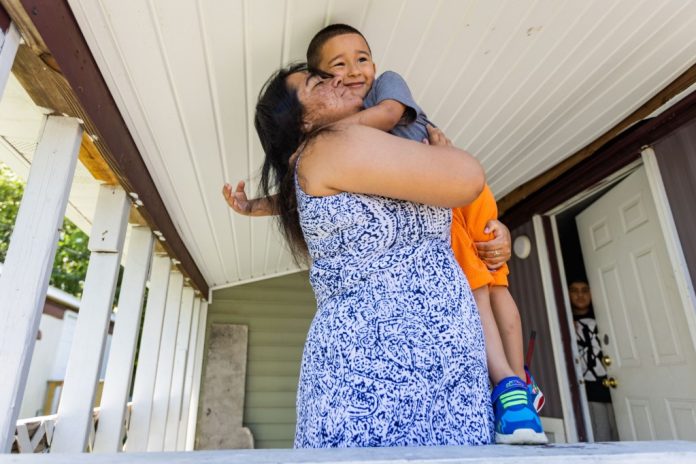
Mirna Yamileth Valladares Flores holds son Ruber Aviel Ortez Valladares, 4, at her home in Norfolk, Virginia on Saturday, July 29, 2023. (Tess Crowley / The Virginian-Pilot)
___
Here to stay
According to Jennifer Bickham Mendez, a sociologist at the College of William & Mary who studies the experiences of Latin American immigrants to the U.S. South, and Virginia in particular, this population is a significant segment of Hampton Roads.
Immigration from Mexico picked up speed in the late 1990s and early 2000s, partially due to international trade agreements, and Hampton Roads saw growth in the numbers of people from Mexico during this time. Immigrants from Mexico and Central America gained a foothold in northern Virginia in the 1980s and through the early 2000s, employed as domestic workers by well-off diplomats, Bickham Mendez said.
In 1998 and 2001, natural disasters in El Salvador and Honduras pushed more people to migrate to the U.S., where they gained Temporary Protected Status and enough stability to send for relatives. Familial connections and work opportunities drew more immigrants to Virginia, and they began to settle in Hampton Roads, where service and construction jobs were plentiful. Multiple generations now call Hampton Roads home.
According to an analysis of data from the American Community Survey, a yearly survey conducted by the U.S. Census Bureau that compiles detailed housing and population data, the number of Spanish speakers more than quadrupled across Hampton Roads between 2000 and 2010, with steady growth between 2010 and 2021, the most recent year for which data is available.
Virginia Beach is home to region’s largest population of Spanish speakers, with about 20,000 residents who speak the language, followed by Newport News and Norfolk with about 10,000 each. Within these communities is a segment of the population with limited English proficiency.
“This is a side of our community that is invisible, but present, and not going away,” Bickham Mendez said. “They’ve been here now for over 20 years. How long does it take to make these changes?”
___
Resources stretched thin
The patchwork of translation and interpretation services available does not always meet the needs of people with limited English proficiency.
Valladares said she runs into many places that provide critical services to her and her family where only English is spoken, including schools, hospitals and Department of Motor Vehicle locations, to name a few. She thinks interpretation services, ideally in person, should always be available in these places.
Mirna Yamileth Valladares Flores, right, niece Misahela Nicol Flores Sevilla, 16, far left, and daughter Eliana Yamileth Ortega Valladares, 13, left, watch son Ruber Aviel Ortez Valladares, 4, play at Valladares’s home in Norfolk, Virginia on Saturday, July 29, 2023. (Tess Crowley / The Virginian-Pilot)
“Sometimes they do not have anyone there to help me translate or interpret,” Valladares said. “Sometimes they put me in front of a camera or computer. Someone is translating over the camera, but I feel it’s not the same. I need somebody live to be there beside me.”
Bickham Mendez said experiences like Valladres’s are common for immigrants in the region.
“In Hampton Roads, resources are stretched thin, so you’re often dealing with a situation in which there’s only one or two Spanish speakers at social services, or the community organization that’s offering food assistance or an early childhood program,” she said. Schools have few bilingual staff, and, while courts are required to provide interpreters, defense attorneys may not always have access to them.
Verliz Vartolon settled in Chesapeake after immigrating from Guatemala. When she tried to apply for social services — she declined to specify which service — they did not have an interpreter who could help. Vartolon, speaking through an interpreter, said her caseworker, who only spoke English, promised to call back but never did.
Vartolon also cited issues of communicating with clinics to set up appointments for her children and filling out paperwork associated with doctor visits.
Confusing bureaucracy can add another layer of complication to accessing public services, Bickham Mendez said.
Emi Serrano, a mother of three who lives in Norfolk, ran into difficulty attempting to navigate DMV bureaucracy. It took her three visits to accomplish her business.
Speaking through an interpreter, she said the first time she went to obtain her driver’s license, she wanted to use Google Translate to ease the process but was told that wasn’t allowed. The second time, Serrano went for a state ID. Again, she said she wasn’t allowed to use Google Translate. The third time, she brought another person to interpret.
Paper exams at the DMV in Virginia are available in 26 languages, including Spanish, and the use of phones — and by extension Google Translate — is prohibited during a test. The Virginia Driver’s Manual is available only in English and Spanish.
Options for live interpretation, however, are limited. Hard of hearing DMV clients can make an appointment with a sign language interpreter, but those who need interpretation in other languages must provide their own.
By contrast, the DMV in Washington uses a phone service to provide free on-demand interpretations in 240 languages. North Carolina residents can request appointments with American Sign Language or language interpreters.
___
Trying to participate in civic life
In addition to challenges communicating with public institutions and services, a lack of language accessibility can hinder participation in civic life.
A group of parents spoke about the lack of language services to Norfolk City Council at a public hearing April 19. The group collectively spoke about the challenge of communicating with public institutions, and the meeting served to illustrate its point.
Elise Peterson McMath, a former English as a second language teacher and organizer for the nonprofit New Virginia Majority — a political group which advocates for racial, economic and environmental justice — asked that the city provide an interpreter. Her request was denied.
According to a city spokesperson, the city doesn’t always provide interpreters in part because of the low numbers of immigrants in the area. About 4,000 people who speak Spanish, or 2% of Norfolk’s population, who responded to the American Community Survey in 2021 speak English less than “very well,” meaning they checked boxes for speaking English well, not well, or not at all.
“We do not have any particular high concentrations of non-English speaking households in Norfolk. Spanish speakers comprise the largest segment, but they’re still a relatively small portion of the overall population,” Norfolk spokesperson Chris Jones wrote in an email. “Given that, we are generally not required to provide language translation services.”
Peterson McMath also requested extra time for the parents in the group to speak at the council meeting, given that they would have to use an interpreter. Community participants at council meetings are typically limited to three minutes. However, when their comments are delivered in two languages, Spanish speakers effectively have half the time.
That request also was denied, so Peterson McMath spoke rapidly in English and Spanish to interpret for the group of parents, the city council members and other meeting attendees. Requests for more time are typically granted by the mayor, Jones said.
Peterson McMath is not a professional interpreter but offers help where she can.
“If you speak Spanish, people will depend on you in ways that are professionally inappropriate, because it’s not the same thing as being a licensed interpreter,” Peterson McMath said. “Even if you’re 100% bilingual, there are certain aspects of being an interpreter that you have to follow to make sure you translate every single thing.”
When something a person says is interpreted, it’s possible their words will get summarized, conveyed inaccurately or left out altogether. An inaccurate interpretation essentially silences the person’s voice, Peterson McMath said. There’s also the risk of an untrustworthy interpreter deliberately misrepresenting a person’s words.
“If I was not a person of good moral character, I could have gone up (before council) and said, ‘She thinks your hairline is atrocious,’” Peterson McMath said. “There’s something to be said for having someone who has professional stakes in the matter.”
The City of Norfolk does provide options for language translation in other contexts, according to Jones. The Norfolk Cares hotline, a single point of contact to request city services or find out information about the city, handles 10 to 15 calls per day from Spanish speaking customers. A language line with roughly 200 languages is available for public safety calls. The city also is looking to hire and train more bilingual staff.
Other cities in Hampton Roads also do not provide language interpretation during city meetings without prior arrangement, according to clerks’ offices.
___
A federal mandate
The different types and levels of interpretation services available result from Title VI of the Civil Rights Act of 1964, which protects people from discrimination based on race, color or national origin. Under Title VI, state and local organizations that receive federal aid have a responsibility to ensure people with limited English proficiency can access their programs.
However, compliance with Title VI can take into account a number of variables, such as the number or proportion of people with limited English proficiency being served, the frequency with which non-English speaking people come into contact with the program, the importance of the program to people’s lives and the resources available to the organization.
In addition, enforcement of requirements for interpretation under Title VI is often “next to nil,” Bickham Mendez said. Some service providers might decide they don’t have to provide interpretation services based on the population size of non-English speakers in Hampton Roads.
“In my experience, schools and early childhood programs, and increasingly some social services, are more apt to understand and see that they’re not going to be able to do their jobs if they’re in denial about the proportion of Spanish speakers and non-English speakers in our area,” Bickham Mendez said.
Good translations can make all the difference.
Serrano gave birth to her youngest child in May. The hospital initially used a computer and a remote interpreter on a video call to communicate. That was somewhat helpful, Serrano said, but ultimately didn’t inspire a much confidence. The audio quality was poor and it was difficult to understand the interpreter.
On her second day at the hospital, an in-person interpreter was brought on. It was a vast improvement, and Serrano was able to ask questions about her health and the health of her newborn child.
___
Language isn’t the only barrier
Language and cultural barriers are only one element that may limit a person’s ability to access public services, Bickham Mendez said.
Questions about eligibility come into play, such as what public services a person is entitled to, depending on their residency or citizenship status. Immigrant parents are often the legal representatives of their infants and children, “but it turns out babies are terrible at filling out paperwork,” Bickham Mendez said.
There is also a layer of fear or uncertainty immigrants may experience when interacting with public entities. The worry of deportation or of incurring a public charge — a demerit for those working toward citizenship who need to prove they will not be dependent on the government — may prevent someone from accessing services.
In addition to language and interpretation services that help non-English speakers navigate daily life in Hampton Roads, Bickham Mendez emphasized the importance of educational opportunities for the children of immigrants.
“These are citizens of the United States and our future, and the United States is becoming more and more diverse,” she said. “When we’re not providing equity in terms of educational opportunities for our students, particularly students who are bilingual or learning English, we’re not just hurting the future of this entire group, but of the country.”
Valladares is hopeful for more opportunities for her community.
She would like to see at least one interpreter at each school, and she’d also like to see English as a second language classes available in the afternoons and evenings for adults.
“We are hard workers,” Valladares said. “We just came here to work and to be good people, nice people. We just need help and for someone to listen to us. We need support.”
Thania Valle interpreted interviews for this report.
LAHAINA, Hawaii (AP) — As the death toll from a wildfire that razed a historic Maui town climbed to 93, authorities warned that the effort to find and identify the dead was still in its early stages. The blaze is already the deadliest U.S. wildfire in more than a century.
Crews with cadaver dogs have covered just 3% of the search area, Maui Police Chief John Pelletier said Saturday.
“We’ve got an area that we have to contain that is at least 5 square miles, and it is full of our loved ones,” he said, noting that the number of dead is likely to grow and “none of us really know the size of it yet.”
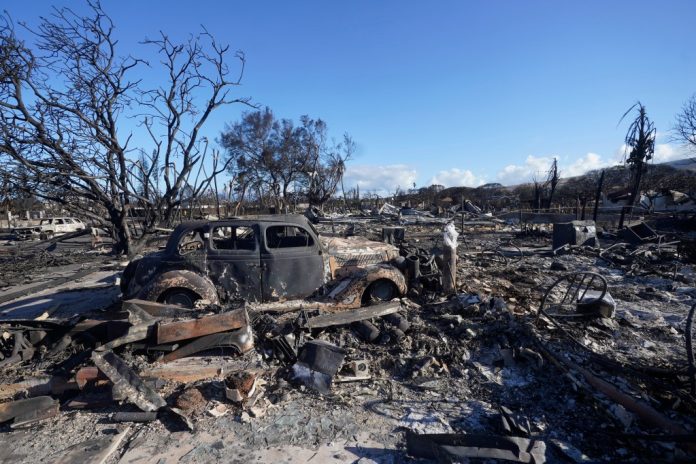
He spoke as federal emergency workers picked through the ashen moonscape left by the fire that razed the centuries-old town of Lahaina. Teams marked the ruins of homes with a bright orange “X” to indicate an initial search, and “HR” when they found human remains.
Pelletier said identifying the dead is challenging because “we pick up the remains and they fall apart.” The remains have been through “a fire that melted metal.” Only two people have been identified so far, he said.
During the search efforts, the barks of cadaver dogs alerting their handlers to potential remains echoed over the hot, colorless landscape.
“It will certainly be the worst natural disaster that Hawaii ever faced,” Gov. Josh Green said as he toured the devastation on historic Front Street. “We can only wait and support those who are living. Our focus now is to reunite people when we can and get them housing and get them health care, and then turn to rebuilding.”
At least 2,200 buildings were damaged or destroyed in West Maui, Green said, nearly all of them residential. Across the island, damage was estimated at close to $6 billion.
The Upcountry fire affected 544 structures, most of them homes, Green said.
As many as 4,500 people are in need of shelter, county officials said on Facebook, citing figures from the Federal Emergency Management Agency and the Pacific Disaster Center.
Pelletier encouraged people with missing family members to go to a family assistance center to take a DNA test.
“We need to identify your loved ones,” Pelletier said.
Those who escaped were thankful to be alive as they mourned those who didn’t make it.
Retired fire captain Geoff Bogar and his friend of 35 years, Franklin Trejos, initially stayed behind to help others in Lahaina and save Bogar’s house. But as the flames moved closer and closer Tuesday afternoon, they knew they had to flee.
Each escaped to his own car. When Bogar’s vehicle wouldn’t start, he broke through a window to get out, then crawled on the ground until a police patrol found him and brought him to a hospital.
Trejos wasn’t as lucky. When Bogar returned the next day, he found the bones of his 68-year-old friend in the back seat of his car, lying on top of the remains of the Bogars’ beloved 3-year-old golden retriever Sam, whom he had tried to protect.
Trejos, a native of Costa Rica, had lived for years with Bogar and his wife, Shannon Weber-Bogar, helping her with her seizures when her husband couldn’t. He filled their lives with love and laughter.
“God took a really good man,” Weber-Bogar said.
The latest death toll surpassed that of the 2018 Camp Fire in northern California, which left 85 dead and destroyed the town of Paradise. A century earlier, the 1918 Cloquet Fire broke out in drought-stricken northern Minnesota and raced through rural communities, destroying thousands of homes and killing hundreds.
The wildfires are the Hawaii’s deadliest natural disaster in decades, surpassing a 1960 tsunami that killed 61 people. An even deadlier tsunami in 1946, which killed more than 150 on the Big Island, prompted development of a territory-wide emergency alert system with sirens that are tested monthly.
Hawaii emergency management records do not indicate that the warning sirens sounded before fire hit the town. Officials sent alerts to mobile phones, televisions and radio stations, but widespread power and cellular outages may have limited their reach.
Fueled by a dry summer and strong winds from a passing hurricane, the wildfires on Maui raced through parched brush covering the island.
“It outpaced anything firefighters could have done in the early hours,” U.S. Fire Administrator Lori Moore-Merrell said.
The most serious blaze swept into Lahaina on Tuesday and destroyed nearly every building in the town of 13,000, leaving a grid of gray rubble wedged between the blue ocean and lush green slopes.
Maui water officials warned Lahaina and Kula residents not to drink running water, which may be contaminated even after boiling, and to only take short, lukewarm showers in well-ventilated rooms to avoid possible chemical vapor exposure.
Maui’s firefighting efforts may have been hampered by limited staff and equipment.
Bobby Lee, president of the Hawaii Firefighters Association, said there are no more than 65 county firefighters working at any given time, who are responsible for three islands: Maui, Molokai and Lanai.
Lahaina resident Riley Curran said he doubted that county officials could have done more, given the speed of the flames. He fled his Front Street home after seeing the oncoming fire from the roof of a neighboring building.
“It’s not that people didn’t try to do anything,” Curran said. “The fire went from zero to 100.”
More than a dozen people formed an assembly line on Kaanapali Beach Saturday to unload water, toiletries, batteries and other essentials from a catamaran that sailed from another part of Maui.
David Taylor, marketing director of Kai Kanani Sailing, which owns the boat, said many of the supplies were for hotel employees who lost their homes and were living with their families at their workplaces.
“The aloha still exists,” he said as the group applauded when they finished unloading the boat. “We all feel it really intensely and everybody wants to feel like they can do something.”
Caitlin McKnight, who also volunteered at an emergency shelter at the island’s war memorial, said she tried to be strong for those who lost everything.
“It was evident that those people, those families, people of the Maui ohana, they went through a traumatic event,” McKnight said, using a Hawaiian word for family. “You could just see it in their face.”
___
Kelleher reported from Honolulu, and Dupuy reported from New York. Associated Press writers Rebecca Boone in Boise, Idaho; Andrew Selsky in Bend, Oregon; Bobby Caina Calvan in New York; Audrey McAvoy in Wailuku, Hawaii; Ty O’Neil in Lahaina, Hawaii; and Lisa J. Adams Wagner in Evans, Georgia contributed to this report.
___
Associated Press climate and environmental coverage receives support from several private foundations. See more about AP’s climate initiative here. The AP is solely responsible for all content.
As Norfolk slogs through negotiations with a developer over plans for a future casino next to Harbor Park, a legal battle brought by another city business partner over casino development rights is still being waged in court.
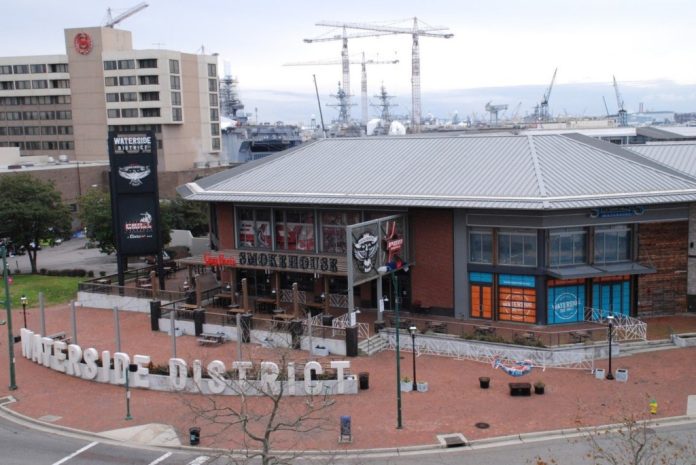
Cordish Companies, the Baltimore-based developer that revamped Waterside, sued the city in 2021, arguing Norfolk was in breach of its contract and had actively sought to exclude the location from being the site of a casino. A Richmond judge dismissed the lawsuit last year, but Cordish appealed.
At a July 12 hearing in the Court of Appeals of Virginia, representatives for the parties argued over the language of the 2013 Cordish contract with the city and the Norfolk Redevelopment and Housing Authority, and what that meant for a casino at Waterside.
Attorney John Lynch, who represents the Cordish-owned LLC, Norfolk District Associates, argued that the trial court did not take into account the scope of the Waterside lease language regarding a potential casino, according to a recording of the oral arguments. The company initially argued that it never would have agreed to do the expensive Waterside overhaul if the city had not also agreed to eventually support a casino bid from Cordish.
“If we’re going to invest $43 million at Waterside we don’t want the city of Norfolk subsidizing and competing with us on another project, which is exactly what they’re doing,” Lynch said.
The Norfolk District Associates lease agreement for Waterside says “neither the City nor NRHA will subsidize or provide a performance-based grant for a restaurant and entertainment development of over 75,000 square feet similar to the project,” for 10 years.
In court filings, the city argued the lease with Waterside never allowed use as a casino, and therefore it could not be considered similar to the HeadWaters Resort and Casino project.
“Waterside has no casino. The Lease prohibits Waterside from having a casino. And the Lease precludes the characterization of casinos as being ‘similar to’ Waterside,” attorneys wrote in the city’s appeals brief.
Norfolk approved a land deal with the Pamunkey Indian Tribe in 2019 that set the stage for the development of the HeadWaters Resort and Casino located next to Harbor Park — less than a mile from Waterside. City voters approved a referendum allowing gambling at the proposed location in 2020. But three years later, negotiations over the casino have hit numerous road bumps and plans for the project have not been approved.
The city argued in court filings that while the Waterside lease left open the possibility of negotiations to amend the lease if state law changed to allow gaming at the location, that didn’t happen, therefore it was under no obligation to help the company obtain government approvals for a casino.
The city’s legal representative, Ryan Frei, wrote in a July 19 brief that no amendment was ever made to the Waterside lease to allow a casino at the site even after the possibility of such was allowed by state law. Additionally, he reiterated that the “government approvals” in the contract referred to liquor licensing and permitting, but not a casino.
Lynch said the contract violation occurred between 2018 and 2020 when they allege the city worked via the General Assembly to oppose a mandatory request for proposal process for a casino and lined up the sale of the property slated for the HeadWaters casino at below market rate. The city still owns the land where the casino is planned, but has to sell it because the casino must be built on privately held land.
Lynch argued those actions amounted to a subsidy.
“They had duty to the (Norfolk District Associates) not to subsidize the project that is similar to this project and couldn’t subsidize it for 10 years — any project that was 75,000 square-feet, that was a restaurant or entertainment venue,” Lynch said. “That’s exactly what they did.”
In oral arguments, Frei said the city has not subsidized HeadWaters through its partnership with the tribe and by the definitions set out in the contract, a casino is not an entertainment venue.
Lynch said during arguments the city’s own contract amendments around exclusivity for the Pamunkey Indian Tribe to operate a casino in Norfolk prove Cordish’s case that the city knew it was violating the contract.
“If they thought the exclusivity provision with Cordish as not enforceable, why would they have to exclude it in an amendment with the tribe?” Lynch said. “So we believe they’ve admitted the enforceability.”
Judges Richard Y. AtLee, Doris Henderson Causey and James W. Haley, Jr. heard the arguments and will issue a ruling. At the oral arguments, the judges focused on the language in the city’s lease with Cordish, which was repeatedly referred to as the “heartbeat” of the case in briefs and the trial court’s final order.
The lawsuit, which also names City Attorney Bernard Pishko as a defendant, seeks $100 million in damages. There is no deadline for the court to make a decision.
The city of Norfolk did not provide a response to an inquiry from The Virginian-Pilot about what, if any, potential impact the legal proceedings have had on the HeadWaters project.
But a city spokesperson said in the interim, “the lease agreement at Waterside between the Norfolk Redevelopment and Housing Authority and Norfolk District Associates remains in full effect, as it has throughout the course of this litigation.”
Cordish did not respond to inquires about the case and its potential impact on the HeadWaters development.
A spokesperson for the HeadWaters casino project also declined to discuss the case.
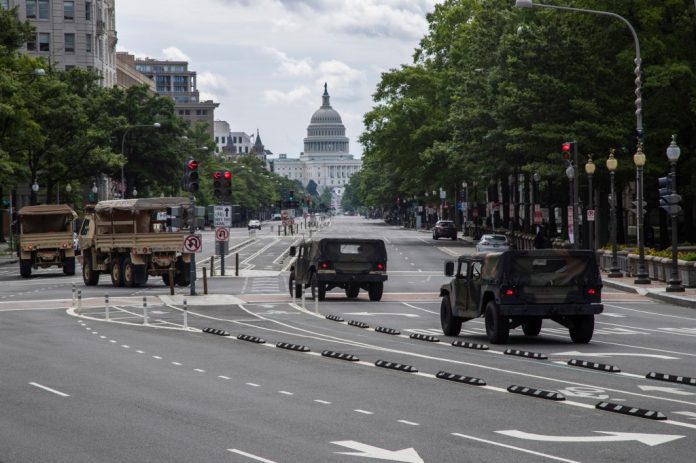
WASHINGTON (AP) — The Pentagon is developing plans to restructure the National Guard in Washington, D.C., in a move to address problems highlighted by the chaotic response to the Jan. 6 riot and safety breaches during the 2020 protests over the murder of George Floyd, The Associated Press has learned.
The changes under discussion would transfer the District of Columbia’s aviation units, which came under sharp criticism during the protests when a helicopter flew dangerously low over a crowd. In exchange, the district would get more military police, which is often the city’s most significant need, as it grapples with crowd control and large public events.
Several current and former officials familiar with the talks spoke on condition of anonymity to discuss internal deliberations. They said no final decisions have been made.
A key sticking point is who would be in control of the D.C. Guard — a politically divisive question that gets to the heart of what has been an ongoing, turbulent issue. Across the country, governors control their National Guard units and can make decisions on deploying them to local disasters and other needs. But D.C. is not a state, so the president is in charge but gives that authority to the defense secretary, who generally delegates it to the Army secretary.
According to officials, Defense Secretary Lloyd Austin is weighing two options: maintaining the current system or handing control to U.S. Northern Command, which is in charge of homeland defense.
Senior officials have argued in favor of Northern Command, which would take control out of the hands of political appointees in Washington who may be at odds with the D.C. government, and giving it to nonpartisan military commanders who already oversee homeland defense. Others, however, believe the decision-making should remain at the Pentagon, mirroring the civilian control that governors have on their troops.
The overall goal, officials said, is not to decrease the size of the district’s Guard, but reform it and ensure it has the units, equipment and training to do the missions it routinely faces. The proposal to shift the aviation forces is largely an Army decision. It would move the D.C. Air Guard wing and its aircraft to the Maryland Guard, and the Army aviation unit, with its helicopters, to Virginia’s Guard.
An Army official added that a review of the D.C. Guard examined its ability to provide rapid response, mission command and coordination with other forces when needed over the past four years. The review, which led to the recommendations, involved the District Guard and Army leaders.
D.C. Mayor Muriel Bowser’s office did not respond to a request for comment Friday on the proposed changes.
But Bowser and other local officials have long claimed that the mayor’s office should have sole authority to deploy the local guard, arguing that the D.C. mayor has the responsibilities of any governor without the extra authorities or tools.
When faced with a potential security event, the mayor of D.C. has to go to the Pentagon — usually the Army secretary — to request National Guard assistance. That was true during the violent protests in the city over the killing of George Floyd at the hands of a police officer in 2020, and later as an angry mob stormed the Capitol on Jan. 6, 2021, in an effort to overturn the election of Joe Biden as president.
As the Jan. 6 riot was unfolding, city leaders were making frantic calls to Army leaders, asking them to send Guard troops to the Capitol where police and security were being overrun. City leaders complained heatedly about delays in the response as the Pentagon considered Bowser’s National Guard request. City police ended up reinforcing the Capitol Police.
Army leaders, in response, said the district was demanding help but not providing the details and information necessary to determine what forces were needed and how they would be used.
Army officials were concerned about taking the Guard troops who were arrayed around the city doing traffic duty and sending them into a riot, because they were not prepared and didn’t have appropriate gear. And they criticized the city for repeatedly insisting it would not need security help when asked by federal authorities in the days leading up to Jan. 6.
The swirling confusion spurred congressional hearings and accusations that political considerations influenced the Trump administration’s response to the unrest in the Democratic-majority city. Defense officials rejected those charges, and blamed the city.
Within the Pentagon, however, there are broader concerns that D.C. is too quick to seek National Guard troops to augment law enforcement shortfalls in the city that should be handled by police. In recent days, a city council member suggested the D.C. Guard might be needed to help battle spiking local crime.
The restructuring is an effort to smooth out the process and avoid communications problems if another crisis erupts.
An Army investigation in April 2021 sharply criticized the D.C. Guard, saying troops lacked clear guidance and didn’t fully understand how to use helicopters appropriately during the civil unrest in June 2020.
The probe was triggered by widespread objections, including from Congress, after one of the D.C. Guard helicopters hovered low enough over protesters near the Capitol One Arena to create a deafening noise and spray protesters with rotor wash. There were also concerns that the Guard used a medivac helicopter — with medical markings — to make such a “show of force” against the crowds gathered to protest Floyd’s death.
The report found that the use of medical helicopters was appropriate because it was an emergency, but the episode raised worries among defense leaders about the need for improved planning, training and oversight of the D.C. Guard’s use of aviation and calls for a stricter approval process.
Associated Press writer Ashraf Khalil contributed to this report.