NORFOLK — How good Old Dominion might be this season remains a mystery.
Who will be the Monarchs’ starting quarterback does not.
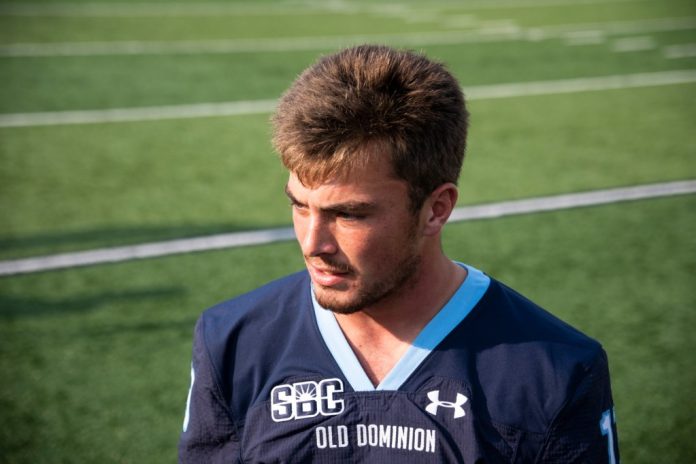
Grant Wilson, a junior transfer from Fordham who has experience in first-year offensive coordinator Kevin Decker’s up-tempo offense, will start for ODU in its Sept. 2 opener at Virginia Tech, fourth-year head coach Ricky Rahne said Tuesday.
The start will be the first in the 6-foot-3, 217-pound Wilson’s college career after he spent two seasons as a backup at Fordham.
Wilson won the job after a three-man battle with sophomore Jack Shields and true freshman Colton Joseph.
“He had a great camp,” Rahne said of Wilson during the team’s annual media day event at S.B. Ballard Stadium. “I’m excited about our quarterback room in general. I really was pleased with the quarterback play we had all camp.
“Grant’s earned it and done a nice job.”
Wilson, a native of Arlington, completed 10 of 13 passes for 93 yards and two touchdowns at Fordham, where Decker was a record-setting coordinator before joining Rahne’s staff this offseason.
“I’m still going to say I think we have a couple of quarterbacks,” Decker said, adding that Joseph has the potential to push the other two.
“Grant’s familiarity with the offense obviously helps.”
Wilson was a two-time district offensive player of the year at Yorktown High. He passed for 2,632 yards and 24 touchdowns as a high school senior.
Wilson said he models himself after former Fordham quarterback Tim DeMorat, who passed for 4,981 yards and 56 touchdowns — both school records — last season.
“I feel ready,” Wilson said. “I’m preparing the way I know how.”
PESHAWAR, Pakistan (AP) — Eight people who got trapped in a disabled cable car dangling high above a valley in Pakistan returned safely to the ground Tuesday after military commandos staged a daring and delicate rescue using helicopters and a makeshift chairlift.
The daylong ordeal began when six children got into the gondola for a trip to school. Two adults were with them. But then a cable snapped, bringing the car to a halt and trapping the group in midair. They were helpless, suspended hundreds of meters (feet) above a remote, mountainous landscape.
Six hours passed before a helicopter arrived. When the rescues began at last, at least one child who was plucked out of the car could be seen in video footage swinging at the end of a cable attached to the aircraft.
But the choppers also added an element of danger. The air currents churned up by the whirling blades risked weakening the only cable holding the car aloft and preventing it from crashing to the bottom of the river canyon in the Battagram district in Khyber Pakhtunkhwa province.
Because helicopters could not fly after sunset, rescuers eventually shifted from an airborne effort to a risky operation that involved using one cable that was still intact to approach the car with the chairlift.
Slowly, all eight people were pulled to safety.
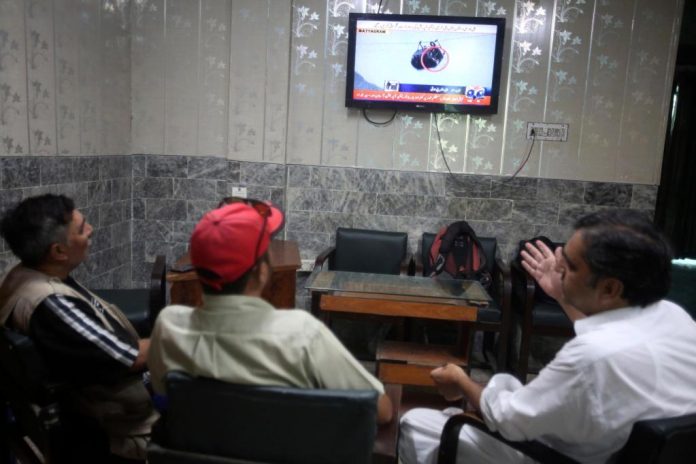
Caretaker Prime Minister Anwaar-ul-Haq Kakar congratulated the military and other rescuers for the success. The drama transfixed the country for hours as Pakistanis crowded around televisions in offices, shops, restaurants and hospitals.
“Relieved to know that … all the kids have been successfully and safely rescued,” Kakar said on X, the service formerly known as Twitter. “Great team work by the military, rescue departments, district administration as well as the local people.”
In a statement, the military said the rescue involved the commandos, pilots from the army and air force and the support of local authorities.
As the children were handed over to their families, most burst into tears, said Nazir Ahmed, a senior police officer.
“Everyone was praying for this moment,” he said. He said villagers hugged the commandos and other rescuers.
According to Pakistani TV stations, some of those trapped were in contact with their families by cellphone. Authorities said the two adults were consoling the children, who were between the ages of 11 and 15.
Food and water were supplied to the car earlier in the day, said Bilal Faizi, a spokesperson for the state-run emergency service.
Villagers frequently use cable cars to get around Pakistan’s mountainous regions. But the cars are often poorly maintained, and every year people die or are injured while traveling in them.
Kakar said he ordered safety inspections of the country’s cable cars and chairlifts.
While awaiting help, the group was hanging precariously 350 meters (1,150 feet) above ground, according to Taimoor Khan, a spokesman for the disaster management authority.
In 2017, 10 people were killed when a cable car fell into a ravine hundreds of meters (feet) deep in the popular mountain resort of Murree after its cable broke.
ATLANTA (AP) — John Eastman, the conservative attorney who pushed a plan to keep Donald Trump in power, turned himself in to authorities Tuesday on charges in the Georgia case alleging an illegal plot to overturn the former president’s 2020 election loss.
Eastman was booked at the Fulton County jail and is expected to have an arraignment in the coming weeks in the sprawling racketeering case.
He was indicted last week alongside Trump and 17 others, who are accused by District Attorney Fani Willis of scheming to subvert the will of Georgia voters in a desperate bid to keep Joe Biden out of the White House. It was the fourth criminal case brought against the Republican former president.
Trump, whose bond was set Monday at $200,000, has said he will surrender to authorities in Fulton County on Thursday. His bond conditions prohibit him from intimidating co-defendants, witnesses or victims in the case, including on social media. He has a history of assailing the prosecutors leading the cases against him, including Willis.
Eastman said in a statement provided by his lawyers that he was surrendering Tuesday “to an indictment that should never have been brought.” He criticized the indictment for targeting “attorneys for their zealous advocacy on behalf of their clients” and said each of the 19 defendants was entitled to rely on the advice of lawyers and past legal precedent to challenge the results of the election.
A former dean of Chapman University Law School in Southern California, Eastman was a close adviser to Trump in the run-up to the Jan. 6, 2021, attack on the U.S. Capitol by the president’s supporters intent on halting the certification of Biden’s electoral victory. He wrote a memo laying out steps Vice President Mike Pence could take to stop the counting of electoral votes while presiding over Congress’ joint session on Jan. 6 in order to keep Trump in office.
After the 2020 election, Eastman and others pushed to put in place a slate of “alternate” electors falsely certifying that Trump won and tried to pressure Pence to reject or delay the counting of legitimate electoral votes for Biden, a Democrat.
Bail bondsman Scott Hall, who was accused of participating in a breach of election equipment in rural Coffee County, Georgia, also turned himself in to the Fulton County Jail on Tuesday.
Two other defendants, former Justice Department lawyer Jeffrey Clark and former Georgia Republican Party chair David Shafer, have filed paperwork aiming to transfer the case to federal court. Willis has filed paperwork in Fulton County Superior Court, where the indictment was filed, seeking a March 4 trial date. Legal maneuvering, such as the attempts to move the case to federal court, could make it difficult to start a trial that soon.
Lawyers for Clark argued in their court filing Monday that he was a high-ranking Justice Department official and the actions described in the indictment “relate directly to his work at the Justice Department as well as with the former President of the United States.” Shafer’s attorneys argued that his conduct “stems directly from his service as a Presidential Elector nominee,” actions they say were “at the direction of the President and other federal officers.”
Clark’s attorneys also asked the federal court to stay any proceedings in Fulton County Superior Court — including the execution of any arrest warrant — until a determination has been made whether the case should be moved to federal court. U.S. District Judge Steve Jones gave Willis’ office until 3 p.m. Wednesday to respond.
Former White House chief of staff Mark Meadows last week made similar arguments in a federal court filing, saying his actions were taken in service to his White House role. A judge has scheduled a hearing for Monday in that case.
Meadows on Tuesday filed an emergency motion in an attempt to avoid having to turn himself in to the Fulton County Jail by the deadline at noon Friday. He asked the judge to ensure that outcome by immediately ruling that his case can be moved to federal court or by issuing an order prohibiting Willis from arresting him before Monday’s hearing.
Meadows’ motion says Willis on Tuesday morning rejected a request for an extension. She said in an email that “at 12:30 p.m. Friday I shall file warrants in the system,” he said.
Clark was a staunch supporter of Trump’s false claims of election fraud and in December 2020 presented colleagues with a draft letter pushing Georgia officials to convene a special legislative session on the election results, according to testimony before the U.S. House committee that investigated the Jan. 6 Capitol riot. Clark wanted the letter sent, but Justice Department superiors refused.
Shafer was one of 16 Georgia Republicans who signed a certificate declaring falsely that Trump had won the 2020 presidential election in the state and declaring themselves the “duly elected and qualified” electors even though Biden had won the state and a slate of Democratic electors was certified.
Shafer was one of several defendants whose lawyers negotiated bond amounts with the district attorney’s office on Tuesday. His bond was set at $75,000.
Bond was set at $100,000 for Jenna Ellis, an attorney who prosecutors say was involved in efforts to convince state lawmakers to unlawfully appoint presidential electors. Bond was set at $50,000 for Michael Roman, a former White House aide who served as a director of Trump’s Election Day operations and was involved in efforts to put forth a set of fake electors after the 2020 election.
Bond was set at $10,000 for Shawn Still, another of the fake electors who was elected to the Georgia state Senate in November 2022 and represents a district in Atlanta’s suburbs. Cathy Latham, another fake elector who also is accused of participating in a breach of election equipment in Coffee County, had a bond set at $75,000.
Norfolk schools will require most students serving long-term suspensions to attend alternative school. The school board last week approved revisions to the policy governing suspensions and expulsions, allowing for the change.
The revised policy states, “Students shall be required to attend alternative school during, and in some cases after, any period of long-term suspension, unless the division, at its sole discretion, determines that the circumstances warrant denying the student the ability to attend any school within the division during the period of the long-term suspension.”
Long-term suspensions are generally 11 to 45 days. In certain cases, long-term suspensions could extend beyond 45 days while not exceeding a year.
The revised policy also states that students or guardians “failing to enroll in and attend alternative school when ordered to do so will be treated as truant.” A warning of potential consequences for truancy will be included in suspension notices sent to students and guardians when alternative school attendance is required.
A new roof is an expensive endeavor. It’s rarely less than a four-figure job, and costs can climb as sky-high as $46,000. Of course, given the importance of a roof to a home, you shouldn’t skimp on fixing it, but it sure would be nice to save. Which leads to the thought: Can repairing/replacing your roof be a DIY project? Should you even consider doing your own roofing?
Here’s when you should, when you shouldn’t, and what you should know about roof replacements and repairs to help you decide.
Do-it-yourself roofing pros and cons
When considering a DIY roof repairs, here are some of the advantages and disadvantages to weigh.
Pros of DIY roofing
•You’ll save money: Anytime you can do a home improvement project yourself, you’ll save on labor costs. And with roofs, the labor costs are considerable — overall, often 60 percent of the price tag, according to Angi, the contractor-search site. The average expenditure for having a pro replace your roof is $10,530, vs $5,682 to do it yourself, according to the U.S. Census Bureau’s latest American Home Survey. Therefore, doing it on your own can save you almost half the cost.
•You’ll avoid delays: If you need a repair done sooner rather than later — you’re seeing leaks, feeling drafts, or noticing buckling — waiting around for a contractor might not be a luxury you have. (And you can bet some companies will charge more for rush service.) Doing it yourself allows you to address the problem fast, containing the damage and protecting your home.
Cons of DIY roofing
•Roof work is dangerous: At the risk of stating the obvious: Roofing takes place high up, and if you fall, it’s a long way down. You may think you’ve a head for heights, but traversing your roof can be tricky, especially if it has a steep slope or multiple levels. You’ll also need to be in good shape, as bending, climbing and hauling are continuously required — often under hot or windy conditions.
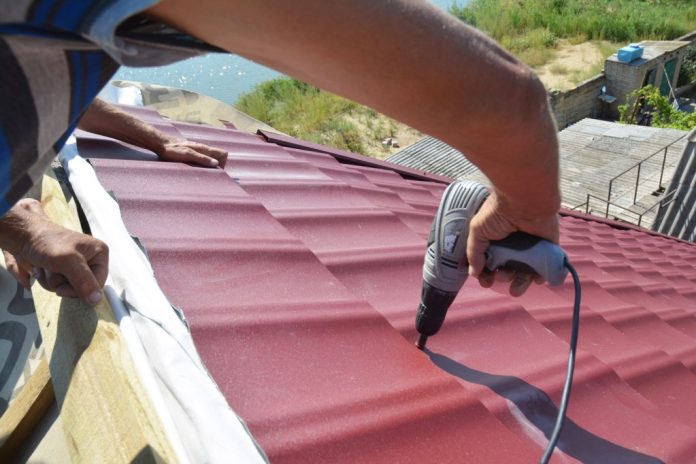
•Roof work is difficult: Being a roofer requires strength and dexterity: Bench-pressing 75 pounds at the gym is not the same as hefting 75-pound packages of shingles up a rickety ladder. And while roof work itself isn’t brain surgery, it does involve many steps and you can incur surprises along the way — like discovering some serious structural damage to the roof after you strip off the old shingles. You’re also going to need some specialized tools to make the job go easier and faster : roofing nailer, air compressor, air hose, caulk gun, extension ladder and snips, to name just a few. Be prepared to haul many of them up the ladder too.
Can you reroof a house yourself?
Replacing a roof is a large, multifaceted project: It typically involves removing the existing shingles, making spot repairs to the underlying shingles and structure, and then installing new shingles. But there are two key elements to consider to see if undertaking it yourself is worthwhile.
Roof size and orientation
The bigger your roof, the more materials you’ll need. And the more time you’ll invest in transporting and installing them.
Another factor to consider is the angle of your roof, or slope, as the pros say. Low-sloped roofs are easier to install shingles on because of their flatter angles. Conversely, higher-angled roofs are more time-consuming and difficult. If your roof has lots of extra elements, like chimneys, dormers or skylights, the job gets more complicated, too.
Roofing material
There are a variety of roofing materials to choose from, such as asphalt, metal, wood, clay, and slate. And some are kinder to DIY-ers than others. Lightweight materials like asphalt or wood shake are going to be easier to install than heavier or more ornate materials like metal or slate.
In general, asphalt shingles — though not the most glam — are affordable and surprisingly durable, lasting on average up to 30 years. If you decide to go this route, pay close attention to the hail rating, as not all asphalt shingles are the same quality. Look for ones that have a UL 2218 Class 3 or 4 rating.
Meanwhile, metal roofs offer exceptional durability of up to 50 years. And they can be hurricane and hail resistant, offering your home protection in the severest weather conditions. But with metal roofs, you cannot replace just one shingle. Instead, you have to do an entire panel based on the way they’re joined together.
Other things to consider in DIY-ing a roof job
You might need a permit before you begin work. You can check with your municipal authorities to see if they require one — and if they’ll give one to an amateur. And, if you have an HOA, make sure to receive their approval, too. They may insist on you hiring a professional.
Also, you’ll want to check your homeowner’s insurance policy. Most won’t cover roof repairs and replacements due to normal aging and wear-and-tear, but many will cover roofing damage caused by common perils, such as hail, fire, or winds. However, they may require a professional bonded and licensed roofer do any work. If your roof gets damaged further by your efforts, they might not cover that. They probably wouldn’t cover bills from any injuries you incur, either.
What sort of roof repairs can you DIY?
Frankly, replacing an entire roof is often too daunting for most DIY-ers. Repairs, however, are a different story. Here are some simple ones you can undertake with minimal investment:
Replace shingles: If a storm or winter weather or the ravages of time have damaged a few shingles (they might appear cracked or rotted), you could probably fix them up yourself. Replacing a shingle basically involves removing the nails and breaking the seal if needed. Next, remove the shingle and replace it with a fresh one.
Fix the flashing: If your roof has a chimney or dormers, it has flashing, a thin metal material used to direct water away from entry points in your home. As you inspect your shingles, give the flashing a quick examination to see if it’s leaking. If you notice any leaks, reseal its joints using a caulk gun filled with roofing cement.
How to save money on roof repairs and replacements
If roofing costs are a concern — but you’re unsure about going it alone — here are some other ways to get the project’s price in line.
•Buy the materials yourself: Usually, professional roofers provide the materials (which you pay for). But if they don’t have exactly what you want or need on hand, you could possibly save a bit by ordering and even fetching the stuff yourself from a supplier.
•Pitch in: You can do a demi-DIY job, in which you hire a roofing pro but still do some of the work — the more basic jobs, like transporting new shingles up to the roof and bringing old ones down, or carting debris away. You’ll save even more in labor costs if you can get a friend or two to play contractor’s little helper.
•Hire a general contractor: Instead of hiring a roofing company, engage a general contractor to be a guide, supervising while you undertake the work. They’ll be an invaluable resource in helping you choose the right materials in the right quantities; can help you if you encounter any snags; and save you from costly do-overs and mistakes. A general contractor could add 10 percent to 20 percent to the total project price, but it’s still cheaper than using professional roofers to do the entire job, which almost doubles your DIY cost.
The bottom line on DIY roof replacements and repairs
When it comes to roof redos, time, costs, and physical effort all shape your decision-making process.
If you’re a novice DIY-er, doing small repair jobs like replacing shingles is a wise way to learn more about how your roof works and save money. If you have more technical expertise, replacing a roof on your own will save you thousands of dollars in labor costs — but be realistic about your skill set and strength.
Also, while you might save money doing it yourself, it might take days or even weeks to finish the project. Meanwhile, pros can install a roof in as little as a day or two. So, you’ll want to weigh savings versus time to determine which is the best fit for you.
Drivers may have noticed the big green “Krem Bakery & Cafe” sign hanging on a storefront on Virginia Beach Boulevard near North Lynnhaven Road. For months, brown paper covered the windows, hiding the work going on inside.
The wait is over. The cafe is open, specializing in European desserts and baked goods such as eclairs, macarons and tarts. It also has a limited menu of breakfast and lunch items like stuffed crepes, and a ham and cheese panini sandwich.
I visited for breakfast and took some treats home for later.
Yellow flowers floated inside green vases on the tables, brightening the dining room on this cloudy drizzly day. I admired the green pillows on a bench along one wall and the brown couches with gold legs on the other side. The modern green and gold decor was inviting.
Rekaya Gibson
Syrniki, a fried Ukrainian pancake at Krem Bakery & Cafe in Virginia Beach.
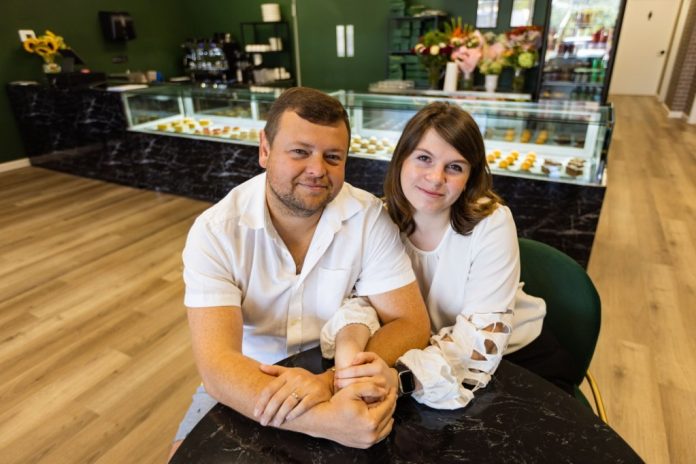
The owners are Ukrainian natives Max Kremenchugskiy and his wife, Iryna, who were cooking and working the counter. The display case was low and wide like a jewelry store counter, yet filled with goodies found in a Parisian bakery. I placed my order and sat down at one of the many black tables.
A server delivered my food with a smile. It was my first time trying syrniki, fried Ukrainian pancakes. They were made with farmer’s cheese. The golden rounds looked appetizing; I expected a smooth and creamy texture. But they crumbled with a fork and tasted like dry cottage cheese instead. The syrniki were slightly sweet but didn’t need syrup. The accompanying cream was enough. It provided an extra dose of sugar with a vanilla flavor. Good pick. I would order the dish again.
I was in nirvana for the next two days with what I took home.
I “ate” the popular lemon tart with my eyes before ingesting it. The sheen on the yellow chocolate dome made me feel like Narcissus, the god of vanity, seeing his reflection in water for the first time. I was in love. I used the back of the spoon to break the dome and dug into layers of a lemony mousse with fresh lemon pulp and gel, shortbread and frangipane with mint. The creamy sweet dessert had a zesty punch that would make the Kool-Aid Man proud. Scrumdiddlyumptious.
I enjoyed the chocolate éclair too. I cut it in half to share with my husband, Curtis. The filling looked like a cold luscious pudding. Each nibble had plenty of chocolate pastry cream unlike some I’ve had at other establishments.
At some point, I tiptoed into the kitchen for an impromptu taste test of the chocolate, strawberry and vanilla macarons. Their flavor profiles were spot-on but my favorite was the Raffaello — a bite-sized delight. It was an almond macaron with white chocolate coconut ganache that was dipped in white chocolate and coconut flakes. It was decadent. I could eat at least six of them in one sitting. Imagine my frustration lusting after the only one left for Curtis. Ugh.
The weekend wasn’t complete until I stuffed my face with the pear mousse pastry. One bite, multiple yums and a few smacking sounds escaped my lips. The chocolate exterior and the pear compote interior sent my endorphins through the roof. I never knew I needed the combo in my life. The crunchy toasted almonds, the fluffy mousse and the moist sponge cake played their parts too. Dazzling. I thought to myself: Pear doesn’t get enough love; I don’t know why people don’t use it more often.
I’m grateful for Iryna’s creativity. She first came to the United States in 2013 on a J-1 student visa and worked at the Oceanfront where she met Max, who has lived in the country since he was 8. She returned home to complete her degree and came back in 2015 on a fiancé visa. Years later, Iryna realized that she had a passion for baking and learned to perfect high-quality desserts similar to those in Europe. After the war broke out in Ukraine, she raised $25,000 in two months by selling more than 5,000 macarons to support efforts in her country. That’s when the couple knew the idea of opening a bakery would be a good move.
I concur.
Rekaya Gibson, [email protected], 757-295-8809; on Twitter, @gibsonrekaya
___
If you go
Where: 2923 Virginia Beach Blvd., Virginia Beach
Hours: 8 a.m. to 3:30 p.m. Tuesday through Saturday
Prices: Bakery items $3 to $11; breakfast $10 to $15; salads/sandwiches $9 to $13
PESHAWAR, Pakistan (AP) — Army commandos dangling from helicopters plucked two children from a broken cable car suspended hundreds of meters (feet) above a canyon Tuesday in a remote part of Pakistan, the military said. Four more children and two adults still awaited rescue as night fell.
The military said in a statement that the rescue mission was still underway. Footage on TV stations showed a child in a harness being pulled to safety. The commandos’ rope could be seen swaying in the wind against the mountainous landscape.
An expert described the rescue as extremely delicate because the wind generated by the helicopter blades could further weaken the remaining cables holding the car aloft.
Relatives of those trapped prayed while anxiously watching the operation unfold. The rescue also transfixed the country as Pakistanis crowded around televisions in offices, shops, restaurants and hospitals.
According to Pakistani TV stations, some of those trapped were in contact with their families by cellphone. Authorities said the two adults were consoling the children, who were between the ages of 11 and 15.
One of the cables snapped while the eight passengers were crossing a river canyon Tuesday morning in Battagram district in Khyber Pakhtunkhwa province. The children had been on their way to school.
Villagers frequently use cable cars to get around Pakistan’s mountainous regions. But the cars are often poorly maintained, and every year people die or are injured while traveling in them.
Helicopters were sent to attempt to pluck the people from the cable car but only after the group spent six hours precariously suspended 350 meters (1,150 feet) above ground, according to Taimoor Khan, a spokesman for the disaster management authority.
Pakistan’s caretaker prime minister, Anwaar-ul-Haq Kakar, wrote on X that he ordered authorities “to urgently ensure safe rescue and evacuation” of the eight people.
“I have also directed the authorities to conduct safety inspections of all such private chairlifts and ensure that they are safe to operate and use,” he said on the platform formerly known as Twitter.
Several helicopters hovered above the scene, and ambulances gathered on the ground.
Tipu Sultan, a retired army brigadier and defense expert, warned that the helicopters themselves could make the situation worse but that the commandos would be well aware of that risk. Khan added that the pilots were flying “carefully.”
“Let us pray that those trapped in the cable car are safely rescued,” Sultan said.
In 2017, 10 people were killed when a cable car fell into a ravine hundreds of meters (feet) deep in the popular mountain resort of Murree after its cable broke.
Mirna Valladares se sentía frustrada. Casi no había recibido información de la escuela intermedia en Norfolk, donde asiste su hija de 13 años.
Valladares, que fue maestra en su natal Honduras, llamó al colegio y solicitó un intérprete para traducir entre inglés y español. Le respondieron que nadie estaba disponible.
Valladares es parte del pequeño pero creciente número de residentes en Hampton Roads que son principalmente hispanohablantes. Tanto ciudadanos como habitantes que hablan inglés “menos que bien”, como lo designa la encuesta sobre la comunidad estadounidense del censo federal, tienen el derecho a recibir servicios públicos y a participar en la vida cívica, pero su acceso en queda obstaculizado muchas ocasiones a causa de la escasez de servicios de interpretación y traducción en las siete ciudades.
Desilusionada por la falta de comunicación, Valladares fue al colegio intermedio en su día libre para tratar de hablar con los administradores. Esperó por tres horas para que alguien le interpretara — en persona, como prefiere Valladares, o por teléfono usando el servicio de interpretación bajo demanda que contrata las escuelas públicas de Norfolk (Norfolk Public Schools). Según Valladares, ni el personal de la escuela ni del distrito pudieron atenderla ese día.
Terminaron sacando a su hija Eliana de clase para que interpretara.
Eso fue como añadir leña al fuego para Valladares, que no quería que Eliana perdiera tiempo de clase ni que se le responsabilizara de interpretar entre su mamá y la escuela.
“Eso no es justo”, exclamó Valladares. “Ella no debe estar traduciendo por mí. ¿Esto es algo tan importante para sus calificaciones, y le dicen a mi hija que traduzca? No es justo”.
Los medios sociales, boletines informativos, textos, correos electrónicos y llamadas automáticas del distrito escolar están disponibles en español, explicó Michelle Washington, vocera de Norfolk Public Schools. El distrito escolar no respondió a nuestra solicitud a comentar sobre el incidente específico que Valladares describió.
Eliana Yamileth Ortega Valladares, 13, en su hogar en Norfolk, Virginia el sábado 29 de julio de 2023. Valladares es la única en su familia que habla ingls. (Tess Crowley / The Virginian-Pilot)
Eliana Yamileth Ortega Valladares, 13, muestra una impresión de la bandera de Honduras, su pas natal, en su hogar en Norfolk, Virginia el sábado, 29 de julio de 2023. Usó la bandera para un proyecto de la clase de historia que ganó el premio de primer lugar para el mes de la herencia hispana. A Valladares le gusta la historia; su mamá, Mirna Yamileth Valladares Flores, era maestra en Honduras, pero ahora trabaja como pintora comercial en Norfolk, Virginia. (Tess Crowley / The Virginian-Pilot)
Mirna Yamileth Valladares Flores, derecha, y su sobrina Misahela Nicol Flores Sevilla, 16, izquierda, de pie en la cocina mientras su hijo Ruber Aviel Ortez Valladares, 4, juega en el hogar de Valladares home en Norfolk, Virginia el sábado, 29 de julio, 2023. (Tess Crowley / The Virginian-Pilot)
Mirna Yamileth Valladares Flores prepara un desayuno hondureño tradicional para su hijo Ruber Aviel Ortez Valladares, 4, en su hogar en Norfolk, Virginia el sábado, 29 de julio de 2023. El desayuno incluye plátanos, huevos, frijoles machacados, queso y crema salvadoreña. (Tess Crowley / The Virginian-Pilot)
Mirna Yamileth Valladares Flores, derecha, sobrina Misahela Nicol Flores Sevilla, 16, izquierda, y su hija Eliana Yamileth Ortega Valladares, 13, izquierda, ven a su hijo Ruber Aviel Ortez Valladares, 4, jugar en casa de Valladares en Norfolk, Virginia el sábado 29 de julio, 2023. (Tess Crowley / The Virginian-Pilot)
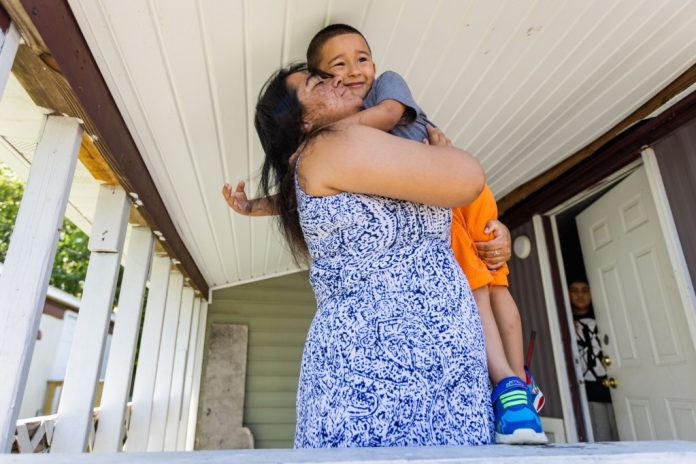
Mirna Yamileth Valladares Flores carga a su hijo Ruber Aviel Ortez Valladares, 4, en su hogar en Norfolk el sábado, 29 de julio de 2023. (Tess Crowley / The Virginian-Pilot)
___
Aquí para quedarse
Según Jennifer Bickham Méndez, socióloga de la universidad College of William & Mary que estudia las experiencias de inmigrantes latinoamericanos que viven el sur de EEUU y Virginia específicamente, esta población es un segmento bastante grande de Hampton Roads.
Inmigrantes de México y Centro América establecieron una fuerte presencia en el norte de Virginia a partir de la década de los 80 y hasta los 2000 como trabajadores domésticos de diplomáticos acomodados, dijo Bickham Méndez. Las catástrofes naturales en El Salvador y Honduras impulsaron a más personas de la región a migrar a EEUU, donde obtuvieron estatus de protección temporal (Temporary Protected Status o TPS en inglés). Las conexiones familiares y oportunidades de empleo atrajeron a más inmigrantes a Virginia, y también comenzaron a establecerse en Hampton Roads. Para múltiples generaciones Hampton Roads es su hogar.
Un análisis de los datos obtenidos en la encuesta sobre la comunidad estadounidense, que es un sondeo anual llevado a cabo por la Oficina del Censo de los Estados Unidos que recopila información detallada sobre viviendas y demografía, la población de hispanohablantes se cuadruplicó entre el 2000 y el 2010 en Hampton Roads y presentó crecimiento continuo entre el 2010 y el 2021, que es el año más reciente con datos disponibles.
Virginia Beach tiene la población más grande de hispanohablantes con unos 20,000 habitantes que hablan el idioma español y le llaman a la ciudad su hogar. Las ciudades de Newport News y Norfolk le siguen con unos 10,000 cada una. Cada una de estas comunidades incluye un segmento de la población con un dominio limitado del inglés.
“Este es un lado invisible de nuestra comunidad pero que está presente y no se irá”, dijo Bickham Méndez. “Han vivido aquí por más de 20 años. ¿Cuánto tiempo toma hacer estos cambios?”
___
Recursos sobrecargados
El conjunto fragmentado de servicios de traducción e interpretación disponible no siempre satisface las necesidades de las personas con un dominio limitado del inglés.
Valladares dijo que ella se topa con muchos lugares que ofrecen servicios fundamentales para ella y su familia en donde solo se habla inglés, incluyendo escuelas, hospitales, sucursales del departamento de vehículos motorizados, entre otros. Ella cree que en estos sitios los servicios de interpretación, idealmente en persona, siempre deberían estar disponibles.
“A veces no tienen ninguna persona ahí para ayudar traducir o interpretar para mí”, explicó Valladares. “A veces me ponen frente una cámara o computadoras. Alguien está traduciendo por medio de la cámara, pero no se siente igual. Yo necesito alguien en persona a mi lado”.
Experiencias como las de Valladares son comunes para los inmigrantes, dijo Bickham Méndez.
“En Hampton Roads los recursos están sobrecargados, entonces frecuentemente encuentras situaciones en las que solo tienen una o dos personas que hablan español en una organización de asistencia social o comunitaria que provee ayuda con alimentos o programas de primera infancia”, ella explicó. Las escuelas tienen poco personal bilingüe, y, aunque es obligatorio para los tribunales proveer intérpretes, los abogados defensores no siempre tienen acceso a estos.
Verliz Vartolon se mudó a Chesapeake después de inmigrar de Guatemala. Cuando trató de solicitar servicios de asistencia social — no especificó cuál — no tenían una interprete que le pudiera ayudar. Vartolon dijo, a través de un intérprete, que la trabajadora gestionando su caso, que solo hablaba inglés, prometió llamarla pero nunca lo hizo.
Vartolon también mencionó enfrentar problemas para comunicarse con clínicas con el fin de hacer citas para sus hijos y llenar el papeleo para las citas médicas.La burocracia confusa puede añadir otra complicación para acceder servicios públicos, dijo Bickham Méndez.
Emi Serrano, una madre de tres hijos que vive en Norfolk, se encontró con dificultades al tratar de navegar la burocracia del DMV (las siglas en inglés del departamento de vehículos motorizados). Tuvo que ir tres veces para completar los tramites.
Por medio de un intérprete, Serrano explicó que la primera vez fue para obtener su licencia de conducir y quiso usar el Traductor de Google para facilitar el proceso, pero no se le permitió usarlo. La segunda vez, Serrano fue a solicitar una identificación, y no una licencia. Nuevamente no se le permitió usar Traductor de Google. La tercera vez, llevo a una persona para que fungiera como intérprete.
Los exámenes escritos del DMV en Virginia están disponibles en 26 idiomas, incluso el español, pero usar un teléfono — y por extensión el Traductor de Google — está prohibido durante el examen. El manual de conductor de Virginia está disponible solo en inglés y español.
Sin embargo, las opciones para interpretación en persona son limitadas. Los clientes sordos o con debilidad auditiva pueden hacer una cita con un intérprete de lengua de señas, pero los que necesitan interpretación en otro idioma deben llevar su propio intérprete, como hizo Serrano.
En cambio, el DMV en Washington, D.C., usa un servicio de interpretación telefónica a demanda gratuito para 240 lenguajes. Los residentes de Carolina del Norte pueden pedir una cita para intérpretes de lengua de señas estadounidense u otros idiomas.
___
Intentando participar en la vida cívica
Aparte de tener desafíos para comunicarse con instituciones y servicios públicos, la falta de acceso lingüístico impide la participación en la vida cívica.
Un grupo de padres de familia habló sobre la falta de servicios lingüísticos durante una sesión pública el 19 de abril con el consejo municipal de Norfolk. El grupo expresó colectivamente los desafíos existentes en comunicarse con instituciones públicas, y la misma reunión sirvió como un ejemplo gráfico de esto.
Elise Peterson McMath, ex profesora de inglés como segunda lengua y organizadora para el grupo sin fines de lucro New Virginia Majority, que aboga por la justicia racial, económica y ambiental, pidió a la municipalidad un intérprete antes de la reunión. Su solicitud fue denegada.
Según el vocero de la cuidad, Norfolk no siempre provee interpretes en parte debido a los bajos números de hispanohablantes en la zona. Unas 4,000 personas, o 2% de la población de Norfolk, que respondieron a la encuesta sobre la comunidad estadounidense en el 2021 hablan inglés menos que “muy bien”, refiriéndose a donde marcaron las casillas indicando no hablar inglés, no hablarlo bien, o hablarlo bien.
“No tenemos altas concentraciones específicas de hogares en donde no se habla inglés en Norfolk. Los hispanohablantes constituyen el segmento más grande, pero son una porción relativamente pequeña de la población total”, escribió en un correo electrónico el vocero de la cuidad de Norfolk Chris Jones. “Debido a esto, por lo general no se requiere que proveamos servicios de traducción de idiomas”.
Peterson McMath también pidió tiempo adicional para los padres del grupo poder hablar en la reunión debido a la necesidad de usar un intérprete. Normalmente se limita a los integrantes de las reuniones del consejo a comentar por tres minutos.
Pero cuando hay que repetir todo lo dicho en español en inglés, los hispanohablantes se quedan con la mitad de ese tiempo.
Esa solicitud también fue negada, así que Peterson McMath habló rápidamente en inglés y español para interpretar para el grupo de padres de familia, miembros del consejo municipal y otros asistentes.
“Si hablas español, la gente va a depender de ti en maneras que son inapropiadas profesionalmente, porque no es igual a tener un intérprete acreditado”, expresó Peterson McMath. “Aunque seas 100% bilingüe, existen ciertos aspectos que los intérpretes tienen que seguir para asegurar que traduzcan cada palabra”.
Cuando alguien dice algo que se interpreta después, es posible que sus palabras sean resumidas, transmitidas incorrectamente o excluidas. Una interpretación incorrecta esencialmente silencia la voz de la persona, dijo Peterson McMath.
También existe el riesgo de que un intérprete no confiable mal represente las palabras de una persona intencionalmente.
“Si yo no fuera una persona de buen carácter moral, pude haber pasado ante el consejo y dicho ‘Ella piensa que tu línea capilar es atroz’”, dijo Peterson McMath. “Hay que reconocer el valor de tener a alguien profesional participando en este asunto.”
La ciudad de Norfolk sí ofrece opciones de traducción de idiomas en otros contextos, según Jones. La línea telefónica Norfolk Cares, un punto de contacto para pedir servicios municipales o información sobre la ciudad, atiende entre 10 a 15 llamadas al día de clientes en español. Una línea telefónica con acceso a unos 2000 lenguajes está disponible para llamadas de seguridad pública. El municipio también busca contratar y capacitar más personal bilingüe.
___
Un mandato federal
Los distintos tipos y niveles de servicios lingüísticos disponibles se deben al Título VI de la ley de derechos civiles del 1964, que protege a las personas de la discriminación basada en raza, color u origen nacional. De acuerdo con el Titulo VI, las organizaciones locales y estatales que reciben ayuda federal tienen la responsabilidad de asegurar que las personas con un dominio limitado del inglés tengan acceso a sus programas.
Sin embargo, cumplir con Titulo VI representa tomar en cuenta una gran cantidad de factores, por ejemplo, el número o proporción de personas con dominio limitado del inglés, la frecuencia de contacto entre personas que no hablan inglés y un programa, la importancia del programa en la vida de las personas y los recursos disponibles para la organización.
Además, la aplicación del Título VI ha sido casi nula, dijo Bickham Méndez. Algunos proveedores de servicios pueden concluir que no tienen que ofrecer interpretes basándose en la población de personas que no hablan inglés en Hampton Roads.
“En mi experiencia, las escuelas y programas de primera infancia así como cada vez más servicios sociales tienen mejor capacidad de entender y ver que no podrán hacer su trabajo si se niegan a aceptar la proporción de hispanohablantes y de personas que no hablan inglés en la zona”, dijo Bickham Méndez.
Las buenas traducciones hacen una gran diferencia.
Serrano dio a luz a su hijo más pequeño en mayo. Inicialmente el hospital usó una computadora y un intérprete remoto por video llamada para comunicarse con ella. Eso ayudaba algo, pero no inspiraba mucha confianza, dijo Serrano. La calidad del audio era mala y era difícil entender al intérprete en la llamada.
En su segundo día en el hospital, había un intérprete en persona. Fue una gran mejoría, y Serrano pudo preguntar sobre su salud y la de su recién nacido.
___
El lenguaje no es el único obstáculo
Las barreras culturales y del lenguaje son solo una parte de los factores que limitan la capacidad de acceder servicios públicos, explicó Bickham Méndez.
También surgen preguntas sobre la elegibilidad de acceso, por ejemplo, a cuáles servicios públicos tiene derecho una persona depende de su estatus de residencia o ciudadanía. En el caso de padres inmigrantes con hijos ciudadanos, los progenitores son comúnmente los representantes legales de sus infantes y niños, “pero los bebés son terribles llenando papeleo”, dijo Bickham Méndez.
Cuando los inmigrantes están interactuando con agencias públicas pueden sentir una nube de incertidumbre o temor. El temor a la deportación o ser una carga pública — algo negativo para los que están buscando ser ciudadanos estadounidenses porque necesitan probar que no van a depender del gobierno — puede prevenir el acceso a los servicios.
Además de los servicios lingüísticos y de interpretación para ayudar a las personas que no hablan inglés a navegar la vida cotidiana en Hampton Roads, Bickham Méndez recalco la importancia de dar oportunidades educativas para los hijos de los inmigrantes.
“Ellos son ciudadanos de los Estados Unidos y nuestro futuro, y Estados Unidos es más y más diverso”, ella dijo. “Cuando no estamos proveyendo oportunidades educativas equitativas para nuestros estudiantes, especialmente estudiantes que son bilingües o que están aprendiendo inglés, no solo estamos perjudicando el futuro de este grupo entero, sino el del país”.
Valladares tiene esperanza de que haya más oportunidades para su comunidad.
Le gustaría ver por lo menos un intérprete en cada escuela, y que se ofrezcan clases de inglés como segunda lengua en las tardes y noches para los adultos.
“Somos muy trabajadores”, dijo Valladares. “Estamos aquí solo para trabajar y ser buena gente, personas agradables. Necesitamos ayuda y que alguien nos escuche. Necesitamos apoyo”.
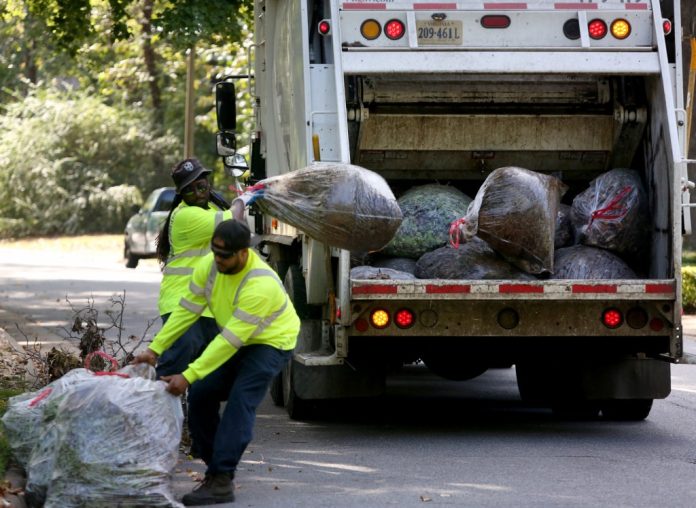
In July, the city’s waste management division was three-and-half weeks behind on picking up residents’ yard waste. Now, it’s lagging by about a half-week, according to Public Works Director L.J. Hansen.
The city will hold a hiring event from 10 a.m. to 2 p.m. Saturday at the Waste Management facility, 3024 Holland Road. Interested candidates can learn more about job duties, requirements and workplace environment. The job requires working from 6:30 a.m. to 5 p.m. four days a week.
The positions offer benefits and new hires are eligible for a $4,000 bonus paid in increments during the first year of employment.
The waste management division was able to fill more than half of its vacancies over the last month but still has nine openings.
“We are making good progress and looking forward to the hiring fair,” Hansen said.