Home Blog Page 191

Patriotic Festival brings together the military community

0

NORFOLK — Before country star Sam Hunt took the stage Saturday night, Scope Arena filled with Patriotic Festival-goers decked out in cowboy hats, boots and red, white and blue.

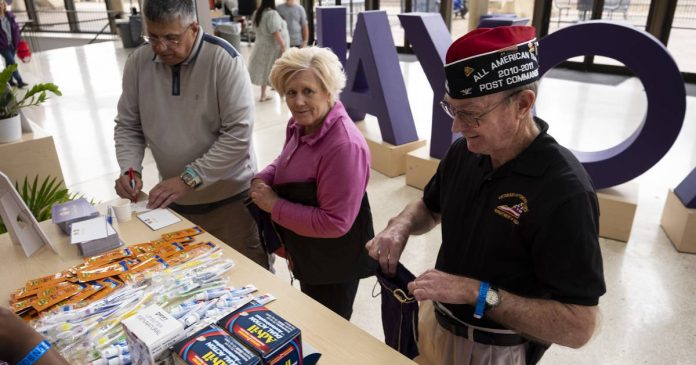
Companies and organizations dedicated to supporting veterans and service members set up booths for the country music festival Memorial Day weekend, including Crown Royal’s Purple Bag Project.

Festival-goers filled bags with toothbrushes, gum, lip balm and more, along with a personal note to be sent to a service member overseas.

Retired Army Col. Bob Clinebell filled a bag and wrote, “Thank you for your service,” — the same thing he has heard many times over the years.

He said the weekend is not just for veterans like him.

“It’s not about us,” Clinebell said. “It’s about those who have given their lives.”

This was the second year the Patriotic Festival was held in Norfolk. Before the country star-studded line-up each night, the free “tailgating area” opened to the community to check out the different patriotic accessories and services available.

VFW members also were there to share about their mission.

Companions for Heroes is a nonprofit that connects service members and rescue animals to service dog training. The result is “saving two lives,” Development Director Regina Wages said.

People who filled bags at with the Purple Bag Project left knowing they had shown their appreciation for the men and women who serve abroad.

Samuel Johnson, a Virginia Beach resident, said the goal is to “put a smile on their face, even just five minutes.”

Representatives from the various military branches attended, along with local businesses, bringing “a very patriotic” community together, said Ira Agricola, the Patriotic Festival president.

Daywatch

Weekdays

Start your morning with today’s local news

Hampton Roads is home to 15 military installations, including Naval Station Norfolk, the world’s largest naval base, and thousands of military personnel.

The weekend festival was a chance to get the “military and community to come together.”

“I hope people feel a little more patriotic,” retired chief petty officer Kathy Goodall said, adding she also hopes people “feel a little more appreciative of the freedoms they have.”

The festival has been going for nearly 20 years, though it did not take place in 2020 and ′21 due to the pandemic. Previously, it had been held at the Virginia Beach Oceanfront.

In the past, headliners included Luke Combs, Darius Rucker, Old Dominion and more.

Country stars Walker Hayes, Sam Hunt and Cody Johnson performed Friday, Saturday and Sunday, respectively.

Kelsey Kendall, [email protected]

For Vietnam War veteran, 53-year-old memories of combat still painfully fresh

0

VIRGINIA BEACH — The names of roughly 200 sailors are etched into a 15-foot granite obelisk at Joint Expeditionary Base Little Creek-Fort Story.

Among them is the name of a man retired Master Chief Gerald “Jerry” Gandy saw die.

“I don’t even want to read about him. I don’t want to see his name … Because he is not dead to me. He is still with me,” Gandy sternly said.

The 82-year-old met with a reporter and photographer at his Virginia Beach home to remember those he lost in battle.

Memorial Day, then dubbed “Decoration Day,” was first recognized in 1868 to honor soldiers killed during the Civil War. In 1971, the day became a federal holiday. Over time, Memorial Day became an unofficial celebration kicking off summer. But for combat veterans, the day has little to do with the beginning of a new season. Rather, it is a reminder of the untimely, violent end of a brother or sister in arms.

For nearly four hours, the Vietnam veteran painstakingly recounted the fights, detailing the sights, sounds, smells and the bloodshed of his time in the jungle — including the attack that left him wounded. Gandy shared his experiences under the condition that the deceased not be named.

Gandy, a radioman first class promoted to chief petty officer, served as captain of a river patrol boat from Sept. 13, 1969, to July 17, 1970, as part of Task Force 116 during Operation Game Warden. He participated in 178 combat patrols and engaged in armed conflict seven times. He was 29.

The operation ran from December 1965 to March 1973. The mission was to deny Vietcong access to resources in the Mekong River Delta. Because water travel was the primary means of transportation and communication, control of the Delta — which winded through 15,000 square miles of Vietnam — was considered crucial.

Rows of nipa palm trees crowded the banks of the narrow rivers and canals. The broad leaves of the palms grew to 30 feet high, allowing enemies to move virtually undetected.

The Navy used 31-foot patrol boats, typically manned by a crew of four enlisted sailors and one South Vietnamese law enforcement officer or soldier, to check cargo and identify papers of boaters plying the waterways, set up night ambushes at suspected enemy crossing points, support allied forces with gunfire and transportation, and enforce curfew restrictions. The boats — often traveling in pairs — were equipped with radar, radios, and front- and rear-facing .50-caliber machine guns.

Skirmishes and bloodshed were commonplace.

“In our area, it was rancid with dead people floating in the canal, floating in the river. The stench was something that — a person might look at me and say, ‘I can’t stand this stench,’ but I had smelled it so long, I couldn’t even smell it anymore,” Gandy said.

Question: Can you give me an example? Describe an incident where you lost a crew member.

“You work so closely with your people, you get to love them just like they are your brother. But you also know that you are in a war zone,” Gandy said.

“I had a forward gunner. … We were going into ambush one night … We pulled up to the bank and tied up. My forward gunner, his job once we tied up, we had a small rope with a heavy screw on it. He would part the nipa palm. It would completely engulf the edges of the canal and you were blind — you could see nothing behind it. He parted the nipa palm to throw the rope and I saw a hole come through and his head just exploded,” Gandy said.

The crew was setting up along a Rach Giang Thanh waterway.

“We didn’t know they were there. We just happened to tie up at the wrong place … It was just boom, boom and it’s just over. And the shock doesn’t hit you until two days later. You are mechanical, you just go through the drill,” Gandy said.

“You carry that with you. I told him to tie us off and that is what he did. Here with you now and two seconds later, he is not with you anymore … I wrote his fiancé a letter. She wrote me back and thanked me, but there’s no way to make that easy,” Gandy said.

The last time Gandy saw the forward gunner was as his body was hoisted up to a helicopter.

“Even if our people are dead, you don’t want to leave them,” Gandy said.

Question: Can we shift to the incident that left you injured? Describe the minutes leading up to when chaos broke loose.

“We would all go in right after dark … I would be given coordinates to set up my ambush … I have a chart, a map. But, you know, we would never use light. You’re doing 30 knots up a canal and you don’t even know which way it is turning because you’re scared to go any slower. And we use these little red flashlights and I would follow the chart until I got to the X where I knew we were supposed to set up. And that would be our ambush position,” Gandy said.

The crew was about 40 minutes, or just over 6 miles, into its commute to the ambush position near Phouc Xuyen on the Perfume River when things went south.

Question: Had the journey there been uneventful until that point?

“It was very quiet. That’s why I wasn’t that worried. You go on intel of contact. We had no intel of any recent action in that area. We knew they were there because intel told us they were there, but they wasn’t picking on the boats,” Gandy said.

Under Gandy’s direction, the boat was “running the banks,” driving parallel to shore in shallow water in order to maximize their speed.

“I was standing in the cockpit, standing beside the boat captain. I had just got through instructing him on where to pull in for our position. I guess I was looking over with my red eye — the little red flashlight — and then all at once I heard it and I knew what it was,” Gandy said.

A rocket-propelled grenade struck the bow of the 31-foot fiberglass patrol boat.

“There was a third class — he was a Vietnamese third class,” Gandy said.”We were in the period of Vietnamization where we would take one or two of their people at a time, bring them on our boat and train them. I got very close to him. He took me home with him one time. He was just a wonderful young man.”

“When it hit, he was forward of me. And it hit him first. And I didn’t realize I was going down. I was completely coherent at that point and I was going down and he’s reaching for me to help him — he was just tattered with shrapnel. And his hand had been blown off and all I could see was two big white knuckles reaching for me. He was reaching for me to help him and I couldn’t. I failed him. And that’s the last thing I remember. But I’ll always hold myself responsible for not being able to help him.”

The blast punctuated Gandy’s time in Vietnam.

“When that RPG hit the boat — it is what put me out of country actually. I lost three sections of rib, a large lobe of my right lung was gone, and about half my liver,” Gandy said.

The damage to Gandy’s lung was suffocating him.

“I could not breathe. It is a horrible feeling, let me tell you. They had given me morphine, and what they did is they dumped me on a riverbank and turned me on my good lung to keep my insides out of the mud — I had a big gaping wound… I was begging them to shoot me,” Gandy said.

Gandy drifted in and out of consciousness.

“I remember laying on the deck of a helicopter, blood washing everywhere. I saw a body bag beside me and I knew it was that Vietnamese. We took a last trip together,” Gandy said.

The Vietnam War officially ended April 30, 1975. The Vietnam Veterans Memorial in Washington, lists more than 58,300 members of the U.S. armed forces who were killed or went missing in action. The U.S. military has estimated that between 200,000 and 250,000 South Vietnamese soldiers died.

Operation Game Warden had ended two years prior, in 1973. The game warden forces lost 200 sailors in the boats from its inception to its discontinuation. But Task Force 116′s kill ratio — about 40 enemies killed in action to every one American — was one of the highest of U.S. forces during the Vietnam War.

Daywatch

Weekdays

Start your morning with today’s local news

In the decade that followed his Vietnam service, Gandy was awarded two Bronze Stars with valor, two Purple Hearts and the Vietnamese Cross of Gallantry. The awards, fixated in shadow boxes, decorate the walls of his home.

Gandy spent three years in and out of hospitals being put back together. He is marred with scars from Vietnam — his rib cage was never rebuilt and his body is still speckled with tiny black dots of shrapnel.

“But not all wounds you see,” Gandy said.

Gandy keeps a photo album of roughly two dozen photos taken while he was in Vietnam. Among those is one of him with four of his crew. Gandy is shown kneeling in front, while his forward gunner has his arm draped around the Vietnamese soldier.

Question: Can you reflect on the others you lost whose names are on the monument at Little Creek?

“Losing one of them is like losing a part of you … I just hope they rest in peace,” Gandy said.

Caitlyn Burchett, [email protected]

Pentagon says allies will unite to train Ukrainians on F-16s, but warns jets aren’t ‘magic weapons’

0

Defense Secretary Lloyd Austin said Thursday that European allies are developing a coordinated program to train Ukrainian forces on the F-16 fighter jet, but Pentagon leaders warned that it will be a costly and complex task and won’t be a magic solution to the war.

Austin said the allies recognize that in addition to training, Ukraine will also need to be able to sustain and maintain the aircraft and have enough munitions. And he said air defense systems are still the weapons that Ukraine needs most in the broader effort to control the airspace.

“There are no magic weapons,” said Army Gen. Mark Milley, chairman of the Joint Chiefs of Staff, who spoke alongside Austin at a Pentagon press conference. He said providing 10 F-16s could cost $2 billion, including maintenance.

“The Russians have a thousand fourth and fifth-generation fighters, so if you’re going to contest Russia in the air, you’re going to need a substantial amount of fourth and fifth-generation fighters.”

As a result, he said, allies did the right thing by first providing Ukraine with a significant amount of integrated air defense to cover the battlespace. He said F-16s have a future role as part of Ukraine’s air capabilities, but it’s “going to take a considerable length of time to build up an air force that’s the size and scope and scale that would be necessary.”

Austin said the Dutch and Danish defense ministers are working with the U.S. on the effort, and that Norway, Belgium, Portugal and Poland have already offered to contribute to the training. In addition, he said the allies will set up a fund so that other nations can contribute to the overall effort.

“We expect more countries to join this important initiative,” Austin said, adding that the training is “an important example of our long-term commitment to Ukraine security.”

Austin earlier in the day said he hopes that training for Ukrainian pilots on American-made F-16 fighter jets will begin in the coming weeks, bolstering Ukraine in the long run but not necessarily as part of an anticipated spring counteroffensive against Russia.

Austin and Milley spoke at the close of a virtual meeting of defense leaders from around the world to discuss the ongoing military support for Ukraine. Ukrainian leaders gave them an update on the war effort and the military gaps that troops are facing. Austin said the biggest gap continues to be ground-based air defense.

The leaders, in their 12th meeting, heard about ongoing combat operations and the counteroffensive and discussed how the allies, who have faced their own stockpile pressures, can continue to support Kyiv’s fight against Russia. Ukrainian officials have not formally announced the launch of their much-anticipated counteroffensive, although some say it has already begun and the pace of attacks suggests it’s underway.

“We’re going to have to dig deeper, and we’re going to have to continue to look for creative ways to boost our industrial capability,” Austin said before the military leaders began their closed session. “The stakes are high. But the cause is just and our will is strong.”

Daywatch

Weekdays

Start your morning with today’s local news

European leaders have said they are talking about which countries may have some of the F-16s available. The United States had long balked at providing the advanced aircraft to Ukraine, and only last weekend did President Joe Biden agree to allow other nations to send their own U.S.-made jets to Kyiv.

“We hope this training will begin in the coming weeks,” Austin said. “This will further strengthen and improve the capabilities of the Ukrainian Air Force in the long term. And it will complement our short-term and medium-term security agreements. This new joint effort sends a powerful message about our unity and our long-term commitment to Ukraine’s self-defense.”

European allies have been vocal in their support for the fighter jet training in recent days.

Josep Borrell, the European Union’s foreign policy chief, said Tuesday that training for Ukrainian pilots had begun in Poland and some other countries, though Polish Defense Minister Mariusz Blaszczak said training was still in the planning phase. The Netherlands and Denmark, among others, are also making plans for training.

“We can continue and also finalize the plans that we’re making with Denmark and other allies to start these these trainings. And of course, that is the first step that you have to take,” Dutch Defense Minister Kajsa Ollongren said.

Ukraine has long sought the sophisticated fighter to give it a combat edge as it battles Russia’s invasion, now in its second year.

The Biden administration’s decision was a sharp reversal after refusing to approve any transfer of the aircraft or conduct training for more than a year because of worries that doing so could escalate tensions with Russia. U.S. officials also had argued against the F-16 by saying that learning to fly and logistically support such an advanced aircraft would be difficult and take months.

Memorial Day is full of contradiction

0

Memorial Day is supposed to be about mourning the nation’s fallen service members, but it’s come to anchor the unofficial start of summer and a long weekend of discounts on anything from mattresses to lawn mowers.

Auto club AAA said in a travel forecast that this holiday weekend could be “one for the record books, especially at airports,” with more than 42 million Americans projected to travel 50 miles (80 kilometers) or more. Federal officials said Friday that the number of air travelers had already hit a pandemic-era high.

But for Manuel Castañeda Jr., 58, the day will be a quiet one in Durand, Illinois, outside Rockford. He lost his father, a U.S. Marine who served in Vietnam, in an accident in California while training other Marines in 1966.

“Memorial Day is very personal,” said Castañeda, who also served in the Marines and Army National Guard, from which he knew men who died in combat. “It isn’t just the specials. It isn’t just the barbecue.”

But he tries not to judge others who spend the holiday differently: “How can I expect them to understand the depth of what I feel when they haven’t experienced anything like that?”

___

It’s a day of reflection and remembrance of those who died while serving in the U.S. military, according to the Congressional Research Service. The holiday is observed in part by the National Moment of Remembrance, which encourages all Americans to pause at 3 p.m. for a moment of silence.

___

The holiday stems from the American Civil War, which killed more than 600,000 service members — both Union and Confederate — between 1861 and 1865.

There’s little controversy over the first national observance of what was then called Decoration Day. It occurred May 30, 1868, after an organization of Union veterans called for decorating war graves with flowers, which were in bloom.

The practice was already widespread on a local level. Waterloo, New York, began a formal observance on May 5, 1866, and was later proclaimed to be the holiday’s birthplace.

Yet Boalsburg, Pennsylvania, traced its first observance to October 1864, according to the Library of Congress. And women in some Confederate states were decorating graves before the war’s end.

But David Blight, a Yale history professor, points to May 1, 1865, when as many as 10,000 people, many of them Black, held a parade, heard speeches and dedicated the graves of Union dead in Charleston, South Carolina.

A total of 267 Union troops had died at a Confederate prison and were buried in a mass grave. After the war, members of Black churches buried them in individual graves.

“What happened in Charleston does have the right to claim to be first, if that matters,” Blight told The Associated Press in 2011.

In 2021, a retired U.S. Army lieutenant colonel cited the story in a Memorial Day speech in Hudson, Ohio. The ceremony’s organizers turned off his microphone because they said it wasn’t relevant to honoring the city’s veterans. The event’s organizers later resigned.

___

Someone has always lamented the holiday’s drift from its original meaning.

As early as 1869, The New York Times wrote that the holiday could become “sacrilegious” and no longer “sacred” if it focuses more on pomp, dinners and oratory.

In 1871, abolitionist Frederick Douglass feared Americans were forgetting the Civil War’s impetus — slavery — when he gave a Decoration Day speech at Arlington National Cemetery.

“We must never forget that the loyal soldiers who rest beneath this sod flung themselves between the nation and the nation’s destroyers,” Douglass said.

His concerns were well-founded, said Ben Railton, a professor of English and American studies at Fitchburg State University in Massachusetts. Even though roughly 180,000 Black men served in the Union Army, the holiday in many communities would essentially become “white Memorial Day,” especially after the rise of the Jim Crow South, Railton said.

Meanwhile, how the day was spent — at least by the nation’s elected officials — could draw scrutiny for years after the Civil War. In the 1880s, then-President Grover Cleveland was said to have gone fishing — and “people were appalled,” said Matthew Dennis, an emeritus history professor at the University of Oregon.

By 1911, the Indianapolis 500 held its inaugural race on May 30, drawing 85,000 spectators. A report from The Associated Press made no mention of the holiday — or any controversy.

___

Dennis said Memorial Day’s potency diminished somewhat with the addition of Armistice Day, which marked World War I’s end on Nov. 11, 1918. Armistice Day became a national holiday by 1938 and was renamed Veterans Day in 1954.

An act of Congress changed Memorial Day from every May 30th to the last Monday in May in 1971. Dennis said the creation of the three-day weekend recognized that Memorial Day had long been transformed into a more generic remembrance of the dead, as well as a day of leisure.

In 1972, Time Magazine said the holiday had become “a three-day nationwide hootenanny that seems to have lost much of its original purpose.”

___

Even in the 19th century, grave ceremonies were followed by leisure activities such as picnicking and foot races, Dennis said.

The holiday also evolved alongside baseball and the automobile, the five-day work week and summer vacation, according to the 2002 book, “A History of Memorial Day: Unity, Discord and the Pursuit of Happiness.”

In the mid-20th century, a small number of businesses began to open defiantly on the holiday.

Once the holiday moved to Monday, “the traditional barriers against doing business began to crumble,” authors Richard Harmond and Thomas Curran wrote.

These days, Memorial Day sales and traveling are deeply woven into the nation’s muscle memory. This weekend, 2.7 million more people will travel for the unofficial start of summer compared to last year — despite inflation, according to AAA.

The Transportation Security Administration said it screened 2.66 million people at airport checkpoints on Thursday, about 2,500 more than last Friday, and the highest number since the Sunday after Thanksgiving in 2019. The Federal Aviation Administration had predicted that Thursday would be the busiest travel day of the holiday period, with more than 51,000 airline flights.

Meanwhile, Jason Redman, 48, a retired Navy SEAL who fought in Iraq and Afghanistan, said he’ll be thinking of friends he’s lost. Thirty names are tattooed on his arm “for every guy that I personally knew that died.”

He wants Americans to remember the fallen — but also to enjoy themselves, knowing lives were sacrificed to forge the holiday.

___

Associated Press airlines writer David Koenig in Dallas contributed to this report.

For families with disabled veterans, caregivers can be a lifeline

0

It has been more than three years since Lillie Williams noticed something was “just not right” with her husband, Alfonso.

“I thought his hearing was bad,” Lillie said. “The doctor checked his ears, and she said, ‘Mrs. Williams, he has dementia.’”

Alfonso, an 87-year-old Virginia Beach resident and U.S. Air Force veteran, was diagnosed with frontotemporal dementia. The disorder is debilitating; the diagnosis, life-changing.

“Naturally, I figured I could do it. I am strong — I could be his caregiver. But that wasn’t so,” Lillie said.

According to the Elizabeth Dole Foundation, there are more than 5.5 million spouses and children serving as a caregiver to their disabled military veteran. Betsy Eves, a fellow for the foundation, said most loved ones find themselves stepping into the role of a caregiver “out of necessity.”

“Your family member is wounded, ill or injured and you have no other choice but to help them, so you jump into this survival mode where you just take care of everything for your service member,” Eves said.

Dubbed “hidden heroes” by the Elizabeth Dole Foundation, family caregivers of military veterans are often isolated, forced to give up careers or lifestyles to provide around-the-clock medical and emotional support. The foundation, which was created in 2012 by North Carolina Sen. Elizabeth Dole, aims to connect family caregivers of military veterans with resources they may need.

The resources available can range from mental wellness therapy to connecting the family with a hired personal care assistant to care for the veteran.

“The resources people need looks different from family to family. I don’t need the same kind of support as a person who has a veteran with an amputation,” said Eves, who is a caregiver to her husband, a disabled Army veteran with a traumatic brain injury.

The emotional and physical struggle of caring for your disabled veteran, Lillie said, is an experience she knows all too well.

“You cry a lot because it hurts you. He is not the same man I married 67 years ago. This is a different man,” Lillie said. “But it is all right. This is our life.”

Lillie acted as Alfonso’s sole caregiver for about a year, supported by her “love team” — the couple’s adult children. But Lillie soon began struggling with anxiety and losing weight from the stress of caring for her husband.

“It is hard, emotionally, physically — all that,” Lillie said.

After persistent urging from her own doctor, Lillie finally gave in and sought out a caregiver for Alfonso. In November 2021, the Williamses were matched with Shirley Braswell, a certified nursing assistant and personal care assistant, in partnership with Senior Services of Southeastern Virginia and the Department of Veteran Affairs.

Braswell provides in-home assistance for Alfonso three days a week and some evenings. With 33 years of experience under her belt, Braswell said caring for someone with dementia can be “extremely stressful,” whether you are a family member or a professional.

”It is important that you know what you are doing. Someone who doesn’t understand might get angry with him. Or if he gets irritated, you have to calm him down or change the subject to get his mind off what he is angry about,” Braswell said. ”If he says it’s raining, I say, ‘It sure is. It is raining hard.’”

According to Mayo Clinic, individuals suffering from frontotemporal dementia may have extreme changes in behavior and personality and speech and language problems.

“Sometimes I have to tell families, ‘I have got this. You can leave me with him. Let me do my job,’” Braswell said.

Lillie and Braswell laughed as they chatted, discussing Alfonso’s love of jazz, boxing and spur-of-the-moment adventures — glimmers of his past self that occasionally break through his diagnosis.

Braswell took a moment to check on Alfonso, who was napping in the next room. She returned joking he was “conked out” from a night of dancing in the street to soul music.

Daywatch

Weekdays

Start your morning with today’s local news

In a way, Braswell helps take care of Lillie, too, offering a listening ear as Lillie navigates her emotions during trying times.

“When Al is asleep like now, she will ask me ‘How are you doing today?’ as an opening. I will say, you know, ‘Today has just been rough.’ And she listens. There is nothing she can do, no help, but it makes me feel better,” Lillie said.

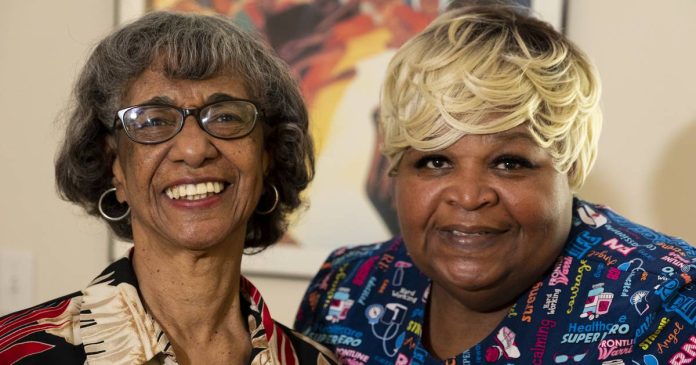
Lillie Williams sits for a portrait at her residence in Virginia Beach, Virginia. Williams’ husband, Alfonso Williams, was diagnosed with dementia three years ago.

Since Braswell was matched with the Williams family, Lillie said she is more “self-serving” — working to take care of what she needs. She has started gaining weight back and gotten a handle on her anxiety.

“I have accepted that this will be. And it is going to get worse,” Lillie said. “But we really lucked out with Ms. Braswell.”

To family caregivers of disabled loved ones, whether they are military veterans or not, Lillie encourages them to seek out the resources they need.

“You may not think you need a caregiver. But you do,” Lillie said. “A caregiver will take some of the weight off your heart and off your back.”

Caitlyn Burchett, [email protected]

Want to believe? UFO tracking company visits Hampton Roads, touts app for reporting sightings

0

If you’ve ever seen a UFO — or UAP, for unidentified anomalous phenomena — in Hampton Roads, a new app wants to show you’re not alone.

At least 4,000 sightings have been reported in Norfolk and Virginia Beach over the last 50 years, according to data collected by Enigma Labs, a UAP tracking company that describes itself as a neutral aggregator of unexplained events aiming to support research into the topic. With Enigma’s Apple iOS app, users can report their own sightings. They are then vetted, scrubbed of personal identifying information and added to an interactive map within days, according to Alejandro Rojas, head of research and content for Enigma.

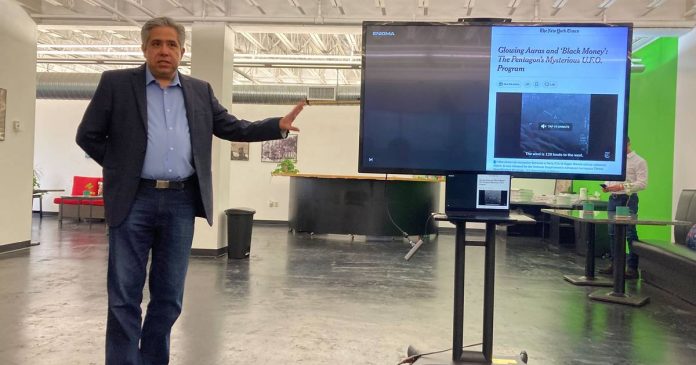
“There is no really official data set that anybody is putting up. We’re hoping to be that,” Rojas said to an audience of about 30 at an event in downtown Norfolk this week.

Rojas summarized the history of UAP sightings, the various federal investigations that have been conducted, and recently declassified information that’s raising more and more questions about what these sightings are. Rojas said part of the challenge is that it’s extremely difficult to determine exactly what a UAP is, but by collecting anecdotes you begin to see trends in the shapes, sizes and types of UAPs, as well as where they’re being seen.

“Anecdotal information doesn’t prove anything, it points us in the right direction, it shows us where to look, but we need data,” Rojas said.

Enigma uses artificial intelligence to vet UAP sightings, according to Rojas, employing research parameters to filter out fake reports and ones that have reasonable explanations.

Enigma hosted a pop-up at last month’s Something in the Water festival, which was organized by noted UAP enthusiast Pharrell Williams. Williams told W Magazine in 2019 that while he’s never seen a UAP himself, he “of course” believes in aliens in part because of how vast outer space is. Enigma even wrote a blog post about water-based UAPs reported throughout history and timed it with the start of the festival. Since then, the company has spent weeks in the Hampton Roads area to raise awareness and try to build community interest in UAPs. It has also created a Virginia-focused Facebook group.

Daywatch

Weekdays

Start your morning with today’s local news

Rojas said Hampton Roads is a good place to connect with people because of the large military presence — many sightings happen around military installations, and military aircraft are some of the best at documenting them. The region also boasts many anglers and outdoors enthusiasts, who are often the types to see something unusual in the skies or over the water.

A video of a UAP is paused for display during a hearing of the House Intelligence, Counterterrorism, Counterintelligence, and Counterproliferation Subcommittee hearing on "Unidentified Aerial Phenomena," on May 17, 2022, in Washington.

Sightings off the coast of Virginia Beach have played a big role in the huge shift in the conversation around UAPs in recent years — from looney conspiracy theories to the subject of serious government hearings. Lts. Ryan Graves and Danny Accoin, who were F/A-18 Super Hornet pilots based out of Naval Air Station Oceana, said they saw UAPs almost daily from the summer of 2014 to March 2015 while training off the USS Theodore Roosevelt.

Though the pilots don’t make any claim of knowing what they saw or where the phenomena came from, their close encounters were enough to make them doubt earthly explanations. The objects could be in the air all day, moving at speeds that wouldn’t be possible with known technology, they said, and the pilots nearly collided with one — giving them a close enough look that they described it as a “sphere encasing a cube.”

The Pentagon first confirmed the existence of its Advanced Aerospace Threat Identification Program, which investigates UFO reports, to the New York Times in 2017. Since then, many elected officials have spoken publicly about UAPs.

NASA will broadcast a public meeting of its team that is studying UAPs at 10:30 a.m. on Wednesday. To tune in, visit https://www.nasa.gov/live.

To download the Enigma app, go to the App Store on your iPhone or Apple computer and search Enigma Labs, LLC. Rojas said an Android app is in the works.

Gavin Stone, 757-712-4806, [email protected]

Investigation after death of sailor reveals Navy SEALs training plagued with failures in medical care, other problems

0

WASHINGTON — The training program for Navy SEALs is plagued by widespread failures in medical care, poor oversight and the use of performance-enhancing drugs that have increased the risk of injury and death to those seeking to become elite commandos, according to an investigation triggered by the death of a sailor last year.

Medical oversight and care were “poorly organized, poorly integrated and poorly led and put candidates at significant risk,” the nearly 200-page report compiled by the Naval Education and Training Command concluded.

The highly critical report said flaws in the medical program “likely had the most direct impact on the health and well being” of the SEAL candidates and “specifically” on Kyle Mullen, the sailor who died. It said if the shortcomings had been addressed, his death may have been preventable.

The investigation also dug deep into the longstanding problem of sailors using steroids and similar banned drugs as they try to pass the SEAL qualification course. The report recommends far more robust testing for the drugs — a move the Navy and the military more broadly have been slow to make — and better education for service members in order to prevent their use.

Mullen collapsed and died of acute pneumonia just hours after completing the grueling Hell Week test last year. A report released in October by Naval Special Warfare Command concluded that Mullen, 24, from Manalapan, New Jersey, died “in the line of duty, not due to his own misconduct.”

It said there was no evidence of performance-enhancing drugs, but that he had an enlarged heart that contributed to his death. The report said, however, that he was not tested for some steroids because needed blood and urine samples were not available, and that multiple vials of drugs and syringes were later found in his car.

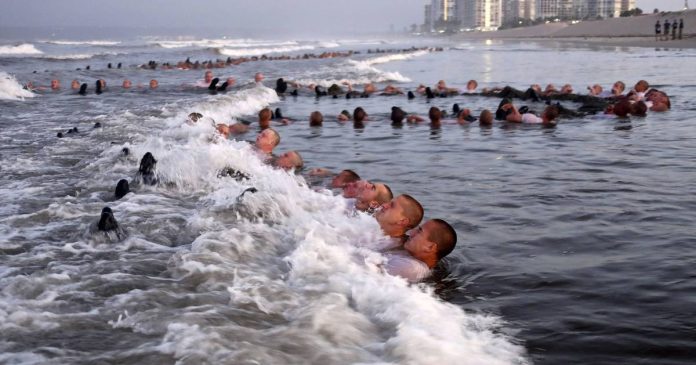
His death shined a light on the brutal test that pushes SEAL candidates to their limits. During the five-and-a-half day test, which involves basic underwater demolition and survival and other combat tactics, sailors are allowed to sleep just twice, for two-hour periods only. It tests physical, mental and psychological strength along with leadership skills, and is so grueling that at least 50% to 60% don’t finish it.

Navy leaders conducted multiple reviews and investigations in the wake of his death, and this latest report makes a lengthy series of recommendations for changes to medical care staffing and training and to drug testing.

Rear Adm. Keith Davids, who heads Naval Special Warfare Command, said the Navy will learn from the tragedy and was already taking steps to prevent it from happening again.

“Our effectiveness as the Navy’s maritime special operations force necessitates demanding, high-risk training,” Davids said in a statement. “While rigorous and intensely demanding, our training must be conducted with an unwavering commitment to safety and methodical precision.”

He said the command will “honor Seaman Mullen’s memory by ensuring that the legacy of our fallen teammate guides us towards the best training program possible for our future Navy SEALs.”

U.S. Rep. Chris Smith, R-N.J., said in a statement that the probe “exposed a culture that needs radical change, and the Navy has given every indication that they will implement serious changes to address the egregiously flawed command structure and failure after failure that led to Kyle’s death.”

Smith was briefed on the investigation Thursday along with Mullen’s mother, Regina, a registered nurse who has vowed to work to force changes to ensure this doesn’t happen to another family.

“Looking at the egregious failures that went on, there needs to be serious accountability,” she said. “The next stage of accountability is where I am focused.”

Already the command has taken steps to overhaul procedures, add medical staff and improve their training, particularly on heart and breathing problems commonly seen during Hell Week. Commanders are also doing more drug testing and heart screenings.

The latest report notes that special operations forces are routinely required to carry out high-risk military operations, and thus require demanding training. But it said SEAL instructors in recent years appeared to focus on weeding out candidates, rather than teaching or mentoring. Compounding that problem, the report said, is that candidates were often reluctant to seek medical care because it would be seen as weak and could get them removed from the course or delay their completion. According to the Navy, about 888 SEAL candidates are considered every year, and the goal is to graduate 175.

The “ability to continue training through discomfort and some degraded physical condition was seen as a positive trait by instructors and this was understood by candidates,” the report said.

As a result, candidates would push on and not tell medical staff or leaders about injuries, and there was pressure to use drugs to help keep them going.

Daywatch

Weekdays

Start your morning with today’s local news

The use of performance-enhancing drugs has been a persistent problem. Investigations in 2011, 2013 and 2018 into suspected steroid use by SEAL candidates led to discipline and requests for enhanced testing.

The use of hair follicle testing was denied at least twice by Navy leaders over that time. Random testing for steroids wasn’t authorized by the Defense Department. The Navy has asked the department to do a study on testing and to allow random tests and sweeps for drugs, but those requests have not been approved by the Pentagon. In the wake of Mullen’s death, however, the command began some additional testing.

The new report, however, suggests there may have been conflicting messages to candidates. In one case, it noted that during a discussion about the policy with Mullen’s class, an instructor, who was not identified, told sailors that all types of people make it through the course, including “steroid monkeys and skinny strong guys. Don’t use PEDS, it’s cheating, and you don’t need them. And whatever you do, don’t get caught with them in your barracks room.”

The report said that after an “awkward silence” the instructor added, “that was a joke.” It said some candidates interpreted it as an implicit endorsement of using the drugs. Barracks are subject to routine inspections, which the report said were done about once a week during Mullen’s class, and it noted several instances where the drugs were found or sailors admitted to their use.

According to the report, Mullen told his mother that he was thinking about buying some of the performance-enhancing drugs, “because he did not want to be at a disadvantage since many other candidates were taking PEDS.” It said his mother encouraged him not to. The report details that in addition to drugs in his car, his phone also had text messages discussing their use and attempts to buy them.

The report concluded that Mullen’s death was not “unforeseeable,” noting that candidates had sought medical treatment for pneumonia 11 times in 2021 and early 2022, and there were 112 visits for other similar issues.

Three Navy officers received administrative “non-punitive” letters as a result of Mullen’s death. Navy Capt. Brian Drechsler, who was commander of the Naval Special Warfare Center, received a letter and was pulled out of the job this month. Capt. Brad Geary, commanding officer of Naval Special Warfare’s Basic Training Command, and an unnamed senior medical officer also got letters. The report never names the medical officer, but notes a number of concerns with his command.

USS George Washington redelivered to the Navy after days of sea trials

0

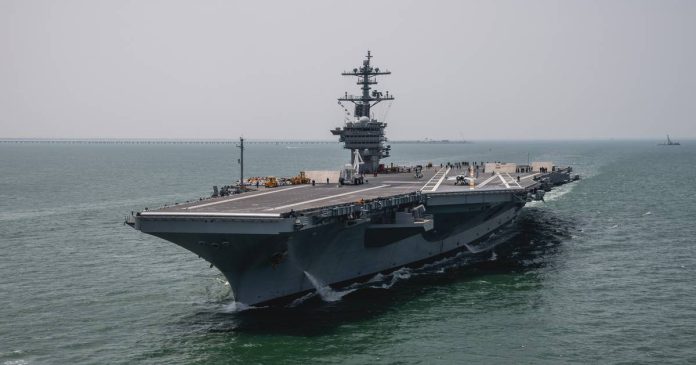
The USS George Washington was redelivered Thursday to the Navy after spending six years at Newport News Shipbuilding.

The Washington was delivered following three days of sea trials. Sea trials test the carrier’s systems and operations system, and demonstrate all the carrier’s capabilities at sea.

“Getting our warship redelivered and back out to sea to take its place as the premier CVN (nuclear-powered aircraft carrier) in the world’s greatest Navy is a direct result of the tenacity and grit displayed by our warfighters,” said Capt. Brent Gaut, the Washington’s commanding officer.

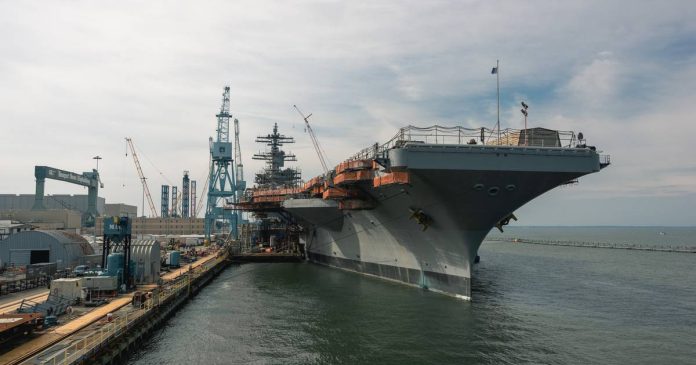
The Washington has been at Newport News Shipbuilding since 2017 for its mid-life refueling and complex overhaul, a process that typically takes four years. The refueling and complex overhaul of an aircraft carrier is a multi-year project performed only once during a carrier’s 50-year service life that includes refueling the ship’s two nuclear reactors, as well as significant repairs, upgrades and modernization.

“George Washington has gone through a transformation and now returns to the fleet as a fully recapitalized ship, ready to support any mission and serve our nation for another 25 years,” said Todd West, a Newport News Shipbuilding vice president.

The Washington will shift homeports in the coming year, replacing the USS Ronald Reagan in Yokosuka, Japan.

Caitlyn Burchett, [email protected]
Rep. Jen Kiggans introduces bipartisan bill to support service member mental health

0

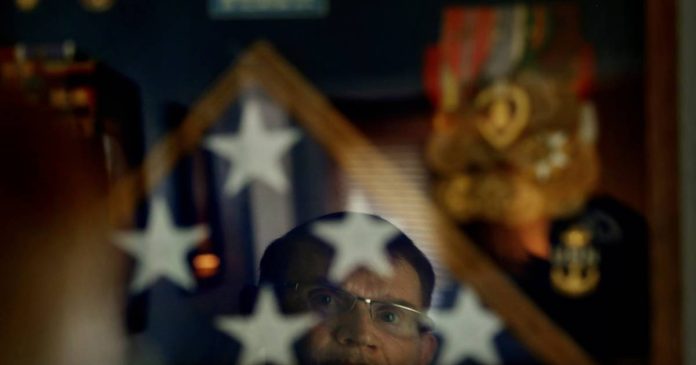
New legislation introduced by U.S. Rep. Jen Kiggans would work with the Navy to tackle systemic problems uncovered by the suicides of local sailors.

Kiggans, a Republican who represents the 2nd District, introduced last week the Sailor Standard of Care Act, what she calls a “bipartisan solution” to improve mental health care for sailors. She championed the legislation in response to the suicides of seven Hampton Roads-based sailors last year. The tally for 2023 already is at two.

“It infuriates me that the number of sailors who die by suicide continues to rise,” Kiggans said.

The act was introduced May 16 — one day before the Navy released a comprehensive investigation into command climate aboard the USS George Washington and sailor quality of life unique to a shipyard environment following three suicides within a week. The Navy also released an investigation into four suicides linked to Norfolk’s Mid-Atlantic Regional Maintenance Center (MARMC), ultimately finding the deaths were not connected.

While the Navy found no one person was responsible for the deaths at either command, leadership said the Hampton Roads-based suicides reflect a failure in maintaining a suitable Navy standard.

“In both cases there was an organizational drift — a slow erosion over time — conditions that were clearly not right became acceptable,” reads a memorandum signed by Adm. Michael Gilday, chief of naval operations, and Carlos Del Toro, secretary of the Navy. The memo was released May 17.

If it becomes law, the Sailor Standard of Care Act would implement an increase of mental health resources to commands with more than 15 sailors on limited duty and create an online dashboard to track sailor quality of life. It also calls for a study into reimbursement rates for private providers under TRICARE.

“We look at recruitment, we look at retention — the suicides are just one issue but how are we not providing for our military men and women and their families? I think the most important place to start is addressing mental health care,” Kiggans said.

Additionally, the act would require sailors on limited duty to undergo a mental health screening when they begin limited duty and every 60 days after that. And it would work to identify inefficiencies in the Navy’s medical separation process by requiring the Navy to provide briefings to the House Armed Services Committee.

The medical separation process is intended to take 230 days from start to finish, but the MARMC investigation found the process averages 360.

The extensive wait time was noted in the investigation facts of three of the four MARMC sailors who died by suicide. The referral to the disability evaluation system, the initial step in a medical separation, should take seven days. But it took 216 days for Cameron Armstrong; 151 days for Deonte Autry; and 45 days for Janelle Holder.

Daywatch

Weekdays

Start your morning with today’s local news

“Just keeping people guessing about what their future holds is not healthy, it’s especially not good for anyone’s mental health,” Kiggans said.

The legislation will now begin its way through Congress. It is supported by Reps. Rob Wittman, R-1st District, and Bobby Scott, D-3rd.

The investigation into the sailor quality of life at shipyards and the MARMC-related suicides came with 48 and 23 recommendations, respectively. According to a memo on “setting a new course for Navy quality of service,” the Navy will work for the next three months to identify a definitive timeline on when all recommendations would be implemented.

Some long-term solutions will require congressional funding or authorization, of which Kiggans said she is ready to help secure funding and prioritize top issues.

“I was able to speak with Admiral (Daryl) Caudle and the Master Chief Petty Officer of the Navy (James Honea) and let them know I want to partner with them, you know — what do you need from Congress to be able to implement your findings?” Kiggans said.

Resources for service members and veterans struggling with mental health, including 24-hour crisis hotlines, can be found below:

  • The Military Crisis Line: call 1-800-273-8255, ext. 1; or text “273Talk” to 839863
  • Military OneSource: 1-800-342-9647
  • National Suicide Prevention Lifeline: 988 — call or text

Caitlyn Burchett, [email protected]
USS George Washington departs Newport News shipyard for sea trials in final overhaul phase

0

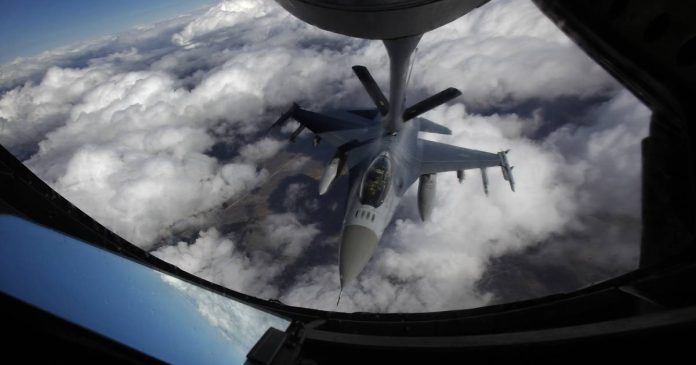
After six years in the shipyard, the USS George Washington departed Monday from Newport News Shipbuilding for sea trials.

Sea trials mark the final phase of the Washington’s overhaul. The Washington has been in dry dock at Newport News Shipbuilding since 2017 for its mid-life refueling and complex overhaul, a process that typically takes four years. The refueling and complex overhaul of an aircraft carrier is a multi-year project performed only once during a carrier’s 50-year service life that includes refueling the ship’s two nuclear reactors, as well as significant repairs, upgrades and modernization.

The Washington got underway just days after the Navy released a comprehensive investigation into command climate and sailor quality of life unique to a shipyard environment. The investigation was in response to the suicides of three Washington sailors within the span of one week.

Adm. Daryl Caudle, commander of U.S. Fleet Forces, said last week that throughout the investigation, it was “pointedly obvious the Navy had failed the George Washington.”

Since entering its maintenance period, the Washington has experienced nine suicides among its crew dating back to 2017.

A redelivery date for the Washington is expected later this year, HII’s president, Chris Kastner, said during the company’s fourth quarter report released in February 2023.

Following its delivery back to the Navy, Washington will shift homeports in 2024, replacing the USS Ronald Reagan in Yokosuka, Japan.

Caitlyn Burchett, [email protected]