Home Blog Page 171

Princess Anne senior tennis star comes up just short in epic title defense – Daily Press

0

NEWPORT NEWS — Like last year, Harrison Lee knew not to panic when cramps struck. Unlike last year, though, he couldn’t overcome a tough opponent while fighting them.

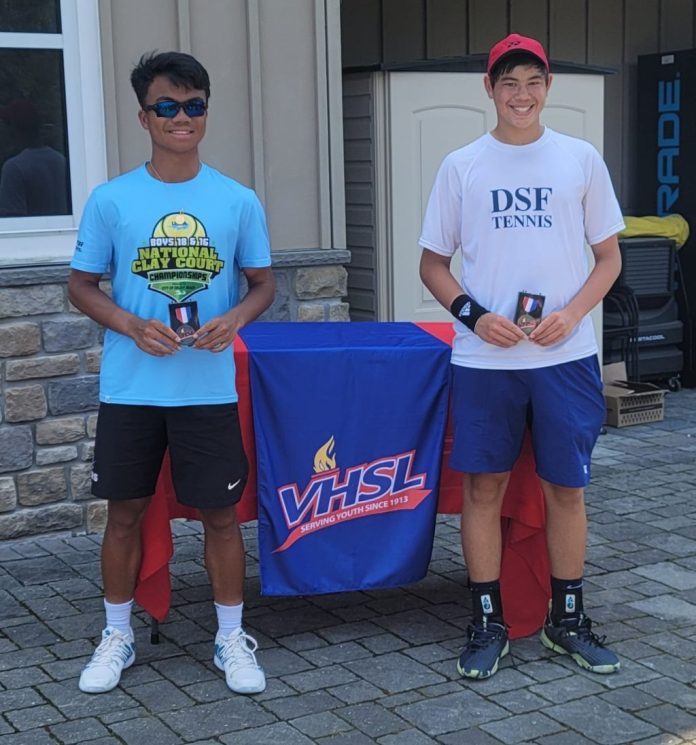
Lee, a Princess Anne High senior who won the 2022 Class 5 singles championship, was the last hope for a Hampton Roads player to take an individual tennis title in any VHSL class this year, but he lost his bid to repeat in a 6-4, 4-6, 1-0 (10-7) epic to sophomore Dylan Chou of Douglas Freeman.

Finalists from York County, Newport News and Chesapeake already had fallen Saturday morning at Huntington Park.

Lee and Chou, friends who often are doubles partners in U.S. Tennis Association events, played for more than 2 1/2 hours despite a format designed to shorten matches. Instead of enduring full third sets in VHSL tournaments this season, competitors took three-minute breaks if they split two sets, then immediately played decisive match tiebreaks to 10.

In a match with grueling rallies, impressive shotmaking and excellent sportsmanship, Lee rallied from 2-0 behind to win the second set and force the decider. In that tiebreak, Lee overcame a 4-0 deficit to pull even at 7, but he felt his left quadriceps lock at that point.

“I realized I just have to go aggressive,” he said.

He netted a forehand service return, then doubled over in agony. About a minute later, he called for a medical timeout, leading to about a five-minute break.

A long rally ensued at 7-8, but Lee chipped a backhand into the net. On Chou’s first match point, Lee netted a forehand early in the rally to end the encounter, and Chou could barely celebrate.

About 15 minutes after the match, Lee sat on a bench and said he felt fine. “Right now I feel like I could go again,” he said. “He got me in straight sets a couple of weeks ago, and I made the points go longer today.”

The match was a homecoming for Chou, whose parents grew up in Newport News.

“I felt bad for him; it was such a great match,” Chou said. “I was cramping in the second set.”

Lee still can cherish last year, when he fought off cramps in a full third set to win 6-2, 3-6, 7-5 over Riverbend’s Jack Wexler in the final. Lee soon will try to earn a starting spot for the James Madison Dukes.

In other singles finals at Huntington Park:

Class 4 boys

Grafton junior Rainer Christiansen seemed on the verge of his first title, but Lightridge senior Sid Dabhade wrested it away in a hard-hitting 2-6, 6-0, 1-0 (10-4) victory. Dabhade, last year’s runner-up, trailed 4-1 in the tiebreak but won the last nine points of a match that finished before Lee and Chou completed their first set.

Class 4 girls

Great Bridge sophomore Kayla Kennedy, last year’s surprising champ, had been unbeaten this season until falling 6-2, 6-3 to a player she defeated in a semifinal last year, Broad Run sophomore Izzy Rotaru.

“It’s her forehand topspin because she’s a lefty, and her serve is amazing,” Kennedy said in complimenting Rotaru, who celebrated her 16th birthday with the championship after losing on her 15th birthday to the Great Bridge star last season.

Class 5 girls

Menchville sophomore Tori Epps also was unbeaten until her final, which freshman Ana Maria Rincon of Roanoke’s Patrick Henry High won 6-2, 6-1.

“20-1, pretty good season,” Epps said with a smile afterward. “I should have stayed in the points longer.”

Class 6 boys

Colgan junior Matthew Staton took his third consecutive championship, routing Yorktown’s Rayan El Khalifi 6-0, 6-1 in all-Northern Virginia clash.


Class 6 girls

In another Northern Virginia duel, James Madison High’s Simone Bergeron, who has committed to Elon, won her second straight title by defeating Battlefield sophomore Sofia Raval 6-4, 6-2.

Ted Kaczynski, known as the Unabomber, has died in federal prison at 81 – Daily Press

0

By MICHAEL BALSAMO and LINDSAY WHITEHURST (Associated Press)

WASHINGTON (AP) — Theodore “Ted” Kaczynski, the Harvard-educated mathematician who retreated to a dingy shack in the Montana wilderness and ran a 17-year bombing campaign that killed three people and injured 23 others, died Saturday. He was 81.

Branded the “Unabomber” by the FBI, Kaczynski died at the federal prison medical center in Butner, North Carolina, Kristie Breshears, a spokesperson for the federal Bureau of Prisons, told The Associated Press. He was found unresponsive in his cell early Saturday morning and was pronounced dead around 8 a.m., she said. A cause of death was not immediately known.

Before his transfer to the prison medical facility, he had been held in the federal Supermax prison in Florence, Colorado, since May 1998, when he was sentenced to four life sentences plus 30 years for a campaign of terror that set universities nationwide on edge. He admitted committing 16 bombings from 1978 and 1995, permanently maiming several of his victims.

Years before the Sept. 11 attacks and the anthrax mailing, the Unabomber’s deadly homemade bombs changed the way Americans mailed packages and boarded airplanes, even virtually shutting down air travel on the West Coast in July 1995.

He forced The Washington Post, in conjunction with The New York Times, to make the agonizing decision in September 1995 to publish his 35,000-word manifesto, “Industrial Society and Its Future,” which claimed modern society and technology was leading to a sense of powerlessness and alienation.

But it led to his undoing. Kaczynski’s brother, David, and David’s wife, Linda Patrik, recognized the treatise’s tone and tipped off the FBI, which had been searching for the Unabomber for years in nation’s longest, costliest manhunt.

Authorities in April 1996 found him in a 10-by-14-foot (3-by-4-meter) plywood and tarpaper cabin outside Lincoln, Montana, that was filled with journals, a coded diary, explosive ingredients and two completed bombs.

As an elusive criminal mastermind, the Unabomber won his share of sympathizers and comparisons to Daniel Boone, Edward Abbey and Henry David Thoreau.

But once revealed as a wild-eyed hermit with long hair and beard who weathered Montana winters in a one-room shack, Kaczynski struck many as more of a pathetic loner than romantic anti-hero.

Even in his own journals, Kaczynski came across not as a committed revolutionary but as a vengeful hermit driven by petty grievances.

“I certainly don’t claim to be an altruist or to be acting for the ‘good’ (whatever that is) of the human race,” he wrote on April 6, 1971. “I act merely from a desire for revenge.”

A psychiatrist who interviewed Kaczynski in prison diagnosed him as a paranoid schizophrenic.

“Mr. Kaczynski’s delusions are mostly persecutory in nature,” Sally Johnson wrote in a 47-page report. “The central themes involve his belief that he is being maligned and harassed by family members and modern society.”

Kaczynski hated the idea of being viewed as mentally ill and when his lawyers attempted to present an insanity defense, he tried to fire them. When that failed, he tried to hang himself with his underwear.

Kaczynski eventually pleaded guilty rather than let his defense team proceed with an insanity defense.

“I’m confident that I’m sane,” Kaczynski told Time magazine in 1999. “I don’t get delusions and so forth.”

He was certainly brilliant.

Kaczynski skipped two grades to attend Harvard at age 16 and had published papers in prestigious mathematics journals. His explosives were carefully tested and came in meticulously handcrafted wooden boxes sanded to remove possible fingerprints. Later bombs bore the signature “FC” for “Freedom Club.”

The FBI called him the “Unabomber” because his early targets seemed to be universities and airlines. An altitude-triggered bomb he mailed in 1979 went off as planned aboard an American Airlines flight; a dozen people aboard suffered from smoke inhalation.

Kaczynski killed computer rental store owner Hugh Scrutton, advertising executive Thomas Mosser and timber industry lobbyist Gilbert Murray. California geneticist Charles Epstein and Yale University computer expert David Gelernter were maimed by bombs two days apart in June 1993.

Mosser was killed in his North Caldwell, New Jersey, home on Dec. 10, 1994, a day he was supposed to be picking out a Christmas tree with his family. His wife, Susan, found him grievously wounded by a barrage of razor blades, pipes and nails.

“He was moaning very softly,” she said at Kaczynski’s 1998 sentencing. “The fingers on his right hand were dangling. I held his left hand. I told him help was coming. I told him I loved him.”

When Kaczynski stepped up his bombs and letters to newspapers and scientists in 1995, experts speculated the Unabomber was jealous of the attention being paid to Oklahoma City bomber Timothy McVeigh.

A threat to blow up a plane out of Los Angeles before the end of the July Fourth weekend threw air travel and mail delivery into chaos. The Unabomber later claimed it was a “prank.”

The Washington Post printed the Unabomber’s manifesto at the urging of federal authorities, after the bomber said he would desist from terrorism if a national publication published his treatise.

Patrik had had a disturbing feeling about her brother-in-law even before seeing the manifesto and eventually persuaded her husband to read a copy at the library. After two months of arguments, they took some of Ted Kaczynski’s letters to Patrik’s childhood friend Susan Swanson, a private investigator in Chicago.

Swanson in turn passed them along to former FBI behavioral science expert Clint Van Zandt, whose analysts said whoever wrote them had also probably written the Unabomber’s manifesto.

“It was a nightmare,” David Kaczynski, who as a child had idolized his older brother, said in a 2005 speech at Bennington College. “I was literally thinking, ‘My brother’s a serial killer, the most wanted man in America.’”

Swanson turned to a corporate lawyer friend, Anthony Bisceglie, who contacted the FBI. The investigation and prosecution were overseen by now-Attorney General Merrick Garland, during a previous stint at the Justice Department.

David Kaczynski wanted his role kept confidential, but his identity quickly leaked out and Ted Kaczynski vowed never to forgive his younger sibling. He ignored his letters, turned his back on him at court hearings and described David Kaczynski in a 1999 book draft as a “Judas Iscariot (who) … doesn’t even have enough courage to go hang himself.”

Ted Kaczynski was born May 22, 1942, in Chicago, the son of second-generation Polish Catholics — a sausage-maker and a homemaker. He played the trombone in the school band, collected coins and skipped the sixth and 11th grades.

His high school classmates thought him odd, particularly after he showed a school wrestler how to make a mini-bomb that detonated during chemistry class.

Harvard classmates recalled him as a lonely, thin boy with poor personal hygiene and a room that smelled of spoiled milk, rotting food and foot powder.

After graduate studies at the University of Michigan at Ann Arbor, he got a job teaching math at the University of California at Berkeley but found the work difficult and quit abruptly. In 1971, he bought a 1½-acre parcel about 4 miles (6 kilometers) outside of Lincoln and built a cabin there without heating, plumbing or electricity.

He learned to garden, hunt, make tools and sew, living on a few hundred dollars a year.

He left his cabin in Montana in the late 1970s to work at a foam rubber products manufacturer outside Chicago with his father and brother. But when a female supervisor dumped him after two dates, he began posting insulting limericks about her and wouldn’t stop.

His brother fired him and Ted Kaczynski soon returned to the wilderness to continue plotting his vengeful killing spree.

___

Balsamo reported from Miami. This story includes biographical material written by former Associated Press writer Derek Rose.

Theodore ‘Ted’ Kaczynski, known as the ‘Unabomber,’ has died in federal prison – Daily Press

0

By MICHAEL BALSAMO (Associated Press)

WASHINGTON (AP) — Theodore “Ted” Kaczynski, known as the “Unabomber,” has died in federal prison, a spokesperson for the Bureau of Prisons told The Associated Press on Saturday.

Kaczynski was found dead around 8 a.m. at a federal prison in North Carolina. A cause of death was not immediately known.

He had been moved to the federal prison medical facility in North Carolina after spending two decades in a federal Supermax prison in Colorado for a series of bombings that targeted scientists.

Kaczynski was serving life without the possibility of parole following his 1996 arrest at the primitive cabin where he was living in western Montana. He pleaded guilty to setting 16 explosions that killed three people and injured 23 others in various parts of the country between 1978 and 1995.

What’s planned for the vacant lot at the corner of Virginia Beach and N. Oceana boulevards? – Daily Press

0

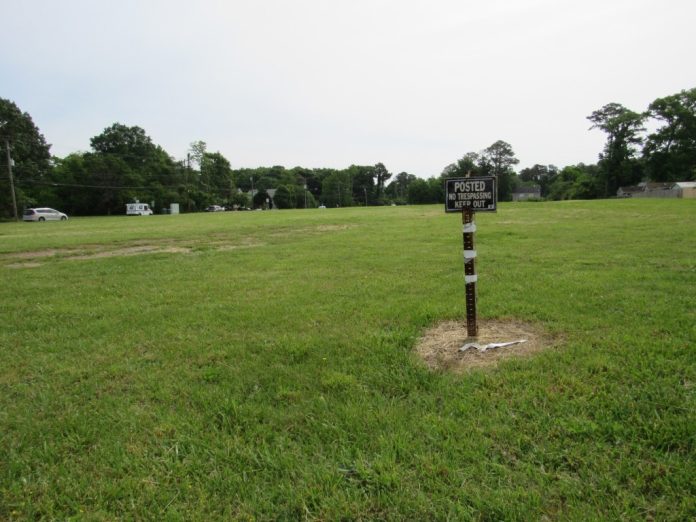
Born Primitive, a Virginia Beach-based athletic wear company, is expected to develop the site.

Plans call for a 34,313-square-foot warehouse with 7,004 square feet of office space, according to city documents. The company is headquartered at 1632 Virginia Beach Blvd., about a half mile west of the planned warehouse.

Born Primitive, a veteran owned and operated company founded in 2014, is designing the office portion of the warehouse with red, white and blue metal plans to align with the company’s branding. The 4.4-acre site is roughly halfway between First Colonial Road and Birdneck Road.

Eric Hodies, [email protected]

How Huntington Ingalls’ private health clinics provide affordable care while reducing costs – Daily Press

0

Huntington Ingalls Industries’ bet on improved health care at decreased cost has paid off since it opened clinics at two of its subsidiary shipyards in Newport News and Gautier, Mississippi, over a half-decade ago, according to a company executive.

The clinics are a critical part of the health strategy for the company, said Karen Velkey, the HII vice president of compensation and co-chair of Blueprint Virginia Health Care and Life Sciences executive committee. Huntington Ingalls, the parent company of Newport News Shipbuilding, is Virginia largest industrial employer and Mississippi’s largest employer.

The company sought to open the facilities to increase access and affordability, as well as promote health which also would serve as an incentive to workers. The clinics are operated by QuadMed — a company that formed from a large printing business that struggled to find quality affordable care for its employees. The printing company began to invest in primary care health instead of being a buyer.

The company has invested $100 million into the clinics, which offer in-house X-rays, labs, physical therapy, dental, vision and pharmacy services. The investments have saved about $725 million for HII, according to Velkey.

“The results are also changing people’s lives,” she said.

The clinics are not meant to displace other primary care doctors, but serve as a supplemental health service to reduce need for more serious and expensive care later while still offering PCP services for those who choose to use it. HII data shows users of the clinics visit and are admitted to Emergency Departments less often then non-users of the clinics. Workers and their dependents, as well as retirees on company health plans are able to use the clinics where visits are often $15 — such as for an X-ray, Velkey said.

The two health centers are visited about 60,000 times a year combined — with about one-third of visits for primary care provider services, about one third for radiology services and one third for other services such as physical therapy, according to Velkey. The clinics are at 94% utilization and indicates need for expansion, her presentation said.

Before the clinics opened, there was opposition against them during that time’s union bargaining contract, according to Charles Spivey, president of United Steel Workers Local 8888, which represents about 10,000 workers.

He said there were initial doubts about how a company health provider may impact employment for workers if they are found to be sick and they may no longer be able to go to their contemporary primary care providers, he said.

Velkey said trust is an important factor in the health clinics; QuadMed does not share health data with HII.

Additionally, the level of the staff who use the clinics is low, according to Spivey citing internal surveys. He said this doesn’t mean anything negative specifically about the clinics but reflects the relative newness of the clinics and that many workers have opted to continue seeing doctors and providers with whom they’ve built relationships. He said some Local 8888 members have campaigned to try and build trust between employees and the clinics.

Velkey presented the information about the HII clinics at the Virginia Chamber of Commerce Health Care Conference in Richmond. Also during the health care conference, leaders from state government, health care systems, insurance companies and more spoke about workforce development, behavioral health care and the constant subject of the shortage of providers and knock on-impacts that has on numerous aspects of health care.

In an interview before her presentation, Velkey said there are no immediate plans about creating a brick and mortar clinic for their Northern Virginia-based Mission Technologies division, which handles AI and other military tech. Virtual care is one option being explored, she said.

“We’re constantly looking to improve and grow and include as many of our employees and their families as we’re able to,” she said.

Ian Munro, 757-447-4097, [email protected]

Filko gets book banning all wrong – Daily Press

0

Although Joseph Filko’s political leanings are generally transparent, his May 3 column, “The education wars continue,” is more so, despite his fine closing plea that we focus on our common humanity. My career as a high school English teacher (all secondary grades including AP) in Fairfax County and an adjunct professor at GWU provided me with a lot of direct experience in culture wars and book banning. Having taught bilingual immigrant students, as well as many African Americans, I believe that sensitivity to their individual needs —- as well as those of my majority Anglo students — is important. So is balanced representation of information.

Mr. Filko is lengthily specific about three books that feature “racism, sexism, xenophobia or anti LGBTQI+” being censored by “the left,” yet makes no specific mention of the huge preponderance of banned books — ones that are offensive to the political “right.” Without furnishing any supporting evidence, he states that unnamed organizations are trying to “script and condition” our children in order to bring about “cultural changes.” My students, from our study of logic and propaganda, would have recognized “script and condition” as Loaded Language. He suggests, without any evidence, that unnamed “advocacy groups” (who are they???) see no meaning in the term “age appropriate.” He then concludes that one side is guilty of wanting young minds to be “riddled with forbidden zones;” the other, of a “force-fed woke ideology.” Is not “force fed” a menacing use of language? And exactly what does “woke” mean? To right-wing elements, it is a loaded, derogatory term. “Forbidden zones” in a teenaged brain, on the other hand, sounds pretty typical.

Mr. Filko’s conclusion is conciliatory and anti-excessive censorship. In many ways, though, Filko belies his own claim, with which I heartily agree, that students introduced to a wide variety of literature will come to “rational conclusions” of their own. Hopefully, they will also learn to parse editorials for bias.

Virginia Dopp

Williamsburg

The US and Canada saw dangerous smoke this week. It’s a routine peril for many developing countries – Daily Press

0

By SUMAN NAISHADHAM (Associated Press)

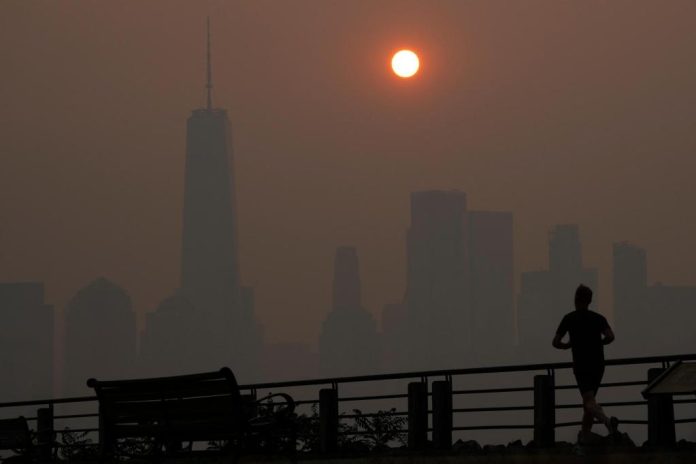
WASHINGTON (AP) — Thick, smoky air from Canadian wildfires made for days of misery in New York City and across the U.S. Northeast this week. But for much of the rest of the world, breathing dangerously polluted air is an inescapable fact of life — and death.

Almost the entire world breathes air that exceeds the World Health Organization’s air-quality limits at least occasionally. The danger grows worse when that bad air is more persistent than the nightmarish shroud that hit the U.S. — usually in developing or newly industrialized nations. That’s where most of the 4.2 million deaths blamed on outdoor air pollution occurred in 2019, the UN’s health agency reported.

“Air pollution has no boundaries, and it is high time everyone comes together to fight it,” said Bhavreen Kandhari, the co-founder of Warrior Moms in India, a network of mothers pushing for clean air and climate action in a nation with some of the world’s consistently worst air. “What we are seeing in the U.S. should shake us all.”

“This is a severe air pollution episode in the U.S.,” said Jeremy Sarnat, a professor of environmental health at Emory University’s Rollins School of Public Health. “But it’s fairly typical for what millions and millions of people experience in other parts of the world.”

Last year, nine of the 10 cities with the highest annual average of fine particulate matter were in Asia — including six in India, according to air quality company IQAir, which aggregates readings from ground level monitoring stations worldwide.

Fine particulate matter, sometimes denoted as PM 2.5, refers to airborne particles or droplets of 2.5 microns or less. That’s far smaller than a human hair, and the particles can reach deep into lungs to cause eye, nose, throat and lung irritation and even affect heart function.

Sajjad Haider, a 31-year-old shopkeeper in Lahore, Pakistan, rides his motorbike to work daily. He wears a mask and goggles against frequent air pollution in the city of 11 million, but suffers from eye infections, breathing problems and chest congestion that get worse as smog grows in winter.

On his doctor’s advice, he relies on hot water and steam to clear his chest, but said he cannot follow another bit of the doctor’s advice: Don’t go out on his motorbike if he wants to keep his health.

“I can’t afford a car and I can’t continue my business without a motorbike,” said Haider.

Last year, Lahore had the world’s highest average concentration of fine particulate matter at nearly 100 micrograms per cubic meter of air. By comparison, New York City’s concentration hit 303 at one point on Wednesday.

But New York’s air typically falls well within healthy levels. The U.S. Environmental Protection Agency’s standard for exposure is no more than 35 micrograms per day, and no more than 12 micrograms a day for longer-term exposure. New York’s annual average was 10 or below the past two years.

New Delhi, a heaving city of more than 20 million where Kandhari lives, usually tops the list of the many Indian cities gasping for breath as haze turns the capital’s sky gray and obscures buildings and monuments. It’s worse in autumn, when the burning of crop residues in neighboring states coincides with cooler temperatures that trap deadly smoke over the city, sometimes for weeks.

Vehicle emissions and fireworks set off during the Hindu Diwali festival add to the murk, and the results include coughs, headaches, flight delays and highway pileups. The government sometimes asks residents to work from home or carpool, some schools go online and families that can afford them turn to air purifiers.

On Thursday, even as a hazardous haze disrupted life for millions across the U.S., New Delhi still ranked as the second-most polluted city in the world, according to daily data from most air quality monitoring organizations.

Kandhari, whose daughter had to give up outdoor sports over health scares related to the bad air, said the air pollution is constant but policymakers only seem to notice its most acute moments. That has to change, she said.

“We should not compromise when it comes to access to cleaner air,” Kandhari said.

Many African countries in the Sahara Desert regularly grapple with bad air due to sandstorms. On Thursday, AccuWeather gave nations ranging from Egypt to Senegal a rating of purple, for dangerous air quality. It was the same rating given this week to New York and Washington, D.C.

Senegal has suffered unsafe air for years. It’s especially bad in Senegal’s east as desertification — the encroachment of the Sahara onto drylands — carries particles into the region, said Dr. Aliou Ba, a senior Greenpeace Africa campaigner based in the capital of Dakar.

The Great Green Wall, a massive tree-planting effort aimed at slowing desertification, has been underway for years. But Ba said pollution has been growing worse as the number of cars on the road, burning low-quality fuel, increases.

In the U.S., the 1970 passage of the Clean Air Act cleared up many smog-filled cities by setting limits on most sources of air pollution. The landmark regulation led to curbs on soot, smog, mercury and other toxic chemicals.

But many developing and newly industrialized nations have weak or little-enforced environmental laws. They suffer increased air pollution for other reasons, too, including a reliance on coal, lower vehicle emissions standards and the burning of solid fuels for cooking and heating.

In Jakarta, capital of Indonesia, the world’s fourth-most populous country, it’s often difficult to find clear blue sky, with power plants and vehicle emissions accounting for much of the pollution. It’s also one of the world’s largest coal-producing nations.

In one apartment building in the north of the city, between two busy ports where coal is shipped and stockpiled and where factories burn more, residents tried filtering coal dust with a net. It didn’t work.

“My family and I often feel itching and coughing,” Cecep Supriyadi, a 48-year-old resident, said. “So, when there is a lot of dust entering the flat, yes, we must be isolated at home. Because when we are outside the house, it feels like a sore throat, sore eyes, and itchy skin.”

An Indonesian court in 2021 ruled that leaders had neglected citizens’ rights to clean air and ordered them to improve it.

China has improved since Beijing was notorious for eye-watering pollution that wreathed office towers in haze, diverted flights and sent the old and young to hospitals to be put on respirators. When the air was at its worst, schools that could afford it installed inflatable covers over sports fields with airlock-style revolving doors and home air filters became as ubiquitous as rice cookers.

Key to the improvement was closing or moving heavy industries out of Beijing and nearby areas. Older vehicles were taken off the road, many replaced with electric vehicles. China still is the world’s largest producer and consumer of coal, but almost none is consumed at street level. The average PM 2.5 reading in Beijing in 2013 of 89.5 — well above the WHO’s standard of 10 — fell to 58 in 2017 and now sits at around 30. China had just one city — Hotan — in the world’s top 10 for worst air.

Mexico City, ringed by mountains that trap bad air, was one of the most polluted cities in the world until the 1990s, when the government began limiting the number of cars on the streets. Pollution levels dropped, but the city’s 9 million people — 22 million including suburbs — rarely see a day when air pollution levels are considered “acceptable.”

Each year, air pollution is responsible for nearly 9,000 deaths in Mexico City, according to the National Institute of Public Health. It’s usually worse in the dry winter and early spring months, when farmers burn their fields to prepare for planting.

Authorities haven’t released a full-year air quality report since 2020, but that year — not considered particularly bad for pollution, because the pandemic reduced traffic— Mexico City saw unacceptable air quality on 262 days, or 72% of the year.

In the summer months, intense rains clean the city’s air somewhat. That’s what brought Verónica Tobar and her two children out Thursday to a small playground in the Acueducto neighborhood near one of the city’s most congested avenues.

“We don’t come when we see that the pollution is very strong,” Tobar said. Those days “you feel it in your eyes, you cry, they’re itchy,” she said.

Her son was diagnosed with asthma last year and changes in temperature make it worse.

“But we have to get out, we can’t be locked up,” Tobar said as her children jumped off a slide.

___

Naishadham reported from Washington. Associated Press researcher Yu Bing in Beijing and journalists Babar Dogar in Lahore, Pakistan; Mark Stevenson and Teresa de Miguel in Mexico City; Sheikh Saaliq in New Delhi; Sam Mednick in Dakar, Senegal; Edna Tarigan and Victoria Milko in Jakarta, Indonesia; and data journalist Camille Fassett in Seattle contributed to this report.

___

Associated Press climate and environmental coverage receives support from several private foundations. See more about AP’s climate initiative here. The AP is solely responsible for all content.

Hickory swings its way into a second consecutive state softball championship game – Daily Press

0

LEESBURG — Hickory hacked its way to the softball state semifinals, and on the cusp of a second consecutive Class 5 championship game, the free-swinging Hawks kept swinging.

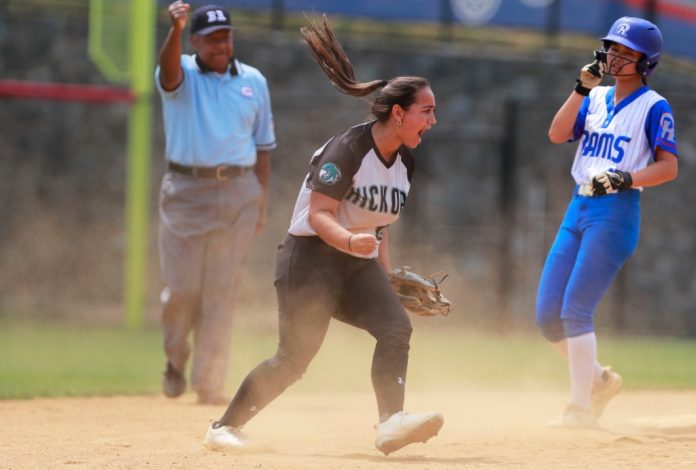
Three players drove in runs, and Emily Miller battled through a complete game in the circle to lead Hickory to a 4-3 victory over Riverside in a semifinal Friday on the Rams’ home field.

The Hawks (20-4) will play Woodgrove — a 2-0 semifinal winner over Nansemond River — for the title at 11 a.m. Saturday at Riverside High. Hickory has won 12 consecutive games and will play for the title after falling 2-1 to Stone Bridge in last season’s championship game.

“We work so much on hitting,” Hawks coach Shane Smith said. “We got some girls who swing, they swing it hard, and this team’s just had a knack for getting two-out hits this year, and that happened again today.”

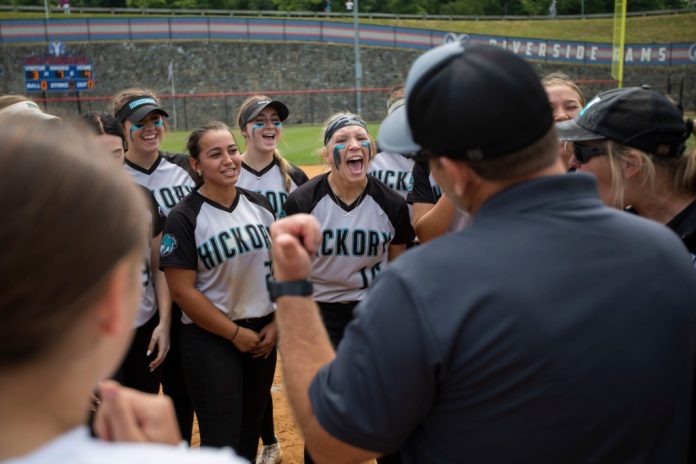
Hickory players celebrate their victory over Riverside in the Class 5 softball semifinals Friday at Riverside High in Leesburg. Tess Crowley/Staff

Cali Megaro, the Hawks’ leading hitter, delivered the defining blow Friday. Hickory was clinging to a 2-1 lead when Megaro stepped in with two outs and two on base in the bottom of the fifth inning. Megaro fell behind 0-2 against reliever Kaylie Avvisato, who entered to face Megaro. But Megaro, a junior, laced a line drive into the opposite field to bring home two runs and put the Hawks ahead 4-1.

“Our team is aggressive at the plate,” said Megaro, who has 41 hits and raised her batting average above .600 after hitting .588 during the regular season. “We can track the ball well to our bats, and when we do, it goes far.”

Hickory’s Paiton Everett drove in a run with a sacrifice fly in the second, and Shannon Coleman followed with a two-out RBI single for a 2-1 lead.

Miller, who improved to 10-1 this season, surrendered three consecutive hits to start the game, including Ashley Gabbert’s RBI single. But she kept the Rams off the base paths after that until Hailey Peterson’s solo home run and Kaylan Hoehn’s RBI double in the sixth.

Miller finished by retiring four of the final five batters she faced.

Nansemond River’s bid to make it an all-Southeastern District final was stymied earlier Friday by Woodgrove ace Abbey Lane. The right-hander, who has signed with George Mason, limited the Warriors (19-4) to two hits, struck out 11 and retired 19 of the final 20 batters she faced.

Woodgrove (26-1), of Purcellville, scored its only runs on Lane’s two-out, two-run double in the fifth inning against Nansemond River’s Cierra Gawryluk, who scattered five hits and struck out three.

Jami Frankenberry, [email protected]. Twitter @JamiVP

As negotiations drag on, Virginia budget amendments hang in the balance – Daily Press

0

Time is running out for Virginia lawmakers to come to an agreement on amendments to the state’s two-year budget plan before the start of the next fiscal year.

School districts will be left in the lurch if legislators can’t reach a compromise by July 1, said Aaron Spence, superintendent of Virginia Beach City Public Schools.

“So much of that funding goes toward teacher compensation so the biggest issue will be uncertainty about whether or not we will be able to pay our teacher contracts,” he said.

During this year’s General Assembly session, legislators debated a series of amendments to last year’s budget plan, including $1 billion in tax cuts proposed by Republican Gov. Glenn Youngkin.

The Republican-controlled House proposed a plan that would enact the governor’s tax cuts, and provide about $383 million for local school divisions. The Democrat-held Senate put forth a plan that would nix the governor’s tax cut package and give about $1 billion to local school divisions.

In recent weeks, both sides have been vocal about the need to reach an agreement, with each advocating for their proposals.

Several Democratic legislators gathered at a rally outside Ebenezer Baptist Church in Virginia Beach last week to speak out against corporate tax cuts and call for more funding for public schools.

“We are at a crossroads,” said House Minority Leader Don Scott. “Do we let the MAGA agenda dictate our path, leading us toward tax handouts to big corporations, or do we invest in schools here in Virginia Beach, Norfolk, Suffolk and Portsmouth? I am proud to stand with our schools.”

Youngkin has called on legislators in recent weeks to wrap up their work.

“Virginians need a budget and the governor has continuously encouraged the General Assembly to reach a resolution,” Youngkin spokesperson Macaulay Porter said in a statement. “As the governor has said, due to Virginia’s surplus of funds we can afford to cut taxes and invest in critical priorities.”

The state passed a two-year budget in 2022 and approved stopgap funding this year, meaning state government will continue to operate without any action. But without it, the state will enter the next fiscal year with a surplus and no framework for what to do with the money.

Spence said he’s fairly confident legislators will reach an agreement before July 1. But he said waiting until the last minute places extra pressure on schools and localities.

For instance, Spence said, if the General Assembly ultimately approves a substantial amount of money for new teachers, but requires a matching contribution from localities, then cities won’t have as long to come up with that funding.

“I think some localities will find themselves scrambling to find those local dollars,” he said. “So there are quite a few issues with waiting this long to get the budget squared away.”

Carol Bauer, vice president of the Virginia Education Association, said the lack of answers on the budget amendments is already causing stress for many educators.

“There is a lot of uncertainty and many are wondering if they want to remain in a system that isn’t supporting the work they are doing,” she said.

The ongoing budget negotiations are headed by House Appropriations Committee Chair Barry Knight and Senate Finance and Appropriations Committee Chair Janet Howell and Co-Chair George Barker. The three legislators largely work behind closed doors, meaning little updates have been available to the public.

Scott, D-Portsmouth, said legislators don’t receive extensive updates either.

“The way it’s done we get some updates but for the most part, it’s a very close to the vest process because there are so many things that can go astray when you are negotiating,” he told The Pilot. “You don’t want to be talking about what’s in the deal and what it looks like until you have a deal on the table.”

Knight, R-Virginia Beach, said last month that budget conferees were meeting every couple of weeks and were getting “smaller things” out of the way. But he said they wouldn’t have a proposal until June because clashes in Congress over the debt ceiling left too many unknowns.

Dave Wesolowski, chief of staff for Barker, D-Alexandria, told The Pilot this week there is no time estimate for when negotiations will conclude.

“At the end of the Legislative Session the two major concerns, shared by Senate Finance and House Appropriations, were the (federal) debt ceiling negotiations and indications of an economic downturn that could effect revenues,” he wrote in an email. “While the former has been taken care of the latter remains a concern … Howell and Barker as well as Chairman Knight believe that the worst thing we can do is adopt a revised budget and then have to immediately come back to make cuts if conditions change.”

Wesolowski said an update will be provided during the Senate Finance and Appropriations Committee’s meeting in Richmond on Tuesday.

Youngkin, who campaigned on a promise to cut taxes, successfully pushed for about $4 billion in tax cuts last year, including repealing the state’s 1.5% sales tax on groceries.

The governor is now pushing to increase the standard income tax deduction for individuals and couples, to lower the corporate tax rate from 6% to 5%, and to remove age requirements so younger veterans could benefit from a law passed last year allowing those 55 or older to deduct from their taxable income tens of thousands of dollars in military retirement pay.

“The governor’s proposal to reduce taxes will make Virginia more competitive with neighboring states, grow Virginia, and reduce the burden on small business owners and Virginians,” Porter wrote.

Democrats have voiced strong opposition to lowering the cooperate tax rate. After the rally, Scott said the state isn’t struggling to bring in new businesses.

“Virginia was able to attract Amazon, recently LEGO and several other large organizations without any tax cuts,” he said. “So why is the governor asking for this now?”

Katie King, [email protected]

High school scoreboard | Smithfield shuts out Tuscarora in Class 4 baseball semifinal, advances to championship game – Daily Press

0

Baseball

Class 5 semifinals

Cox 3, Mills Godwin 1 

Independence 6, Nansemond River 3

Class 4 semifinals

Hanover 2, James Wood 0

Smithfield 1, Tuscarora 0

Maddax Brown pitched five scoreless innings, and Ty Hedgepeth came in and pitched two scoreless innings to lead the Packers. Evan Brobst drove in the only run on a line drive to left field. The Packers advanced to Saturday’s final against Hanover at 11 a.m. at Spotsylvania High School.

Class 3 semifinals

Caroline 9, Cave Spring 7

New Kent 12, Liberty Christian 8

Class 2 semifinals

Patrick County 10, Buckingham 3

Poquoson 5, Alleghany 4

Softball

Class 6 semifinals

James Madison 2, Osbourn Park 1

McLean 4, Kellam 3

Class 5 semifinals

Hickory 4, Riverside 3

WP: Miller.

Woodgrove 2, Nansemond River 0

Class 5 semifinals

Louisa County 5, Hanover 4

Halifax County 13, Spotsylvania 7

Class 3 semifinals

Northside 1, New Kent 0

WP: Compton. LP: Berg.

York 12, Cave Spring 9

Class 2 semifinals

Tazewell 5, Page County 0

James River of Buchanan 2, King William 1

Boys soccer

Class 6 quarterfinal

Landstown 2, Battlefield 0

Ryan Walsh and Jason Nofsker scored on assists by Nolan Brown and Trey Gohr as the Eagles earned a state semifinal matchup Saturday at 3 p.m. against Lewis.

Class 5 semifinals

Cox 2, Riverside 1

Princess Anne 2, Albemarle 2 (PA won 4-3 on penalty kicks)

Class 4 semifinals

Jamestown 2, Jefferson Forest 0

Smithfield 0, Loudoun County 0 (Smithfield won 4-3 on PKs)

Class 3 semifinals

Meridian 2, Monticello 0

Charlottesville 3, Tabb 1

Class 2 semifinals

Clarke County 2, Radford 1

Glenvar 5, Poquoson 1

Girls soccer

Class 5 semifinals

Independence 4, First Colonial 3

Deep Run 6, Princess Anne 0

Class 4 semifinals

Smithfield 2, Tuscarora 0

Western Albemarle 2, Great Bridge 0

Class 3 semifinals

Brentsville District 2, Charlottesville 0

Lafayette 2, Wilson Memorial 0

Class 2 semifinals

Clarke County 6, Glenvar 0

Wise County Central 2, Bruton 0

Boys tennis

Class 6

Singles semifinals: Rayan Elkhalifi (Yorktown) d. Vincent Yi (Ocean Lakes) 6-4, 6-3; Matthew Staton (Colgan) d. Ryan Battaglia (W.T. Woodson) 6-0, 6-2.

Doubles final: Adi Gupta and Nikola Galov (Langley) d. Staton and Rebhi Villasmil (Colgan) 0-6, 6-0, 1-0 (12-10).

Class 5

Singles semifinals: Harrison Lee (Princess Anne) d. Aarush Rajalana (Riverside) 6-2, 6-3; Dylan Chou (Douglas Freeman) d. Matthew Onoff (Menchville) 6-0, 6-1.

Doubles final: Zach Fleishman and Grant Kroodsma (Deep Run) d. Lee and Zachary Stoney (Princess Anne) 6-3, 6-2.

Class 4

Singles semifinals: Rainer Christiansen (Grafton) d. Gordon Fairborn (Western Albemarle) 6-2, 6-1; Sid Dabhade (Lightridge) d. Jamison Wallace (Powhatan) 4-6, 6-2, 1-0 (10-4).

Doubles final: Brader Eby and Luke Kielbasa (Western Albemarle) d. Sid Dabhade and Thanush Buneti (Lightridge) 7-6 (7-4), 6-2.

Class 3

Singles semifinals: Lucas Beasley (Christiansburg) d. Nicolas Crespo (Tabb) 6-3, 6-2; Evan Bernstine (Goochland) d. Conner Miller (Wilson Memorial) 6-0, 6-1.

Doubles final: Evan Bernstine and Alex Peskin (Goochland) d. Lucas Beasley and Ian Rasor (Christiansburg) 7-5, 6-1.

Class 2

Singles semifinals: Jack Clem (Richlands) d. Simphiwe Matibini (Bruton) 6-1, 6-0; Alec McIlwain (Glenvar) d. Cayden Swats (Riverheads) 6-4, 6-3.

Doubles final: Briggs Crabtree and Chase Hamlin (John Battle) d. Cayden Swats and Adam Higgins (Riverheads) 4-6, 7-6, 1-0 (10-5).

Girls tennis

Class 6

Singles semifinals: Simone Bergeron (James Madison) d. Meghan Moore (Cosby) 6-1, 6-1; Sofia Raval (Battlefield) d. Jocelyn Limbago (W.T. Woodson) 7-6 (7-3), 6-1.

Doubles final: Noelle Talarek and Kai Henryson-Gibbs (Langley) d. Deana Sultanaeva and Carly Mew (Robinson) 6-1, 6-4.

Class 5

Singles semifinals: Tori Epps (Menchville) d. Paige Suter (Douglas Freeman) 6-1, 6-0; Ana Maria Rincon (Patrick Henry of Roanoke) d. Ashton Dillman (Princess Anne) 6-0, 6-0.

Doubles final: Rincon and Sawyer Stephenson (Patrick Henry of Roanoke) d. Esha Kidambi and Elli Michalopoulou (J.R. Tucker) 6-4, 6-4.

Class 4

Singles semifinals: Kayla Kennedy (Great Bridge) d. Claire Rawlins (Salem Spartans) 6-2, 6-0; Izzy Rotaru (Broad Run) d. Miranda McCoy (Eastern View) 6-4, 6-1.

Doubles final: Rotaru and Sienna Bhide (Broad Run) d. Kennedy and Chase London (Great Bridge) 6-3, 7-5.

Class 3

Singles semifinals: Lauren Wimmer (Abingdon) d. Valentina Crespo (Tabb) 6-2, 6-3; Martina Ribera (Maggie Walker) d. Raygan Wade (Spotswood) 6-0, 6-0.

Doubles final: Wimmer and Grayson Woodall (Abingdon) d. Ribera and Ella Wiatt (Maggie Walker) 3-6, 6-4, 1-0 (10-7).

Class 2

Singles semifinals: Parker White (Marion) d. Emily Tharpe (Randolph-Henry) 6-2, 6-1; Lydia Pratt (Radford) d. Ellen Waag (East Rockingham) 6-1, 6-1.

Doubles final: Isabella Gustafson and Avery Flynn (Glenvar) d. White and Maddie Austin (Marion) 7-5, 6-2.

Class 1

Singles semifinals: Madison Green (Middlesex) d. Alexa Olinger (Eastside) 6-1, 6-0; Maggie Minton (George Wythe of Wytheville) d. Alex DiGrassie (Buffalo Gap) 6-1, 6-0.

Doubles final: Carly Sturgill and Clare Huff (Galax) d. Maggie Wonderling and Laney Williams (Rappahannock) 6-3, 1-6, 1-0 (10-8).