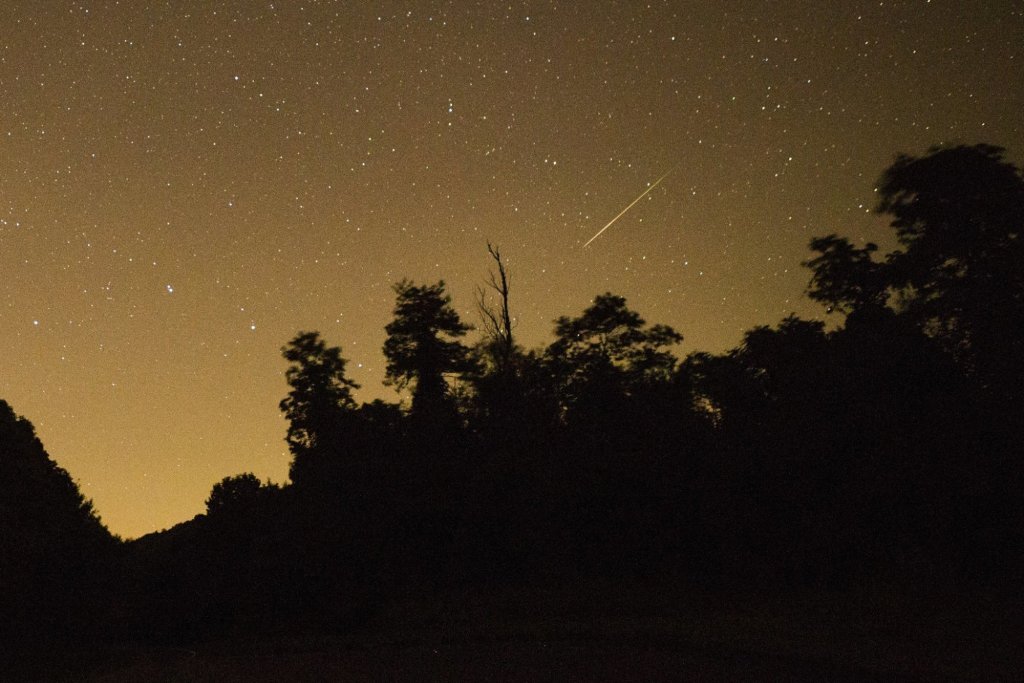
Hey, stargazers. We have some good news.
The Perseid meteor shower, which NASA says is considered the best one of the year, will peak this weekend.
The celestial event is associated with the comet Swift-Tuttle, and there are a number of spots in the greater Hampton Roads area to take in the show.
Swift-Tuttle is a big ball of ice and rock that sheds pieces of dusty debris. As Earth moves through the comet’s path, sky watchers get to witness the debris burn up in the atmosphere, resulting in the shower.
This year, the cosmic display will be better than usual since the moon is expected to only be about 10% illuminated, according to Space.com.
“(Hourly) rates this weekend are expected to be near 50 as seen from the northern hemisphere and 10 as seen from south of the equator,” according to the American Meteor Association. “With an entry velocity of 59 km/sec., the average meteor from this source would be of swift velocity. Viewers in the southern hemisphere have a limited view of this shower as the radiant only rises just before dawn and is located low in their northern sky.”
That means for folks in rural areas, or urban areas with less light pollution, there will be a visible meteor about once a minute.
The best time for viewing, according to this year’s Farmers Almanac, is during the pre-dawn hours Sunday, between 2 and 4 a.m. That’s when the sky is at its darkest. But meteors also will be visible late Saturday night.
Bob Berman, astronomer for the Farmers Almanac, reports that it takes about 20 minutes for eyes to adjust to the dark, and large swaths of sky with no trees are best for viewing.
The weather is expected to be dry, with mostly clear skies. And to get away from city lights, Hampton Roads stargazers have several options.
On the northern side of the region, James City County, upper York County, the Eastern Shore and the Middle Peninsula have several dark spots. To the west, Isle of Wight and Surry counties offer good viewing. Southern portions of Suffolk, Chesapeake and Virginia Beach are other prime locations, along with the Outer Banks.
“If you’re an avid sky watcher or have a sky map, it does help to know that the Perseid shower is named for the constellation Perseus, which is its radiant,” Berman wrote. “A radiant is the point of origin of the meteor shower, so the Perseid meteors will appear to be traveling away from the constellation Perseus in the night sky. Locating the constellation Perseus might therefore help you to see as many meteors as possible.”
Eliza Noe, [email protected]