Brown v. Board of Education, Belton v Gebhart and Bolling v. Sharpe.
If all or even one of these landmark Supreme Court cases above look familiar, it’s because they are, and rightfully, crucial parts of history. These significant cases originated based on discrimination against minorities in schools in the United States. All three cases fought for the same common factor, that is equal rights to a formidable, enriched education with race and background being inconsequential.
Decades later, despite the connotations and positive research based in part from affirmative action, the Supreme Court, with a conservative majority, seeks “color neutral” admissions policies based upon the idea that race should not be considered.
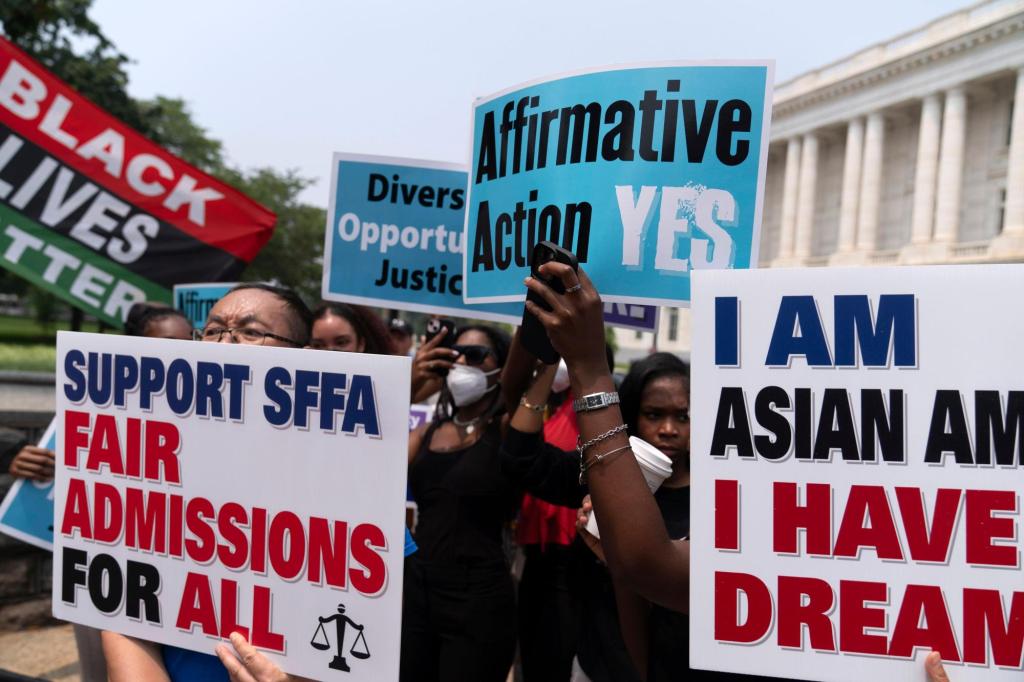
The Supreme Court recently ruled that Harvard University and the University of North Carolina at Chapel Hill were not permitted to use race as a factor when considering whether to admit a prospective student. The inevitable trickling down of the decision and its effect on institutes of higher education is a growing concern for students, prospective students and universities trending towards major ripple effects around the world.
A product of the civil rights movement, affirmative action is intended to ensure that applicants are treated equally without regard to race, color or religion. Since its introduction, it has been shaped and criticized and subjected to analytical and political interpretations.
One of the bigger debates is that many wrongly believe affirmative action allows unqualified students to be admitted simply based on racial identity. That sort of narrow-minded, divisive opinion is in large part one of the problems with America and how we deal with questions of race and diversity.
The truth is affirmative action policies are meant to ensure that qualified applicants won’t be rejected based strictly on race, ethnicity, religion or nationality. It’s to give brown children a fair shot to get into great schools with the same ease and grace that a non-minority applicant would. Research has proven that diversity in higher education improves learning outcomes for all students and the benefits extend beyond graduation.
Seeking schools that are representative of an individual race, gender or background is of ingrained symbolic imagery. Media and content released on behalf of a school can be indicative of whether persons of color can see themselves fitting into a particular student body. When people can’t find themselves reflected in the images they see and people they meet, it can teach a powerful lesson about one’s value in a society, a key reason why representation is important.
On a personal note, in the mid 2000s, I was touring colleges, pondering the excitement that awaited wondering what college life was like, how easy the campus would be to navigate, and if there were people there who would look like me. I lucked out attending Virginia Commonwealth University and getting an immense taste of many cultures while learning so much in the process.
Denying the factor of race in this time, not just in admissions-related processes but others as well, is risky. The atrocities built upon the enormity by protests on behalf of the marginalized, such as the 1963 March on Washington, Freedom Rides and more recently the Black Lives Matter movement, all left an impact and questioned the status quo. The ideology that minimizing race is a step in a positive direction is not just unjust, but harmful.
I wished we lived in a world where race and socio-economic status didn’t matter, but that is not the case. Colleges and universities have a lot of work to do in their efforts to achieve diverse and flourishing student bodies — student bodies that represent the many shades of people in the world. A world in which I pray and hope my young brown boy is given every opportunity to succeed and be successful despite the many obstacles he will face.
Claudette Brooks is a public relations specialist at William & Mary in Williamsburg.