Linda Ambrus Broenniman, author of “The Politzer Saga,” has added a new, novel chapter to Holocaust history.
Her book reads like a detective story that connects the dots, pulling together pieces of a puzzle in a wonderful, suspenseful way.
It is not a book of fiction. It is the record of her quest to uncover the secrets of her family’s 300-year-old history.
In the introduction of her book, Linda writes, “In 1949 my Hungarian parents crossed the ocean to start a new life. They have survived World War II, escaped a Stalinist regime, and finished their medical studies. They wanted to leave behind the pain and suffering. They wanted to start again. And they did, building successful careers as doctors in the United States. My six siblings and I were raised Catholics in what was an idyllic American childhood.
“When I was 27, I accidentally discovered that my father was Jewish. And that much of what I knew about him, and his family was a lie. But I was young, not ready to embark on a journey to excavate the truth. Thirty-three years later, I could no longer ignore the yearning to know the truth that lay buried. It was time. Perhaps not too late, but almost. Many who knew the stories of my father’s family could no longer remember them or had died. ”
Then, in 2006, Linda’s family learned that her Catholic mother was honored by the Israeli government as Righteous Among the Nations, an honor recognizing non-Jews “who acted according to the noblest principles of humanity by risking their lives to save Jews during the Holocaust.”
Her name is inscribed on the wall at Yad Vashem (the World Holocaust Remembrance Center in Israel.) Among the names inscribed at Yad Vashem are Oskar Schindler and Raoul Wallenberg. Linda’s mother risked her life to save Jews from deportation to Nazi extermination camps, among them her father and grandmother.
Linda was still in the dark about her father’s Jewish family. He refused to talk about the past. But Linda’s mother once mentioned a box put away that contained old family photos and documents. Then in February 2011, Linda’s parents’ home caught fire. Her father survived with minor burns, but her mother succumbed to her injuries.
Five years later, Linda got a call from her sister, saying she had found the box, rescued from the fire.
“The box arrived,” Linda writes. “When I opened it nervously, its musty odor reminded me of an attic closed off to fresh air for decades. The box was filled with dog-eared filles and manila envelopes of photos. The documents were in Hungarian and German. Amazingly, they survived World War I, World War II, the Hungarian Revolution of 1956, and the fire in my parent’s home.”
At the bottom of the box was a composition book titled “Our Family Tree.” It was written in English. Its author was Gabor Varany, Linda’s father’s cousin. He remembered everything.
There was much more to discover about the 300 years of the Politzer family history. At the recommendation of a friend, Linda teamed up with Andras Gyekiczki, a Hungarian researcher in Budapest who had degrees in law and sociology.
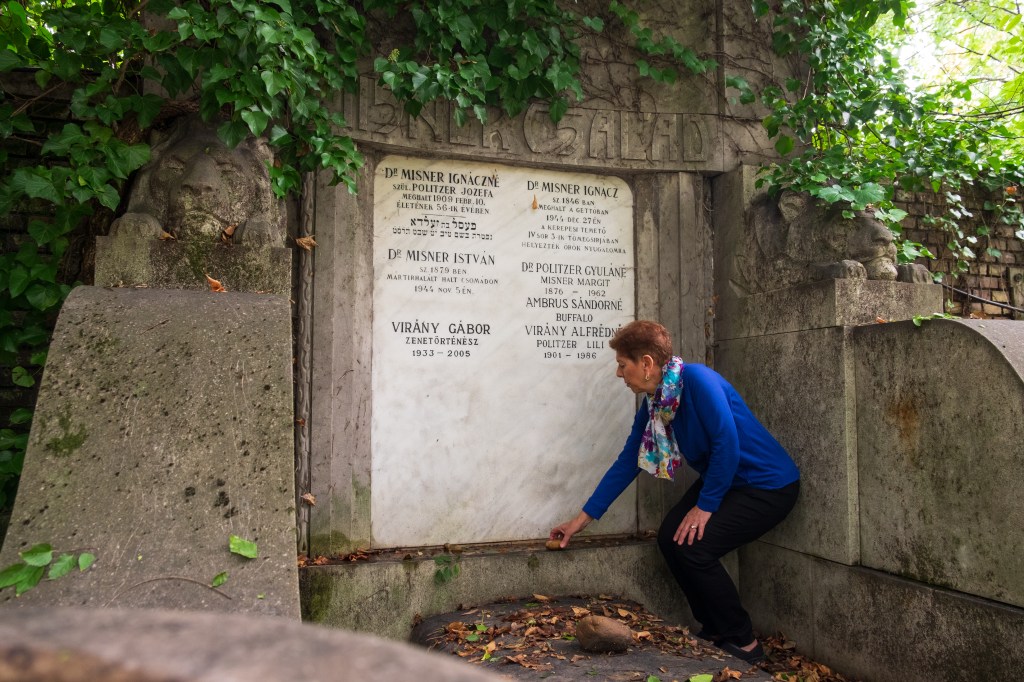
“Andras was an amazing sleuth, a master of connecting the dots to lead us to more discoveries, “ Linda writes. “From names and dates on gravestones, he explored birth, death, and marriage records, most handwritten in ancient registers.
“Ironically, cemeteries became the place where my family felt most alive to me. Their names were etched into gravestones with dates, names of spouses or other family members, proof that they have lived and died. That they had really been of this place.”
Gyekiczki wrote: “I hardly know any nonfiction saga to better exemplify Hungarian Jewish fate of the past 300 years as this Politzer Saga story. All that fantastic talent, diligence, and readiness to act for and during much of modern Hungary. All those sufferings, torture, and misery they went through.”
For Linda it wasn’t enough to find the family her father never spoke of. She needed to write their stories. “It was a way to connect to their lives and make them even more real. By writing about them, I began to understand where my siblings and I came from.”
The Hungarian Jewish Museum and Archives mounted a permanent exhibit in the newly renovated Rumbach Synagogue, based on the family stories based on the book. Linda and her family will be traveling to Budapest in September for the celebration of the exhibit.
It was my Gazette column about my reunion with Dr. George Berci, a 101-year-old famous medical researcher and Holocaust survivor, that brought me together with Linda.
She got in touch with Dr. Berci and me, wondering whether her father, also a Jewish Holocaust survivor who escaped from a Nazi slave labor camp, was ever part of our work gang.
It turned out, he never was.
The printed version of “The Politzer Saga” will be published on Sept. 12, 2023 and can be pre-ordered on Amazon.com. To learn more about the book and the exhibit, visit www.politzersaga.com.
Frank Shatz is a Williamsburg resident. He is the author of “Reports from a Distant Place,” the compilation of his selected columns. The book is available at the Bruton Parish Shop and Amazon.com.