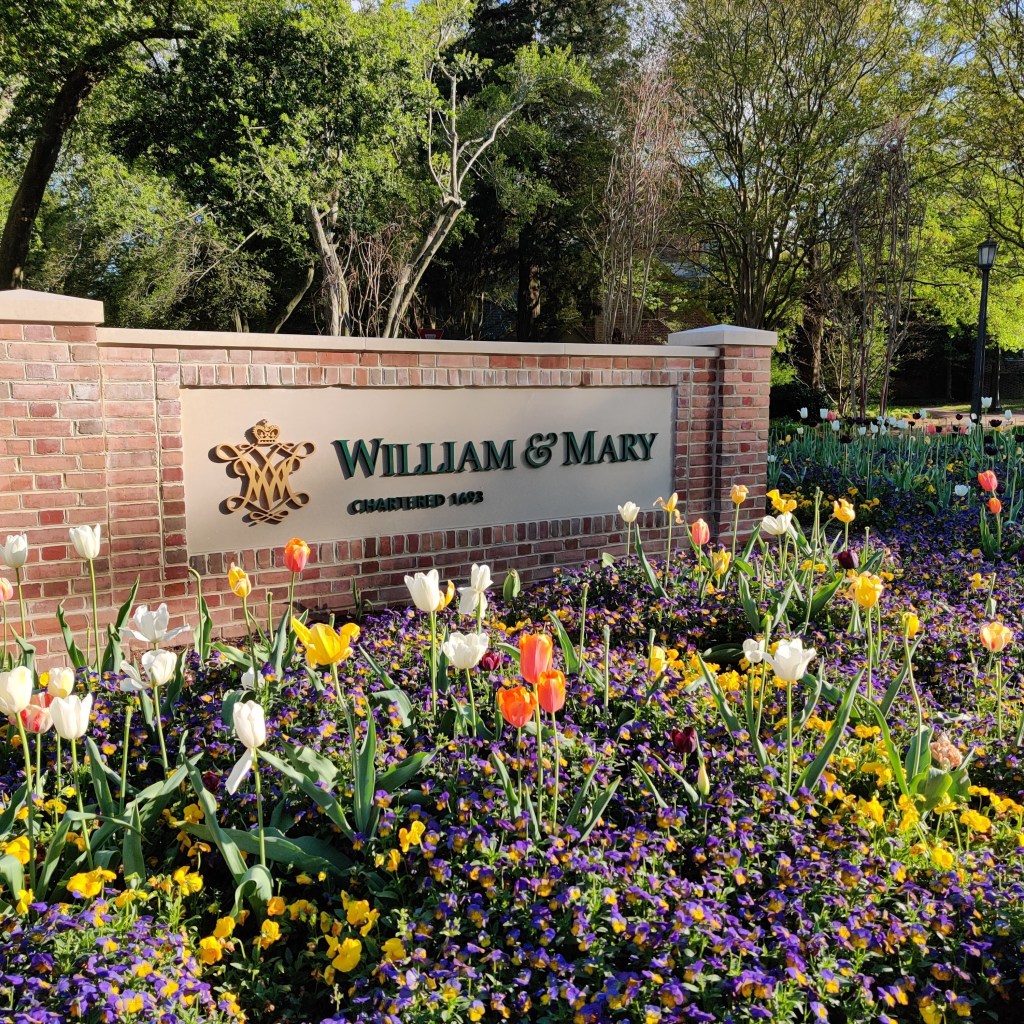
The national media have recently featured the discovery on the Michigan State University campus of a forgotten 1881 observatory. William & Mary can trump that.
Almost entirely forgotten today, an observatory was built by the college in 1778, likely the first observatory in America.
Jeffery Shy, a local resident, published a detailed account in 2002 in the Journal of Astronomical History and Heritage, which I depend on here.
Shy makes the case that the college was in the forefront of scientific education in the 18th century, under the nascent influence of William Small (professor, 1760-1764) and especially under the guidance of its eighth president (1777-1812), Bishop James Madison.
In 1762, the board of visitors appropriated funds to purchase “a proper Apparatus for the instruction of the Students of the College in Natural and Experimental Philosophy.” And in 1764, Small was dispatched to London, where he purchased and sent back an impressive collection of scientific instruments, the best in America.
Among the purchases: “The Acroamatic Telescope with a Triple Object Glass 3½ feet focus,” “two Eye Tubes for Astronomy and one for Day Objects,” “A 12 Inch Concave Mirror, a flat mirror,” “A 6 Inch Concave Mirror” and “5 Lenses of different Sorts in Frames.”
But the considerable ambitions evinced by Small’s purchases pretty much evaporated when Small chose not to return to the college; the equipment lay largely unused until 1771 when his successor, Thomas Gwatkin, stepped in, and then with Madison’s 1773 appointment to the faculty.
In 1778, Madison moved to have an actual observatory built, presumably someplace on the college’s 330-acre campus, though precisely where we don’t know.
Shy cites the account book of the contractor, Humphrey Harwood, detailing, for example, on May 2, 1778, the cost of “Buildg pillers to Observitory.” The “pillers,” Shy explains, would have been piers for several telescopes, including the one Small bought, as well as perhaps another, an 18-inch reflecting instrument made in Scotland and known for its “optical superiority.”
Shy calculates from Harwood’s accounts that building the observatory required the equivalent of 81 days of labor (most likely enslaved labor) and some 10,000 bricks.
Although science and even astronomical observation flourished here well into the 19th century, the 1778 observatory seems to have been doomed. No record of what precisely happened to it exists. Shy writes that the structure was known to no longer exist in 1789, when Madison noted it had yet to be rebuilt. The guess is that it was destroyed with other structures during the occupation of the campus by the French following the Siege of Yorktown in 1781.
So, our observatory is older than Michigan State’s. Now, we need to find it.
Terry Meyers is chancellor professor of English emeritus from William & Mary.