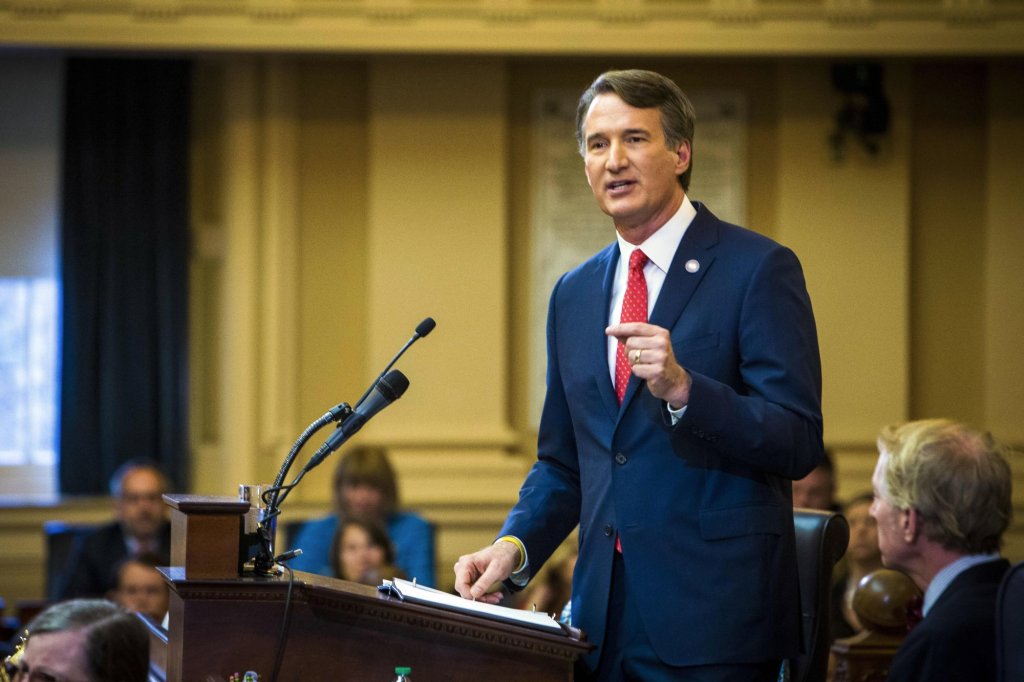
RICHMOND — Gov. Glenn Youngkin touted job growth and business expansion at a joint committee meeting Wednesday as he called on Virginia’s legislators to wrap up budget negotiations.
“If we want our current moment of growth to continue, if we want our businesses, our students and our communities to thrive, our course for the current budget is clear,” he said. “Please send me one.”
Youngkin addressed the General Assembly committees as legislators said they were closing in on a budget deal. They approved a two-year budget in 2022, but have struggled this year to reach a compromise on a series of budget amendments.
During Wednesday’s meeting, Secretary of Finance Stephen Cummings provided an overview of the state’s standing.
The forecast from December projected that 2023 general fund revenue would be $1.5 billion higher than the level assumed in the 2022 Appropriations Act, according to Cummings. But that forecast took into account a potential recession — and that recession never materialized, leaving $3.6 billion in excess state funds.
The secretary of finance, however, urged continued caution due to the potential global ramifications of an economic slowdown in China and the possibility of a federal budget impasse in October. Additionally, he said refunds related to the newly enacted Pass-Through Entity Tax are expected to have a $1 billion net impact on fiscal year 2024.
Virginia employment grew by 2.7% in fiscal year 2023, Cummings explained.
“Virginia is in excellent condition with the largest workforce ever and the highest labor participation rate in over a decade,” he said. “Recent data suggests that we are also winning in the domestic migration war.”
Cumming said rating agencies should be “very happy” with Virginia.
“We have never been in a situation where we are better prepared for unforeseen challenges,” he said.
After Wednesday’s meeting, Sen. Louise Lucas told The Virginian-Pilot she believed legislators would “absolutely” wrap up budget negotiations by the end of the day.
“I have every expectation that we are going to come together in a consensus for this budget today and get this done,” said Lucas, D-Portsmouth. “It’s going to make a lot of people in Virginia happy.”
The General Assembly was unable to reach an agreement on budget amendments during the legislative session due to disagreements over Youngkin’s proposed tax cut package. He is pushing for $1 billion in cuts, including lowering the corporate income tax rate from 6% to 5%, increasing the standard income tax deductions for individuals and joint filers, and expanding tax exemptions on veterans’ pensions by eliminating age requirements.
House Republicans backed the governor’s plan, while the Democrat-held Senate wanted to nix the tax cuts and give about $1 billion to fund school divisions.
The budget negotiations are headed by House Appropriations Committee Chair Barry Knight and Senate Finance and Appropriations Committee Chair Janet Howell and Co-Chair George Barker.
Corporate tax cuts, which Democrats have adamantly opposed, are off the table, Barker told The Pilot earlier this month.
But there are ongoing disagreements over the standard income tax deductions for individuals and joint filers. Senate Democrats have offered one-time tax rebates of $200 for individuals and $400 for couples.
After the joint committee meeting Wednesday, Youngkin told reporters he’d be open to one-time rebates now if more long-term tax relief was considered in the next budget.
On Wednesday, Sen. Tommy Norment — a committee member and longtime legislator who is no novice to budget talks — said this year’s negotiations stand out.
“It’s been more of an ideological debate between the House and the Senate,” he said. “We have one group focusing on the principle of tax relief and the other focusing on what they consider prioritized spending. Much of the impasse over the months has been on trying to reconcile those two different philosophical approaches.”
In previous years, Norment, R-Williamsburg, explained that a lack of funding sometimes led to less debate.
“Many times in the past we just haven’t had the revenue and this time we have the revenue and so it’s a question of what are we going to do with it,” he said. “This sounds ridiculous but it’s almost more challenging when you have more money than less money because when there is less money both the elected officials and the general public seem to understand that better.”
Katie King, [email protected]