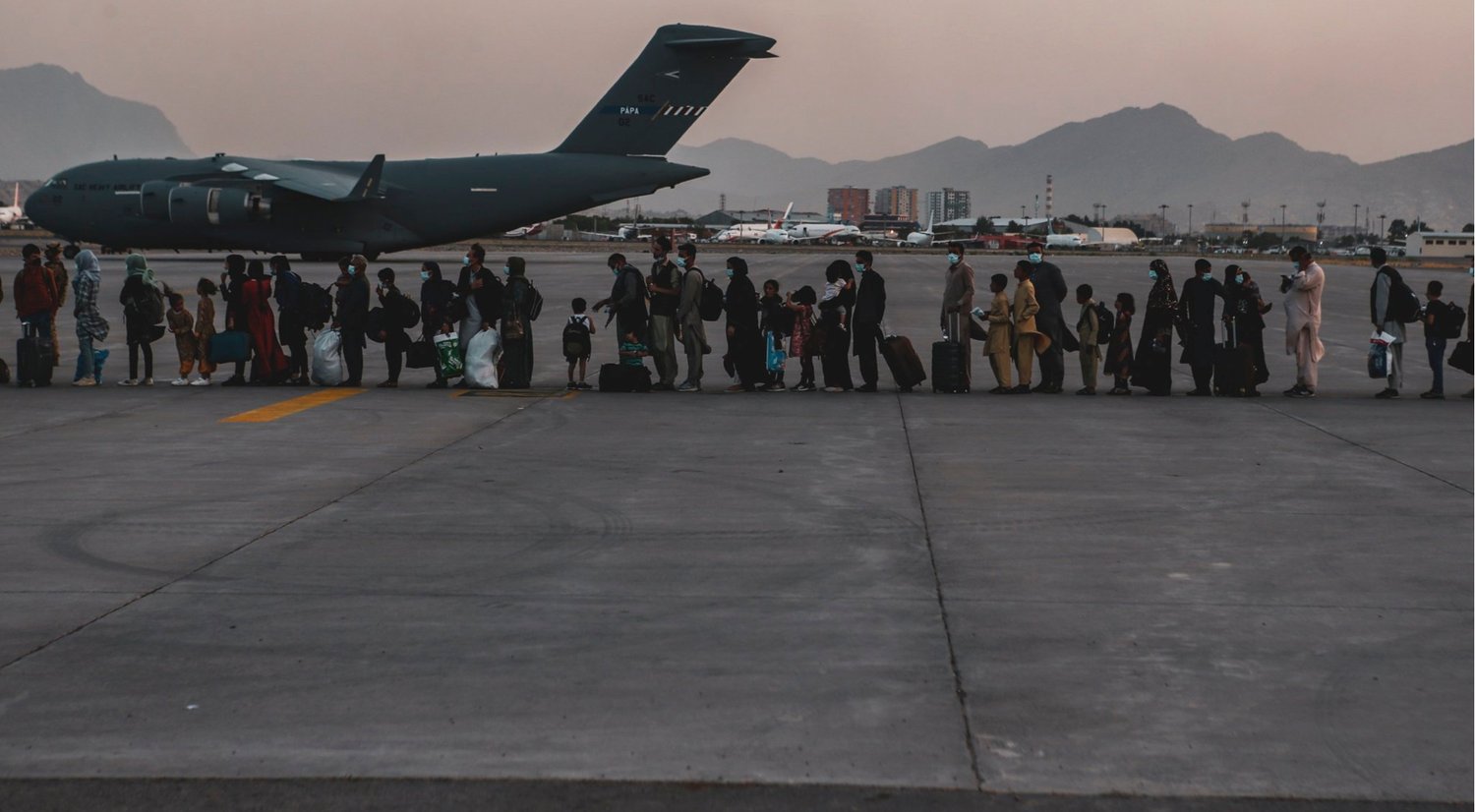
Yet, while the nation may be ready to move on from war, many American veterans are still scrambling to help Afghan asylum seekers find safe passage and find adoptive communities. The rapid collapse of the U.S.-backed government in Afghanistan and frantic non-combatant evacuation operation (NEO) in its wake have stoked emotional traumas for those veterans that continue to smolder.
The inglorious withdrawal marked a dramatic ending to one of the longest chapters of America’s Global War on Terror and a war that Andrew Bacevich describes as an unambiguous strategic failure.[1] In a new book, Paths of Dissent: Soldiers Speak Out Against America’s Misguided Wars, Bacevich joins Daniel A. Sjursen as co-editor of a compendium of reflective essays by American veterans who have borne the brunt of America’s post-9/11 generational campaigns in Iraq and Afghanistan. Paths of Dissent puts those veterans’ voices at the center of the discourse—veterans whose journeys led them into dissenting openly with the ways in which American power has been exercised abroad.
The text features fifteen intimate essays from veterans who served in the U.S. Army, Navy, and Marine Corps. Their unifying argument, set forth by Bacevich and Sjursen, is that America’s military campaigns during the Global War on Terror amounted to “flagrant malpractice.” Among the many transgressions the book’s author’s allege are the irresponsible expenditure of lives and treasure and the wreaking of havoc on our troops, the people we sought to liberate, and the foundations of our own democracy—all justified under the rationalizations of senior leaders professing self-exculpatory versions of history.[2]
Bacevich and Sjursen are careful to differentiate the authors’ dissent from a general opposition to war. The authors in Paths of Dissent are neither pacifists nor were they naturally inclined to be anti-war when they entered the military. Instead, their stories are those of men and women who were “serving soldiers or combat veterans who actively oppose[d] military policies that they deem ill-advised, illegal, or morally unconscionable.”[3] While there is some diversity of perspective, readers experience a common journey that unites each voice: the initial pride and moral clarity of duty giving way to moral ambiguity and ultimately culminating with a new moral clarity where each was moved to preach their own truth on the wars they fought in. What is at stake, according to Bacevich, is no less than the soul of our nation.
What Works
What Paths of Dissent does well is its intimate, diverse portrayals of courage across the ranks, from field grade officers to junior enlisted service members—all following a moral imperative to correct the narrative.
Jason Dempsey explores the political and institutional dysfunctions of the war. Dempsey deployed as an infantry officer to both Iraq and Afghanistan and found himself working in assignments that highlighted major impediments to basic coordination between the Department of Defense, Department of State, and ultimately with Congress. Those hindrances to effective coordination frequently lead to large projects operating at cross purposes, wasting exorbitant amounts of taxpayer money. Dempsey labeled the dysfunction as “the Accountability-Avoidance Two-Step,” which he defined as a civil-military dynamic that enabled both politicians and generals to bask in the public adoration of the military without being held to any account for military failures.[4]
Erik Edstrom dives into the inner life of a former idealist. In his essay, Edstrom laments the disconnect between the advertised principles of the U.S. military and the reality in combat where he “saw the systematic dehumanization and devaluation of Afghan lives on a regular basis.” He says, “We searched homes, people, and cars unilaterally and without warning…we regularly violated Karzai’s Twelve, a series of principles intended to protect civilian lives and safeguard Afghan citizens against the deep indignities of a foreign military occupation.”[5] Like many of his fellow authors, Edstrom notes that his reasons for joining the military were “a conflated mix of economic necessity and idealistic do-goodery.”[6] His observation is reminiscent of comedian George Carlin, who said that “inside every cynical person, there is a disappointed idealist.”[7] Channeling the jaded idealism common across all of these essays, Dempsey puts it another way, quoting World War II veteran Paul Fussell: “To become disillusioned, you must earlier have been illusioned.”[8]
Other voices raise qualms with the military institution itself. Jonathan W. Hutto, Sr., shines light on the endemic history of institutional racism in the military. Hutto, a U.S. Navy veteran, details how he overcame an oppressive disciplinary board convened on the USS Theodore Roosevelt. Under the auspices of the Military Whistleblower Protection Act and related DoD guidance, he organized the “Appeal for Redress” in 2006 which saw over two thousand service members petition Congress for an end to the Afghanistan and Iraq Wars.[9] Hutto lauds the power of the enlisted corps as one that “if organized, can potentially help change the course of history.” He raises the class nature of the rank structured military where “[b]y and large, enlisted members hail from the margins of American society, rural towns and blighted urban centers all but abandoned by the elites.”[10]