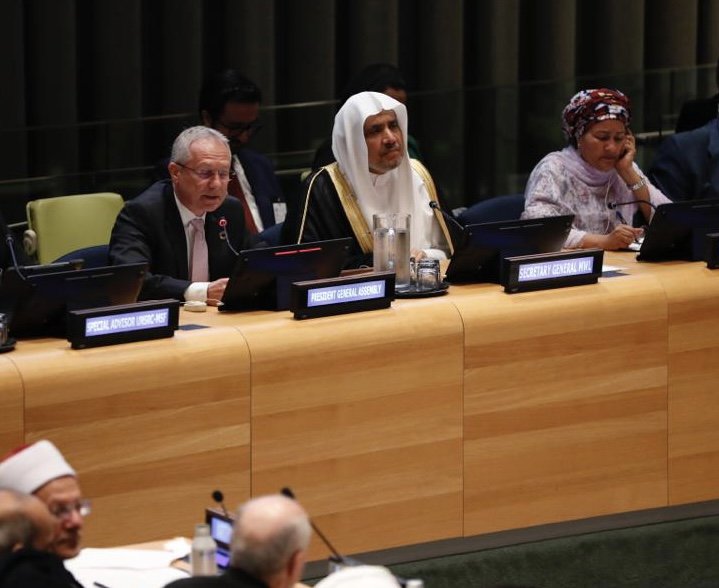
Sheikh Mohammed bin Abdul Kasim Al-Issa of Saudi Arabia is a man on a mission.
As secretary-general of the Muslim World League, a worldwide charity that serves as a voice of Muslims and promotes interfaith dialogue, Al-Issa led a high-level faith summit at the United Nations recently that gathered hundreds of spiritual leaders and diplomats for a unique purpose: to bridge east-west divisions.
The summit resulted in a commitment to establish a global day to celebrate east-west relations and to establish an educational curriculum based on shared values between the peoples of the world.
Mitchell Reiss, who served as president and CEO of The Colonial Williamsburg Foundation and the U.S. Special Envoy for the Northern Ireland Peace Process, worked closely with Protestant and Catholic parties to end violence and achieve a lasting peace and called Al-Issa “one of the great voices of interfaith dialogue and friendship in the world.”
“He is the architect of the Makkah Charter, which is a sort of blueprint for modern, moderate Islam,” Reiss added. “It gained support of every major branch of Islam. That kind of inclusivity is what makes Sheikh Al-Issa and The Muslim World League so compelling and important.”
Al-Issa served as Saudi Arabia’s minister of justice from 2009 to 2015. In addition of being the secretary-general of the Muslim World League, he is also president of the International Islamic Halal Organization. He is considered a leading global voice on moderate Islam as well as a key figure in the fight against extremist ideology.
In an interview, I asked Al-Issa, what made him decide to embark on such a challenging journey as starting an interfaith dialogue?
“In recent years, humankind has become more divided, capitalizing on perceived differences rather than recognizing and appreciating our countless similarities,” he said. “It is this knowledge that made me want to dedicate my life to promote understanding of different cultures and peoples through the transformative power of interfaith engagement.”
He noted that the global challenges we are facing require collaboration, rather than isolation. And faith is something that connects the vast majority of humankind. Over 84% of people around the world define themselves as religious and many of them find themselves on the frontlines of climate crisis, conflicts and economic struggle.
I asked Al-Issa, what are the principles that guide him in his work?
“I am guided by the core principles of my Islamic faith and the principles outlined in the ground-breaking Charter of Makkah which include equality, harmony, diversity, as well as planetary welfare,” he replied. “I would also say that in my capacity as the secretary-general of the Muslim World League I am driven by my fervent desire to improve the lives of those who face a daily uphill struggle in some of the worlds more challenging circumstances.”
Another aspect of Al-Issa’s effort is to fight extremist ideology.
“Extremist ideology has no place in Islam, or any other faith for that matter,” he told me. “People of faith are very keen to ensure that religion is seen as a force for positive good, not hate and violence. At the heart of all major faiths is a desire to bring people together through the religious community. Extremist ideology, whether that be of groups like the Islamic State or far-right terror groups, is anathema to these core principles and is disturbingly one of key drivers of people’s misunderstanding of religion. This is why it is so important to champion interfaith cooperation, break down those misconceptions, and fight against extremism in all its forms.”
According to Al-Issa, the Arab world has actively embraced these efforts. The Makkah Charter, which the Muslim World League put together in 2019, was approved by Islamic leaders in 139 countries. The charter champions anti-extremism, religious and cultural diversity, and legislation against hate and violence, as well as environmental treaties and women’s rights.
The publication of the Makkah Charter led to breakthrough moments of cooperation and progress between Islam and other faiths. Al-Issa and other senior Islamic leaders were invited to Auschwitz by the American Jewish Committee in a ground-breaking display of Muslim/Jewish cooperation.
“To me, visiting Auschwitz was an emotionally arresting experience that further confirmed my desire to fight extremism, intolerance and hatred in all its forms,” he said. “To stand in the same spot where countless perished made the idea of Holocaust denial and anti-Semitism even more absurd and vile. If we let extremism of any kind fester, then it is not unlikely we will see events like the Holocaust happen again.”
Al-Issa expressed confidence that the Muslim World League will play a role in ensuring that such horrendous events never happen again.
“This is why it was so important to become the first senior Islamic figure to visit Auschwitz,” he said. “It gave me hope we are entering a new era of positive interfaith cooperation and dialogue. Moments like that highlights that, despite our differences in religious practice, there are common principles across all faiths that can be leveraged to create a better world for us all.”
Frank Shatz is a Williamsburg resident. He is the author of “Reports from a Distant Place,” the compilation of his selected columns. The book is available at the Bruton Parish Shop, and Anazon.com.