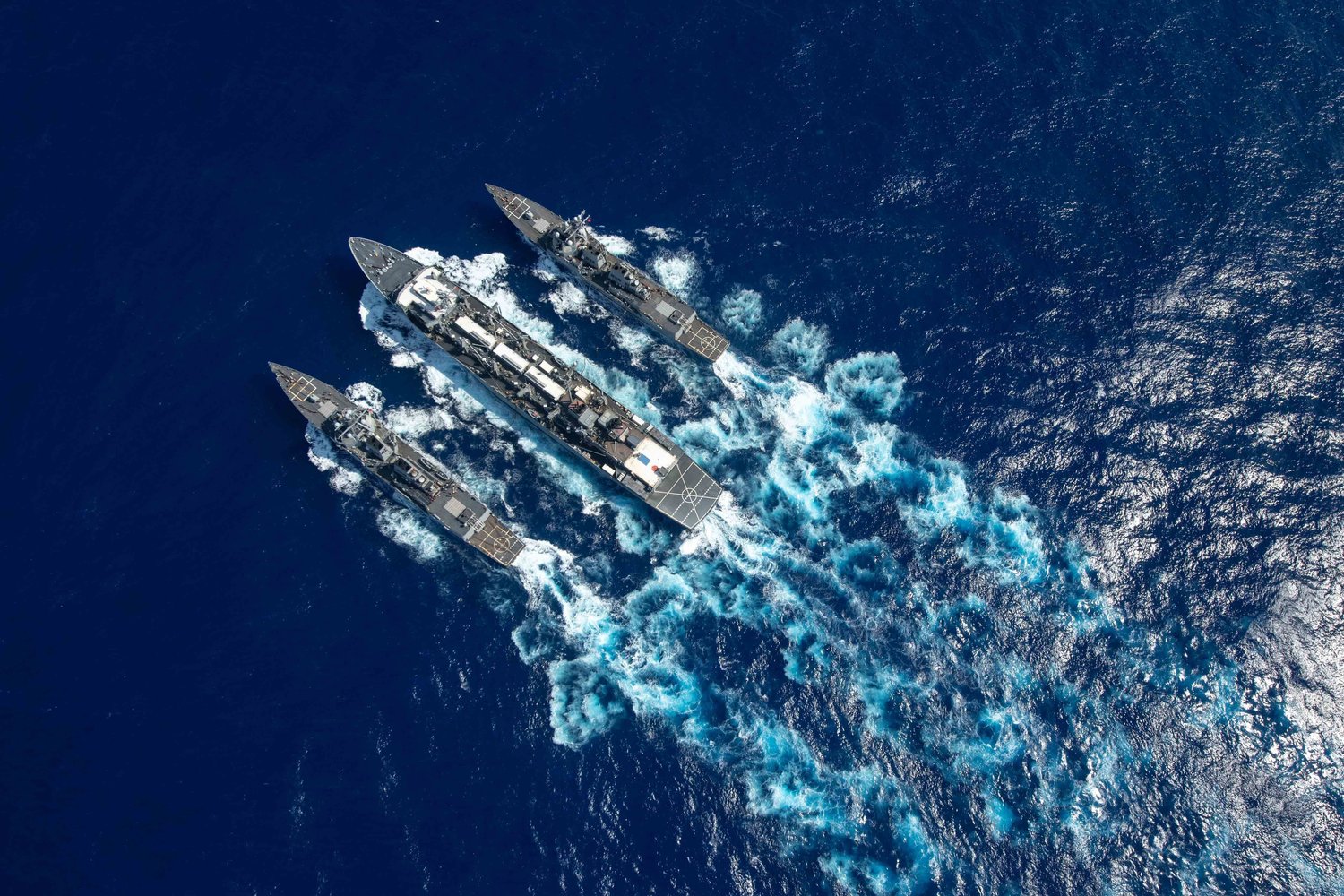
Complicating finding and engaging enemy fleets is the fact that navies must carry their ordnance and fuel over great distances. They must also be able to replenish effectively before and after combat, a task that might have to be accomplished while remaining at sea. To break down this daunting problem, Cares and Cowden propose reconceptualizing maneuver in the three phases of Fiske’s day. In the authors’ reconception, properly integrating logistical considerations into our thinking on naval power means planning operations in terms of cruising, approach, and attack, corresponding to strategic, operational, and tactical levels and terms, respectively. In portraying how logistics must be handled at each stage of this process, Fighting the Fleet asserts that combat, maneuver, and logistics are inseparable concepts that must be planned in concert with one another.
With these concepts in mind, Cares and Cowden ultimately turn to four functions of fleets derived from J.C. Wylie: strike, scout, screen, and base. Building on their discussion of Hughes and Fiske, the authors argue that these three theories “are the fleet commander’s tools for controlling the pattern of tactical events in a naval campaign…fleet commanders can wield the four functions to achieve, sustain, and leverage control at sea for victory.”[5]
Interestingly, Fighting the Fleet only briefly addresses why the ideas of Fiske, Wylie, and Hughes have largely been forgotten:
Indeed, as it is presented today at the Naval War College, naval operational art is joint operational art, which is at its core Army operational art. It is as if Wylie and Fiske never existed. Today a “joint sailor” is not someone who thinks like a sailor at all but one who thinks almost entirely like a 1980s-vintage Army planner.
This is harsh criticism but not unwarranted. The services play their own unique roles within the context of a joint campaign. Universal, Army-derived joint language is twice insufficient: it is too generic for services’ use in planning their idiosyncratic missions, and it fails to give the joint planner a complete understanding of how the unique parts fit into a complex whole.[6]
While joint doctrine is problematic for the reasons laid out throughout the book, Cares and Cowden argue the Navy’s principal problem is that it has no way of expressing its own doctrine to itself before translating it into joint language. Rediscovering that vernacular is, ultimately, the mission of this work. This is an important argument which is only briefly outlined in the introduction. An earlier presentation of some of these details would have made the impact even more powerful.
With the common use of drone surveillance and attacks in Ukraine, it appears the world may very well be moving from what Fighting the Fleet calls the “Missile Age” to the “Robotics Age.” Rather than obviating the lessons the authors seek to teach, Cares and Cowden instead assert that in all likelihood the previously discussed concepts will continue to be important:
[B]uoyancy, power, search, surveillance, movement, logistics, and control will all continue to operate in their same, uniquely naval ways in the robotic future. The fundamental difference—a difference of degree, not of character—will be the extent to which future naval forces become even more controllable, versatile, adaptive, and survivable as these new technologies are perfected and embraced. This is simply a step further along a continuum in the evolution of naval combat theory.”[7]