The line between celebrating heritage and creating a fully rounded history can be a fine one in many institutional histories. Appreciating this tendency, Royal Air Force-insider John Shields reassesses the 1982 Falklands Conflict, seeking to explode multiple myths while also providing a better assessment of the air campaign by focusing on the operational rather than the tactical level of war. Shields served thousands of hours navigating on the Tornado F3 and earned a Ph.D. from King’s College London. He also has a deep interest in professional military education; he currently teaches at the U.S. Air War College. These areas of expertise and passion shine through in this work, making it particularly valuable to any Western military planner or operator. In short, Shields wrote a case study about the Falklands War that can be read more broadly as enlightening air operators about air campaigns.
Shields contends that previous scholars have placed too much emphasis on the “tactical level outputs of the campaign” such as sorties flown rather than the actual effect of weapons, particularly regarding how weapon employment affected the “ability of each side to strike the decisive blow against their opponent.”[1] As such, he stresses identifying the British centers of gravity and how they changed during the conflict. U.S. Department of Defense doctrine defines a center of gravity as “the source of power that provides moral or physical strength, freedom of action, or will to act.”[2] Shields explains how initially the British aircraft carriers served as the center of gravity due to their ability to control the air through their Harriers. However, air control only functions as an enabler; thus, over time the center of gravity shifted, because the key to victory required taking and controlling Stanley, the capital city of the islands. As a result, the second and third centers of gravity were troops on the ground: first the amphibious assault force and finally the British land forces moving toward Stanley.
Shields shows little partiality for his own institution, seeking to provide an objective account. Indeed, he argues the conflict’s “outcome was a function of Argentine failings rather than British successes.”[3] Neither side, importantly, had adequately prepared for this conflict. He even suggests Argentina may have lost the war twenty years before the conflict began by doctrinally deciding to prioritize air support for the ground, thereby choosing to fund immediate needs over the pursuit of a more balanced long-term strategy to develop a force for an unknown future.[4] Of course the U.S. and multiple other nations have done the same, such as in the Global War on Terror, when Secretary of Defense Robert Gates cut F-22 production to focus on capabilities needed for counterinsurgency.
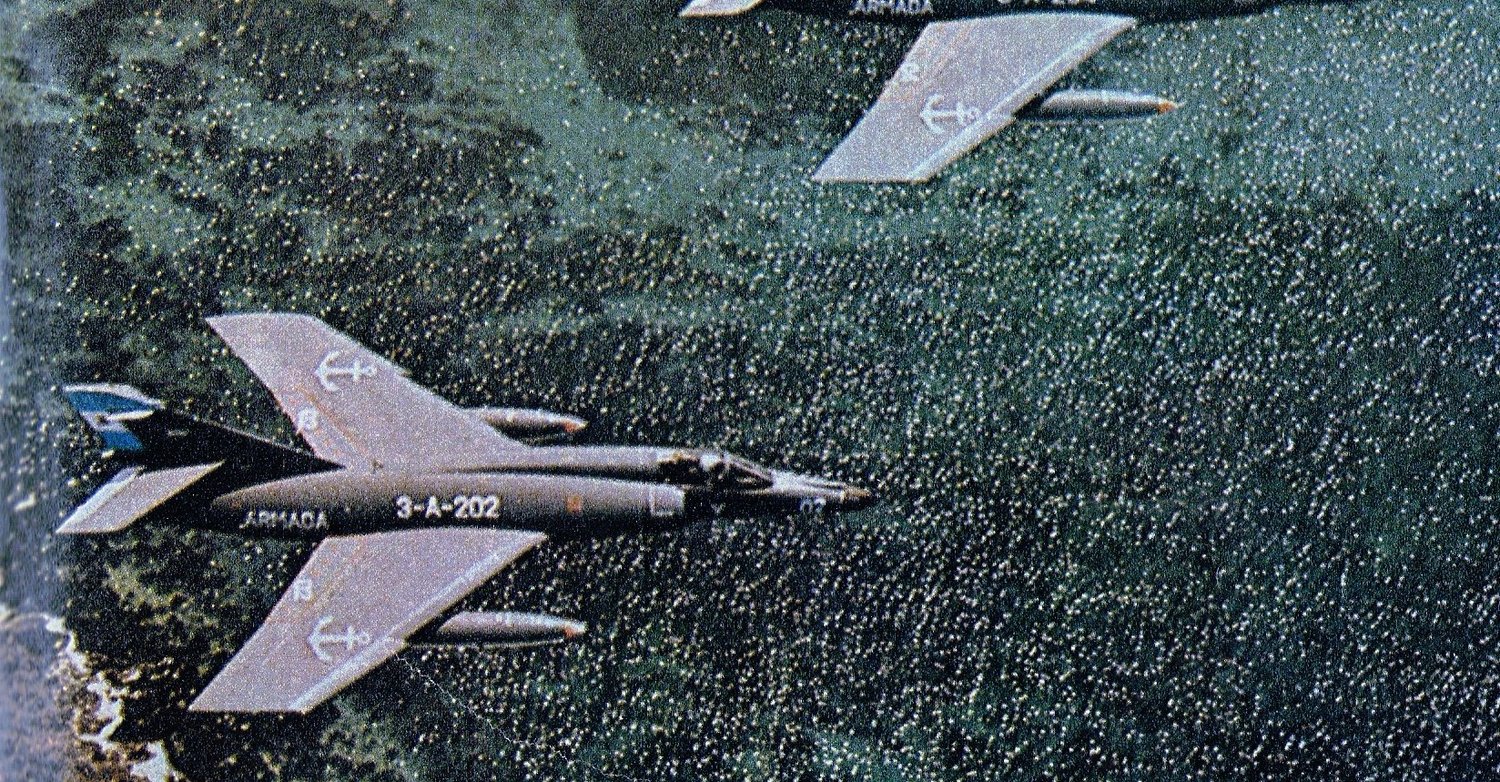
Despite inadequate preparation, both forces had an opportunity to adapt.[5] Shields notes, however, that interservice rivalry significantly undermined the air campaigns of both sides.[6] The Argentinian Air Force also made critical apportionment errors, increasingly using its aircraft for ground attack when it had yet to secure enough control of the air.[7]
As a result, Shields repeatedly shows how Argentinian aircraft struggled to employ their weapons effectively. In the first phase of the war, between May 1 and May 19, in which airpower predominated, for example, they planned to employ 206 weapons. Aircraft carrying 170 weapons managed to reach the Falkland islands, with aircraft carrying 107 weapons subsequently evading British combat air patrols. Aircraft, however, only managed to employ 15 weapons against the British fleet. With only one weapon detonating successfully, Argentina had a success rate of .005 percent. This low rate owes much to the challenge that the Argentine Air Force had in locating the British, having not adequately organized and developed its intelligence, surveillance, and reconnaissance capabilities prior to the conflict to support joint operations. Shields effectively supports this information with helpful and clear infographics.[8]
The second phase of the war was Operation Sutton, in which the British offered up a decisive target for the Argentines as its amphibious force approached and landed on the Falklands. Because Argentina lacked effective intelligence, surveillance, and reconnaissance capabilities, however, the British successfully approached the islands and began landing their troops and equipment 28 hours before Argentina detected the landing.[9] As a result, they “doomed themselves to a reactive strategy dictated by British decisions for the remainder of the campaign—all for the sake of a useful intelligence gathering capability.”[10]
They also failed to adapt mentally, not realizing that focusing on striking British carriers was not the most effective use of their weapons at this phase in the war, or so Shields asserts.[11] Whether he is correct is unknowable, however, given that human behavior is unpredictable; the sinking of a British carrier at any phase in the war could possibly have caused British civilian leadership to disengage from the conflict.