There are many reasons to participate in Colonial Road Runners or Peninsula Track Club races. For those select elite athletes, written up weekly this summer in the Gazette, who have the talent and desire to compete on a world-class level (Isaac Lamprecht in the triathlon), the national-class level (Adam Otstot, national Masters champion in the track 10,000 meters), national collegiate level in distance events (Caroline Bauer), national USATF 800-meter track finalist (Derek Holdsworth), and state age group record and world age graded level (Isabella Strumke), to excel can be immensely satisfying.
Then there are runners like Roger Hopper and Emily Honeycutt, multiple CRR Grand Prix champions, well on their way to more titles in 2023. But there are vast numbers of those in the middle ground, who compete for personal satisfaction, personal records or improvement, along with improving their health, or for social reasons or camaraderie. Without them, area road races could not be successful.
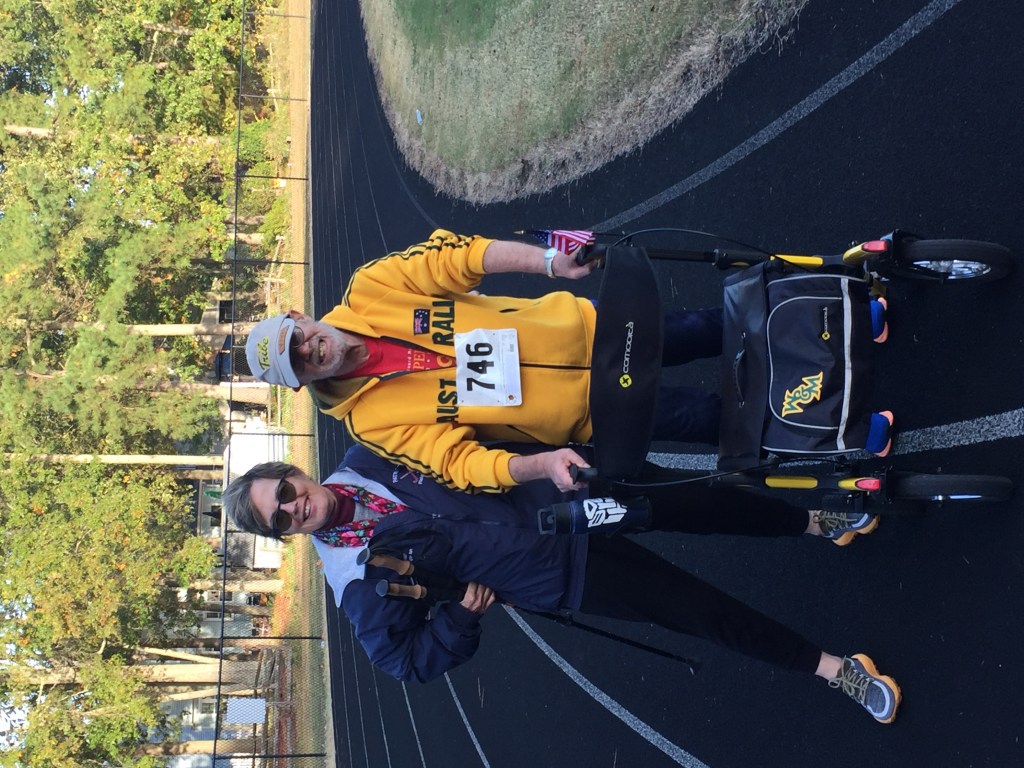
But even at the back of the pack, competing, and just finishing the distance can be very important. That is especially so for those who are overcoming life hurdles from health setbacks. That was the case this past month for October 2021 stroke victim George Fenigsohn of Poquoson, for decades the premier race walker on the Peninsula, and a 2014 inductee into the Virginia Peninsula Road Racing Hall of Fame, the only race walker enshrined in that group. It took Fenigsohn an hour and a half to complete the July 4 Independence Day 5K on the Yorktown Battlefield Tour Roads. In his prime, he race-walked that 5K road distance in a little more than 26 minutes.
Fenigsohn’s race walking career started at William & Mary. He himself will tell you he was not that talented of a runner, starting at Newport News High School under the legendary coach Julie Conn, although he tried hard. He tells the story of former W&M track coach Harry Groves, a notably blunt person, taking him aside, and saying, “George, you run so slow, you might as well be walking!” And that’s exactly what he became, a race walker in 1967 while competing for W&M in track meets. Race walking then was a collegiate scoring event.
Fenigsohn had been the premier race walker on the Peninsula since then, for almost 50 years. He is the first race walker inducted into the Hall of Fame, both for his accomplishments as a race walker, but also for his dedication to the sport through the years, conducting countless race-walking clinics or workshops, and encouraging many others to take up the sport. He was justifiably known for years as the “Race Walking Guru of the Peninsula.”
Fenigsohn’s race walking PRs are 7:35 (mile), 26:08 (5K), 56:22 (10K) 1:31 (8 miles) and 1:56 (20K). Despite what Groves said, he was actually relatively fast as a runner, at least by local road racing standards, going 5:00 for the mile, 17:36 for the 5K, 37:07 for the 10K, and 1:26 for the half marathon. But it is his race walking accomplishments that got him into the Hall of Fame. While at W&M, he raced indoors at New York City’s Madison Square Garden and in Baltimore; and at the Pan American Games Trials 20K in 1968. Later, as a Masters racewalker, he competed in the Penn Relays in 1999 (with his 10K PR of 56:22), and at the National Senior Games in 2003 (placing third in the nation at the 1,500 and 5,000 meters).
Fenigsohn was twice honored by the Peninsula Sports Club, was first place several times in the Virginia Senior Games, and has been nationally ranked in his age group for racewalking. A Poquoson resident, and with a doctorate in counseling, he was a counselor for Thomas Nelson Community College in Hampton, and a therapist for Rock Landing Psychological Group in Newport News. Earlier he was a family life teacher in the York County school system.
Fenigsohn’s life-changing moment came suddenly one day in 2021. Fenigsohn emailed, “I’m gonna do the best I can. I have a hard time talking and I’m dictating the best the machine will allow. The stroke occurred in October 2021. It was a violent experience. It was a serious stroke. I almost died in the hospital. It’s called a Wallenberg.” Wallenberg’s Syndrome is defined as a neurological condition caused by a stroke in the brain stem, specifically in one of the arteries that provide blood to the cerebellum, which coordinates and regulates muscular activity in the body.
Fenigsohn continued, “I don’t remember a lot because I was in hospitals several times. I got up into a wheelchair and then a walker. And now I’m on walking sticks, Nordic walking sticks, thanks to Jim Elder from Colonial Sports. When I go out for 30 minutes or more, I use the walking sticks, but I have a host of situations. One is stroke fatigue, which is very common, where you feel tired a great deal, and sleep doesn’t help. I sleep about 10 hours a night, but most days I still have to nap. Another situation is ataxia. The stroke took away my sense of balance and I walk with some difficulty. I can walk sometimes 20 minutes or more without a cane, but I bump into things and sometimes I have to hold on to walls. But I’ve made some progress on this. My balance is still very poor. I go to physical therapy once every two weeks and I practice for hours, standing, sitting and moving, bending over. It’s been a long journey. I feel like stroke people make their best progress the first six months and I’m going on this coming October two years. I think I’ve plateaued a great deal.”

“My family, my son and daughter, and especially my wife Leigh, have been very kind to me, really helped me out. She drives me to various therapies. I can’t drive on the Interstate. I can drive locally in Poquoson. The entire right side of my body cannot feel hot or cold or pain. It’s a very peculiar situation. Both hands are weak and I have a hard time holding on to things.”
But Fenigsohn persists in his recovery. “I’ve done about five races with the CRR and the PTC just to enter. My times have been horrible. I don’t even worry about the times. An hour and a half for 5K. It’s just I need somebody to go with me often, to help me along in case I fall. Randy Hawthorne and others have been very kind. It’s been hard doing the races because I just don’t have the energy. I’ve walked almost two hours, but the weather has to be right for that. I can’t stand the heat, but I do go to a gym here in Poquoson. I’m trying extremely hard to overcome this. I’m 75 now, I don’t know how much more I can do.”
“I was racing right up until the stroke happened and was second in the [CRR race walking] Grand Prix.” He had enough Grand Prix points to end up second for that Grand Prix in 2021, behind Tom Gerhardt, but holding off Paul Rienth.
‘My friends have been tremendous, helping me out. We moved to my daughter’s house in Poquoson, which has one floor. I read all the results of the races and I dream about them. I dream about doing workouts at Cary Field [now Zable Stadium], about doing repeat quarters and halves. It’s not unusual to dream about the past because I know those days are gone. I do hope that I can keep on with my walking. And I can read, watch television and try to call my friends and stay in touch.
In my life I’ve had cancer, a heart attack and a stroke and I feel like what’s next? I’ll work out as hard as I can. No one can tell me why the stroke happened. I think other people, when they get a stroke at my age, just don’t make it. And I’m glad that that didn’t happen to me.”
Hawthorne, CRR treasurer and another inductee into the Road Racing Hall of Fame, emailed, “I went down to Poquoson a half dozen times to take him out for a walk (with his rollater). Then we’d go out to lunch and talk about the “old” running days. I’ve known George since his freshman year at W&M (class of 1969). Remember in 1968 seven of us went to Europe for 10 weeks in a VW bus and stayed in tents and sleeping bags. George and another broke off from the rest of us and hitch hiked for the last 4 weeks—and went to Czechoslovakia, looked up Emil Zatopek [one of the all-time greats in distance running] and went running through the woods with him.”
Rick Platt is president of Colonial Road Runners.