Two York County artists, Diane Abbott Monach and Jeanne Wayman Eickhoff, create a beautiful tapestry of collaboration spanning across multiple artistic mediums, especially in the art of friendship.
Both artists are well known in their respective fields: Diane an accomplished costume designer, playwright and director, and Jeanne known for her realistic depictions of Yorktown and landscapes extracted from sketches and photos she takes around the world.
Their paths first crossed in York County where, as mothers, they supported high school art programs. But when a local ladies group brought them together at a county favorite, Pop’s Diner, they truly gravitated to each other as artists, former Wolverines and writers. Diane earned her MFA at the University of Michigan, specializing in costume design for famous musicals such as “My Fair Lady” and “Joseph and the Amazing Technicolor Dreamcoat.” She also wrote “Lady Lambert,” a play that won the prestigious University of Michigan Hopwood Award. Diane is the mother of Bruce, Keith and Grace, and lived in Naples and Oahu before settling in York County.
Jeanne, another Michigan alumna, known for her paintings of historic Yorktown, is also an expert in graphic design. Her work has been compared to Van Gogh and Hopper, but she’s also designed graphics for military aircraft training software for Boeing Aerospace — more recently for York Country’s Art on the River show, which this year celebrated its 10th anniversary. She contributes more than just the logo; she judged the show and served 14 years as the county’s arts commissioner. Jeanne is the mother of Nicole and Aaron, and lived in nine states before settling in York County.
Despite different backgrounds and areas of expertise, Diane and Jeanne shared a connection in their passion for writing and publishing. While in Italy, Diane wrote a book called “The Substitute Bridegroom,” penned under her middle name, Jeanne. At the same time, Jeanne (Eickhoff), was in the midst of research and creating characters for a historical novel and found inspiration in Diane’s writing.
Friendship blossomed as they found time, sometimes three times a week, to write, talk and edit each other’s work at a local restaurant with Wi-Fi and privacy booths. When the restaurant closed, they struggled to find another collaboration space. With no luck, they each found themselves pulled back to their major art fields, sewing and painting, logo design for Jeanne and costume design for Diane at the Williamsburg Players.
They remained fierce friends. Diane proved their mutual inspiration was not limited to writing. Despite a busy life and travel, she found time to create exquisite, personalized quilts for Jeanne’s first two grandchildren to the delight of the entire family.
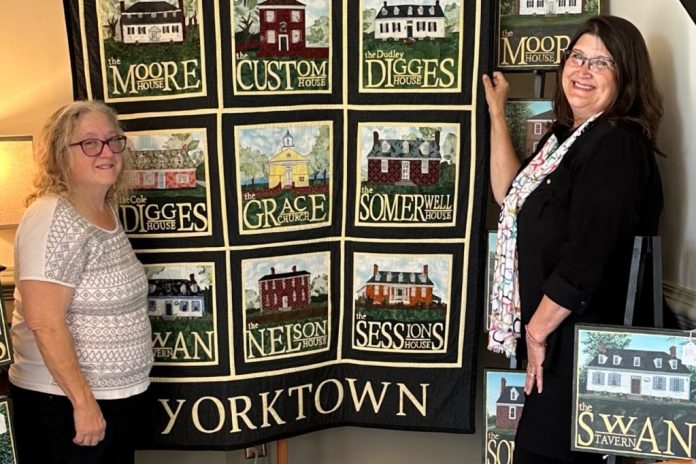
Then, in a truly magnificent act of friendship, Diane made a very special quilt for Jeanne on her 60th birthday: the nine-part series of her intricate paintings known as the “Houses of Historic Yorktown.” The series depicts landmarks of Yorktown, including the Nelson House and Grace Church, among others. Diane painstakingly replicated the entire series with stunning likeness to Jeanne’s original set that is sold in postcard versions.
Sharon Owen, the long-standing manager of York Hall Gallery, has long represented Jeanne’s art in her gallery that also features extraordinary quilting. This summer, Sharon graciously brings this unique set for together for public viewing on the main floor, originals together side by side, in a display of history, art and love.
Now through August, purchase a raffle ticket for a framed and signed print and/or a one-of-a-kind quilted tote bag made by Diane Monach. Courtesy of Nicole Eickhoff
Their lives have since guided them on more paths, yet Diane and Jeanne remain close friends and continue to pursue their passions in art, writing and publishing. Their story is a testament to the power of collaboration and enduring bond of friendship.
Diane has collaborated before on another one of Jeanne’s paintings, the popular Yorktown Onion. Now through August, purchase a raffle ticket for a framed and signed print and/or a one-of-a-kind quilted tote bag made by talented Diane. This beautiful, handcrafted bag is sturdy to hold books and will last for years to come. All proceeds of this raffle will benefit the gallery and are available at York Hall.
Nicole Marie Anne Eickhoff is the daughter of Jeanne Eickhoff and lives in Spain.
REMLINGEN, Germany — Sascha Hruzik was serving in the German army nearly 20 years ago when he was asked to become a bone marrow donor.
He didn’t think twice. He is the kind of guy who will do anything for others.
A steelworker who has renovated much of his two-story home with his own hands, he is also a volunteer fireman who recently spent 48 consecutive hours rescuing residents in a nearby town from flooding.
So, 20 years ago, he got his mouth swabbed and his DNA went into the World Marrow Donor Association database. And for a decade, he didn’t think much about it.
Then in late 2015, a German Red Cross official knocked on his door.
Your DNA matches someone in the United States, he told Sascha. She’s terribly sick and without a bone marrow treatment soon, she will die. Sascha immediately agreed to be her donor.
That someone was my sister-in-law, Patti Minium Moonis, who lives in Newport News. Her husband was my brother, Mike, who died of cancer in 2001.
In 2015, Patti was sick with chronic myeloid leukemia, a particularly deadly form of cancer that had not been cured by four rounds of conventional treatment. Without a bone marrow transplant, she might survive a year, but more likely she had just months.
She has a loving second husband in Mike Moonis, who for years has worked two jobs to support the blended family of seven kids. He lost his first wife, Lea, to cancer. Now he and the kids were preparing for a life without their mother and spouse.
That November in Richmond, Patti got the infusion of bone marrow cells. It worked. Though health issues remain, she’s enjoyed seven years of life that in 2015 she did not know she would have.
But for months afterward, she wondered.
“I really wanted to get to know the person who saved my life,” she said. “I wondered if that would ever happen.” But many countries insist on donor anonymity.
Sascha Hruzik in the size small T-shirt that was a gift intended for his daughter. In 2015, he donated bone marrow that saved the life of writer Harry Minium’s sister-in-law. In June, Minium visited Hruzik and his family in Germany.
In July 2016, she finally knew. She’d gone for her weekly appointment at the Massey Cancer Center’s bone marrow transplant clinic, and a nurse handed her an envelope. “From your donor,” it said.
Inside was a note. The writer had included his address but not his name. Attached to the note were two linked pearls.
Hello, unknown patient,
I am a 30 year-old man from Germany. I have belonged from the it goes well to you and you could celebrate Christmas with your family. This has made me and my family very happy!!! we wish you furthermore quite a lot of strength and would like to hand over to you this selfformed angel.
Dear greetings from your donator and my family
Patti wrote back. Not having a name, she chose “Otto,” the name of her German grandfather. The nickname would stick.
They began emailing on Facebook. But their communication was haphazard because no one in Sascha’s family speaks much English and Patti knew no German at all. Sascha’s wife, Nadine, speaks better English than he, and kept Patti up to date on how the family was doing.
Yet for seven years, Patti and Sascha did not speak.
That changed on June 30 when I picked up a rental car in Berlin, where I was visiting friends, and made the 140-mile drive to Remlingen.
Nadine had texted that Sascha would be home from work at 4:30 p.m., so I left Berlin around 10:30 a.m. and took a leisurely drive through the back roads of Germany. I killed time by stopping to take pictures and wander through the small towns.
I worried about how things would go because I speak little German and we had no plan other than for Patti and Sascha to connect by video call. The family hoped to find a friend to help interpret, but there were no promises.
When I arrived, four people were waiting on the front porch: Sascha and Nadine; Nadine’s mother, Conny; and Patrick, one of Sascha’s co-workers. Patrick was there, thank goodness, to interpret. Sascha and Nadine’s daughter, Johanna, was at a school party.
Germans often aren’t overly friendly when you first meet them. It’s a cultural thing I’ve come to understand, and things were a little formal at first. But I quickly felt like a member of the family.
They invited me in and we ate cake in their dining room. I told them of how my brother, Mike, met Patti. He was an editor at the Daily Press newspaper who interviewed her for an editing job.
He hired her; then they began dating and married. They were devoted to each other and their children until the day he died. I described how I was there when Mike died and Patti hugged him for a while, repeating “I love you” over and over. Tears welled in Nadine’s eyes.
I suggested we do a WhatsApp video call with Patti, who was waiting in Newport News, where it was six hours earlier, with her husband and daughter. I called her and said, “Someone here wants to speak to you.”
I turned the phone toward Sascha.
“Hi, oh, hi!” Patti exclaimed. I couldn’t see her, but I could hear that she was already in tears.
“I am so happy to see you.”
Patrick translated: “He also says he’s happy.”
Pretty soon Conny was crying. Later, the two steelworkers were dabbing at their eyes. Eventually I lost it, too.
“This is,” Sascha said, “one of the greatest experiences of my life. I will never forget this day.”
“I can’t thank you enough,” Patti said later in the conversation. “It is unbelievable that you are so far away. I wish I could touch you.”
He did touch her, I said, with his blood.
“I wish I could give you a hug,” Patti said.
“He may not like it,” I replied, “but I’m going to give him a hug when I leave.”
“Is everything OK with the illness?” he asked.
“Yes. I’m in remission. Everything is perfect. You saved my life.”
He didn’t quite understand so I told him, “Alles sehr gut.” All is very good.
“You will always be my dear Otto,” Patti said later.
“Yes, I am,” he responded.
After about 20 minutes, I suggested we take a break and I would call back.
Nadine and Conny continued to weep.
___
In 2015, the Red Cross contacted Sascha and he went to a nearby hospital for tests. Patti, meanwhile, underwent treatment to essentially destroy her immune system lest it reject the transplanted cells.
Doctors needed to confirm that Sascha was healthy and an ideal match for Patti. Once the match was confirmed, he began injecting himself three times a day in the stomach with filgrastim, which increases the amount of certain blood-forming cells in the bloodstream.
Marrow can be drawn directly from the bone under anesthesia or can be distilled from a donor’s blood. Sascha’s procedure was the less invasive one; he spent a few hours in the hospital with IVs taking blood out of one arm and returning the blood to him in the other.
Patti, the former editor, has blogged about her struggles since my brother died, struggles that more recently have included breast cancer. On the blog, she posted her first letter to Otto:
Our seven children were terrified, six of whom already lost a parent to cancer … But I am alive and thriving thanks to you.
Sweet Otto, I just need you to know how special you are in my heart, in my husband’s heart, in my kids’ hearts. We consider you a member of our family – your blood pumps through my veins.
___
On our visit, I brought presents from Patti. After the first call, Sascha and the family opened them. He immediately claimed the T-shirt that said, “Someone in Virginia loves me.”
It was small and intended for Johanna, but he put it on anyway. He beamed as I took a photo, and he wore it the rest of the day.
At home in Remlingen, Germany: Sascha, the donor, is second from left. With him are his mother-in-law, Conny; daughter Johanna; wife Nadine; and co-worker and translator Patrick.
I learned more about the family during the break. Sascha and Nadine grew up in Remlingen, a town of about 1,000 people nestled in rural Lower Saxony about 50 miles south of Hanover. They met when he was 12 and she was 11, and they’ve been a couple ever since they were teenagers. Nadine works with special needs students.
Johanna returned home during the break and was as shy as you would expect any 11-year-old to be. She sat on her dad’s lap as I called Patti again.
Johanna said little, but moments into the conversation, tears began rolling down her cheeks. Even at her age, but with a German schoolchild’s grasp of English, she knew her father had saved Patti’s life.
Goodbyes on the phone were hard. After we hung up, we talked about the experience.
“I was so excited and so happy to see Patti,” Nadine said. “We’ve waited so long.”
When we walked outside, we all hugged.
“Thank you so much,” I said as I hugged Sascha, “for saving Patti’s life.”
“I would do it again tomorrow,” he said. “To save someone’s life, of course I would do it. I am so glad to have talked to Patti. It’s so hard to put into words how much this means.
“I will never forget this day.”
___
For information on becoming a bone marrow donor, go to bethematch.com
Minium is a former Virginian-Pilot and Daily Press reporter who is senior executive writer for athletics at Old Dominion University. Reach him at [email protected]
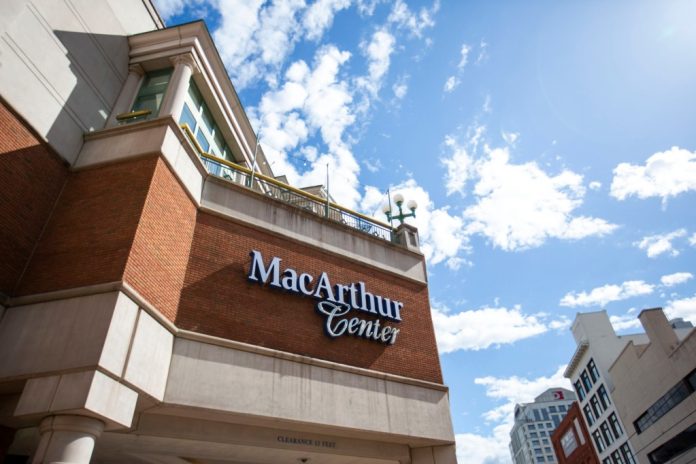
Re “Norfolk weighs what to do with several aging school buildings amid declining enrollment” (July 17): Why not transform MacArthur Center mall into a new Maury High School? Utilize the existing Maury High School building for other purposes. If it’s decided to tear the existing Maury High School building down, then convert that wonderful green space into a public park for all to enjoy.
Deborah Prince, Norfolk
Carbon emissions
Re “Recent flash floods and withering heat show the importance of good planning” (Our Views, July 13): I agree with your call to “look out for one another” — and in Ellicott City, Maryland, we know that it is impossible to prepare for two 1-in-1,000-year floods in less than two years (July 2016 and May 2018).
A major factor in the frequency of these extreme weather events is climate change. A national carbon fee and dividend, enacted by Congress, is needed to shut off the carbon dioxide emissions faucet quickly and fairly. A logical plan is for a carbon fee to be placed at the point of fossil fuel extraction, and the collected fee returned monthly to all households on an equal basis — where a person is a person, no matter what they do for a living.
This helps the most vulnerable households survive and thrive economically in our energy transition. We must also “border-correct” the fee, using our tariff powers to pressure other nations, including China, to transition out of fossil fuels while defending more energy efficient U.S. industries.
Planning for the extreme consequences of climate change must include a transition out of fossil fuel use. If we refuse to mitigate the chief cause of climate change with rapid energy transition to low-carbon-emitting sources, our efforts to deal with the consequences will be a recurring nightmare that is beyond looking out for one another. If we really want to look out for each other, we need to discuss core policies such as carbon fee and dividend.
Sabrina S. Fu, Ellicott City, Maryland
Women’s sports
Until recently, there were either no women’s athletic opportunities or else girls had to fight to be included begrudgingly on boys’ teams. Women have come a long way in developing girls’ sports, encouraging participation, and striving for commensurate pay and recognition. Title IX did wonders toward providing opportunities for women’s athletics. Girls can now get college scholarships and compete on numerous professional teams.
Lately, transgender individuals have begun competing in women’s sports, which has understandably led to a backlash of protests from female athletes. The problem is these biologic men generally have larger physiques and years of muscle enhancing effects of testosterone giving them a decided advantage over their biologic female counterparts.
Witness Mary Gregory shatter weightlifting records, and so on. Although their numbers are small, their effect is devastating. Some female athletes are now retiring as they cannot hope to compete.
There have for many years been numerous girls or women playing in men’s leagues, such as little league baseball, softball, football (usually as a placekicker), soccer, wrestling and other sports, especially when legitimate women’s opportunities didn’t exist. Instead of engaging and overpowering smaller women, why can’t a transgender woman compete in the men’s league as a woman? If exceptional girls can play in the boys’ leagues, then why can’t biological males continue to play in the boys’ league similar to biological females who elect to be included in those leagues. Certainly, that is a better fit. Why do they have to invade and disrupt woman’s sports?
Gwinnett gained a six-game series split against the Norfolk Tides by defeating them 6-2 Sunday afternoon before 3,104 at Coolray Field in Lawrenceville, Georgia.
The International League first-half champion Tides (60-34) fell to 12-8 in the second half. The Stripers (42-53) improved to 9-11 in the second half.
The Tides will return to Harbor Park for a six-game series against the Nashville Sounds, starting at 6:35 p.m. Tuesday.
Gwinnett starter AJ Smith-Shawver (1-2), one of Atlanta’s top prospects, gained his first victory in his fifth Triple-A start. The 20-year-old right-hander shut out the Tides for five innings on two hits, striking out six and yielding two walks. He was sent to the Stripers on June 26 after being called up from Double-A for four MLB appearances spanning 16 2/3 innings with the Braves.
Tides left-hander Drew Rom (7-6) gave up all six Gwinnett runs in five-plus innings, surrendering seven hits and two walks while striking out three.
Gwinnett went ahead 2-0 in the second inning as Yolmer Sanchez and Magneuris Sierra got hits and eventually scored. The Stripers extended the margin to 4-0 in the fourth as Joe Hudson hit an RBI double and scored on a Sanchez single.
With Smith-Shawver out of the game, the Tides trimmed the margin to 4-2 in the top of the sixth off reliever Roel Ramirez. Ryan McKenna and Heston Kjerstad led off with hits and scored when Connor Norby lined a single to center. But the Tides’ rally ended when Joey Ortiz grounded into a double play.
Gwinnett immediately responded as Hoy Park was plunked by a pitch and Hudson walked. That prompted Tides manager Buck Britton to replace Rom with Kyle Dowdy, who walked Daniel Robertson to load the bases. Sierra’s sacrifice fly and Luke Williams’ single to right drove in the day’s final runs.
Kjerstad finished with three of Norfolk’s seven hits, including his pair of doubles.
INTERNATIONAL LEAGUE SECOND-HALF STANDINGS
(through some of Sunday’s games; 1H refers to the team’s first-half record)
Team, W-L, Pct., 1H
Lehigh Valley (Phillies), 13-7, .650, -, 36-37
Worcester (Red Sox), 13-7, .650, -, 39-36
Iowa (Cubs), 13-8, .619, 0.5, 43-30
Buffalo (Blue Jays), 12-8, .600, 1.0, 34-41
c-Norfolk (Orioles), 12-8, .600, 1.0, 48-26
*St. Paul (Twins), 12-8, .600, 1.0, 43-31
*Nashville (Brewers), 11-8, .579, 1.5, 40-34
Scranton/W-B (Yankees), 11-8, .579, 1.5, 34-40
*Columbus (Guardians), 10-9, .526, 2.5, 33-41
Indianapolis (Pirates), 11-10, .524, 2.5, 33-41
Rochester (Nationals), 11-10, .524, 2.5, 34-39
*Jacksonville (Marlins), 10-10, .500, 3.0, 32-42
*Louisville (Reds), 10-10, .500, 3.0, 40-33
Durham (Rays), 10-11, .476, 3.5, 40-35
Gwinnett (Braves), 9-11, .450, 4.0, 33-42
*Memphis (Cardinals), 9-11, .450, 4.0, 39-36
*Omaha (Royals), 7-12, .368, 5.5, 38-34
Toledo (Tigers), 7-14, .333, 6.5, 33-41
Syracuse (Mets), 6-14, .300, 7.0, 33-41
*Charlotte (White Sox), 3-16, .158, 9.5, 35-40
*Does not include Sunday’s result.
c-clinched first-half title and berth in championship series in September.
“Barbenheimer” didn’t just work – it spun box office gold. The social media-fueled fusion of Greta Gerwig’s “ Barbie ” and Christopher Nolan’s “ Oppenheimer ” brought moviegoers back to the theaters in record numbers this weekend, vastly outperforming projections and giving a glimmer of hope to the lagging exhibition business, amid the sobering backdrop of strikes.
Warner Bros.’ “Barbie” claimed the top spot with a massive $155 million in ticket sales from North American theaters from 4,243 locations, surpassing “The Super Mario Bros. Movie” (as well as every Marvel movie this year) as the biggest opening of the year and breaking the first weekend record for a film directed by a woman. Universal’s “Oppenheimer” also soared past expectations, taking in $80.5 million from 3,610 theaters in the U.S. and Canada, marking Nolan’s biggest non-Batman debut and one of the best-ever starts for an R-rated biographical drama.
It’s also the first time that one movie opened to more than $100 million and another movie opened to more than $80 million in the same weekend. When all is settled, it will likely turn out to be the fourth biggest box office weekend of all time with over $300 million industrywide. And all this in a marketplace that increasingly curved towards intellectual property-driven winner takes all.
The “Barbenheimer” phenomenon may have started out as good-natured competition between two aesthetic opposites, but, as many hoped, both movies benefitted in the end. Internationally, “Barbie” earned $182 million from 69 territories, fueling a $337 million global weekend. “Oppenheimer” did $93.7 million from 78 territories, ranking above “Barbie” in India, for a $174.2 million global total.
The only real casualty was “Mission: Impossible: Dead Reckoning Part I,” which despite strong reviews and a healthy opening weekend fell 64% in weekend two. Overshadowed by the “Barbenheimer” glow as well as the blow of losing its IMAX screens to “Oppenheimer,” the Tom Cruise vehicle added $19.5 million, bringing its domestic total to $118.8 million.
“Barbenheimer” is not merely counterprogramming either. But while a certain section of enthusiastic moviegoers overlapped, in aggregate the audiences were distinct.
Women drove the historic “Barbie” opening, making up 65% of the audience, according to PostTrak, and 40% of ticket buyers were under the age of 25 for the PG-13 rated movie.
“It’s just a joyous time in the world. This is history in so many ways,” said Jeff Goldstein, Warner Bros.’ president of domestic distribution. “I think this marketing campaign is one for the ages that people will be talking about forever.”
“Oppenheimer” audiences meanwhile were 62% male and 63% over the age of 25, with a somewhat surprising 32% that were between the ages of 18 and 24.
Both “Barbie” and “Oppenheimer” scored well with critics with 90% and 94% on Rotten Tomatoes, respectively, and audiences who gave both films an A CinemaScore. And social media has been awash with reactions and “takes” all weekend – good, bad, problematic and everywhere in between – the kind of organic, event cinema, watercooler debate that no marketing budget can buy.
“The ‘Barbenheimer’ thing was a real boost for both movies,” Goldstein said. “It is a crowning achievement for all of us.”
“Oppenheimer” had the vast majority (80%) of premium large format screens at its disposal. Some 25 theaters in North America boasted IMAX 70mm screenings ( Nolan’s preferred format ), most of which were completely sold out all weekend — accounting for 2% of the total gross. Theaters even scrambled to add more to accommodate the demand including 1 a.m. and 6 a.m. screenings, which also sold out.
“Nolan’s films are truly cinematic events,” said Jim Orr, Universal’s president of domestic distribution.
IMAX showings alone made up 26% of the domestic gross (or $21.1 million) from only 411 screens and 20% of the global gross, and “Oppenheimer” will have at least a three-week run on those high-demand screens.
“This is a phenomenon beyond compare,” said Rich Gelfond, the CEO of IMAX, in a statement. “Around the world, we’ve seen sellouts at 4:00 a.m. shows and people travelling hours across borders to see ‘Oppenheimer’ in IMAX 70mm.”
This is the comeback weekend Hollywood has been dreaming of since the pandemic. There have been big openings and successes – “Spider-Man: No Way Home,” “Top Gun: Maverick,” “Avatar: The Way of Water” among them, but the fact that two movies are succeeding at the same time is notable.
“It was a truly historic weekend and continues the positive box office momentum of 2023,” said Michael O’Leary, President & CEO of the National Association of Theatre Owners. “People recognized that something special was happening and they wanted to be a part of it.”
And yet in the background looms disaster as Hollywood studios continue to squabble with striking actors and writers over a fair contract.
“Barbie” and “Oppenheimer” were the last films on the 2023 calendar to get a massive, global press tour. Both went right up to the 11th hour, squeezing in every last moment with their movie stars. “Oppenheimer” even pushed up its London premiere by an hour, knowing that Emily Blunt, Matt Damon and Cillian Murphy would have to leave to symbolically join the picket lines by the time the movie began.
Without movie stars to promote their films, studios have started pushing some falls releases, including the high-profile Zendaya tennis drama “Challengers.”
But for now, it’s simply a positive story that could even continue for weeks to come.
“There could be a sequel next weekend,” said Paul Dergarabedian, the senior media analyst for Comscore. “The FOMO factor will rachet up because of this monumental box office event centered around the movie theater experience.”
Estimated ticket sales for Friday through Sunday at U.S. and Canadian theaters, according to Comscore. Final domestic figures will be released Monday.
1. “Barbie,” $155 million.
2. “Oppenheimer,” $80.5 million.
3. “Sound of Freedom,” $20.1 million.
4. “Mission: Impossible-Dead Reckoning Part I,” $19.5 million.
5. “Indiana Jones and the Dial of Destiny,” $6.7 million.
6. “Insidious: The Red Door,” $6.5 million.
7. “Elemental,” $5.8 million.
8. “Spider-Man: Across the Spider-Verse,” $2.8 million.
9. “Transformers: Rise of the Beasts,” 1.1 million.
Two women were taken to a hospital following a shooting early Sunday morning in Portsmouth.
Police described one woman’s injuries as life-threatening and the other woman’s injuries as non-life-threatening.
The shooting took place near the 600 block of Edwards Street on the south side of Portsmouth, according to a tweet posted by the police department at 1:43 a.m.
Police declined to share further information about the incident.
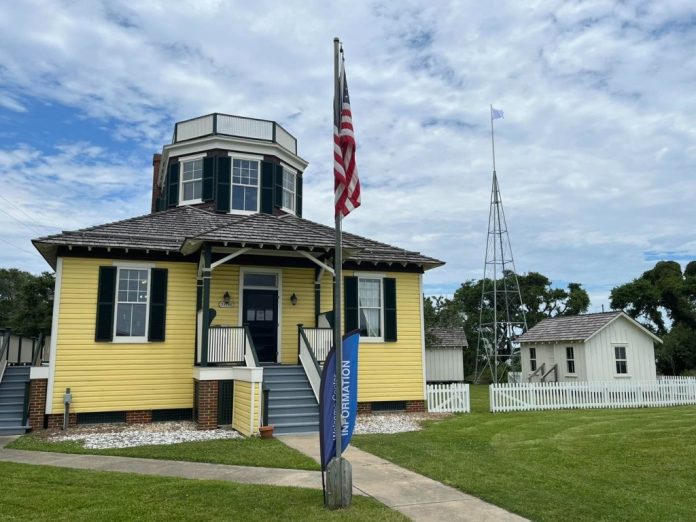
A new coastal warning display weather tower was recently installed at the U.S. Weather Bureau Station at Cape Hatteras National Seashore thanks to philanthropic partner Outer Banks Forever and the Outer Banks Visitors Bureau.
The U.S. Weather Bureau, predecessor to the modern-day National Weather Service, established several weather stations and observation posts in North Carolina as part of a national network of weather stations throughout the late-1800s and early-1900s. Construction of the weather station in Hatteras was completed in 1901 and commissioning occurred on Jan. 1, 1902.
In the absence of modern early warning systems, weather stations like the one in Hatteras helped predict rough seas and severe weather. Weather observers often had just hours or minutes to warn residents of approaching storms using flags flown from the weather tower, and sirens. The new weather tower in Hatteras replaces a tower that was removed in the 1980s after it collapsed.
Several years ago, Cape Hatteras National Seashore began several projects to revive and protect the 1901 U.S. Weather Bureau building, which showed signs of suffering from the effects of the harsh coastal environment. The installation of a new roof, interior and exterior painting, and repairs to wooden handrails and porch decking, helped preserve the integrity of the historic building and provided much-needed protection from the elements. The fabrication and installation of the new weather tower caps off the series of preservation projects at the bureau.
Located at 57190 Kohler Road, the building now operates as a welcome center by the Outer Banks Visitors Bureau through a partnership agreement with Cape Hatteras National Seashore. Staff from the Outer Banks Visitors Bureau plan to fly weather condition flags when the building is open to the public.
NEW DELHI (AP) — Hundreds of rescuers ended a four-day search for scores of people still missing after heavy monsoon rains triggered a massive landslide in a village in western India, an official said Sunday.
The rescue teams recovered the bodies of 27 people killed in the Wednesday night landslide that hit the Raigadh district village of Irshalwadi, located nearly 80 kilometers (50 miles) from Mumbai, the Maharashtra state capital.
Seventy-eight people were thought to be missing as of Sunday, Deepak Avadh, an official of the National Disaster Response Force, said. The state government and the relief agency later decided to end the search operations, Avadh said, implying there was no hope of finding any survivors.
No more bodies were recovered Sunday, he said.
At least 17 of the 48 houses in the village were fully or partially buried under the debris, officials said. The dead included four children, the Press Trust of India news agency said, adding that 75 people were rescued. Four survivors were hospitalized.
Rescuers mostly used rods and shovels. Heavy equipment like earth movers and excavators could not reach the village, which has no paved roads and massive sludge around it, Avadh said. Sniffer dogs were also deployed in the search for survivors.
From the base of a hill, it took about 90 minutes to reach Irshalwadi village by foot. Rainfall and a threat of more landslides caused the rescue operation to be suspended during the night the landslide occurred, the rescue agency said.
India’s weather department placed Maharashtra under alert as the state was lashed by incessant rains the past week. Local train service was disrupted at several places with water flowing inside stations and over tracks, media reported.
Record monsoon rains have killed more than 100 people in northern India over the last three weeks, officials said, as the downpours caused roads to cave in and homes to collapse.
India regularly experiences severe floods during the monsoon season, which runs between June and September and brings most of South Asia’s annual rainfall. The rains are crucial for rain-fed crops planted during the season but often cause extensive damage.
Scientists say monsoons are becoming more erratic because of climate change, leading to frequent landslides and flash floods in India’s Himalayan north.
___
Follow AP’s coverage of the climate and environment at: https://apnews.com/climate-and-environment
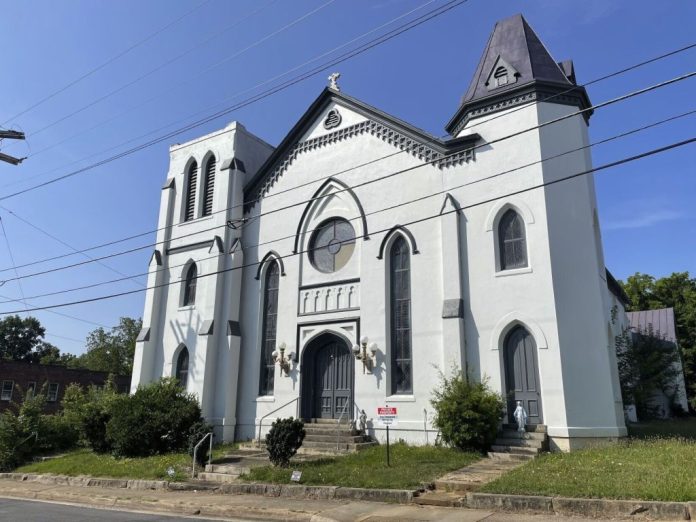
DANIVILLE (AP) — When Jeremy DiMaio took a look at the late 19th-century Gothic Revival church along Jefferson Avenue about three years ago, he asked his then 12-year-old daughter if he should buy it.
“She said, ‘no, but I know you will,’” DiMaio recalled during an interview inside the former First Presbyterian Church building. “So I did.”
Since closing on the purchase of the nearly 150-year-old structure at 200 Jefferson Ave. in April 2021, he has been working diligently to restore it and turn it into an Airbnb christened “Church of the Perpetual Boogie.”
Though months away from completion, the building inside delivers a funky, humorous theme with irreverent touches and rich history.
In the spacious fellowship hall area converted into a living room, a life-size figure of Barack Obama sits cross-legged on a red leather sofa, sporting a smile and an “I voted” sticker.
A 36-pound, 30-foot wide reproduction of Leonardo da Vinci’s “The Last Supper” on a thin, flimsy particle board adorns the back wall.
Other features include a bathroom with a blown-up 1929 First Mortgage Real Estate Gold Bond on the wall, a wood sculpture of a friar DiMaio bought at a flea market near Dulles International Airport and an enlarged First Presbyterian Church black-and-white choir photo from the mid-20th century. The latter was provided by the Danville Historical Society, he said.
He has spent about $130,000 restoring the building so far, and expects the project to cost about $300,000 by the time he finishes. That also includes plans for turning the sanctuary — which boasts an 1899 pipe organ — into a music venue.
“It will be worth it,” DiMaio, 47, said of the costly endeavor.
The name “Church of the Perpetual Boogie” continues the 1970s theme from DiMaio’s other Airbnb he owns in Afton, “Boogie Nights Manor.” The name is a nod to the 1997 Paul Thomas Anderson film “Boogie Nights,” which is set mostly during the ’70s. It’s also the title of a 1977 hit song by the funk-disco group Heatwave.
“I kind of wanted to keep the theme,” he said.
DiMaio’s ongoing project has a Facebook group with about 2,000 members. Word of the “Church of the Perpetual Boogie” has spread.
“I felt really validated when it showed up on Google Maps,” he said. “It showed up as ‘Church of the Perpetual Boogie.’”
Built around 1879, the grayish white structure contains nearly 9,000 square feet and includes a bell tower stamped in 1840. The bell tower was cast by John Wilbank, who also cast the replacement for the damaged Liberty Bell, DiMaio said.
The First Presbyterian Church was the first church in Danville when it started out as a wooden structure in the 1820s, DiMaio said. It was later expanded.
The congregation outgrew the building and moved to the currently operating First Presbyterian Church location on Main Street around 1910.
The Jefferson Avenue building, which DiMaio believes is limestone over red-brick masonry, had been vacant for 11 years when he bought it.
“I try to buy interesting properties and convert them,” he said. “I tend to find properties that have sat on the market that no one else seems to want and find an adaptive re-use.”
His Airbnb will be one unit, with three bedrooms including a total of four beds. Eventually, it will have four bedrooms, DiMaio said.
“I’ve always liked churches,” he said. “I came in here, the first thing that struck me is how sad is a building this old and this historic that’s just rotting.”
At 150 years old, the building was not going to survive much longer, DiMaio thought to himself.
He has converted one room into a dining area. That part of the church required a lot of work. The floor had three layers of paint and DiMaio spent five months scraping red paint off the wall with a razor blade.
The building also had no furniture.
“Over the last two years, I’ve acquired every single piece of furniture,” DiMaio said.
He bought furnishings and decor from all over, Facebook Marketplace, auctions and his own travels.
One item is an old machine, used to make communion wafers and patented in 1908, from a monastery in Northern Virginia. Another one of his finds includes a wine sacristy — for storing wine — made in the 1800s.
The dining room also features a Jacobean buffet table from the late 19th century. A Moroccan clay menorah, which DiMaio bought in Morocco, sits on the table and is more than 100 years old, he said.
He’s turning the fellowship hall into a living room where the sacred altar is a bar. The room is where DiMaio is rebuilding the floor.
“This area took a lot of water damage,” he said.
Half of the old nursery will become the master bedroom and the former pastor’s study will be converted to a bedroom, as well.
As for the spacious sanctuary, that is an entire project onto itself.
“My goal is to work on this space early next year,” DiMaio said.
The sanctuary includes its original hand-painted rose-glass window overlooking the balcony, as well as the original pews.
He also has plans to record an episode of the PBS series, “The Life of A Musician” in the sanctuary in front of the organ and hold a house concert for the show in the fellowship hall.
“It will be a cool music venue,” DiMaio said.
DiMaio has traveled to more than 30 countries and divides his time among Danville, Afton and Northern Virginia.
He is in Danville every other week.
“My friends and social scene is here,” DiMaio said. “It’s a cool enclave of creative, artistic people here.”