Home Blog Page 60

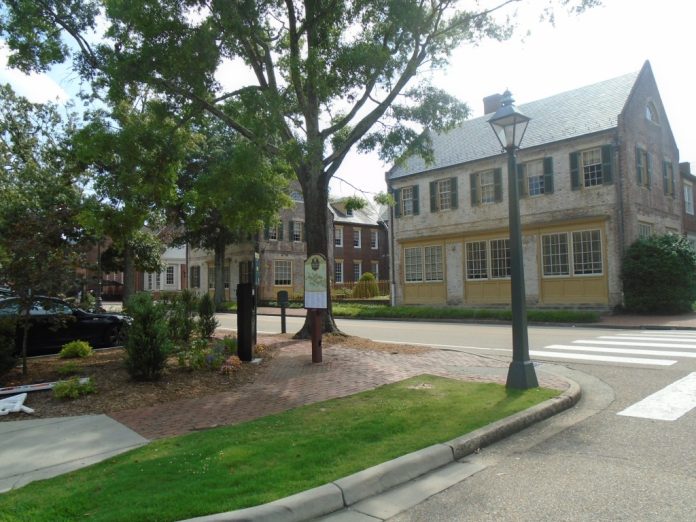
CW says return to Goodwin Building won’t affect Merchants Square parking – Daily Press

0

WILLIAMSBURG — The parking situation in Merchants Square will not be exacerbated by the return of administrative offices to the Goodwin Building, a Colonial Williamsburg spokesperson said.

For the past several years, some area residents have voiced complaints of a lack of parking in the area.

Colonial Williamsburg Foundation employees began returning to work in the building last month after the completion of its renovation. Employees will park on the second floor of the city’s parking garage behind Prince George Street, according to foundation spokeswoman Ellen Peltz.

A 2001 agreement between Williamsburg and Colonial Williamsburg stipulated that the foundation could have 10% or up to 35 parking spaces in the proposed city (P1) garage, as the foundation was transferring ownership of the garage site to the city.

If Colonial Williamsburg decides more spaces are needed, “it will have to pay for the spaces like any other party who wants a monthly pass,” city spokeswoman Nicole Trifone said.

According to Peltz, the Goodwin building will house the president’s suite, fundraising offices, corporate communications and the departments of real estate, licensing and design.

“All other departments will be located in other foundation-owned administrative spaces including the Bruton Heights Education Center,” she said. Some departments currently housed at the Franklin Street Offices will move to Bruton Heights.

Shortly after becoming Colonial Williamsburg president, Cliff Fleet decided that some administrative departments, including his office, should return to the Goodwin Building as headquarters of the foundation. The administrative offices had been removed from the building in 2018.

Over the past two years, the building has been renovated and restored to update and bring to code various services, including electrical, plumbing and heating and air conditioning.

Wilford Kale, [email protected]


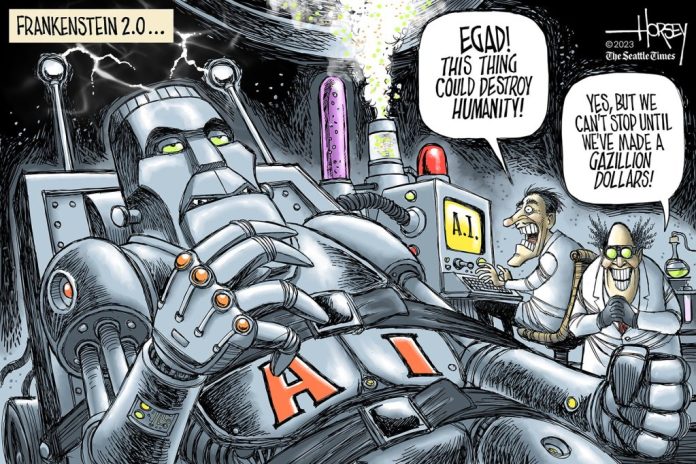
David Horsey: Frankenstein 2.0

0

Cartoon by David Horsey for Aug. 5, 2023.

How 6 Mississippi officers tried to cover up their torture of 2 Black men – Daily Press

0

By MICHAEL GOLDBERG (Associated Press/Report for America)

JACKSON, Miss. (AP) — Men who had sworn an oath to protect and serve were huddled on the back porch of a Mississippi home as Michael Corey Jenkins lay on the floor, blood gushing from his mutilated tongue where one of the police officers shoved a gun in his mouth and pulled the trigger.

As Jenkins writhed in pain, the six white officers devised a scheme to cover up dozens of stunning acts of brutality that they had just carried out during a 90-minute period of terror against Jenkins and a second Black victim.

The officers planted drugs. They stole surveillance footage from the house. They tried to dispose of other evidence. They agreed on a set of lies that would further upend their victims’ lives.

And that was just the cover-up.

Careful to avoid security cameras at the house, they burst in without a warrant, starting the torture session of physical, sexual and psychological abuse. They handcuffed Jenkins and his friend Eddie Terrell Parker and poured milk, alcohol and chocolate syrup over their faces. They forced them to strip naked and shower together to conceal the mess. They mocked the victims with racial slurs. They shocked them with stun guns.

The officers had meant to torture the men without leaving physical scars. But one shot Jenkins in the mouth. Miraculously, Jenkins survived.

The six officers pleaded guilty Thursday to a long list of federal civil rights charges. The Mississippi attorney general’s office announced afterward that it had filed state charges that include assault, conspiracy and obstruction of justice.

Law enforcement officers are seldom charged for crimes committed on the job, and it’s rarer still for them to plead guilty.

The charges follow an investigation by The Associated Press that linked some of the deputies to at least four violent encounters with Black men since 2019 that left two dead and another with lasting injuries.

The officers included Christian Dedmon, Hunter Elward, Brett McAlpin, Jeffrey Middleton and Daniel Opdyke of the Rankin County Sheriff’s Department and Joshua Hartfield, a Richland police officer. They pleaded guilty to charges including conspiracy against rights, obstructions of justice, deprivation of rights under color of law, discharge of a firearm under a crime of violence, and conspiracy to obstruct justice.

The terror began on Jan. 24 in a racist call for extrajudicial violence that felt like it was from a bygone era.

A white neighbor phoned Rankin County Deputy Brett McAlpin and complained that two Black men were staying with a white woman inside a Braxton home. McAlpin told Deputy Christian Dedmon, who texted a group of white deputies so willing to use excessive force they called themselves “The Goon Squad.”

“Are y’all available for a mission?” Dedmon asked. They were.

Opdyke “admits he was wrong for his part in the horrific harms” and “is prepared to face the consequences of his actions,” attorney Jason Kirschberg said in a statement.

Hartfield’s attorney Vicki Gilliam said while he “cannot change what he did, he has shown that he is ready to accept consequences.”

Attorneys for the other men did not immediately respond to requests for comment.

The deputies were under the watch of Rankin County Sheriff Bryan Bailey, who called it the worst episode of police brutality he has seen in his career.

Law enforcement misconduct in the U.S. has come under increased scrutiny. The 2020 killing of George Floyd by Minneapolis police ignited calls for sweeping criminal justice reforms and a reassessment of American race relations. The January beating death of Tyre Nichols by five Black members of a special police squad in Memphis, Tennessee, led to a probe of similar units nationwide.

In Rankin County, the brutality visited upon Jenkins and Parker was not a botched police operation, but an assembly of rogue officers “who tortured them all under the authority of a badge, which they disgraced,” U.S. Attorney Darren LaMarca said.

The county is just east of the state capital, Jackson, home to one of the highest percentages of Black residents of any major U.S. city. A towering monument topped by a Confederate soldier stands across the street from the Rankin County sheriff’s office.

Federal court records detail how they burst into the home without a warrant and tortured Jenkins and Parker before the shooting.

As Jenkins lay bleeding, the officers knew the “mission” had gone too far. Instead of coming clean, they devised a hasty cover-up that included a fictitious narcotics bust and threats.

The officers warned Jenkins and Parker to “stay out of Rankin County and go back to Jackson or ‘their side’ of the Pearl River,” court documents say, referencing an area with higher concentrations of Black residents.

Kristen Clarke, head of the Justice Department’s Civil Rights Division, said the trauma “is magnified because the misconduct was fueled by racial bias and hatred” that recalled the 1964 kidnapping and killing of three civil rights workers.

After Dedmon summoned “The Goon Squad,” the officers crept around the ranch-style home to avoid a surveillance camera. They kicked down the carport door and burst inside without a warrant.

Opdyke found a sex toy, which he mounted on a nearby BB gun and forced into Parker’s mouth. Dedmon tried to sexually assault Jenkins with the toy. The officers used stun guns on them, comparing whose weapons were more powerful.

Elward forced Jenkins to his knees for a “mock execution,” intending to fire the gun without a bullet. But it was loaded, and discharged, cutting Jenkins’ tongue, breaking his jaw and exiting through his neck.

As Jenkins bled on the floor, the officers devised a cover story for investigators: Elward brought Jenkins into a side room to stage a drug bust over the phone and said Jenkins reached for a gun when he was released from handcuffs.

Middleton offered to plant an unregistered gun, but Elward said he would use the BB gun. Dedmon volunteered to plant methamphetamine he had received from an informant.

Prosecutors in Rankin County initially charged Jenkins with a felony based on the methamphetamine. That was later dropped.

Opdyke put one of Elward’s shell casings in a water bottle and threw it into tall grass nearby. Hartfield removed the hard drive from the home’s surveillance system and later tossed it in a creek.

Afterward, McAlpin and Middleton made a promise: They would kill any of the officers who told the truth about what happened.

The officers kept quiet as pressure mounted from a Justice Department civil rights probe. One came forward in June, Sheriff Bailey said.

Bailey said Thursday that he was lied to and only learned the truth when he read unsealed court documents. McAlpin and Elward worked under Bailey for years and were sued several times for alleged misconduct.

The sheriff said the deputies violated existing body camera rules by not wearing them when in uniform. He promised to mandate body cameras be turned on with fewer exceptions and said he was open to more federal oversight. He also called the officers “criminals,” echoing federal prosecutors.

“Now, they’ll be treated as the criminals they are,” U.S. Attorney LaMarca said.

___

Associated Press writer Emily Wagster Pettus contributed to this report.

___

Michael Goldberg is a corps member for the Associated Press/Report for America Statehouse News Initiative. Report for America is a nonprofit national service program that places journalists in local newsrooms to report on undercovered issues. Follow him at @mikergoldberg.

Court throws out conviction after judge says Black man ‘looks like a criminal to me’ – Daily Press

0

By ED WHITE (Associated Press)

DETROIT (AP) — An appeals court on Thursday overturned the drug conviction of a Black man, saying his rights were violated by a Detroit federal judge who was upset over delays in the case and declared: “This guy looks like a criminal to me.”

“Such remarks are wholly incompatible with the fair administration of justice,” the 6th U.S. Circuit Court of Appeals said.

U.S. District Judge Stephen Murphy III, who is white, apologized nearly two years later when the case against Leron Liggins finally was ready for trial. He explained that he was mad at the time “and I regret it.”

Nonetheless, the appeals court said Murphy should have removed himself as Liggins’ attorney had requested. The court threw out a heroin distribution conviction and 10-year prison sentence and ordered a new trial with a different judge.

Allowing the conviction to stand “would substantially undermine the public’s confidence in the judicial process,” 6th Circuit Judge Eric Clay said in a 3-0 opinion.

Prosecutors said the remark was a reference to Liggins’ alleged conduct, not his appearance. But the appeals court said a “reasonable observer” could interpret it differently.

Murphy said he lost his composure in 2020 after Liggins repeatedly had switched between wanting to plead guilty and choosing a trial and also failed to get along with his second lawyer. He ended up with four.

“I’m tired of this case. I’m tired of this defendant. I’m tired of getting the runaround. This has been going on since February 6, 2018,” Murphy said in court.

“This guy looks like a criminal to me. This is what criminals do,” Murphy said. “This isn’t what innocent people who want a fair trial do. He’s indicted in Kentucky. He’s indicted here. He’s alleged to be dealing heroin, which addicts, hurts and kills people, and he’s playing games with the court.”

At trial in 2021, Murphy, a judge for 15 years, apologized and said he could be fair to Liggins.

“I lost my head,” he said.

___

Follow Ed White at http://twitter.com/edwritez

Fewer Americans got jobs in July than expected. But a steady market suggests US may avoid recession – Daily Press

0

By PAUL WISEMAN and RODRIQUE NGOWI (AP Economics Writer)

WASHINGTON (AP) — The job market has cooled over the summer. But it’s still strong enough to defy predictions that higher interest rates would tip the United States into recession.

U.S. employers added 187,000 jobs last month, fewer than expected. But the unemployment rate dipped to 3.5% in a sign that the job market remains resilient.

Hiring was up from 185,000 in June, a figure that the Labor Department revised down from an originally reported 209,000. Economists had expected to see 200,000 new jobs in July.

Still last month’s hiring was solid, considering that the Federal Reserve has raised its benchmark interest 11 times since March 2022. And the Fed’s inflation fighters will welcome news that more Americans entered the job market last month, easing pressure on employers to raise wages to attract and keep staff.

“This is a good strong report,” said Julia Pollak, chief economist at the jobs website ZipRecruiter. ”The worst fears that people had of a painful downturn, a loss of jobs, longer unemployment durations, all those things — those are not coming to pass.”

Unemployment fell to a notch above a half century low as 152,000 Americans entered the job force. The number of unemployed fell by 116,000.

Despite the influx of workers, average hourly wages rose 0.4% from June and 4.4% from a year earlier – numbers that were hotter than expected and are likely to worry the Fed.

The Labor Department revised payroll figures down for both May and June, reducing the number of jobs created in those months by 49,000. With the revisions, June and July were “the two weakest monthly gains in two-and-a-half years,’ noted Paul Ashworth, chief North America economist at Capital Economics.

In July, health care companies added 63,000 jobs. But temporary help jobs – often seen as a sign of where the job market is headed – fell by 22,000. And factories cut 2,000 jobs.

Eugene Lupario, who owns the SVS Group staffing firm in Oakland, California, is seeing signs of a labor market slowdown – though certain businesses, such as restaurants and bars, are still hiring aggressively. “Interest rates have had an impact,’ he said. Banks and home lenders have been hit hard by higher borrowing costs and aren’t looking for much help. “They’re not getting new loans. They’re not getting refis,” Lupario said. “Because rates are where they are, nobody’s going out there and buying first or second homes right now.’

And he said that some of the pandemic hiring frenzy has receded. “During COVID, a nurse, an RN, could ask for and get $100 an hour,’ Lupario said. But hospitals are “not paying $100 an hour anymore. They’re paying pre-COVID rates at $75 to $85 an hour. Those same nurses that were making 100 bucks an hour are sitting on the sidelines maybe waiting for somebody to offer them $100 an hour, not realizing that they’re probably not going to get it.’

The U.S. economy and job market have repeatedly confounded predictions of an impending recession. Increasingly, economists are expressing confidence that inflation fighters at the Federal Reserve can pull off a rare “soft landing’ – raising interest rates just enough to rein in rising prices without tipping the world’s largest economy into recession. Consumers are feeling sunnier too: The Conference Board, a business research group, said that its consumer confidence index last month hit the highest level in two years.

“These numbers,” acting Labor Secretary Julie Su said after the jobs report came out, “are inconsistent with recession.”

There’s other evidence the job market, while still healthy, is losing momentum. The Labor Department reported Tuesday that job openings fell below 9.6 million in June, lowest in more than two years. But, again, the numbers remain unusually robust: Monthly job openings never topped 8 million before 2021. The number of people quitting their jobs – a sign of confidence they can find something better elsewhere – also fell in June but remains above pre-pandemic levels.

The Fed wants to see hiring cool off. Strong demand for workers pushes up wages and can force companies to raise prices to make up for the higher costs.

The U.S. labor market “is now cooling in a gradual and orderly fashion in line with the policy goals at the Federal Reserve, which points to a growing probability of a soft landing for the economy,’ said Joe Brusuelas, chief economist for the tax and accounting firm RSM. “Demand for labor remains solid but is clearly cooling compared to the torrid pace in 2021 and 2022.”

Many businesses continue to struggle to find workers.

In New Hampshire, the unemployment rate was 1.8% in June, tied with South Dakota for the nation’s lowest. “The labor market is very tight in this area,’ said Jeff Winslow, general manager at DiPrizio Pine Sales, a sawmill in Middleton, New Hampshire, near the Maine border that employs 50 workers and could use a few more. “The competition is very difficult to keep up with.’

Finding dependable help, Winslow said, is tough. So the mill pays a $1 an hour bonus to workers who complete their scheduled shifts. He looks for workers on job websites. But gesturing at his roadside help-wanted sign, he said: “My last four or five good hires have come from this sign. People drive by and they see the sign and they see things going on, and it’s a small community; so they know someone that works here or has worked here, and they stop by, and we tell them our story.’

He said he had just talked to a recent high school graduate about joining the firm, promising to provide training. His pitch: “Once you become a skilled employee, we have to pay you to retain-you – or you’ll go up the street to another mill.’

Workers at the mill typically earn around $50,000 a year. “Without a good solid workforce,’ he said, “you don’t have anything, so you have to pay a competitive wage.’

In Goffstown, New Hampshire, Filtrexx Northeast Systems, which makes products that prevent soil erosion, just can’t find enough people locally. So it relies on foreign workers through the federal government’s H-2B visa program. “If it wasn’t for that type of program – with the job market how desperate as it is – I probably wouldn’t be here. I’d probably be out of business or retired or something,’ said regional manager David Letourneau.

But even the visas can be a hassle. “We need them around April,’ Letourneau said. “We don’t get them until June, July. One year we didn’t get them until October … I wish I had an answer on the labor market.’

___

Associated Press video journalist Rodrique Ngowi reported from Middleton and Goffstown, New Hampshire

AP Economics Writer Christopher Rugaber contributed to this report.

____

The headline has been corrected to July, not June.

US employers add a still-solid 187,000 jobs in July; unemployment dips to 3.5% – Daily Press

0

By PAUL WISEMAN and RODRIQUE NGOWI (AP Economics Writer)

WASHINGTON (AP) — The job market has cooled over the summer. But it’s still strong enough to defy predictions that higher interest rates would tip the United States into recession.

U.S. employers added 187,000 jobs last month, fewer than expected. But the unemployment rate dipped to 3.5% in a sign that the job market remains resilient.

Hiring was up from 185,000 in June, a figure that the Labor Department revised down from an originally reported 209,000. Economists had expected to see 200,000 new jobs in July.

Still last month’s hiring was solid, considering that the Federal Reserve has raised its benchmark interest 11 times since March 2022. And the Fed’s inflation fighters will welcome news that more Americans entered the job market last month, easing pressure on employers to raise wages to attract and keep staff.

“This is a good strong report,” said Julia Pollak, chief economist at the jobs website ZipRecruiter. ”The worst fears that people had of a painful downturn, a loss of jobs, longer unemployment durations, all those things — those are not coming to pass.”

Unemployment fell to a notch above a half century low as 152,000 Americans entered the job force. The number of unemployed fell by 116,000.

Despite the influx of workers, average hourly wages rose 0.4% from June and 4.4% from a year earlier – numbers that were hotter than expected and are likely to worry the Fed.

The Labor Department revised payroll figures down for both May and June, reducing the number of jobs created in those months by 49,000. With the revisions, June and July were “the two weakest monthly gains in two-and-a-half years,’ noted Paul Ashworth, chief North America economist at Capital Economics.

In July, health care companies added 63,000 jobs. But temporary help jobs – often seen as a sign of where the job market is headed – fell by 22,000. And factories cut 2,000 jobs.

Eugene Lupario, who owns the SVS Group staffing firm in Oakland, California, is seeing signs of a labor market slowdown – though certain businesses, such as restaurants and bars, are still hiring aggressively. “Interest rates have had an impact,’ he said. Banks and home lenders have been hit hard by higher borrowing costs and aren’t looking for much help. “They’re not getting new loans. They’re not getting refis,” Lupario said. “Because rates are where they are, nobody’s going out there and buying first or second homes right now.’

And he said that some of the pandemic hiring frenzy has receded. “During COVID, a nurse, an RN, could ask for and get $100 an hour,’ Lupario said. But hospitals are “not paying $100 an hour anymore. They’re paying pre-COVID rates at $75 to $85 an hour. Those same nurses that were making 100 bucks an hour are sitting on the sidelines maybe waiting for somebody to offer them $100 an hour, not realizing that they’re probably not going to get it.’

The U.S. economy and job market have repeatedly confounded predictions of an impending recession. Increasingly, economists are expressing confidence that inflation fighters at the Federal Reserve can pull off a rare “soft landing’ – raising interest rates just enough to rein in rising prices without tipping the world’s largest economy into recession. Consumers are feeling sunnier too: The Conference Board, a business research group, said that its consumer confidence index last month hit the highest level in two years.

There’s other evidence the job market, while still healthy, is losing momentum. The Labor Department reported Tuesday that job openings fell below 9.6 million in June, lowest in more than two years. But, again, the numbers remain unusually robust: Monthly job openings never topped 8 million before 2021. The number of people quitting their jobs – a sign of confidence they can find something better elsewhere – also fell in June but remains above pre-pandemic levels.

The Fed wants to see hiring cool off. Strong demand for workers pushes up wages and can force companies to raise prices to make up for the higher costs.

The U.S. labor market “is now cooling in a gradual and orderly fashion in line with the policy goals at the Federal Reserve, which points to a growing probability of a soft landing for the economy,’ said Joe Brusuelas, chief economist for the tax and accounting firm RSM. “Demand for labor remains solid but is clearly cooling compared to the torrid pace in 2021 and 2022.”

Many businesses continue to struggle to find workers.

In New Hampshire, the unemployment rate was 1.8% in June, tied with South Dakota for the nation’s lowest. “The labor market is very tight in this area,’ said Jeff Winslow, general manager at DiPrizio Pine Sales, a sawmill in Middleton, New Hampshire, near the Maine border that employs 50 workers and could use a few more. “The competition is very difficult to keep up with.’

Finding dependable help, Winslow said, is tough. So the mill pays a $1 an hour bonus to workers who complete their scheduled shifts. He looks for workers on job websites. But gesturing at his roadside help-wanted sign, he said: “My last four or five good hires have come from this sign. People drive by and they see the sign and they see things going on, and it’s a small community; so they know someone that works here or has worked here, and they stop by, and we tell them our story.’

He said he had just talked to a recent high school graduate about joining the firm, promising to provide training. His pitch: “Once you become a skilled employee, we have to pay you to retain-you – or you’ll go up the street to another mill.’

Workers at the mill typically earn around $50,000 a year. “Without a good solid workforce,’ he said, “you don’t have anything, so you have to pay a competitive wage.’

In Goffstown, New Hampshire, Filtrexx Northeast Systems, which makes products that prevent soil erosion, just can’t find enough people locally. So it relies on foreign workers through the federal government’s H-2B visa program. “If it wasn’t for that type of program – with the job market how desperate as it is – I probably wouldn’t be here. I’d probably be out of business or retired or something,’ said regional manager David Letourneau.

But even the visas can be a hassle. “We need them around April,’ Letourneau said. “We don’t get them until June, July. One year we didn’t get them until October … I wish I had an answer on the labor market.’

___

Associated Press video journalist Rodrique Ngowi reported from Middleton and Goffstown, New Hampshire

AP Economics Writer Christopher Rugaber contributed to this report.

____

The headline has been corrected to July, not June.

35-year-old woman killed in Newport News shooting – Daily Press

0

Newport News police have identified the woman killed in a shooting Thursday morning in the Southeast Community.

Tahesha Saunders, 35, of Newport News was killed in what police said was likely a domestic-related shooting.

Officers responded to the 1100 block of 33rd Street at about 8:45 a.m. following a report of a shooting. Saunders suffered at least one gunshot wound, according to police, and died at the scene.

No further information has been made available as of Friday morning. The investigation is ongoing, and police are encouraging anyone with information to call the anonymous Crime Line at 1-888-LOCK-U-UP or submit a tip online at P3Tips.com.

Gavin Stone, 757-712-4806, [email protected]

Kremlin critic Navalny convicted of extremism and sentenced to 19 years in prison – Daily Press

0

MELEKHOVO, Russia (AP) — A Russian court convicted imprisoned opposition leader Alexei Navalny on charges of extremism and sentenced him to 19 years in prison Friday. Navalny is already serving a nine-year term on a variety of charges that he says were politically motivated.

The new charges related to the activities of Navalny’s anti-corruption foundation and statements by his top associates. It was his fifth criminal conviction and the third and longest prison term handed to him, all of which his supporters see as a deliberate Kremlin strategy to silence its most ardent opponent. It wasn’t immediately clear whether he would serve this new term concurrently with his current sentence on charges of fraud and contempt of court.

The prosecution had demanded a 20-year prison sentence, and the politician himself said beforehand that he expected to receive a lengthy term.

Navalny was also sentenced in 2021 to two and a half years in prison for a parole violation. The extremism trial took place behind closed doors in the penal colony east of Moscow where he is imprisoned.

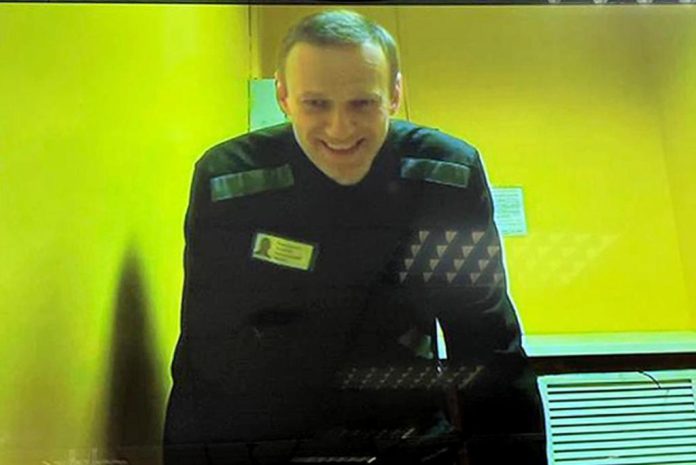
Navalny appeared in the courtroom Friday afternoon, wearing prison garb and looking gaunt, but with a defiant smile on his face. As the judge read out the verdict, the politician stood alongside his lawyers and his co-defendant with his arms crossed, listening with a serious expression on his face.

It took the judge less than 10 minutes to announce the verdict and the sentence — something that in Russia usually takes hours and even days.

The 47-year-old Navalny is President Vladimir Putin’s fiercest foe and has exposed official corruption and organized major anti-Kremlin protests. He was arrested in January 2021 upon returning to Moscow after recuperating in Germany from nerve agent poisoning that he blamed on the Kremlin.

Navalny’s allies said the extremism charges retroactively criminalized all of the anti-corruption foundation’s activities since its creation in 2011. In 2021, Russian authorities outlawed the foundation and the vast network of Navalny’s offices in Russian regions as extremist organizations, exposing anyone involved to possible prosecution.

One of Navalny’s associates, Daniel Kholodny, stood trial alongside him after being relocated from a different prison. It wasn’t immediately clear what sentence was handed to Kholodny.

Navalny rejected all the charges against him as politically motivated and accused the Kremlin of seeking to keep him behind bars for life.

On the eve of the verdict hearing, Navalny released a statement on social media, presumably through his team, in which he said he expected his latest sentence to be “huge … a Stalinist term.” Under the Soviet dictator Joseph Stalin, millions of people were branded “enemies of the state,” jailed and sometimes executed in what became known as the “Great Terror.”

In his statement, Navalny called on Russians to “personally” resist and encouraged them to support political prisoners, distribute flyers or go to a rally. He told Russians that they could choose a safe way to resist, but he added that “there is shame in doing nothing. It’s shameful to let yourself be intimidated.”

The politician is currently serving his sentence in a maximum-security prison — Penal Colony No. 6 in the town of Melekhovo, about 230 kilometers (more than 140 miles) east of Moscow.

He has spent months in a tiny one-person cell, also called a “punishment cell,” for purported disciplinary violations, such as an alleged failure to button his prison clothes properly, introduce himself appropriately to a guard or to wash his face at a specified time.

On social media, Navalny’s associates urged supporters to come to Melekhovo on Friday to express solidarity with the politician.

About 40 supporters from different Russian cities gathered outside the colony, one of them told The Associated Press in the messaging app Telegram. Yelena, who spoke on condition that her last name was withheld for safety reasons, said the supporters weren’t allowed into the colony, but decided to stay outside until the verdict as announced: “People think it’s important to be nearby at least like that, for moral support. We will be waiting.”

Navalny was ordered to serve the new prison term in a “special regime” penal colony, a term that refers to the Russian prisons with the highest level of security and the harshest inmate restrictions. It wasn’t immediately clear when he would be transferred to such a colony from the Melekhovo prison.

By law, Navalny has 10 days to appeal the verdict, and if he does, it will not take effect until the appeal is adjudicated.

Russian law stipulates that only men given life sentences or “especially dangerous recidivists” are sent to those types of prisons.

The country has many fewer “special regime” colonies compared to other types of adult prisons, according to state penitentiary service data: 35 colonies for “dangerous recidivists” and six for men imprisoned for life. Maximum-security colonies are the most widespread type, with 251 currently in operation.

___

Associated Press writer Dasha Litvinova contributed to this report from Tallinn, Estonia.

Poquoson race walker overcomes stroke – Daily Press

0

There are many reasons to participate in Colonial Road Runners or Peninsula Track Club races. For those select elite athletes, written up weekly this summer in the Gazette, who have the talent and desire to compete on a world-class level (Isaac Lamprecht in the triathlon), the national-class level (Adam Otstot, national Masters champion in the track 10,000 meters), national collegiate level in distance events (Caroline Bauer), national USATF 800-meter track finalist (Derek Holdsworth), and state age group record and world age graded level (Isabella Strumke), to excel can be immensely satisfying.

Then there are runners like Roger Hopper and Emily Honeycutt, multiple CRR Grand Prix champions, well on their way to more titles in 2023. But there are vast numbers of those in the middle ground, who compete for personal satisfaction, personal records or improvement, along with improving their health, or for social reasons or camaraderie. Without them, area road races could not be successful.

But even at the back of the pack, competing, and just finishing the distance can be very important. That is especially so for those who are overcoming life hurdles from health setbacks. That was the case this past month for October 2021 stroke victim George Fenigsohn of Poquoson, for decades the premier race walker on the Peninsula, and a 2014 inductee into the Virginia Peninsula Road Racing Hall of Fame, the only race walker enshrined in that group. It took Fenigsohn an hour and a half to complete the July 4 Independence Day 5K on the Yorktown Battlefield Tour Roads. In his prime, he race-walked that 5K road distance in a little more than 26 minutes.

Fenigsohn’s race walking career started at William & Mary. He himself will tell you he was not that talented of a runner, starting at Newport News High School under the legendary coach Julie Conn, although he tried hard. He tells the story of former W&M track coach Harry Groves, a notably blunt person, taking him aside, and saying, “George, you run so slow, you might as well be walking!” And that’s exactly what he became, a race walker in 1967 while competing for W&M in track meets. Race walking then was a collegiate scoring event.

Fenigsohn had been the premier race walker on the Peninsula since then, for almost 50 years. He is the first race walker inducted into the Hall of Fame, both for his accomplishments as a race walker, but also for his dedication to the sport through the years, conducting countless race-walking clinics or workshops, and encouraging many others to take up the sport. He was justifiably known for years as the “Race Walking Guru of the Peninsula.”

Fenigsohn’s race walking PRs are 7:35 (mile), 26:08 (5K), 56:22 (10K) 1:31 (8 miles) and 1:56 (20K). Despite what Groves said, he was actually relatively fast as a runner, at least by local road racing standards, going 5:00 for the mile, 17:36 for the 5K, 37:07 for the 10K, and 1:26 for the half marathon. But it is his race walking accomplishments that got him into the Hall of Fame. While at W&M, he raced indoors at New York City’s Madison Square Garden and in Baltimore; and at the Pan American Games Trials 20K in 1968. Later, as a Masters racewalker, he competed in the Penn Relays in 1999 (with his 10K PR of 56:22), and at the National Senior Games in 2003 (placing third in the nation at the 1,500 and 5,000 meters).

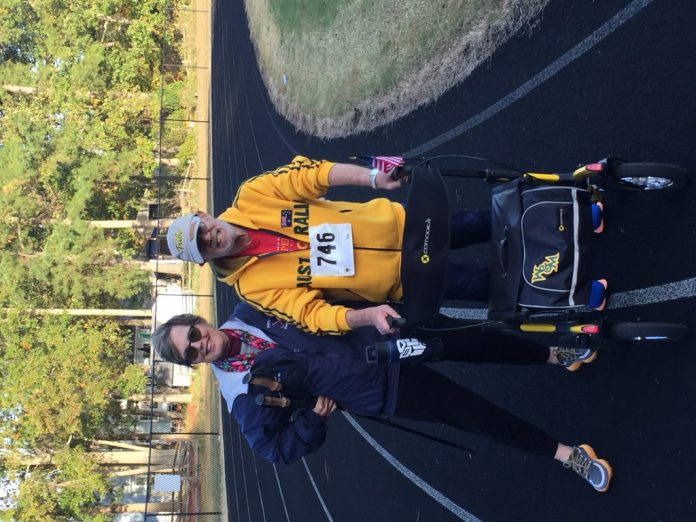
George Fenigsohn at the 2021 Night Owl 9K at Freedom Park, three months before his stroke. George was inducted into the Virginia Peninsula Road Racing Hall of Fame in 2014, the only race walker enshrined in that group. Courtesy of George Fenigsohn

Fenigsohn was twice honored by the Peninsula Sports Club, was first place several times in the Virginia Senior Games, and has been nationally ranked in his age group for racewalking. A Poquoson resident, and with a doctorate in counseling, he was a counselor for Thomas Nelson Community College in Hampton, and a therapist for Rock Landing Psychological Group in Newport News. Earlier he was a family life teacher in the York County school system.

Fenigsohn’s life-changing moment came suddenly one day in 2021. Fenigsohn emailed, “I’m gonna do the best I can. I have a hard time talking and I’m dictating the best the machine will allow. The stroke occurred in October 2021. It was a violent experience. It was a serious stroke. I almost died in the hospital. It’s called a Wallenberg.” Wallenberg’s Syndrome is defined as a neurological condition caused by a stroke in the brain stem, specifically in one of the arteries that provide blood to the cerebellum, which coordinates and regulates muscular activity in the body.

Fenigsohn continued, “I don’t remember a lot because I was in hospitals several times. I got up into a wheelchair and then a walker. And now I’m on walking sticks, Nordic walking sticks, thanks to Jim Elder from Colonial Sports. When I go out for 30 minutes or more, I use the walking sticks, but I have a host of situations. One is stroke fatigue, which is very common, where you feel tired a great deal, and sleep doesn’t help. I sleep about 10 hours a night, but most days I still have to nap. Another situation is ataxia. The stroke took away my sense of balance and I walk with some difficulty. I can walk sometimes 20 minutes or more without a cane, but I bump into things and sometimes I have to hold on to walls. But I’ve made some progress on this. My balance is still very poor. I go to physical therapy once every two weeks and I practice for hours, standing, sitting and moving, bending over. It’s been a long journey. I feel like stroke people make their best progress the first six months and I’m going on this coming October two years. I think I’ve plateaued a great deal.”

George Fenigsohn uses Nordic walking sticks when he goes out for 30 minutes or more. The walking sticks were provided by Jim Elder from Colonial Sports. Courtesy of George Fenigsohn

“My family, my son and daughter, and especially my wife Leigh, have been very kind to me, really helped me out. She drives me to various therapies. I can’t drive on the Interstate. I can drive locally in Poquoson. The entire right side of my body cannot feel hot or cold or pain. It’s a very peculiar situation. Both hands are weak and I have a hard time holding on to things.”

But Fenigsohn persists in his recovery. “I’ve done about five races with the CRR and the PTC just to enter. My times have been horrible. I don’t even worry about the times. An hour and a half for 5K. It’s just I need somebody to go with me often, to help me along in case I fall. Randy Hawthorne and others have been very kind. It’s been hard doing the races because I just don’t have the energy. I’ve walked almost two hours, but the weather has to be right for that. I can’t stand the heat, but I do go to a gym here in Poquoson. I’m trying extremely hard to overcome this. I’m 75 now, I don’t know how much more I can do.”

“I was racing right up until the stroke happened and was second in the [CRR race walking] Grand Prix.” He had enough Grand Prix points to end up second for that Grand Prix in 2021, behind Tom Gerhardt, but holding off Paul Rienth.

‘My friends have been tremendous, helping me out. We moved to my daughter’s house in Poquoson, which has one floor. I read all the results of the races and I dream about them. I dream about doing workouts at Cary Field [now Zable Stadium], about doing repeat quarters and halves. It’s not unusual to dream about the past because I know those days are gone. I do hope that I can keep on with my walking. And I can read, watch television and try to call my friends and stay in touch.

In my life I’ve had cancer, a heart attack and a stroke and I feel like what’s next? I’ll work out as hard as I can.  No one can tell me why the stroke happened. I think other people, when they get a stroke at my age, just don’t make it. And I’m glad that that didn’t happen to me.”

Hawthorne, CRR treasurer and another inductee into the Road Racing Hall of Fame, emailed, “I went down to Poquoson a half dozen times to take him out for a walk (with his rollater). Then we’d go out to lunch and talk about the “old” running days. I’ve known George since his freshman year at W&M (class of 1969). Remember in 1968 seven of us went to Europe for 10 weeks in a VW bus and stayed in tents and sleeping bags. George and another broke off from the rest of us and hitch hiked for the last 4 weeks—and went to Czechoslovakia, looked up Emil Zatopek [one of the all-time greats in distance running] and went running through the woods with him.”

Rick Platt is president of Colonial Road Runners.

Congressional delegation to tour blood-stained halls where Parkland school massacre happened – Daily Press

0

PARKLAND, Fla. (AP) — Nine members of Congress are expected to tour the blood-stained and bullet-pocked halls at Marjory Stoneman Douglas High School on Friday, shortly before ballistics technicians reenact the massacre that left 14 students and three staff members dead.

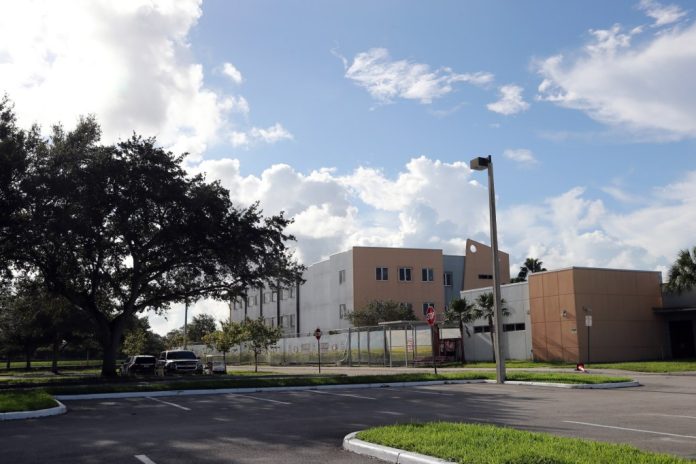
Few have been inside the three-story building since the Valentine’s Day 2018 shooting. The structure looms over the campus, locked behind a chain-link fence for use as evidence in last year’s penalty trial for the shooter.

There is broken glass on the floor, along with wilted roses, deflated balloons and discarded gifts. Opened textbooks and laptop computers remain on students’ desks — at least those that weren’t toppled during the chaos.

In one classroom, there is an unfinished chess game one of the slain students had been playing, the pieces unmoved. The Associated Press was one of five media outlets allowed to tour the building after shooter Nikolas Cruz’s jury went through.

The shooting, which sparked a nationwide movement for gun control, traumatized the South Florida community. Cruz, a 24-year-old former Stoneman Douglas student, pleaded guilty in 2021 and was sentenced to life in prison.

Florida Democratic Rep. Jared Moskowitz, who organized the tour with Republican Rep. Mario Diaz-Balart, said he expects the event to have “a profound impact” on the six Democrats and three Republicans who belong to the House School Safety and Security Caucus. They will be joined by Cruz’s prosecutors and members of the victims’ families.

This will be the first time a congressional delegation has toured the site of a mass shooting, Moskowitz said. The tour was suggested by Max Schachter, whose 14-year-old son, Alex, died in the shooting. Schachter is now a full-time school safety advocate.

“When you watch something like this on TV, you’re a thousand feet away — they show a picture of the building,” said Moskowitz, who is a Stoneman Douglas graduate. “You don’t see the impact that the shooting had on the families … or the impact on a community when a school becomes a war zone.”

After the tour ends, the caucus members and families will go to a nearby hotel to discuss school safety issues. Moskowitz said he thinks it will take time for the congressional members to take everything in emotionally and intellectually.

“You’re not going to walk through this and then get out a pen and paper and start writing down your policy ideas,” he said. “But we have got to figure out how no other families become part of this exclusive club no one wants to belong to.”

After the members leave, ballistics experts will fire up to 139 shots of live ammunition during a reenactment. The experts will fire from the same spots as Cruz, with an identical AR-15-style semiautomatic rifle, and the bullets will be caught by a safety device. The test at the school, which is closed for summer break, is expected to take several hours.

Technicians outside the building will record the sound of the gunfire, seeking to capture what the Broward County deputy assigned to the school, Scot Peterson, heard during the six-minute attack.

The reenactment is part of a lawsuit by the victims’ families and the wounded that accuses Peterson of failing in his duty to protect them and their loved ones.

Peterson, who worked for the Broward County Sheriff’s Office and is named in the lawsuit, said he didn’t hear all the shots and could not pinpoint their origin because of echoes. He got within feet of the building’s door and drew his gun, but backed away and stood next to an adjoining building for 40 minutes, making radio calls. He has said he would have charged into the building if he knew the shooter’s location.

Families of the victims who filed the lawsuit contend Peterson knew Cruz’s location, but retreated out of cowardice and in violation of his duty to protect their loved ones.

Peterson, 60, was acquitted in June of felony child neglect and other criminal charges for failing to act, the first U.S. trial of a law enforcement officer for conduct during an on-campus shooting.

The burden of proof is lower in the civil lawsuit. Circuit Judge Carol-Lisa Phillips allowed the reenactment, but made clear she was not ruling on whether the recording will be played at trial. That will have to be argued later, she said. It is likely Peterson’s attorneys will oppose the attempt.

No trial date has been set. The families and wounded are seeking unspecified damages.

After Friday, the Broward school district says it will begin demolishing the building.