Change Management is a role we often place on leaders. We know that too much change impacts performance and saps motivation, so “managing transitions” and “mitigating turbulence” are common phrases relating to this managing change.More often, however, what the organization actually needs is Stability Management.
Leaders must make the work environment predictable and routine, with clear expectations for performance.People perform their best when they have a clear and stable environment in which to function. Here are five things that you can do to create stability in your organization.
Inside the National Building Museum, Washington, D.C. Photo by Pete Fovargue.
Pete Fovargue is a Civil Engineer in the US Navy. He is focused on helping others achieve their potential as a leader and launched the website Learn Lead Conquer. You can read more of his articles LearnLeadConquer.com.
Set a schedule
A set schedule makes your work life predictable.Clear expectations go a long way.
The time and location of meetings
Deadlines for weekly reports
The start of the work day and the end of it
I was on the rowing team in college.For four years our winter training schedule was exactly the same:
Monday: 8 x 8 minutes of medium intensity rowing Tuesday: 8 mile run Wednesday: 5 x 5 minutes of high intensity rowing Thursday: 5 mile run day and circuit training Friday: sprint day Saturday: rowing technique and lifting
I dreaded going to practice because it was so difficult.We took our training very seriously and competed with each other daily. The athletes that performed well would compete for a seat in the Varsity boat.Those that didn’t consistently perform well would fight for a seat in the JV boat.
Two things got me through the winter training season:mutual suffering with my friends and the predictability of the schedule.
The practice schedule helped me survive.I knew what to expect each day and I would base my decisions around it.Practice affected the meals I ate, when I ate them, the clothes I wore, and when I studied (we had classes too). It is easier to achieve high performance when you can mentally prepare.
Encourage a Routine
A routine is how you complete work based on the structure of a schedule.I use a routine to fill in the empty space and optimize the schedule I am given by my boss.
Elements of a routine include:
When do you close out distractions to focus?
When do you answer emails and phone calls?
When do you work out for the day?
When and who do you eat lunch with?
A routine eliminates daily decisions.Having to make fewer decisions gives you the energy to focus on the most important ones. Every time a decision is made, it must be communicated throughout the organization.Communication takes time and energy no matter what. Be aware of how much communication is required to solidify the changes you are pushing.Don’t endanger success by bundling too many changes together.
Be Patient
Sometimes you will have to sideline new ideas.If you are the one creating all of the innovative ideas, your team may be struggling to keep up with the changes. There is a limit of perceived change that your team can endure.Be patient and pace yourself, even when the changes are improvements that directly make things better for your team.
Innovative ideas are most likely to happen in a stable environment.When you feel like you are drowning in changing expectations, innovation is the least of your concerns. Stability management requires the leader to take a more passive role.You can only cajole and prod your team toward high performance so much.
Allow Yourself to Be Bored
You need to become comfortable being bored.The successful organizations I have seen had leaders who weren’t central in creating new ideas.They built trust instead, so that lower level leaders were comfortable making decision on their own.
A bored leader is uncomfortable at the beginning because they have earned their position being a hero.A paradigm shift is required in your leadership approach since you are measured by the success of your team.It won’t be easy for you, but it is necessary for the team.
Bored leaders spend more time coaching than directing.It takes time to develop enough trust to achieve organizational stability.You can accelerate the process by observing more and directing less.
Leave Decisions to your Team
There is a balance of creating structure and giving freedom.Focus on the most important 30% of decisions.Let your team decide the remaining 70%. Individuals who have control over their decisions will have greater ownership.Greater ownership makes you feel like you have control.
Change can give the impression that the team has failed.Change wouldn’t be necessary unless there was a compelling reason to change.Without a failure, change may not be on everyone’s mind.If you don’t have a burning platform, it will be hard to inspire your audience.
Give your team the best shot of achieving big goals by weaving stability into the work environment.When the organization is stable, the team will use their extra time to create value.
More recently, H.R. McMaster published Battlegrounds: The Fight to Defend the Free World, in which he introduced in his view on strategic narcissism: the tendency to view the world only in relation to the United States and to assume that the future course of events depends primarily on U.S. decisions or plans.”[12] McMaster elaborates on the concept as a linear thought pattern which puts U.S. action as the central force in world politics, undervaluing the strategies and dispositions of other actors.[13] The result of this influence, in his estimation, is strategic failure: the plan fails to yield the desired political outcomes. McMaster points to the 20 years the U.S. struggled to make progress in Afghanistan; Booth points to a host of blunders from a variety of different nations throughout history, especially in Cold War maneuverings and politics.
McMaster and Booth also propose solutions to this problem: strategic empathy and cultural relativism, respectively. The former counteracts narcissistic biases by forcing strategists and policymakers to personify their opponent in a way that meaningfully penetrates the other’s psyche.[14] Booth, on the other hand, goes even further in his argument, parsing how strategists fail to account for enemy considerations:
To know the enemy has always been a cardinal tenet of strategy. If this goal is to be achieved in the future with more regularity than it has in the past, then cultural relativism should take its place in the strategist’s lexicon. Knowing the enemy is the bedrock of the business of strategy: strategic theories, in comparison, are second order problems. To concentrate on doctrines before enemies is to put the theoretical cart before the actual horse—a double error.[15]
Because strategy needs to be crafted in relation to other actors, it is important to understand the enemy at a fundamental level.
As mentioned above, strategy is group decision-making on a larger, systemic scale. As a consequence, it is crafted relative to what the actor wants vis-à-vis a competing actor. As Booth stresses several times: “Strategy, like nature, abhors a vacuum…Without enemies strategy is shapeless: it is like a house without walls…Sometimes the assumption of an enemy relationship will be justified, sometimes it will be misperceived. Sometimes the enemies will be real; sometimes they will be imagined.”[16] Because strategy needs to be crafted in relation to other actors, it is important to understand the enemy at a fundamental level. Whether or not the enemy is real, strategy’s need to construct actors into these juxtaposed roles has two flawed heuristics: accounting for the enemy’s philosophy and approach to war, and accounting for its strategic process.[17]
The two negative tendencies encouraged by ethnocentrism are the imposition of stereotyped strategic decision-making and cultural values on adversaries. For instance, the U.S. strategic climate of today is replete with references to the founders of military theory: Clausewitz, Mahan, Corbett, Douhet, and other common names. As Booth notes, “Philosophies of war, like strategic theories, are products of time and place.”[18] There are always conditional variables from the times and places in which these theorists wrote which must be reconciled against the current operating environment. Their findings must be applied to changing circumstances and reassessed over time, or strategy becomes a rote function of a given society, liable to be circumvented by an enemy with little effort on their part.
Beyond the decision-making framework, the decision-making process itself is also stereotyped, leaving the impression that the enemy’s decisions are not rational, not understandable, and that they are just lucky in their outcomes. Booth argues that this friction is caused by the assumption that the enemy’s decision process is a black box operating along the rational agency model; that is, the enemy uses similar reasoning and a similar process and, regardless of other factors, will always seek value-maximizing outcomes. However, while treated as an objective value, what is rational or reasonable is a relative assessment informed by one’s ethics and personal values.[19] Without understanding those values, one cannot anticipate another’s strategic process or objectives.
Altogether, knowing one’s enemy, down to their cultural-ethical values system, is the key to victory. However, knowing one’s own biases and judgment values is necessary to avoid defeat. Balancing the values of both sides and developing a strategy relative to each is not a part of the U.S. strategic process, resulting in Sun Tzu’s exact prediction. If the United States can identify and control its ethnocentric tendencies in its strategy, then it will see more consistent success.
The notion of seasons has come to me from multiple sources recently. One obvious change has been my professional transition…closing the season of battalion command and embarking on a new duty with a new scope of responsibilities. (This season even ended with a ceremony…most don’t!) The people, the conversations, battle rhythms, challenges, opportunities, office spaces, run routes…it’s all different now. It’s entirely new terrain and it demands adaptation.
The other experience that inspired reflection on change was at Yosemite National Park last week, immersed in an ecosystem that is in a perpetual state of natural change. Seasons incrementally and seamlessly slip into one another, presenting subtly-forming but radical new landscapes of sun and ice, rock and water, cloud, air, plant, animal, and fire.
Half Dome, Glacier Point, and Yosemite Valley, as seen from the Upper Yosemite Falls Trail in Yosemite National Park, CA.
Several informative visitor centers highlighted 4-photo collages of Yosemite through the yearly seasons, which are clearly distinguishable from one another. Greens and pastels blaze forth from the trees and wildflowers in Spring. Waterfalls cascade with powerful imminence in Summer. Fall blankets the valley, creating a 3,000 foot U-shaped bed of warm reds and oranges. Then in Winter, snow smothers all, dampening life and movement and sound.
In those snapshots, the stark transition from season to season is unavoidable. One can see and feel the change.
Leading Through Seasons
In leadership, seeing change is a valuable skill. Even if you’re already in the season, recognizing what’s happening around you and your team is crucial. (Of course, seeing it beforehand is preferred.) Leaders who see changing seasons can sense shifting conditions and behaviors in people, systems, and environment in which they operate.
They listen, they empathize, they are open. They welcome other perspectives, valuing them as indicators, data points of a malleable landscape. And these leaders realize that the current season is only desirable because it is comfortable, and that little growth is borne out of comfort. They can see the change because they are looking for it…they welcome it.
Leaders who can sense a season of…
…personal struggle in others look for disruption in attitude and behavior, and ask “How are you doing?”…then “How are you really doing?”
…overcommitment and limited personal bandwidth are realistic about what the duty will demand and stringent about how many opportunities they say Yes to.
…operational friction have specific questions and data points they seek to indicate progress (i.e. the proper positioning of leaders and assets, the reserve amount of X on hand, the time allotted to subordinate units for planning, and the communications status of command nodes, among others).
…limited time/space for their own priorities understand that they must first fulfill their boss’s priorities, then anticipate and plan around them.
…risk in the organization do so by assessing how many organizational factors will change and by how much, as well as how many aspects of the operation, even minor ones, are compromised or failing (start counting up three or four strained operational variables and you might be in trouble). Here’s another post about that…
…organizational growth notice when high-performing talent arrives to the team, providing opportunity to insert new energy and fresh perspective for growth; or perhaps when a significant event is on the horizon that requires the team to elevate its level of play.
…recovery can make an unbiased assessment of the strain on the team, then adjust expectations to maintain a high-performing state; this leader is able to tell his hardest-working, exhausted subordinate to go home early and get some rest.
Leaders Develop Vision for Change
Regardless of the situation, the best leaders know that by their role and responsibility, they are specifically-positioned to intuit transition and see growth opportunity. These leaders intentionally develop vision to sense impending seasons. Then they fulfill their responsibility to define reality for the team and empathetically guide their followers through the change. In doing so, they model how to lead through change with foresight and intention.
Questions for Leaders
How would you describe the season are you in? How did you arrive at this place and what are you doing about it?
What indicators do you look for to sense change? How do you know it’s coming?
Who helps you identify an impending season? Who helps you get through it? Have you told them how valuable they are?
ASEAN assessment of Indo-Pacific strategic competition is somewhat at odds with the western liberal-democratic conception of great power competition.[4] A view in which Chinese aggression and unavoidable great power competition between Beijing and Washington are headline acts. However, our visiting ASEAN fellows have tended to minimise the uniqueness of great power competition in terms of articulating security challenges facing their nation.[5] When it comes to ASEAN security concerns, most fellows cite transnational crime, terrorism, piracy, and, Illegal, Unreported, Unregulated (IUU) fishing, as the leading security challenges facing their nations. Indeed, ASEAN fellows are largely concerned with how these matters manifest as domestic security crises—e.g., arms trafficking increasing the level of armed citizens. This is a reality which Western countries with warfare-centric navies tend to miss.
A view in which Chinese aggression and unavoidable great power competition between Beijing and Washington are headline acts.
The perspective that we have come to appreciate from ASEAN fellows is that security co-operation brings prosperity, confidence and trust among neighbours. There is opportunity for the region to collectively alleviate poverty and elevate living standards of millions of people, regardless of national borders. Further, one must view Asia-Pacific and Indian Ocean regions as closely integrated and interconnected—politically, economically, social-culturally, and environmentally. There is potential for misunderstanding the complex interconnectedness of concerns if we hold ourselves to a narrowly-defined, reductionist mindset of security, warfare, and military power. ASEAN conceptions of security differ between the nations, but our U.S.-centred assessment of the region assumes cookie-cutter concerns and this essentially leads to inappropriately designed responses.[6]
A clear example is the illusive grey zone. An artefact of the western way of thinking, the broad term seems to have become a synonym for complex, ambiguous, or opaque—a category of situations that don’t fit neatly or are difficult to understand. Listening to our ASEAN Fellows’ perspective has made us consider whether grey is just the norm for the region. We are likely the ones complicating things by expecting the clear black-and-white that comes with a traditional western-focused understanding of ASEAN and a reductionist view of security, warfare, and military power. The reality of interconnected complex relationships is that it is mostly grey. Of course, where ambiguous relationships and ill-understood boundaries exist, adversaries can exploit a seam, exposing crucial partnerships that take decades to mature to increased risk of being undermined. This is what the west is at risk of.
Increasingly, Australian analysts note there are concerns from ASEAN states surrounding AUKUS developments—specifically the acquisition by Australia of nuclear-powered submarines.[7] While fellows agree that this capability development would alter the strategic balance of the Indo-Pacific, in our people-people engagement over many coffees, fellows are quick to underscore that ASEAN concern stems from the potential of nuclear-armed submarines, not necessarily the acquisition of submarines per se.This position is in line with ASEAN political stance on nuclear weapons: in that, nations seek to maintain a region of nuclear-free arms (and proliferation).
A Potential Response: Avoiding Miscalculating ASEAN Solutions
“ASEAN also needs to continue being an honest broker within the strategic environment of competing interests.”[8]
Our person-to-person engagement via the ASEAN fellows program has also prevented the misinterpretation of the ASEAN Way, referring to a mode of cooperation between nations that places national interests and national sovereignty first. This is often used in conjunction with ASEAN centrality, the process through which national interests and sovereignty are protected by non-interference and upheld via decision-making, which is based on consensus and non-confrontation principles. Our Defence research centres work with counterparts at Defence’s International Policy Division and ASEAN policy officers throughout government to host research conferences to showcase the work (and thought) of our ASEAN military fellows.
“If I hadn’t had been so focused on this, I could’ve anticipated that…”
“Where did THIS come from???”
We’ve all uttered these words at one point or another, searching for an explanation as to how our circumstances managed to outpace our intellect, premonition capacity, focused research, and detailed planning effort.
Army Staff Sgt. Ariel Hughes pulls a simulated wounded soldier through an obstacle during the Drill Sergeant of the Year Competition at Camp Bullis, Texas, Aug. 19, 2019. Twelve soldiers from around the U.S. took part in the four-day competition. Link to DoD photo.
Perspective is Decisive
Often, leaders fail to see the impending train wreck because they’re not leading at their level. Their perspective is off…inappropriately focused on something that doesn’t matter. Perhaps, a crisis. Or a shiny data point. Or a loud and captivating person. Any number of events, objects, and interactions are sufficient to divert leader attention.
But a leader’s job is to define priorities, and reality…which means they have a discerning lens through which they see the world, the organization’s landscape of effort. They know how to see that world and have the discipline to do so.
The question is: how do you know what your appropriate perspective is?
What are your triggers for changing perspective? For pausing amidst chaos and unceasing organizational effort to assess the terrain and make course corrections? How do you know when you should stop focusing on small tasks and explore big problems? When do you switch from shallow, rote thinking to deep, creative thinking? What triggers have you identified to snap you out of the comfortable intellectual path on which you so diligently planned…and force you to consider alternatives that are counter to everything your team is doing?
Perspective Triggers
…How do you know when to think differently?
Here are some triggers to consider:
Systems/Processes – at the completion of a routine staff or organizational function like the Operations Process, when everyone is comfortable with the plan. Or perhaps when you make a big organizational change or transition from one phase of effort into another.
Events/Effects – when friendly, enemy, or environmental events occur. For example, crossing the Line of Departure in an attack is a good trigger to examine what is happening after the attack is complete. Destroying X amount of enemy capability is an appropriate time to assess if a high-payoff opportunity is forming, which would necessitate your guidance and organizational change. Conversely, the fact that a friendly element was destroyed is especially relevant if it’s the unit that puts you at 60% capability…and thus, combat ineffective.
Status Changes – one unit reporting that it is struggling in a certain area (sustainment, maintenance, ammunition, timing, communications, etc.) is cause to consider the possibility that this is a systemic problem that will grow. Widening one’s perspective might reveal that.
Conversations – a chat with the boss should trigger a perspective change (i.e. “What should I be doing better to meet my boss’ intent? Have I inappropriately prioritized my own efforts over my boss’?”) Perhaps it’s a frustrated subordinate who voiced concerns…probably a good time to step back and examine if this is a trend. No one else has that perspective or ability to survey the team…you do.
Time of Day – what is the ebb and flow of your perspective? Should you have a larger, more creative perspective during the morning when you are fresh? (If so, should you protect that time…to protect that thinking?)
Level of Fatigue – if you can avoid it…exhausted, hungry, wet, and cold is not the time to make big decisions. Do those states of being generate a trigger for you to reduce your decision making to only the small problems? Is there someone who can pick up the task of deep thinking for you? When you’re at your weakest, do you have a way to minimize decision risk?
The transition between modes of thinking is cognitively taxing. And most of us do it all day long without an appreciation of the toll it takes. Self-aware leaders recognize that they (and their organization) flow through various status of activity and effectiveness, requiring them to change perspective, approach, and guidance. Leaders susceptible to distraction miss big threats. Leaders who think and lead at their appropriate level, with their unique vision of the organization, enable big opportunities.
The failure of national security planners to adequately incorporate multiple perspectives into United States foreign policy has proven costly both financially and in terms of failure to achieve policy objectives. This unilateral focus stems from a combination of limited thinking and limited planning resources that can be difficult to overcome. As global conditions change, however, U.S. policymakers must incorporate multiple perspectives into foreign policy planning. This is especially true in the Indo-Pacific region, where consensus-based discussions are likely to be prioritized over formal alliances and China is operating a parallel strategy in the same countries as the U.S.
Large investments become lost opportunities when great powers fail to adequately account for the perspective of other nations in their foreign policy. The U.S. has given over $3B in foreign aid to Cambodia over the past 30 years and conducted more than 10 annual security cooperation exercises between the U.S. and Cambodian military.[1] Despite the extent of the shared investments, the Cambodians permitted China to demolish U.S.-funded buildings on the Ream Naval Base in 2021 to facilitate Chinese-sponsored port development, and Phnom Penh has truncated U.S. access to the base.[2] The U.S. is not the only great power whose self-interested policy has resulted in unintended consequences. China spent $96B on infrastructure-related projects in the Philippines that ignored local environmental and hiring processes, generating geopolitical, environmental, and social issues that have undermined China’s national interests.[3]
Cambodian navy personnel at Ream naval base in 2019. (Tang Chhin Sothy/AFP)
In recent decades, the United States has been similarly myopic through a combination of heuristic bias among policy elites, resource limitations for its foreign policy institutions, and social systems in academia and policy-making circles that create and reinforce parochial thinking. Intellectuals and other policy elites must avoid such myopia and make a deliberate effort to recognize the significance of other countries’ perspectives by adopting a systems thinking approach. The Secretaries of State and Defense could support such a systems thinking effort through restructuring the way the U.S. formulates strategy documents to provide accountability and clarify the assumptions that inform alternate perspectives. U.S.-based academic institutions and think tanks could resource these efforts through prioritizing the hiring or scholarship of those with alternative perspectives in roles where they can integrate that knowledge into foreign policy works. To imbue these three efforts with a sense of criticality, intellectuals and policy elites must popularize an outcomes-based understanding of why perspectives beyond those of the global powers are important. There are sufficient examples to illuminate these outcomes already—from national security, economics, and overarching foreign policy perspectives.
Challenges and Advantages to Alternative Perspectives
Policymakers and academics use heuristics and are as susceptible to heuristic bias as the rest of the population.[4] Senior U.S. foreign policy decision makers, from State to Defense, must enforce a systematic approach to mitigating the effect of these potential biases if they are to develop truly insightful strategic objectives in conjunction with regional partners and allies.[5] Daniel Kahneman describes heuristic biases that can contribute to issues with a self-centered foreign policy and how they can be mitigated by starting from the perspective of other stakeholder countries. For example, Laos has demonstrated that their government perceives their best interest lies in continuing to conduct Mekong-related agreements with both China and the U.S rather than choosing one power over another. If Defense Department planners incorporate this perspective clearly into a theater posture plan, it could counteract the simple causal claim that the U.S. can gain primacy over China through developmental aid.[6]
Similarly, if State Department planners integrate other countries’ objectives into U.S. strategies, this could identify friction points early, mitigate the assumption that U.S. objectives take priority in international relationships, and clarify challenges to the U.S. strategic narrative. A more inclusive framing of the interests and issues involved can help policymakers avoid underestimating risk and overstating benefits by reconciling the relevant risk and interests of other nations with those of the U.S.[7] Washington, therefore, might have to acknowledge that despite a relative military and economic advantage over Phnom Penh, it might not be able to negotiate access to the latter’s naval facilities.
Policymakers must invest significant time and energy in analyzing third-party perspectives to adequately incorporate alternative ideas into policy documents. The limited time and expertise available for such analysis is a significant reason that the red team, representing the adversary, is rarely as well-represented as the blue team in an analysis.[8]
The sheer number of perspectives that influence global policy add to the length of an analysis and complication of the problem. For example, in an ends-ways-means approach to strategy for the U.S. in the Indo-Pacific, there are potentially hundreds of stakeholder countries, non-governmental and intergovernmental organizations (NGOs and IGOs), cultural groups, and other organizations that bring important perspectives to bear in the situation.[9] It is difficult and time-consuming to integrate these perspectives into an analysis of the situation. Researchers within the U.S. will not have equal access to foreign perspectives as they do domestic ones.
Even dealing with national governments, the U.S. may struggle to build a true picture of how multiple different nations perceive the various elements, for example, of the cultural exchanges and minor projects that make up the Belt & Road Initiative.[10] Micah Zenko describes the advantages of incorporating unique external perspectives into the decision-making processes of a business of government. Hiring and educating practitioners and academics with perspectives that are not centered around the U.S. can provide a more nuanced and consensus-based counterpoint to great power thinking.[11]
Defense policy makers must include people with diverse perspectives as the first part of a broadening process in national security decision making. Lasting effects require an established system for displaying those results. An understanding of multiple perspectives should be taught to aspiring strategists in their academic classes, which would ideally require an in-depth analysis as a part of a best-case strategy preparation.[12] If these multiple perspectives are applied through the lifetime of a strategy, they would help instruct the class on possible reactions, counterreactions and escalations from another point-of-view.
Practical Considerations
Both policymakers and the public have found it difficult to see the relevance of the interests and policy framings of minor stakeholders. Retired U.S. Army General Stanley McChrystal was ridiculed in the press for a slide depicting the numerous perspectives that he considered within Afghanistan, but the single sheet of paper was designed to detail the number of factions and complexity involved in the region.[13] Former Secretary of Defense Donald Rumsfeld was similarly mocked by the American public for using the term “unknown unknowns,” in attempting to describe the dangers of false conviction.[14] In both cases, leaders attempting to describe the complexity of unknown or multiple perspectives were derided for their intellectual pretensions. Overcoming the desire for simplicity is a necessary prerequisite to establishing a complete, systems based policy.
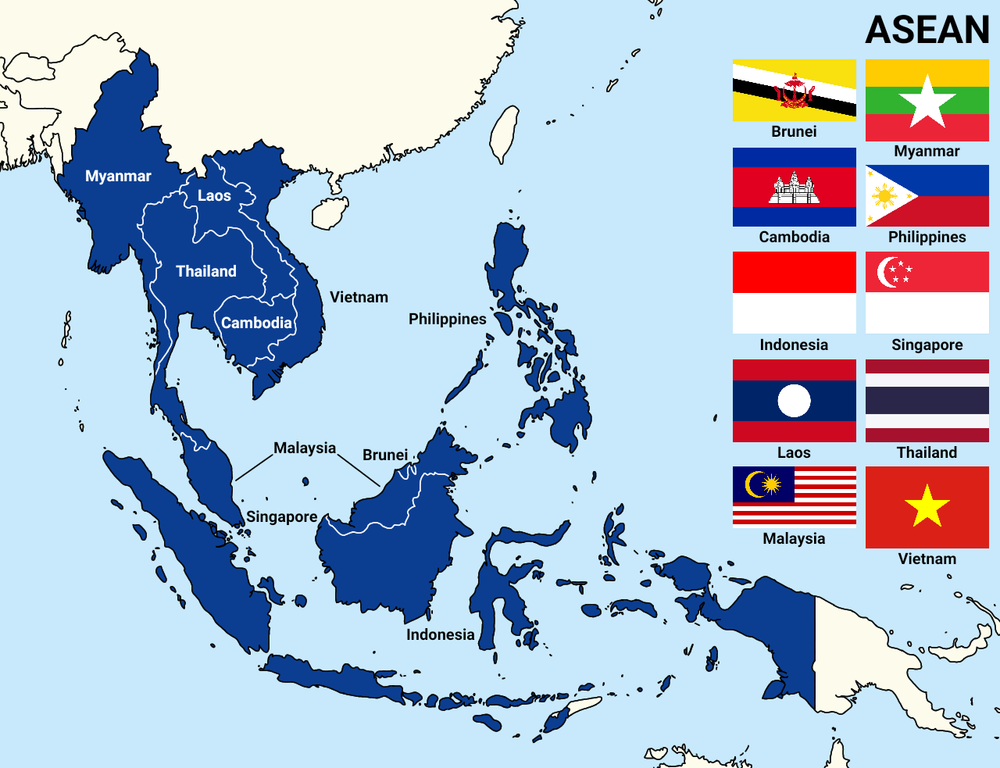
Map and flag of the Association of Southeast Asian Nations countries (Rizky Jogja/Wikimedia)
Recently, applying this desire for simplicity to the question of foreign policy has included a desire to mandate political alignment of other nations with U.S. interests. When U.S. planners frame these relationships from a U.S.-centered perspective, they arbitrarily force stakeholder countries to choose between the U.S. and China as a preferred partner rather than developing a shared approach with collective objectives. Given the Association of Southeast Asian Nations (ASEAN) focus on consensus overall, U.S. strategists could improve their chances of overall success through early identification of regional perspectives on unilateral goals.
Conclusion
The U.S.-Cambodia example provides a deeper understanding of the dynamics at play when policymakers are framing policies involving other independent stakeholders. U.S. relationships with Cambodia and other nations have never been strictly centered around U.S. interests. Recognizing the danger of alignment, many smaller countries in Southeast Asia are pursuing a risk-mitigation strategy of hedging, using resources from China and the United States to maintain bilateral relationships with both countries.[15] In a multinational survey conducted across Southeast Asian nations in 2021, a majority of survey respondents believed that China and the United States will ask their country to choose between the two major powers and that making such a choice is not in their own best interest.[16] The U.S. must incorporate these varying perspectives in crafting deliberate consensus-based strategies in the Indo-Pacific.
Washington cannot afford a focus on unilateral U.S. perspectives, whether to prevent alienating potential partners or to forestall potential adversarial relations. When strategists center policy from a U.S. perspective, they ignore the real cultural risks that accompany those narrative frames. China is just as centered on their own conventional framing, with equally problematic results. Washington must counter Beijing’s growing influence across the instruments of national power without alienating potential allies and partners.
Heather Levy is an officer in the U.S. Army. She earned a Masters in Strategic Studies from the U.S. Army War College and a Masters in International Public Policy from The Johns Hopkins University. The views expressed are the author’s alone and do not reflect those of the U.S. Army, the Department of Defense, or the U.S. Government.
The Strategy Bridge is read, respected, and referenced across the worldwide national security community—in conversation, education, and professional and academic discourse.
Thank you for being a part of The Strategy Bridge community. Together, we can #BuildTheBridge.
Header Image: Refract, 2017 (Joseph Greve)
Notes:
[1] Office of the Spokesperson, “The United States-Cambodia Relationship,” Department of State, August 2, 2022. https://www.state.gov/the-united-states-cambodia-relationship/
[2] Abdul Rahman Yaacob, “Cambodia’s Ream Naval Base Attracts Competing Patrons,” East Asia Forum, September 5, 2022.https://www.eastasiaforum.org/2022/09/05/cambodias-ream-naval-base-attracts-competing-patrons/
[3] Aaron Jed Rabena, “The Belt and Road Initiative and the Philippines: Post-Duterte China Challenge,” March 25, 2022. https://fulcrum.sg/the-belt-and-road-initiative-and-the-philippines-post-duterte-china-challenge/
[4] Tversky, A. and Kahneman, D. (1974). Judgment Under Uncertainty: Heuristics and Biases. Science. 185(4157), 1124-1131.
[5] Kahneman, D. (2011). Thinking, fast and slow. New York: Farrar, Straus and Giroux, 29.
[6] Ibid., 29.
[7] Ibid., 32.
[8] Micah Zenko. Red Team: How to succeed by thinking like the enemy. Basic Books, New York: 2015, ix-xxi.
[9] Bonny Lin, Michael S. Chase, Jonah Blank, Cortez A. Cooper III, Derek Grossman, Scott W. Harold, Jennifer D. P. Moroney, Lyle J. Morris, Logan Ma, Paul Orner, Alice Shih, and Soo Kim, Regional Responses to U.S.-China Competition in the Indo-Pacific Santa Monica, CA: RAND Corporation, 2020, 32-38.
[10] Michael S. Chase and Arthur Chan. China’s Evolving Approach to “Integrated Strategic Deterrence”. Rand Corporation, 2016.
[11] Zenko, 20-24.
[12] Celestino Perez, Jr.,“What Military Education Forgets: Strategy Is Performance,”.War on the Rocks, September 7, 2018. https://warontherocks.com/2018/09/what-military-education-forgets-strategy-is-performance/#:~:text=solely%20a%20discipline.-,Strategy%20is%20performance.,holds%20an%20MA%20and%20Ph.
[13] Elisabeth Bumiller, “We have Met the Enemy, And He Is PowerPoint,” New York Times, April 27, 2010. https://www.nytimes.com/2010/04/27/world/27powerpoint.html
[14] David Graham, “Rumsfeld’s Knowns and Unknowns,” The Atlantic, March 28, 2014. https://www.theatlantic.com/politics/archive/2014/03/rumsfelds-knowns-and-unknowns-the-intellectual-history-of-a-quip/359719/
[15] Cheng-Chwee Kuik and Gilbert Rozman, “Light or Heavy Hedging: Positioning between China and the United States,” in Gilbert Rozman, ed., Joint U.S.-Korea Academic Studies 2015 (Washington, DC: Korea Economic Institute of America, 2015)
[16] Bonny Lin, Michael S. Chase, Jonah Blank, Cortez A. Cooper III, Derek Grossman, Scott W. Harold, Jennifer D. P. Moroney, Lyle J. Morris, Logan Ma, Paul Orner, Alice Shih, and Soo Kim, Regional Responses to U.S.-China Competition in the Indo-Pacific Santa Monica, CA: RAND Corporation, 2020, 4-12.
When serving on staff and even while in command, process often dilutes purpose. As individuals and on teams, we routinely focus on what we’re supposed to do at the expense of appreciating the why or fully realizing the impact of our efforts. Connecting Planning to Purpose This happens throughout the operations process and troop leading procedures. […]
[1] Christopher Layne, “The unipolar exit: beyond the Pax Americana,” Cambridge Review of International Affairs, Vol. 24, Iss. 2 (Jul 2011): 149–164; Fareed Zakaria, “The Self-Destruction of American Power: Washington Squandered the Unipolar Moment,” Foreign Affairs, July 2019; Bidisha Biswas and Anish Goel, “What Comes After US Hegemony? The Asia-Pacific region looks beyond the United States,” The Diplomat, December 19, 2018; Ron Huisken, “China, the US and the Waxing and Waning of Power,” The Strategist, May 21, 2020.
[2] Graham Allison, Destined for War: Can America and China Escape Thucydides’s Trap? (Mariner Books, 2017).
[3] David Brown, “Why China Could Win the New Global Arms Race,” BBC News, July 28, 2022; Anjani Trivedi and Shuli Ren, “Good Luck Taking Away China’s Manufacturing Mojo,” The Washington Post, August 24, 2022; “China Increases Investments in PNG, Sparking Security Fears for Australia,” News.com.au, July 4, 2022.
[4] Paul McLeary, “Indo-Pacific Commander Delivers $27 Billion Plan to Congress,” Breaking Defense, March 1, 2021.
[5] “United States Imports from China,” TradingEconomic.com
[6] Iain Marlow, “Taiwanese Independence is a Charging Rhino That Must Be Stopped, Chin Says,” Bloomberg, September 22, 2022; Alys Davies, “Taiwan Tensions: China Condemns ‘manic’ Visit as Pelosi Continues Tour,” August 4, 2022.
[7] Qiao Liang and Wang Xiangsui, Unrestricted Warfare (People’s Liberation Army Publishing House, 1999): 24.
[8] Lt Gen PC Katoch, “Economic Warfare – Nuances in 21st Century,” Journal of the Centre for Joint Warfare Studies (Dec 2014).
[9] Daniel Immerwahr, How to Hide an Empire: A History of the Greater United States (Farrar, Straus and Giroux, 2019): 215 – 227; 298 – 336; Greg Castillo, “Domesticating the Cold War: Household COnsumption as Propaganda in Marshall Plan Germany,” Journal of Contemporary History, Vol. 40 (2005): 261 – 288.
[10] Yangbin Chen, “From ‘Lamb Kebabs’ to ‘Shared Joy’: Cultural Appropriation, Ignorance and the Constrained COnnectivity within the ‘One Belt, One Road’ Initiative,” Journal of Contemporary China, Vol 29 (2020): 1 – 16; Andrei Miroiu, “Deportations and Counterinsurgency,” Studia Politica, Romain Political Science Review, Vol 2 (2015): 177 – 194.
[11] Daniel Hughes and Andrew Colarik, “Small State Acquisition of Offensive Cyberwarfare Capabilities: Towards Building an Analytical Framework,” Intelligence and Security Informatics (2016): 166 – 179.
[12] Simone Dossi, “On the asymmetric advantages of cyberwarfare: Western literature and the Chinese Journal Guofang Keji,” Journal of Strategic Studies, Vol 43, Iss 2, (2020): 281-308.
[13] Thomas Rid, Active Measures: The Secret History of Disinformation and Political Warfare (New York: Picador 2020): 61 -134.
[14] Thomas Rid, Active Measures: The Secret History of Disinformation and Political Warfare (New York: Picador 2020): 367.
[15] David C. Gompert and Martin C. Libicki, “Decoding the Breach: The Truth About the CENTCOM Hack,” The RAND Blog, February 3, 2015.
[16] Tomohisa Hattori, “Reconceptualizing Foreign Aid,” Review of International Political Economy, Vol 8 (2001): 633 – 660.
[17] Jennifer Hillman and Alex Tippett, “Who Built That? Labor and the Belt and Road Initiative,” Council on Foreign Relations, July 6, 2021.
[18] Qiao Liang and Wang Xiangsui, Unrestricted Warfare (People’s Liberation Army Publishing House, 1999): 206.
[19] Kang-Chun Cheng, “Chinese Businesses are at the Forefront of Environmental Change in Africa,” Quartz Africa, July 20, 2022.
[20] Hongying Wang & Yeh-Chung Lu, “The Conception of Soft Power and its Policy Implications: a comparative study of China and Taiwan,” Journal of Contemporary China, Vol. 47, Iss. 56, (2008): 425-447
[21] Kenneth Osgood, Total Cold War: Eisenhower’s Secret Propaganda Battle at Home and Abroad (University Press of Kansas 2006).
[22] Andrew Dowse and Sascha Dov Bachmann, “Information warfare: methods to counter disinformation,” Defense & Security Analysis (Sep 2022).
I grew up in the South. A little bit in Tennessee and Florida, but mostly in Georgia. Though I spent that childhood in the neighborhoods of suburban Atlanta and not in the country farm fields, I still received the imprint of geographical culture: Southern politeness, Waffle House, sweet tea, country music, NASCAR and The Dukes of Hazard were all accepted – and expected – norms. As was pride in the Confederacy.
The flag of the Confederacy on the ground during a protest against white nationalists in Washington, D.C. Photo credit.
In the South, the was Civil War was viewed as a struggle for states’ rights that happened to end poorly but was still worthy of honoring. Confederate symbols were a part of everyday life, featured on T-shirts, bumper stickers, flags, and signs. General Robert E. Lee was a household hero we could pick out of a line-up of dead generals.
Thinking back, I remember visiting Stone Mountain every summer to watch the laser light show, which concluded in a dramatic scene idolizing Lee, Stonewall Jackson, and Jefferson Davis. At the time I had not internalized why those men had fought, yet I carried forward the pride that they did.
So, it should be no surprise that at some point in high school I ended up with a 4×6 inch Confederate flag sticker. I would not say that I sought out this vestige of the Confederacy; it was simply a natural thing to have.
And as I found myself at the Air Force Academy, trying to retain some individuality among the thousands of cadets, I decided to latch on to my Southern heritage and display this Confederate flag on my newly-issued desktop computer. There it stayed until the next year, when I met Dale.
Dale
Dale was a retired Air Force Colonel who spent much of his time mentoring cadets and former cadets as they progressed through the Air Force (several into the General Officer ranks). Dale is the most thoughtful, articulate, well-read leader I’ve ever known. Interestingly, he has also earned the nickname “The Dragon.”
Robert E. Lee, Stonewall Jackson, and Jefferson Davis carved into the face of Stone Mountain. Photo credit.
In 1997, he stopped by my cadet room for the first time and noticed my Confederate flag.
“What’s that?” he asked.
I replied matter-of-factly, “Oh, I’m from Georgia.”
Dale just stared at me, waiting for an appropriate response to his question. A nervous feeling swelled in my gut; and before I could muster some sort of diversionary comment, he added, “You know, some people find that flag offensive. You might want to consider removing it.”
I nodded in acknowledgement, but more out of respect for an authority figure than in appreciation of his comment. Our conversation carried on for a few minutes more, and I went back to my afternoon cadet activities.
Meeting “The Dragon”
Weeks later, the sticker was still on my computer when Dale stopped by once again. The moment he walked in, I realized I had completely ignored his suggestion. As he glanced down to see the Confederate flag, I watched his demeanor transform from cordial to confrontational; and he locked eyes with me.
“I see you chose not to act on my advice to remove that sticker. So, let me be clear. That is the flag of the Confederacy, which fought to protect its right to own slaves. You might display it because you are from Georgia, but that is not what it means to others. You are going to be a leader. People will pay attention to what you espouse. That flag will undermine your influence and, worse, generate feelings of oppressiveness and hostility. Do you really want that?”
I was mortified.
He continued calmly, “Quite frankly, I’m not sure I want to mentor a cadet who can’t understand or won’t correct a serious issue like this. So, let me know this week if you want to continue our engagements.”
The Dragon turned around and walked out, leaving me feeling quite embarrassed. The instant he left my eyeline, I darted to my computer and scraped off the sticker.
Decisive Mentorship
Dale’s intervention was decisive in shaping my perspective as a leader. At the time I was not mature enough to separate the horrific practice of Southern slavery from my inherited pride in growing up Southern. Not only did he shed light on my ignorance, but he cared enough to hold me to the higher standard when I was slow to change. (And to his credit, he did so when there was no national conversation surrounding racial injustice.)
This is the heart of true mentorship: to guide the formation of someone’s core beliefs, exposing them to perspectives that inspire change and make them a better leader, perhaps even a better person. Some say leaders should avoid trying to personally influence followers in this way, but this is exactly what leaders are supposed to do.
Leaders have an inherent responsibility to shape character and must look for opportunities to do so – to deliberately seek these “teaching moments.” This is especially true in the military, where Americans expect us to lead with character that is commensurate to the responsibility they have given us.
Dale’s admonishment was a blinding flash of the obvious; and after seeing his perspective, I have paid close attention to what I display and espouse in my role as a leader. I have also evolved my beliefs on Confederate military success; I am not so quick to praise the noble tactical achievements of leaders like Robert E. Lee, given that they fought for such an ignoble cause.
Dale mentors me to this day and I am grateful that he continues to invest in me and countless other growing leaders.