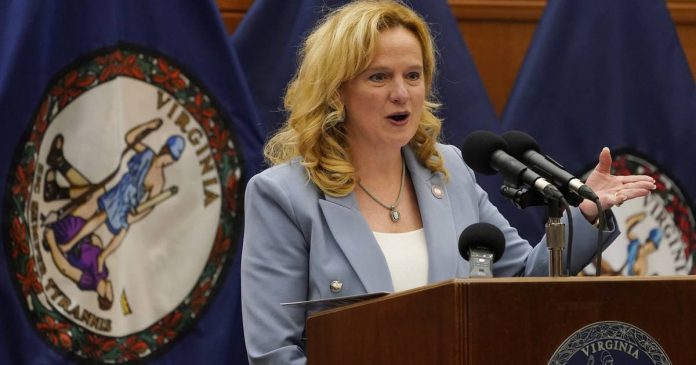
The Virginia Department of Education is allocating $760,000 from federal relief funds to help veterans and retired military personnel start their second careers as teachers.
The money will support the Troops to Teachers Virginia Center, which helps “break down barriers” for service members who hope to become teachers.
“We’re like a clearinghouse of information,” said Karen Hogue, interim director of Troops to Teachers Virginia. “We help these service members who are either transitioning out of the military, or are already out, identify the different ways to become a licensed teacher.”
The funding will be used to help recruit and retain service members in the teaching field. It will do things like reimburse veterans for test fees to become licensed teachers and pay for signing bonuses for high needs school divisions, which the state will identify at a later date, Hogue said.
Since Troops to Teachers Virginia was introduced in 2017, the center has helped approximately 2,500 service members on their “path to licensure.” This could mean anything from offering financial assistance to giving guidance on the myriad routes to becoming a teacher.
Of those who have been helped so far, at least 180 are teaching in Virginia classrooms. Another 30 veterans have earned licenses and are seeking teaching positions.
Gov. Glenn Youngkin’s executive directive last September seeks to address widespread teaching shortages across the state by focusing on recruitment and retention efforts. Superintendent of Public Instruction Jillian Balow said in a press release the directive acknowledges there is “no single solution” to this problem.
“But stepping up our efforts to enlist veterans into our teaching force is a key part of our overall strategy,” Balow said in a press release. “I am so grateful for all of the veterans who have accepted this new mission and for the value they are bringing to our communities and classrooms.”
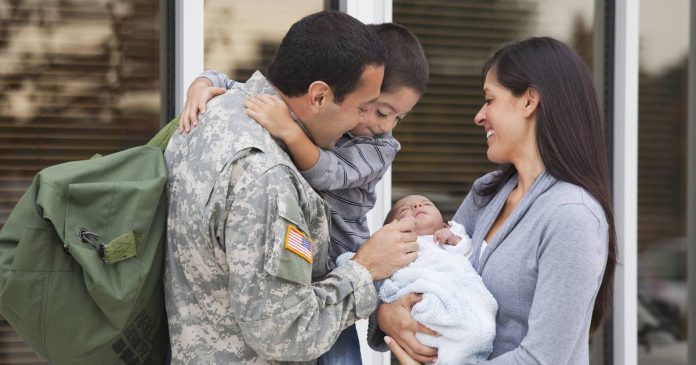
Soldiers and Marines are waiting in limbo for their services to implement the Department of Defense’s new parental leave policy.
The DoD released guidelines Jan. 4 to expand the military parental leave program, giving uniformed parents 12 weeks to welcome additions to their families. A day after the Pentagon issued the long-awaited policy, the Air Force, Space Force and Coast Guard implemented it. The Navy released its policy Jan. 19, two weeks later.
But the Army and Marine Corps have yet to update their policies, putting their personnel who are expecting a child in a holding pattern.
“I am not going to lie, I am a little bit upset about (the delay),” said Vincent Holland, a diesel mechanic specialist for the Army at Fort Eustis in Newport News.
According to the DoD’s directive, active duty birth mothers are allowed 12 weeks of parental leave following six weeks of convalescent leave, while the non-birth parent is eligible for 12 weeks of parental leave. Uniformed parents welcoming adopted or long-term foster children also are authorized 12 weeks of leave.
Holland requested 12 weeks of leave following the birth of his baby boy on Jan. 22. Instead, he was authorized to take the three weeks provided under a now outdated Army policy.
“It was exciting, at first, to find out I would have that much time to bond with our newborn because I never got to bond with our first son, Gianni, because I was deployed. But then I found out the Army had not acknowledged the new Department of Defense policy yet. So we are just playing the waiting game now,” Holland said.
The policy was mandated by the National Defense Authorization Act of 2022, which was signed into law in December 2021.
According to an Army spokesperson, the service was still “refining” and “finalizing” its new policy as of Tuesday — 20 days after the DoD released its directive and more than a year after the armed forces learned the policy was in the works.
“We are being deliberate about this update to ensure a smooth experience for Soldiers,” Lt. Col. Terence Kelley, director of media relations for the U.S. Army, wrote in an email. “This effort includes developing materials to educate the force about the new benefit and modifying our personnel system (IPPS-A) to be ready to receive requests.”
The Marine Corps’ new policy was “in routing for final approval” as of Friday afternoon, according to Yvonne Carlock, the service’s deputy communication strategy and operations officer.
Those who welcomed a new child on or after Dec. 27 or who had unused caregiver or maternity convalescent leave by Dec. 27 will be grandfathered into the new policy. Service members can request to extend their leave once the policies are handed down.
Language in the directive does not identify a deadline for the services to implement the new policy.
But Holland said he was directed by a commanding officer to check in on Feb. 1 to see if the policy was released. The Army did not respond to a request for a date when the service expected to implement its policy.
The slow rollout, Holland said, is putting extra stress on his family.
“Our new baby, Anthony, is having some problems, and my wife and I already have a 6-year-old,” Holland said.
On top of adjusting to a growing family, Holland is also juggling college classes and working a part-time job to provide for his family. Just two days into his leave, he was holding his breath, hoping the Army puts out its new rules before his 21 days are up.
“I was counting on having more time with my baby and my family. … If the policy doesn’t come, I have to figure something out — I will probably have to request to take normal leave,” Holland said.
WASHINGTON — Former Supreme Court Chief Justice Earl Warren’s name is on the U.S. Navy’s newest fuel ship. Justice Elena Kagan smashed a champagne bottle against its hull in a shipyard ceremony in San Diego last weekend.
Two other justices soon will join Warren, who in 1954 wrote the Brown v. Board of Education decision that outlawed segregation in public schools, in a group of ships being named for civil rights leaders. The Navy has awarded contracts for the construction of the Thurgood Marshall and the Ruth Bader Ginsburg. The first ship in this group is named for John Lewis, the longtime congressman and civil rights icon.
It may be unsurprising that Warren, who died in 1974, is not the first justice with a naval vessel bearing his name. But the four earlier justices who have been similarly honored are not among the better-known of the 116 men and women who have served on the Supreme Court.
Supreme Court Justice Elena Kagan, who was the ship sponsor, speaks during the christening for the USNS Earl Warren (T-AO 207) in San Diego on Saturday, Jan. 21, 2023. (Nelvin C. Cepeda/AP)
Instead, the Navy has seen fit to name ships for James Iredell, Alfred Moore, Smith Thompson and Levi Woodbury.
Woodbury was on the court for nearly six years until his death in 1851 and earlier was secretary of the Navy. He was the first to be recognized, and several vessels were named for him, including a destroyer that ran aground off the California coast in 1923 in what has been called the Navy’s largest peacetime disaster.
Twenty-three men died, and the Woodbury was among seven destroyers lost in the Honda Point disaster.
Another vessel named for Woodbury was one of four World War II Liberty ships bearing the justices’ names. More than 2,700 Liberty ships, which carried cargo and troops, were built quickly and cheaply during the war.
Like Woodbury, Thompson also had served as the Navy secretary before joining the court. He died in office in 1843 after serving 20 years. Iredell was among the first justices, named by President George Washington.
Moore took Iredell’s seat but produced only one recorded opinion in his four years as a justice and resigned in poor health. “Moore’s career made scarcely a ripple in American judicial history,” according to “The Oxford Companion to the Supreme Court of the United States.”
Kagan, incidentally, is not the first of the current justices to have christened a ship. Justice Sonia Sotomayor did the honors for the USNS Puerto Rico in 2018.
WASHINGTON — U.S. special operations forces have killed a senior Islamic State group official and 10 other terrorist operatives in remote northern Somalia, the Biden administration announced Thursday.
The operation carried out on Wednesday targeted Bilal al-Sudani, a key financial facilitator for the global terrorist organization, in a mountainous cave complex.
“This action leaves the United States and its partners safer and more secure, and it reflects our steadfast commitment to protecting Americans from the threat of terrorism at home and abroad,” Defense Secretary Lloyd Austin said in a statement.
President Joe Biden was briefed last week about the proposed mission, which came together after months of planning. He gave final approval to carry out the operation this week following the recommendation of Austin and the chairman of the Joint Chiefs of Staff, Army Gen. Mark Milley, according to two senior Biden administration officials who briefed reporters on the operation on the condition of anonymity.
Al-Sudani, who has been on the radar for U.S. intelligence officials for years, played a key role in helping to fund IS operations in Africa as well as the ISIS-K terrorist branch operating in Afghanistan, Austin said.
The U.S. Treasury Department alleged last year that al-Sudani had worked closely with another IS operative, Abdella Hussein Abadigga, who had recruited young men in South Africa and sent them to a weapons training camp.
Abadigga, who controlled two mosques in South Africa, used his position to extort money from members of the mosques. Al-Sudani considered Abadigga a trusted supporter who could help the IS supporters in South Africa become better organized and recruit new members, according to Treasury..
Al-Sudani had originally been designated the Treasury Department in 2012 for his role with al-Shabab, another terrorist organization operating in Somalia. He helped foreign fighters travel to an al-Shabab training camp and facilitated financing for violent extremists in Somalia, according to a senior administration official.
No civilians were injured or killed in the operation, Pentagon officials said. One American involved in the operation was bitten by a military dog, but was not seriously injured, according to an administration official.
U.S. officials provided scant details about how the operation was carried out or the circumstances surrounding al-Sudani’s killing. One official said that U.S. forces had intended to capture al-Sudani but that did not prove to be “feasible” as the operation was carried out.
The operation comes days after Africa Command said it had conducted a collective self-defense strike northeast of Mogadishu, the capital, near Galcad. In that incident, Somalia National Army forces were engaged in heavy fighting following an extended and intense attack by more than 100 al-Shabab fighters.
The U.S. estimated approximately 30 al-Shabab fighters were killed in that operation.
The offensive by Somalian forces against al-Shabab has been described as the most significant in more than a decade.
Al-Shabab holds a much larger footprint in Somalia than does IS.
There are beaches along the coast, mountains to the west and a close proximity to the nation’s capital, said Denice Williams, chair of the Joint Leadership Council of Veterans Service Organizations.
“It’s a great place to live,” Williams said, “but veterans also have to ask, ‘Where am I going to get the most bang for my buck?’”
The General Assembly took action last year to make the commonwealth more appealing to veterans, passing a law that allows veterans 55 or older to deduct from their taxes tens of thousands of dollars in military retirement pay. But some legislators are hoping to go a step further this year by eliminating the age restriction.
“The majority of our veterans retire from the military under the age of 55, and once they are gone they don’t come back,” said Del. Glenn Davis, R-Virginia Beach.
“We lose so many of them when they get out of the military to other states (with better incentives).”
Davis is co-sponsoring a bill from Goochland Republican John McGuire that would lift the age requirement. He said the state should work to retain veterans because they have a range of useful skills and are a valuable part of the civilian workforce if they begin a new career.
The bill passed last year allows veterans 55 and over to deduct up to $20,000 from their state taxes this year, $30,000 in 2024 and $40,000 in 2025 and beyond.
Eliminating the age requirement would cost the state an estimated $37.8 million from the general fund, according to a fiscal impact statement.
Tax cuts will likely be a point of contention during this legislative session, with Republicans backing the more extensive cuts favored by Gov. Glenn Youngkin and Democrats expected to push back as they highlight other priorities.
But this bill, so far, has received bipartisan support.
It’s co-sponsored by a handful of Democrats, including Norfolk Del. Jackie Glass, and unanimously passed a House subcommittee on Friday.
No one spoke against the bill during public comment.
Jay Marts, a 28-year National Guard and U.S. Army retired colonel, told the subcommittee it would be a meaningful way to thank veterans for their service.
“It is a small nod of appreciation for their long service and physical sacrifice,” he said. “We want all veterans to know that Virginia is the best place for them to call home.”
While many aspects of Ronald Reagan’s legacy continue to be hotly debated in the more than thirty years since he left the White House as President of the United States, one facet that is widely agreed upon is that the vast majority of his time and attention during his tenure was focused on strengthening U.S. forces vis-à-vis theirparamount Cold War enemy, the Soviet Union. In Reagan’s War Stories: A Cold War Presidency, Benjamin Griffin deftly analyzes the impact of popular culture on the decisions Reagan made that directly impacted upon the course of the Cold War. Griffin uses a plethora of primary and secondary sources to craft a convincing argument that Reagan, who has been considered by some contemporaries and historians alike as an “intellectual lightweight,” was, in actuality, laser focused on improving the U.S. position against the Soviet Union, effectively using popular culture, especially as conveyed through novels in the current zeitgeist, to help his platform resonate with the general public.[1]
Reagan was infamous for boiling down a complex argument into an easily digestible, if not always accurate, summation. Griffin argues throughout the book that Reagan was highly impressionable, particularly through novels and movies, and that he leaned on these resources to help him make decisions over the course of his life. Reagan’s War Stories can essentially be broken down into three main areas, all of which are novels, movies, or genres of fiction Griffin argues shaped Reagan’s perception and would weigh heavily in his decision-making during his time in public office, at times even more so than formal reports or briefings.
The first novels in question were the books Reagan enjoyed as a youth, particularly the John Carter books by Edgar Burroughs, a science fiction series incredibly popular during Reagan’s childhood, along with other significant books such as That Printer of Udell’sby Harold Bell Wright. Griffin argues that the strong characters, virtuous plot lines, and prevailing savior tropes resonated with Reagan, who lacked a reliable father figure in his life. This is not a groundbreaking or earth shattering observation, and it is a link that any amateur psychologist could make. However, what makes this book special and worthwhile is how Griffin ties the impact of these novels on a young Reagan’s psyche to his actions as president. An example of how these novels led to Reagan’s decisions later in life is when Griffin ascribes Reagan’s continued support of futuristic technology to the initial exposure he received on the subject from his reading of Burroughs as a youth. Griffin argues these works would play a major role in the eventual culmination of the Cold War, when Reagan would announce his support for the Strategic Defense Initiative (SDI); science fiction novels from his childhood would “help Reagan conceptualize the impact of technology, a technique he saw as perfectly reasonable.”[2]
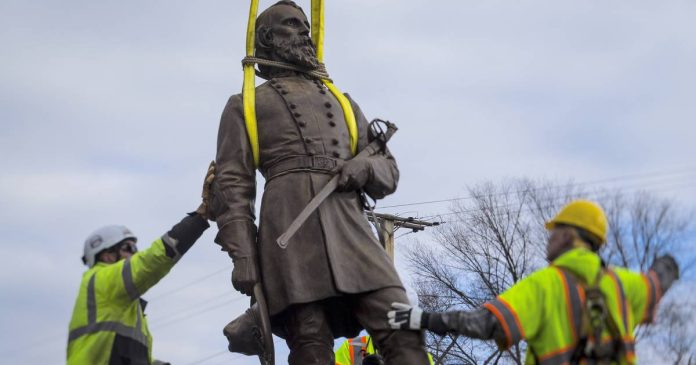
CULPEPER — The remains of a Confederate general unearthed from beneath a monument at the center of a Virginia intersection have been reinterred at a cemetery in his hometown.
Last month, Richmond, which served as the Confederacy’s capital for most of the Civil War, removed the statue of Confederate Gen. A.P. Hill and the general’s remains buried beneath after a court battle. On Saturday, hundreds of people, including Confederate reenactors, gathered to pay their respects to the general at a ceremony in Fairview Cemetery in Culpeper, Hill’s hometown, The Free Lance-Star reported.
The coffin draped in an old Virginia flag was brought into the cemetery on a mule-drawn wagon followed by a riderless horse. After a eulogy, song and prayers, there was a 21-gun salute and three rounds were fired from a cannon.
Richmond removed other Confederate monuments amid the racial justice protests that followed George Floyd’s killing in 2020. But efforts to remove the Hill statue, which sat in the middle of a busy intersection, were more complicated because the general’s remains were interred beneath it about 25 years after his death at the end of the Civil War.
In October, a judge ruled that city officials — not the descendants — would get to decide where the Hill statue went next. City officials have said the removed statue will be stored in an undisclosed location and later given to the Black History Museum and Cultural Center of Virginia. Attorneys for Hill’s indirect descendants agreed his remains would be moved to a cemetery in Culpeper, near where Hill was born.
Many Confederate statues in Virginia were erected decades after the Civil War, during the Jim Crow era, when states imposed new segregation laws, and during the “Lost Cause” movement, when historians and others tried to depict the South’s rebellion as a fight to defend states’ rights, not slavery. Some Confederate tributes remain in Richmond, but they’re on state land, including on Capitol Square surrounding the Virginia State Capitol building.
Ambrose Powell Hill died days before the war’s end in 1865, according to a timeline provided in court documents during a legal battle over the removal of the statue. His remains were interred in a family cemetery in Chesterfield County, according to a city petition to move the remains. The remains were moved in 1867 to Hollywood Cemetery in Richmond, where they remained until 1891, when they were moved to the spot where the monument was unveiled the following year.
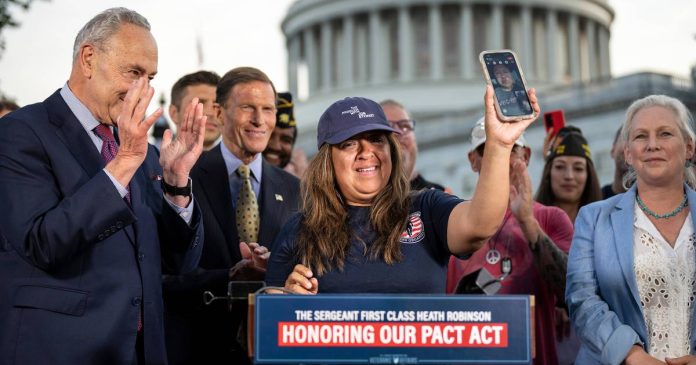
Officials with the Veterans of Foreign Wars are worried some veterans may end up unnecessarily spending thousands of dollars as they seek benefits through a law passed last year, the PACT Act.
The law made more than 20 health conditions presumptive — meaning the veterans are presumed to have gotten the conditions while serving —as a result of exposure to burn pits and other toxic chemicals. The conditions covered include asthma diagnosed after military service, respiratory cancers and emphysema, according to the VA’s website.
It has become easier than ever to file for these disability benefits because of the PACT Act, said Ryan Gallucci, director of National Veterans Service for the VFW. However, the VFW cautions veterans that there are unaccredited consulting groups offering to help veterans secure benefits for a fee, when the veterans could be getting those services for free.
“It would be tragic if veterans waiting for decades thought they had to pay exorbitant fees to get something that just became a lot easier,” said Gallucci, who has helped veterans with disability claims.
The VA recommends veterans only work with VA-accredited representatives, according to its website.
“There are other companies in this space — at the VFW we call them claim sharks — that enter into what we believe are predatory consulting agreements with veterans to ‘help’ them with VA claims,” said Gallucci. “The problem here is when veterans enter into these agreements, they can owe these consulting organizations tens of thousands of dollars of their benefits.”
There are accredited veteran service organizations and attorneys that offer these same services with no fee for an initial filing, Gallucci said. He said veterans should always make surerepresentatives are accredited with the VA because that offers more protections.
“If the veteran thinks that anything doesn’t look right, or if the agent or attorney isn’t agreeing to that fee agreement, they can complain to the VA,” Galluci said. “The VA can discharge that fee agreement and then sanction that agent or attorney.”
VA accreditation is a “safeguard” for veterans, according to Gallucci.
“The tragedy that we see is with these non-accredited companies, (veterans) enter into contracts that include things like binding arbitration clauses, upfront consultation fees that can be in the thousands of dollars, and then the veteran can owe them up to six months of any benefits they receive as a result of working with that consulting group,” he said.
He said some veterans, having experienced past frustrations in getting services, may underestimate how much easier it has become to obtain benefits through the PACT Act.
“They’ve probably been denied several times, and they think that even with the PACT Act that paying to get it done is going to be the best way to get it done,” Gallucci said. “But because these conditions are now presumptive, it’s actually easier than it’s ever been before, and that was the point of the PACT Act.”
As of mid-January, nearly 234,000 PACT Act-related claims had been filed, according to data provided by a Veterans Affairs spokesperson.
“VA is executing a comprehensive veteran outreach plan to make sure that every veteran and survivor gets the care they need and the benefits they deserve,” the spokesperson said in an email. “VA is reaching out to veterans and survivors to make sure that they know about this new law and what it could mean for them and their families.”
Between Dec. 10 and 17, more than 160,000 veterans were screened for toxic exposure and 15,000 veterans applied for PACT Act benefits during the VA’s PACT Act week of action, according to VA data.
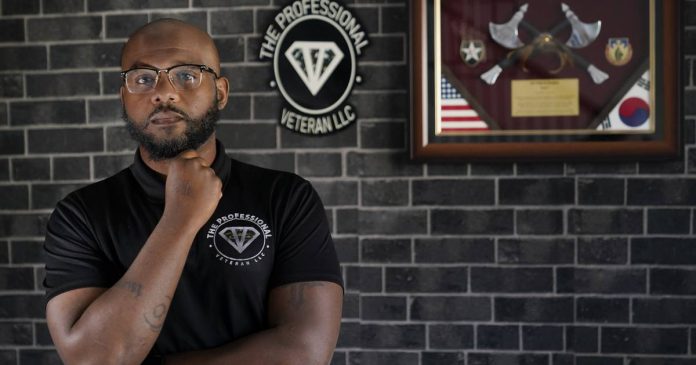
NORFOLK — Phillip Slaughter left the Army after 18 years and found a job similar to one he had in uniform: behind the wheel of a truck. Instead of towing food and bullets through war zones, he hauled packages for FedEx.
It wasn’t what he wanted to do. The work aggravated his post-traumatic stress disorder. It would be three years and several jobs before he landed his ideal position as a sourcing recruiter for a tech company.
“I think it’s the first job that I’ve worked 10 consecutive months without quitting,” said Slaughter, 41, who lives in Clarksville, Tennessee.
Phillip Slaughter, who served in the U.S. Army for 18 years, works in his home office Nov. 10, 2022, in Clarksville, Tenn. Slaughter got out about four years ago and now works as a recruiter for a tech company. His side hustle is helping to write resumes for recent veterans and aiding service members transition into the civilian workforce. (Mark Humphrey/AP)
Slaughter is a U.S. military veteran who found a job he loves at a time when the nation is experiencing some of its lowest monthly veteran unemployment on record. But the rate — 2.7% in October — can mask the difficulty of a transition that sometimes takes years of working unfulfilling jobs, while forging a new identity and a new purpose beyond serving one’s country.
“Even though (veteran unemployment) is low, I’m interested to see a survey on how many people are happy in the position they’re in,” said Slaughter, who also runs his own consulting firm for fellow vets.
Veterans account for about 7% of the civilian population, according to the Bureau of Labor Statistics. Their jobless rate can help gauge the nation’s efforts to assist former service members, experts say. It can also reflect on the military and how it prepares departing personnel. High veteran unemployment is not good for recruiting.
For this Veterans Day, a handful of former service members talked about their experiences looking for work at a time when the veteran jobless rate is so low. For some, it was easy — but others have struggled.
Pierson Gest, a former Army infantryman, landed his first post-military job in August as a hydropower system designer in California.
Gest joined up during the Great Recession, knowing he’d eventually go to school on the GI Bill. Starting college in 2017 was tough at first as he developed study habits. But he got the hang of it, earning his engineering degree in June.
“I was lucky enough to negotiate a six-figure salary,” said Gest, 37, who lives outside San Francisco. “And I definitely used and leveraged my experience in the Army to negotiate that wage on top of my college degree.”
Across the country in Florida, Thomas Holmes is still searching for his ideal job.
Holmes, 46, left the Air Force in 2012 after 17 years, during which he maintained parachute systems for various types of aircraft, from F-15 fighter jets to U-2 spy planes.
He said the one full-time job he’s worked, in the billing and claims department of a warehouse office, was toxic. He quit after about 18 months.
Holmes used the GI Bill to earn three degrees, including a master’s in sports management. He found part-time work in the industry, but rising gas prices and the lure of more consistent hours prompted him to work at a nearby UPS store.
“I’ve applied for many jobs — county jobs, state jobs, all sorts of things,” said Holmes, who lives outside Tampa. “And then all I get is: ‘Well, thanks for your service.’”
Jayla Hair’s transition from Navy to civilian paralegal wasn’t easy, despite a bachelor’s degree in the field and skills that would seem transferable.
Hair, 30, said she applied to about 300 jobs over eight months. After seeking help from a Navy program and friends, Hair overhauled her resume and job interviews eventually came her way. But potential employers cited her lack of experience with state laws and civilian courts.
Hair took temporary jobs in the legal field and recently landed a full-time position as a paralegal for a Fortune 500 company in the Chicago area.
“Just having my military experience was not enough,” said Hair, who plans to pursue a law degree in the future. “If it wasn’t for me having these temporary jobs to build my civilian resume, I don’t know where I’d be right now.”
The tight labor market and demand for workers after the coronavirus pandemic is likely one factor for the low veteran jobless rates, said Jeffrey B. Wenger, a senior policy researcher at the Rand Corp. But so are significant efforts in recent years by the U.S. military, Department of Veterans Affairs and veteran service organizations to provide assistance to outgoing service members.
Training such as resume-writing is now mandatory and American companies have launched initiatives to hire hundreds of thousands of vets.
Many of those undertakings grew from the Great Recession and the abundance of stressed-out service members who served in Iraq and Afghanistan, which “brought the veteran employment crisis to a head,” Wenger said.
“And over the last 10 to 15 years, people have been putting in more and more resources and have become more and more dedicated to fixing that problem,” Wenger said.
Among them is Transition Overwatch, a firm that runs career apprenticeship programs across the country. CEO Sean Ofeldt said the company zeroes in on what active service members want to do as civilians, not what they’re doing or the skills they’ve learned in the military.
“A lot of military members don’t want to keep doing what they did,” said Ofeldt, a former Navy SEAL. “We train them up while they’re still on active duty and then launch them into an actual career with all the support they need for that first 12 months.”
But the formula for supporting veterans has to encompass more than just employment. It needs to focus on social challenges as well, said Karl Hamner, a University of Alabama education professor.
Veterans can feel isolated after losing their tribe of fellow service members. Hamner said new data indicates that loss can be especially acute for women because they formed strong bonds with one another as they navigated a male-dominated military.
In a soon-to-be released national survey of 4,700 female veterans conducted by Hamner and his colleagues, 70% said adjusting to civilian life was difficult; 71% said they needed more time to figure out what they wanted to do.
“They had to prove themselves in a valued, highly regarded profession,” Hamner said. “And now they’re back to trying to figure out what it means to be a civilian woman and deal with all the standard discriminatory stuff.”
“Guard zealously your right to serve in the Armed Forces, for without them, there will be no other rights to guard.”
Virginia BeachMayor Bobby Dyer repeated the words — made famous by President John F. Kennedy in 1962 — during a luncheon Friday to honor Hampton Roads veterans.
The gathering, hosted by theHampton Roads Council of Veterans Organizations, gave veterans, loved ones, supporters and event volunteers a chance to break bread together and partake in a little camaraderie while celebrating America’s veterans.
“We recognize those in attendance who have served, pay special tribute to those missing in action and prisoners of war with a dedicated ceremony, and pay tribute to all of America’s veterans,” said council PresidentDan Doyle.
Nearly300 local veterans and their loved ones got together at the Double Tree hotel in Virginia Beach for the council’s 14th annual Veterans Day luncheon. It was one of the only Veterans Day celebrations not canceled as remnants of Hurricane Nicole moved through the area Friday.
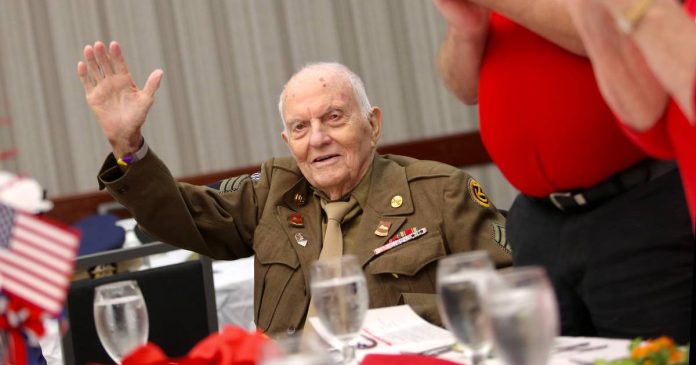
While all attending veterans were recognized, this year’s event had two special honorees introduced to the audience: a World War II veteran who fought at theBattle of the Bulge and a Vietnam War veteran who was held captive for 10 years.
Stewart Boone, who had dreams of becoming a high school band director, was drafted into the Army in August 1942. Twoyears later, he would be on the front lines of one of history’s bloodiest battles. He recalled his time in Belgium digging fox holes in petrified, frozen ground and evading enemy fire and German tanks.
“We had heard reports of troops being massacred, so surrendering had its unknowns,” Boone said.
Boone was one of 11 from his 80-man unit to survive the Battle of Bulge. Now 98, he is the last living survivor from his group.
“They call themselves ‘the lucky 11,’” Boone’s daughter, Brenda Boone Street, said. “But I always tell him he is the luckiest of the 11.”
Members of Virginia Beach’s Boy Scout Troop 407, including from left, Isaac Perez, 13, senior patrol leader, Dante Fritz, 11, Kaiden Fritz, 13, and Paladin Fritz, 12, along with Stan Fritz, scout master, (back), recite the Pledge of Allegiance during Virginia Beach’s Veterans Day Luncheon Nov. 11, 2022. (Stephen M. Katz/The Virginian-Pilot)
An empty table nestled in the corner of the room served as a memorial for prisoners of war and those reported missing in action. One Hampton native sitting a few tables away shared a unique connection with the memorial table.
Bob Allen retired from the Navy in 1983 after 15 years. But he spent the bulk of his military service in a POW camp in Vietnam. While he doesn’t like to share details of his experiences, he said he enjoys seeing the strong military support from community members.
“It shows the veterans they are not forgotten,” Allen said.
Glenn Hart, a retired senior chief petty officer with the Navy, echoed Allen.
“Veterans have issues due to service — post traumatic stress disorder, depression, suicide are highest among our veterans,” Hart said. “It’s important that we remember veterans have these issues and that we don’t forget our responsibility as citizens to support our veterans.”
Pastor John Collins gave the benediction, thanking those who served in his prayer.
“Because of Nov. 11, we should be thankful for those used to secure the blessings of liberty to ourselves and our posterity, as it says in the preamble,” Collins said. “So veterans, whether you fought for God and country — thank you. Whether you fought for flag and freedom — thank you. Whether you fought for democracy or the republic — thank you.”




:quality(70)/cloudfront-us-east-1.images.arcpublishing.com/tronc/YNOEAHZC7JGMDH44AL32QIOKS4.jpg)