Home Blog Page 174

Trump charged over classified documents in 1st federal indictment of an ex-president – Daily Press

0

By ERIC TUCKER, JILL COLVIN and MICHAEL BALSAMO (Associated Press)

MIAMI (AP) — Donald Trump said Thursday that he was indicted for mishandling classified documents at his Florida estate, a remarkable development that makes him the first former president in U.S. history to face criminal charges by the federal government that he once oversaw.

The indictment carries unmistakably grave legal consequences, including the possibility of prison if he’s convicted.

But it also has enormous political implications, potentially upending a Republican presidential primary that Trump had been dominating and testing anew the willingness of GOP voters and party leaders to stick with a now twice-indicted candidate who could face still more charges. And it sets the stage for a sensational trial centered on claims that a man once entrusted to safeguard the nation’s most closely guarded secrets willfully, and illegally, hoarded sensitive national security information.

The Justice Department did not immediately confirm the indictment publicly. But two people familiar with the situation who were not authorized to discuss it publicly said the indictment included seven criminal counts. One of those people said Trump’s lawyers were contacted by prosecutors shortly before he announced on his Truth Social platform that he had been indicted.

Within 20 minutes of his announcement, Trump, who said he was due in court Tuesday afternoon, began fundraising off it for his 2024 presidential campaign. He declared his innocence in a video and repeated his familiar refrain that the investigation is a “witch hunt.”

The case adds to deepening legal jeopardy for Trump, who has already been indicted in New York and faces additional investigations in Washington and Atlanta that also could lead to criminal charges. But among the various investigations he faces, legal experts — as well as Trump’s own aides — had long seen the Mar-a-Lago probe as the most perilous threat and the one most ripe for prosecution. Campaign aides had been bracing for the fallout since Trump’s attorneys were notified that he was the target of the investigation, assuming it was not a matter of if charges would be brought, but when.

Appearing Thursday night on CNN, Trump attorney James Trusty said the indictment includes charges of willful retention of national defense information — a crime under the Espionage Act, which polices the handling of government secrets — obstruction, false statements and conspiracy.

The inquiry took a major step forward last November when Attorney General Merrick Garland, a soft-spoken former federal judge who has long stated that no one person should be regarded as above the law, appointed Jack Smith, a war crimes prosecutor with an aggressive, hard-charging reputation to lead both the documents probe as well as a separate investigation into efforts to subvert the 2020 election.

The case is a milestone for a Justice Department that had investigated Trump for years — as president and private citizen — but had never before charged him with a crime. The most notable investigation was an earlier special counsel probe into ties between his 2016 campaign and Russia, but prosecutors in that probe cited Justice Department policy against indicting a sitting president. Once he left office, though, he lost that protection.

The indictment arises from a monthslong investigation into whether Trump broke the law by holding onto hundreds of documents marked classified at his Palm Beach property, Mar-a-Lago, and whether Trump took steps to obstruct the government’s efforts to recover the records.

Prosecutors have said that Trump took roughly 300 classified documents to Mar-a-Lago after leaving the White House, including some 100 that were seized by the FBI last August in a search of the home that underscored the gravity of the Justice Department’s investigation. Trump has repeatedly insisted that he was entitled to keep the classified documents when he left the White House, and has also claimed without evidence that he had declassified them.

Court records unsealed last year showed federal investigators believed they had probable cause that multiple crimes had been committed, including the retention of national defense information, destruction of government records and obstruction.

Since then, the Justice Department has amassed additional evidence and secured grand jury testimony from people close to Trump, including his own lawyers. The statutes governing the handling of classified records and obstruction are felonies that could carry years in prison in the event of a conviction.

Even so, it remains unclear how much it will damage Trump’s standing given that his first indictment generated millions of dollars in contributions from angry supporters and didn’t weaken him in the polls.

The former president has long sought to use his legal troubles to his political advantage, complaining on social media and at public events that the cases are being driven by Democratic prosecutors out to hurt his 2024 election campaign. He is likely to rely on that playbook again, reviving his longstanding claims that the Justice Department — which, during his presidency, investigated whether his 2016 campaign had colluded with Russia — is somehow weaponized against him.

Trump’s legal troubles extend beyond the New York indictment and classified documents case.

Smith is separately investigating efforts by Trump and his allies to overturn the results of the 2020 presidential election. And the district attorney in Georgia’s Fulton County is investigating Trump over alleged efforts to subvert the 2020 election in that state.

Signs had mounted for weeks that an indictment was near, including a Monday meeting between Trump’s lawyers and Justice Department officials. His lawyers had also recently been notified that he was the target of the investigation, the clearest sign yet that an indictment was looming.

Though the bulk of the investigative work had been handled in Washington, with a grand jury meeting there for months, it recently emerged that prosecutors were presenting evidence before a separate panel in Florida, where many of the alleged acts of obstruction scrutinized by prosecutors took place.

The Justice Department has said Trump and his lawyers repeatedly resisted efforts by the National Archives and Records Administration to get the documents back. After months of back-and-forth, Trump representatives returned 15 boxes of records in January 2022, including about 184 documents that officials said had classified markings on them.

FBI and Justice Department investigators issued a subpoena in May 2022 for classified documents that remained in Trump’s possession. But after a Trump lawyer provided three dozen records and asserted that a diligent search of the property had been done, officials came to suspect even more documents remained.

The investigation had simmered for months before bursting into front-page news in remarkable fashion last August. That’s when FBI agents served a search warrant on Mar-a-Lago and removed 33 boxes containing classified records, including top-secret documents stashed in a storage room and desk drawer and commingled with personal belongings. Some records were so sensitive that investigators needed upgraded security clearances to review them, the Justice Department has said.

The investigation into Trump had appeared complicated — politically, if not legally — by the discovery of documents with classified markings in the Delaware home and former Washington office of President Joe Biden, as well as in the Indiana home of former Vice President Mike Pence. The Justice Department recently informed Pence that he would not face charges, while a second special counsel continues to investigate Biden’s handling of classified documents.

But compared with Trump, there are key differences in the facts and legal issues surrounding Biden’s and Pence’s handling of documents, including that representatives for both men say the documents were voluntarily turned over to investigators as soon as they were found. In contrast, investigators quickly zeroed on whether Trump, who for four years as president expressed disdain for the FBI and Justice Department, had sought to obstruct the inquiry by refusing to turn over all the requested documents.

_____

Tucker reported from Washington. Colvin reported from Des Moines, Iowa.
High school scoreboard | Thursday’s Scores

0

Boys tennisClass 6

Team Final

Langley 5, Freedom of South Riding 1

Doubles semifinals

Adi Gupta and Nikola Galov (Langley) d. Jacob Braud and Robert Teverovskyi (Cosby) 6-2, 6-0; Matthew Staton and Rebhi Villasmil (Colgan) d. Ryan Kim and Matthew Li (Thomas Jefferson S&T) 6-1, 6-3.Class 5

Team Final

Deep Run 5, Cox 0

Singles: Zach Fleishman d. Neil Vanga 6-0, 6-1;

Grant Kroodsma d. James Lonergan 6-0, 6-0; Andrew Lee (DR) led Sam Dixon 6-1, 5-0, did not finish; Aiden Jun d. Alex Ortiz 6-0, 6-0; Andy Liu d. Luca Gandolfo 6-0, 6-1; Kaushik Narasimhan d. Matt Baan 6-0, 6-2.

Doubles semifinals

Harrison Lee and Zachary Stoney (Princess Anne) d. Aarush Rajalana and A.J. Lawal (Riverside) 6-3, 6-3; Zach Fleishman and Grant Kroodsma (Deep Run) d. Patrick Stiles and John Felts (Maury) 6-0, 6-0.Class 4

Team Final

Western Albemarle 5, Hanover 1

Singles: Will Hart (H) d. Gordon Fairborn 6-3, 6-3; Brader Eby (WA) d. Riley Butler 6-0, 6-0; Luke Kielbasa (WA) d. Jay Blaser 6-0, 6-0; Wade Sturman (WA) d. London Mezzenga 6-2, 6-2; Kemper Brown (WA) d. Teagan Cole 5-7, 6-1, 1-0 (11-9); George Rader (WA) d. Bennett Uy 7-6 (7-2), 6-3.

Doubles semifinals

Brader Eby and Luke Kielbasa (Western Albemarle) d. Rainer Christiansen and John Cloud (Grafton) 6-4, 6-3; Sid Dabhade and Thanush Buneti (Lightridge) d. Will Hart and Teagan Cole (Hanover) 6-1, 6-3.Class 3

Team Final

Maggie Walker 5, Monticello 1

Doubles semifinals Class 3

Lucas Beasley and Ian Rasor (Christiansburg) d. Xavier Jones and Gabriel Rosen-Turits (Lafayette)  6-2, 6-3; Evan Bernstine and Alex Peskin (Goochland) d. Luca Bonfigli and J.B. Belmares (Monticello) 7-5, 6-3.

Doubles semifinals Class 2

Briggs Crabtree and Chase Hamlin (John Battle) d. Max de Winter and Nick Felsman (Bruton) 6-1, 6-3; Cayden Swats and Adam Higgins (Riverheads) d. Ethan Carr and Jonathan Thompson (Fort Chiswell) 6-3, 7-5.

Team Final

Glenvar 5, Bruton 2

Girls tennis

VHSL STATE TOURNAMENTClass 6

Team Final

Langley 5, Freedom of South Riding 0

Singles: Noelle Talarek d. Rhea Joseph 6-0, 3-0, retired/injury; Zosia Henryson-Gibbs d. Anya Bhatia 6-0, 6-1; Maya Lam (F) led Kai Henryson-Gibbs 6-4, 1-0, did not finish; Sophia El-Bagdadi d. Anika Bhatia 6-0, 6-1; Penny Walke d. Saayli Patwardhan 6-1, 6-2; Caitlin Kry d. Addison Pounder 6-0, 6-0.

Doubles semifinals

Noelle Talarek and Arakai Henryson-Gibbs (Langley) d. Meghan Moore and Renee Kozlowski (Cosby) 6-0, 6-0; Deana Sultanaeva and Carly Mew (Robinson) d. Sophia Raval and Taylor Buckley (Battlefield) 6-2, 6-1.Class 5

Team FinalDouglas Freeman 5, Princess Anne 0

Singles: Paige Suter d. Ashton Dillman 6-1, 6-0; Anne Douglas Council d. Nielsen Baxley 6-3, 6-3; Ellie Wood (F) led Ysabel Wells 6-3, 5-3, did not finish; Caroline Frank d. Laine Kwong 6-4, 6-0; Caroline Avery d. Sophia Koch 6-3, 6-1; Katherine Pollard d. Rino Sato 6-3, 6-2.

Doubles semifinals

Ana Maria Rincon and Sawyer Stephenson (Patrick Henry of Roanoke) d. Ashton Dillman and Nielsen Baxley (Princess Anne) 6-0, 6-1; Esha Kidambi and Elli Michalopoulou (J.R. Tucker) d. Kamila Bardoun and Sabine Krigsvold (Maury) 6-0, 6-4.Class 4

Team Final

Jamestown 5, Sherando 3

Singles: Julia Clark (J) d. Mikayla Koch 6-1, 6-1; Lauren Elliott (J) d. Morgan Sutphin 6-1, 6-1; Emmy Woolever (S) d. Michelle Zhou 6-1, 6-2; Scarlett Gamez (J) d. Katie Freilich 3-6, 6-2, 1-0 (10-0); Gabriela Koch (S) d. Gladys Smith 6-3, 6-4; Emily Dahl (J) d. Kendall Clark 6-2, 6-0.

Doubles: Clark-Elliott led Koch-Koch 6-4, 0-1, did not finish; Woolever-Sutphin (S) d. Gamez-Zhou 6-2, 6-1; Dahl-Rachel Yu (J) d. Clark-Addyson Kelly 6-1, 6-1.

Doubles semifinals

Kayla Kennedy and Chase London (Great Bridge) d. Claire Rawlins and Lauren Baba (Salem Spartans) 6-0, 6-1; Isabella Rotaru and Sienna Bhide (Broad Run) d. Elizabeth Hughes and Marina Le (Atlee) 6-0, 6-1.Class 3

Team Final

Maggie Walker 5, Abingdon 2


Doubles semifinals Class 3

Lauren Wimmer and Grayson Woodall (Abingdon) d. Valentina Crespo and Malini Dharni (Tabb) 6-0, 6-0; Martina Ribera and Ella Wiatt (Maggie Walker) d. Raygan Wade and Ella Li (Spotswood) 6-3, 6-1.

Doubles semifinals Class 2

Team Final

Marion 5, Poquoson 2

Doubles semifinals Class 1

Maggie Wonderling and Laney Williams (Rappahannock) d. Bailey Collins and Calli Dye (Lebanon) 6-1, 7-5; Carly Sturgill and Clare Huff (Galax) d. Alex DiGrassie and Taylor Hassett (Buffalo Gap) 6-2, 7-5.

As tourists flock to view volcano’s latest eruption, Hawaii urges mindfulness, respect – Daily Press

0

By JENNIFER SINCO KELLEHER (Associated Press)

HONOLULU (AP) — Hawaii tourism officials urged tourists to be respectful when flocking to a national park on the Big Island to get a glimpse of the latest eruption of Kilauea, one of the world’s most active volcanoes.

Kilauea, Hawaii’s second-largest volcano, began erupting Wednesday after a three-month pause.

The U.S. Geological Survey’s Hawaiian Volcano Observatory on Thursday lowered Kilauea’s alert level from warning to watch because the rate of lava input declined, and no infrastructure is threatened. The eruption activity is confined to the closed area of Hawaii Volcanoes National Park.

“Out of respect for the cultural and spiritual significance of a volcanic eruption and the crater area for many kamaʻāina, the Hawaiʻi Tourism Authority urges mindfulness when planning a visit to the volcano,” the agency said in a statement Wednesday night, using a Hawaiian word often used for Hawaii residents.

For many Native Hawaiians, an eruption of a volcano has a deep yet very personal cultural significance. Some may chant, some may pray to ancestors, and some may honor the moment with hula, or dance. Hawaiians ask that people keep a respectful distance.

“Don’t just get out your camera and take photos. Stop and be still and take it in,” said Cyrus Johnasen, a spokesperson for Hawaii County who is Hawaiian. “It’s something that you can’t pay for. In that moment, you are one with Hawaii.”

In recognizing the sacredness of the area, he also urged visitors to not take rocks, refrain from horseplay and leave plants alone.

“A lot of plants up there are native,” he said. “Just be mindful that you will leave a footprint. The idea is you leave one that’s small as possible.”

Word of Kilauea’s lava fountains spread quickly, bringing crowds to the park. “Expect major delays and limited parking due to high visitation,” said a warning on the park’s website Thursday.

There was no exact count available, but officials estimated the first day and night of the eruption brought more than 10,000 people, which is more than triple the number of visitors on a normal day when Kilauea isn’t erupting, park spokesperson Jessica Ferracane said.

Several thousand viewers were watching the USGS’s livestream showing red pockets of moving lava Thursday morning.

“We were on social media, and we saw that it was actually going off while we’re here, so we made the drive from the Kona side,” Andrew Choi, visiting with his family from Orange County, California, told the Hawaii Tribune-Herald. “This feels so ridiculously lucky. We’ve never seen anything like this.”

Park officials suggested visiting at less-crowded times before 9 a.m. or after 9 p.m.

Scientists expect the eruption to continue and remain confined to the Halemaumau crater in the park.

Early Wednesday, lava fountains were as high as 200 feet (60 meters) and decreased to 13 feet to 30 feet (4 meters to 9 meters) in the afternoon, according to the observatory.

“People here on Hawaii Island are getting a spectacular show,” Mayor Mitch Roth said. “And it’s happening in a safe place that was built for people to come view it.”

Hundreds of vintage glass bottles unearthed at Atlantic Park construction site in Virginia Beach – Daily Press

0

VIRGINIA BEACH — Finding debris underground on a construction site isn’t uncommon, but contractors say the amount of vintage glass turning up at the site of the Atlantic Park project has been remarkable.

Hundreds of glass bottles have been uncovered about five feet under the surface of the lot next to 20th Street, between Arctic and Baltic avenues. Some of the vessels date back more than 100 years.

Construction workers removing unusable soil where an entertainment venue will be built discovered dozens of intact bottles along with pieces of broken glass this week.

“For this much to be in one place is definitely unique,” said Cap League, assistant superintendent for W.M. Jordan Co., the general contractor.

Contractors broke ground in April, where a mixed-use project is being built that will feature a surf park, music hall, apartments, shops and restaurants. The city owns the land and is working with Venture Realty Group and musician Pharrell Williams on the project.

Among the artifacts unearthed, League found a Coca Cola bottle manufactured in Richmond with the date Nov. 16, 1915 marked on it. The Root Glass Company of Indiana created the iconic glass contour bottle in 1915 to help the brand stand out from other drinks, according to Coca-Cola.

He also discovered two small vintage Listerine bottles, and an antique Gordon’s London Dry Gin bottle.

W.M. Jordan Senior Project Manager Gary Mulgrew investigates an antique glass bottle in a trailer off 18th St. on the Oceanfront that workers found at the Atlantic Park construction site on Virginia Beach, Va. on Thursday, June 8, 2023. Workers found the bottles five feet below gravel and grassland on a plot of land where the entertainment venue will be located between Arctic and Baltic Ave. and 19th and 20th St. (Tess Crowley / The Virginian-Pilot)

And he spotted another relic: a cobalt blue medicine bottle, about 4 inches tall, featuring the words “Chelf’s Celery-Caffein Comp’d” made by Chelf Chemical Co. of Richmond. The tincture was made after 1908 and was used to treat headaches and head colds, according to the National Museum of American History.

League suspects the area where construction workers are seeing so much glass may have been used as a dumping ground. They’ve also found scrap metal and construction debris in what he describes as an area “almost in the shape of a ditch.”

New details emerge for Virginia Beach’s Atlantic Park project: A giant lagoon, bungalows and more

The land is adjacent to where the old Dome stood and was previously the site of a building constructed in the 1930s or 1940s that once held both the city’s fire and police departments. It’s unclear what was on the land before then.

Clearing the site of debris will be a minor setback; the project is progressing as expected, according to a city spokesperson.

League said he’ll continue to keep an eye out for glass with markings on it. The most interesting ones he’ll display in his office.

Stacy Parker, 757-222-5125, [email protected]

Williamsburg considers forming independent school system – Daily Press

0

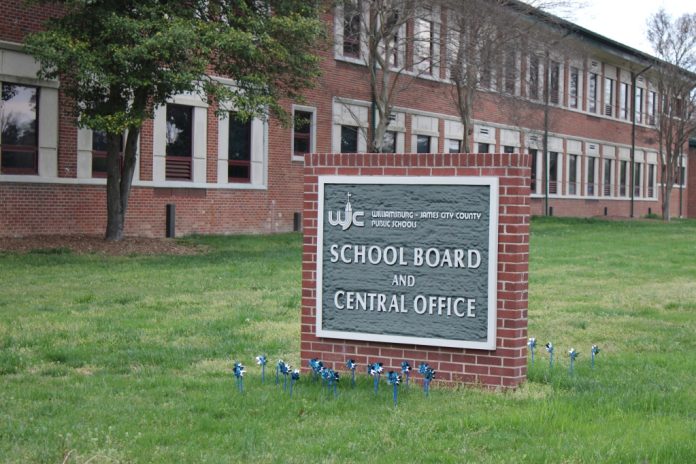
WILLIAMSBURG — The city of Williamsburg is exploring the idea of severing its longstanding agreement with James City County to operate a joint school system.

On Thursday, Williamsburg City Council voted unanimously to proceed with a feasibility study that “would consider and explore the possibility of forming an independent city of Williamsburg public school division,” said City Manager Andrew Trivette.

Currently, the city is in the second year of a five-year contract for the joint operation of the Williamsburg-James City County school system.

According to the school system’s website, there are more than 11,000 students enrolled in kindergarten through 12th grade across the system’s 16 schools. Just over 1,000 students enrolled in the system this past school year were city residents, according to the 2024 Williamsburg city budget. Over 16% of the city’s budget for this fiscal year was slated for Williamsburg-James City County Public Schools.

The study will take place through the fall of 2023, with any implementation of recommendations taking place at the earliest in the 2025-2026 school year, a city news release said.

“I hope for anybody watching that they don’t see this as an indictment of the current education that is being provided to the children,” Mayor Doug Pons said. “We have an outstanding school division. The people that work in our division do an outstanding job so there’s no criticism involved in this at all.”

In a message shared with the school system’s staff on Thursday, Superintendent Olwen Herron said that at the moment, the city’s action doesn’t mean anything for Williamsburg-James City County Schools.

“While we may wonder what the results of the study will be and what action, if any, will be taken, any commentary on those outcomes at this time would be speculative,” Herron said. “As the study unfolds and we learn more about the city’s findings, I will update you. In the meantime, we will continue to deliver the finest instruction, support, and services to our community.”

The study comes as a result of the city’s most recent Goals, Initiatives and Outcomes document, which includes an initiative to “consider alternatives to the traditional K-12 education model for improved pathways to higher education and certificate programs through coordination with local institutions.”

During each contract negotiation, which happens every five years, “we’ve asked ourselves as a body, ‘Will this deliver the best outcome for our students?’ and we really didn’t have the information,” Pons said. “The message is clear that we owe it to our citizenry to have this conversation.”

Pons added that there is no predetermined outcome involved with the study.

“There could be some concern in the community that all of the sudden next year there’s going to be major changes and that’s not the case,” he said. “When we get the study back, then we’ll know better how to proceed.”

Sian Wilkerson, 757-342-6616, [email protected]

Florida woman who fatally shot neighbor appears in court, sheriff releases details of racist threats – Daily Press

0

By CURT ANDERSON (Associated Press)

ST. PETERSBURG, Fla. (AP) — A white Florida woman charged with shooting and killing her Black neighbor told detectives that she called the victim’s children by racist slurs in the months leading up to the slaying, according to an arrest report released Thursday.

Susan Louise Lorincz, 58, admitted to detectives that she called the children “the n-word.” One child told deputies that the night of the shooting, Lorincz “came out of her house and gave the children the middle finger” and also said this: “Get away from my house, you Black slave,” according to the report.

The report from the Marion County Sheriff’s Office came out shortly before Lorincz made her initial appearance in court Thursday by video. She has been charged with the first-degree felony of manslaughter with a firearm, as well as culpable negligence, battery and two counts of assault Sheriff Billy Woods said in a statement.

Lorincz appeared wearing a dark protective vest, answered the judge’s questions about her finances and her attorney, an assistant public defender appointed by the judge, entered a written plea of not guilty. A bond hearing will be scheduled in the coming days.

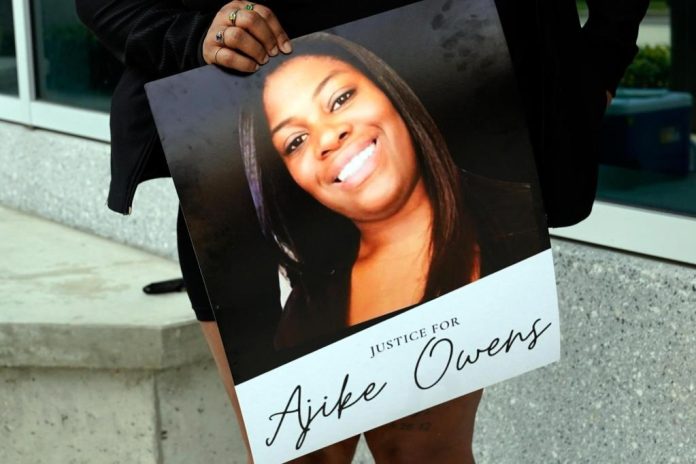
In a statement to investigators after the shooting of Ajike Owens, a 35-year-old Black mother of four, Lorincz was quoted as saying she had problems for two years with children in the neighborhood not “respecting” her — including the victim’s children, who range in age from 3 to 12 years old.

“Lorincz advised that the children of (Owens) have told her in the past they would kill her,” the report said.

The day of the shooting, Lorincz told investigators she had a headache and that “neighbors were outside screaming and yelling, kids were running around” in a grassy area separating two apartment quadruplex buildings, including hers.

That night, while a few children were playing basketball, Lorincz came outside to throw a pair of roller skates at them, hitting one on the feet, according to the report. When Owens then knocked on her door, Lorinz claims that Owens threatened to kill her.

According to the sheriff’s timeline, Lorincz called the department at 8:54 p.m. on the night of the shooting to say kids were threatening her and trespassing. She had previously placed “No trespassing” signs in the grassy areas, despite those being shared areas and not part of her rental. Lorincz said in court she doesn’t own the property.

Many details about the case remain unclear, such as the owner of a red T-shirt that says, “She Slays This Means War” — which was found at the scene, according to the report.

While deputies were on their way, more calls came in to 911 about shots heard in the same area. At 9:04 p.m., one of Owens’ children called 911 to say his mother had been shot, according to the timeline. Lorincz also called again, saying she had shot a woman through her front door. Deputies arrived about three minutes later to find Owens lying on the ground. She was pronounced dead at a hospital a half hour later.

Lorincz claimed “that Owens banged on the door so hard everything started shaking and she thought the door was going to come off,” and that she panicked and said to herself “’Oh my god, she’s really going to kill me this time.’” That’s when Lorincz fired a single round from her .380-caliber handgun, the report says, noting that Lorincz also had a second handgun in the home.

“Lorincz advised that she purchased the firearm for protection after an altercation with the victim,” it says.

During a news conference Wednesday afternoon, the victim’s family, friends and community leaders joined civil rights attorney Ben Crump — who became well-known representing Trayvon Martin’s family — in thanking the sheriff for making the arrest and calling for justice for Owens.

“This is not a difficult case,” Crump said. He called on the state attorney’s office to “zealously prosecute” the shooter.

Crump, along with Owens’s mother and multiple neighbors noted during the news conference that the “feud” the sheriff spoke of was between Lorincz and neighborhood children. Neighbors said Lorincz frequently called the children vile names when they played in the grassy area outside her home.

Authorities had delayed her arrest for several days while looking into a possible “ stand your ground ” claim. Detectives have since said that Lorincz’s actions are not justifiable under Florida law.

The sheriff has said that since January 2021, deputies responded to at least a half-dozen complaints between Owens and Lorincz.

Owens’ mother, Pamela Dias, has said she will now raise her four young grandchildren. The funeral for Owens is set for Monday in Ocala.

___

Associated Press writer Freida Frisaro contributed from Fort Lauderdale.

Portsmouth City Council divided on process of appointing city manager – Daily Press

0

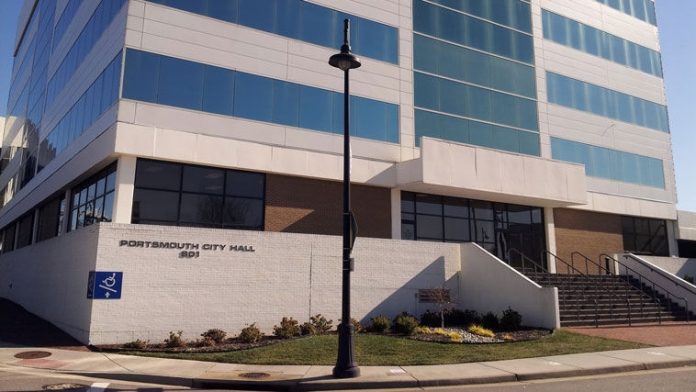
Portsmouth City Council members are split on how to move forward appointing the next city manager as they head into meetings next week to determine the process.

Mimi Terry, the city’s former chief financial officer, was hired as interim in January after a majority of the newly elected City Council fired Tonya Chapman six months into the job.

The city manager is effectively the city’s CEO, tasked with carrying out the council’s vision, developing a budget, supervising city employees and selecting department heads. The traditional process for hiring a city manager typically involves a job advertisement, a narrowing and vetting of qualified candidates and interviews with finalists.

The council is scheduled to meet for a closed session Monday to discuss the appointment, which could lead to an official vote to appoint Terry or pursue a hiring firm. The City Council also meets for its regular meeting Tuesday.

Mayor Shannon Glover said the city should build on its momentum and stability by appointing Terry, who he said has improved morale and provided much needed guidance during a challenging budget season.

City leadership has undergone significant upheaval in recent years, with three city managers serving over the past four years. Chapman was on the job for about six months following the abrupt termination of Angel Jones last summer. Terry was hired as chief financial officer in 2020 but previously said she was fired by Chapman.

Glover said the consequences of such instability have divided the City Council and damaged the city’s image, sometimes resulting in a loss of “institutional knowledge.”

“(We) have already participated in a real-time, on-the-job performance that has met or exceeded expectations,” Glover said. “We’re moving our ship in the right direction and now is not the time to start over from the beginning.”

Vice Mayor Lisa Lucas-Burke said the city likely wouldn’t find a better candidate than Terry if they pursued a firm — a process she said could cost $20,000, according to the mayor.

Terry earned a bachelor’s in accounting from DeVry University, according to the city’s website. The Portsmouth native served as deputy director of finance for Richmond and worked in the finance department for the cities of Hampton, Norfolk and Suffolk.

Portsmouth native Mimi Terry was appointed interim city manager in January. (Courtesy of City of Portsmouth)

Newest council members Mark Hugel and Vernon Tillage credited Terry’s performance as interim, but said they vowed during their campaigns to follow the proper hiring process and that it’s still the right thing to do. Hugel said elected officials should be “diligent” in finding the city’s new chief executive.

“A search is not a referendum on Ms. Terry’s performance,” Tillage said.

Tillage said Glover asked him in December to support the appointment of Terry as interim with the understanding a search would follow. He also said Glover told him last week “people will forget” that Tillage said throughout his campaign he wanted to follow the proper hiring process.

“When they were not in the majority, there was a different feel up here,” Tillage said. “They wanted a process.”

In another jab at Glover, Tillage also said six City Council members offered new dates for Wednesday’s meeting so all could be present. Council members Mark Whitaker and De’Andre Barnes were absent.

Glover later said he didn’t intend to circumvent the process but wanted to hear from the public on how to move forward.

Council member Bill Moody also spoke about the need to “follow the process” for hiring a city manager during his reelection campaign and criticized the previous council majority for not doing so. But he said Wednesday he supported offering Terry the job as her six months as interim has shown more than a one-hour interview could.

Several Portsmouth residents spoke in favor of offering Terry permanently, mostly noting the city has brought her back numerous times to clean things up and that she has a strong community presence. While some supported following the proper process, most said the city should be flexible this time and not lose out on someone who’s proven.

Natalie Anderson, 757-732-1133, [email protected]

3 severed heads from donor bodies left at Chicago employee’s desk after complaints raised about alleged misconduct – Daily Press

0

Nell Salzman | Chicago Tribune

CHICAGO — Dale Wheatley, who performs deliveries for the Anatomical Gift Association of Illinois, came into work two weeks ago and found sage burning and three severed heads lying on a plastic container by his desk.

Wheatley, who has worked for AGA for nearly five years, said he’s never seen anything like the horror movie-like scene he stumbled upon that Wednesday morning in late May.

Wheatley said the heads from AGA donors were placed next to his desk after he reported concerns about the mishandling and poor conditions of donated bodies to his supervisors. But AGA Executive Vice President William O’Connor denied any maltreatment accusations, saying that handling body parts is in Wheatley’s job description.

Wheatley said he filed a police report after the heads showed up at his desk, and is now filing complaints with local and state authorities.

Families of deceased donate bodies to the not-for-profit to be used in the training of medical students at eight universities across the state, and mishandling causes the bodies to be unfit for use, Wheatley said at a news conference with an attorney Tuesday afternoon.

“The place is deplorable. It’s in shabby conditions,” he said. “If you’re in there for more than five minutes, if you start walking around, you start to stick to the floor.”

AGA writes on its website that it aims to “help donors and their families make their donations with the confidence that the AGA will observe the highest standards of responsiveness, respect, privacy and security.”

O’Connor said it is Wheatley’s responsibility to handle the bodies. The organization, formerly known as the Demonstrator’s Society, has been in operation for over a century.

Wheatley manages the “rack room,” or the room where bodies are held at AGA. He drives around to medical institutions, loading and unloading body parts from the tiered racking system in the AGA van. A QR system is used to identify body parts, which are embalmed, distributed for study purposes and then cremated and returned to families.

Northwestern University Feinberg School of Medicine anatomy lab manager Casey Tilden sent an email the day before the heads appeared in Wheatley’s office, complaining about the conditions of the donors they received. “Donors,” or those who have donated their bodies for medical use, were covered with flies or contorted in such a way that they couldn’t be used, Tilden wrote in the email, which was provided to the Tribune.

“There are a handful of donors that were recently delivered with feet and hands that show signs of decomposition,” Tilden said in the message to AGA.

According to Wheatley, other universities have also emailed complaints.

Wheatley felt the heads were a method of retaliation in response to his concerns, he said.

David Fish, an employment lawyer and partner at Fish Potter Bolaños P.C., said he filed complaints on Wheatley’s behalf with the Cook County medical examiner’s office, Illinois Department of Public Health and Illinois Department of Financial & Professional Regulation as part of an effort to clean up conditions at AGA. Copies of those complaints were provided to the Tribune.

In the complaints, Fish asked for an investigation into embalming techniques used at AGA.

“Mr. Wheatley believes that AGA should have, and utilize, a scale to weigh donors’ bodies to determine the amount of embalming fluid required to ensure they are not subject to premature rotting and shorted usefulness,” he wrote.

Fish said he does not want to file a lawsuit but hopes AGA will take Wheatley’s complaints seriously.

“I’ve never seen a situation where heads were left at somebody’s desk. That is unspeakable,” he said. “Those are people’s family members. They’re not a joke … They gave their body to donate it to science.”

Wheatley looked into cameras, shaking, as he recounted his working conditions. He works as many as 12 hours a day, he said.

“I’m beat up,” said Wheatley. “This job has severely weighed on me over the years.”

He has three children — ages 11, 6 and 1 — and said he’s worried about his job security after submitting feedback to O’Connor. His family works in funeral homes and he said he got involved in the industry three years before starting at AGA.

Wheatley confirmed he hasn’t been at work since May 30. He’s still an employee and is taking paid time off, he said at the news conference.

O’Connor said sometimes AGA receives bodies that are “twisted” or “emaciated.”

“We accept every donor,” he said. “And we make a commitment to the donor that their bodies will be studied.”

The issues at AGA need to be addressed before Wheatley will feel good about getting back to work, he said. Wheatley said since taking time off, his wrists and back are feeling better. The only thing that hasn’t improved is his anxiety, he said.

“This is the only thing I can think about. I can’t even sleep. Just the only thing I can think about, running it over and over in my head. I can’t believe this is happening,” Wheatley said.

Without action, people are going to rot away, Wheatley said.

____

©2023 Chicago Tribune. Visit at chicagotribune.com. Distributed by Tribune Content Agency, LLC.

Voices from the violent civil rights era see attacks on voting rights as part of ongoing struggle – Daily Press

0

By GARY FIELDS (Associated Press)

They are part of a small, vanishing group who lived at the epicenter of the struggle for voting rights six decades ago, an era driven by segregation, violence and the yearning for equality that eventually led to laws bringing the U.S. closer to its promise of democracy for all its citizens.

They reflect on the times and their struggles, and why they are certain it all was worth it. On Thursday, a majority of the Supreme Court seemed to reinforce that view by siding with Black voters in a congressional redistricting case from Alabama.

Ten years ago this month, the court halted what many consider the heart of that landmark law — the ability of the Justice Department to enforce it in states and counties with a history of voter suppression.

The stories from those on the front lines of history recount tragedy, racism, oppression and ultimately hope in seeing a president sign into law a measure designed to ensure equal access to the ballot and fair representation in the halls of political power — from city councils to statehouses to Congress.

Stephen Schwerner lost a brother, murdered in Mississippi trying to register Black people to vote. Nearly 60 years after the Voting Rights Act was signed, he remains immensely proud of his brother, Mickey Schwerner, but with a great sense of loss: “I don’t think anybody in our family has ever gotten over it.”

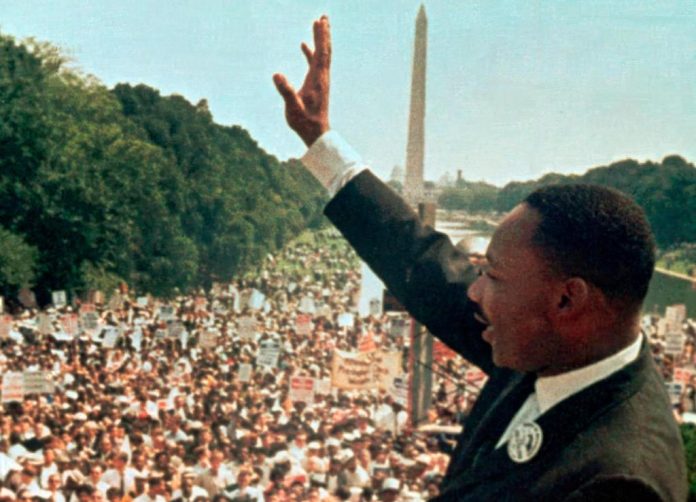
Andrew Young walked with Martin Luther King Jr., on the long road to equality and was with him when he died in Memphis in 1968. Seeing the continued attempts to chip away at voting rights, he knows there are more battles to be fought: “I never thought that the United States or anybody else would be perfect, but I thought we would be constantly getting better.”

Luci Johnson was a teenager when she witnessed “one of the most historic occasions of the 20th century” — her father, former President Lyndon Johnson, signing the law ensuring access to the ballot for people of color. If she could convey a message to Supreme Court justices as they consider another challenge to the Voting Rights Act, it would be for them to remember “what a privilege they all have with access to the voting booth. I would tell them to do all that they can to make liberty and justice a right for all Americans.”

Joel Finkelstein was a young lawyer helping draft the document that became the Voting Rights Act of 1965, overwhelmed to be an accidental witness at the signing and yet unaware of the measure’s magnitude. He remains hopeful, even as voting rights have been eroded over the past decade: “Somehow this country digs out of these messes with people who you never would expect would be there. Go look at 1860. We got Abraham Lincoln, a country lawyer, self-educated out of Illinois, and he became our greatest president, one of the wisest men we would ever have hold public office.”

Norman Hill moved from the protests over civil rights to the organization and political clout of the labor movement, where he helped build a groundswell for voting rights. Now in his ninth decade, Hill said the fight must continue, “not just today, not just tomorrow but as long as we live and breathe.”

Della Simpson Maynor was a teenager who pushed herself to the front of a protest in the small town of Marion, Alabama, and was terrified when police clubbed a pastor who was kneeling to pray. Police later struck her with a club as she tried to get away, and she would hear the gunshot from a state trooper that fatally wounded a young church deacon, Jimmie Lee Jackson. His death prompted a march starting in Selma, which would lead to one of the most violent days of the Civil Rights Movement, Bloody Sunday, when police beat protesters trying to cross the Edmund Pettus Bridge: “Without Bloody Sunday, there would have been no voting rights. But without Jimmie Lee Jackson, there would have been no Bloody Sunday.”

Their voices echo across the past six decades, in searing debates over race, equal treatment and what it means to be an American citizen.

___

The Associated Press coverage of race and voting receives support from the Jonathan Logan Family Foundation. See more about AP’s democracy initiative here. The AP is solely responsible for all content.

Book examining Black midwifery launches Saturday with Hampton event – Daily Press

0

When Linda Holmes was pregnant in 1976, she knew from her time as a Black student activist that she would have to fight to make choices about how she gave birth, from limiting medical intervention to negotiating her partner’s presence in the room.

But she didn’t expect the experience to shape the rest of her career.

“The anger that I felt at the time of birth fueled the work that I’m doing 50 years later,” said Holmes, who now lives in Hampton.

Holmes’ second book, “Safe in a Midwife’s Hands,” shares her research into Black midwifery traditions from the American South to the African continent. It officially launches Saturday with an event at 1865 Brewing Co. in Phoebus.

Named a “Most Anticipated Feminist Book of 2023” by Ms. Magazine, it spans Holmes’ first research project in Alabama in 1981; her 18 years with the Office of Minority and Multicultural Health in New Jersey, where she eventually served as director; a 2019 trip to Ghana, Ethiopia and Kenya to interview midwives; and research around Virginia, where she found some of the earliest plantation records on Black midwife practices. The final chapter, “Hampton to Charlottesville,” shares interviews with  midwife descendants and other research.

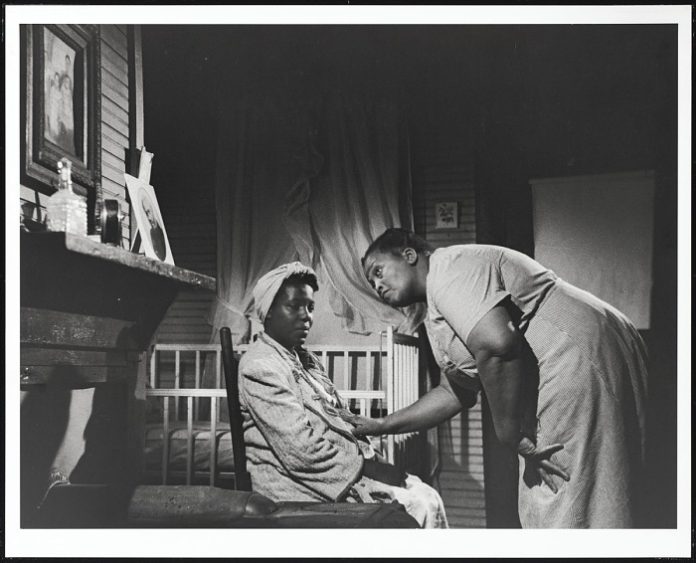
Midwifery has a complicated history in the United States. Midwives were typically women without formal medical education but with hands-on training and experience who cared for other women during pregnancy and childbirth, usually at home.

It was the only option for medical care in childbirth until late in the 1700s and remained the primary option until around 1900. But as doctors, who were mostly male, became involved in the fledgling fields of obstetrics and gynecology in the 19th century, tension grew between midwives and the medical establishment. By the 1930s, most births took place in a hospital, and by the 1970s, when Holmes was pregnant, midwifery was outlawed in many states where it was seen as backward, unhygienic and unsafe.

“At the time, a Black infant in Newark was more likely to die during birth than anyplace else in the country,” Homes wrote in the book’s introduction. The state had decimated Black neighborhoods to build a medical school 10 years before, she wrote, now recognized as one of the underlying causes of the 1967 Newark Rebellion. Nearly 30 people were killed and more than 700 injured in one of the most violent of more than 150 riots sparked by racial injustice around the country that summer.

Courtesy of The Ohio State University Press

Front cover of “Safe in a Midwife’s Hands: Birthing Traditions from Africa to the American South,” by Linda Janet Holmes. Birth traditions that are now recognized as best practices survived in Black communities even as they were otherwise lost around the country.

The reality that their homes were sacrificed for medical advances that didn’t benefit them is an illustration of the way medicine has often left behind or harmed Black communities. James Marion Sims, still lauded as the “father of modern gynecology” for his research in the mid-to-late 1800s, performed experiments on enslaved women, Holmes wrote; a statue in his honor survives in front of the Capitol building in Montgomery, Alabama.

And yet, those harms may also have let Black midwives preserve centuries-old traditions as home births became less common in the 20th century. Because Black communities often had less access to medical care, even when they trusted it, birth traditions that are now recognized as best practices survived even as they were lost around the country.

Mainstream medicine now recognizes that unnecessary drugs and surgeries, for example, can lead to infection or injury to death for mother or infant. But when Holmes was pregnant, opposition to traditional birth practices was near its peak.

When she gave birth to her only child, doctors administered Pitocin, a drug used to induce childbirth, against her wishes and ordered an epidural, which she refused to allow unless she could have her partner in the delivery room. Nurses later told her she was the first person to demand “rooming-in,” or having her child stay in her room for easy breastfeeding — now an increasingly common practice.

“There was this idea that the problem of infant mortality would be solved in terms of outcomes if everyone could have their baby in the hospital with a doctor,” Holmes said. “Now it’s very clear that that’s not true.”

That experience contributed to her decision to pursue a National Endowment for the Humanities grant that allowed her to move to Alabama in 1981 and interview at least 50 midwives shortly after the state outlawed their practice.

The medical community labeled many of their practices as superstitions, Holmes said, and the midwives often couldn’t explain exactly why they engaged in certain traditions. They said it was just something their grandmothers did, Holmes recalled.

But as she later described one of these practices to a nurse midwife who had traveled to Ghana, Holmes said, the midwife recognized the ritual as a naming ceremony. In Alabama, midwives called it “taking the mother up,” a ritual performed about a week after birth that could involve a prayer, a small amount of water poured on the child, a walk around the house, or other elements that they couldn’t explain beyond tradition. In Ghana, these activities occur when the infant is presented to the community for the first time and given their name.

“That was the first time that I began to understand that many of the things that were being labeled as superstition, or backwards or not having any meaning or not making any sense, were a way that these women had to preserve very strong cultural birthing traditions,” Holmes said.

Headshot of a smiling woman with short dark curly hair, long gold earrings and a loose buttoned tunic with colorful patterns

Courtesy of Linda Holmes

Linda Janet Holmes

The relationship between a birthing mother and a midwife, and the community aspect of birth, also stood out to her as recognized best practices, Holmes said. Midwives were often known in the community, rather than being someone a pregnant woman met just as she was about to deliver, as is frequently the case in hospitals. And the presence of multiple women from the community during the birthing process acted almost like a built-in review board, protecting both the mother and the midwife.

Work to collect the oral histories of midwife descendants, people who heard their grandmothers’ or other relatives’ stories, is of vital importance now, Holmes believes. Even in writing this book, her own notes from 1981, which are some of the only records made of the last surviving midwives, were instrumental, she said.

“We don’t know yet all that we can learn from the practices of midwives, traditional historic Black midwives, until we collect the stories,” she said. “Within these stories are ways or practices that would contribute to increasing positive birthing outcomes, not only in Black communities but in all communities.”

Katrina Dix, 757-222-5155, [email protected]

___

If you go

When: 12 p.m. June 15Where: 1865 Brewing Co., 9 S. Mallory St., HamptonCost: FreeDetails: lindajholmes.net