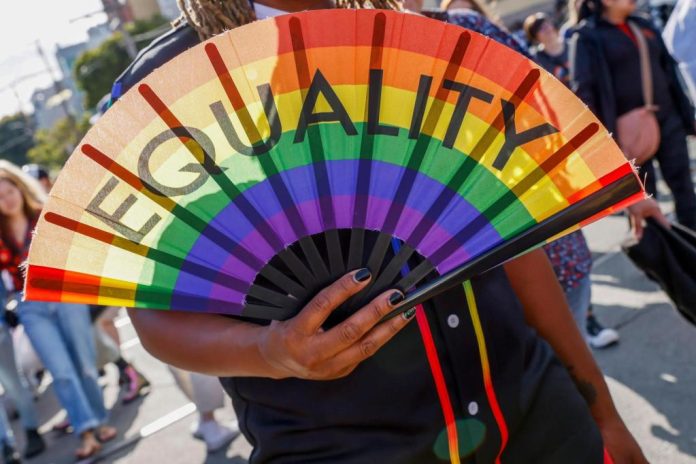
NEW YORK (AP) — Celebrations mingled with displays of resistance Sunday as LGBTQ+ pride parades filled streets in some of the country’s largest cities in annual events that have become part party, part protest.
In New York, thousands marched down Manhattan’s Fifth Avenue to Greenwich Village, cheering and waving rainbow flags to commemorate the 1969 Stonewall uprising, where a police raid on a gay bar triggered days of protests and launched a movement for LGBTQ+ rights.
While some people whooped it up in celebration, many were mindful of the growing conservative countermovement to limit rights, including by banning gender-affirming care for transgender children.
“I’m not trying not to be very heavily political, but when it does target my community, I get very, very annoyed and very hurt,” said Ve Cinder, a 22-year-old transgender woman who traveled from Pennsylvania to take part in the country’s largest pride event.
“I’m just, like, scared for my future and for my trans siblings. I’m frightened of how this country has looked at human rights, basic human rights,” she said. “It’s crazy.”
Parades in New York, Chicago and San Francisco are among events that roughly 400 Pride organizations across the U.S. are holding this year, with many focused specifically on the rights of transgender people.
In Chicago, 16-year-old Maisy McDonough painted rainbow colors over her eyes and on her face for her first Pride Parade.
She told the Chicago Tribune she’s excited to “be united” after a tough year for the community.
”We really need the love of this parade,” she said.
Entertainers and activists, drag performers and transgender advocates are among the parade grand marshals embracing a unity message as new laws targeting the LGBTQ+ community take effect in several U.S. states.
“The platform will be elevated, and we’ll see communities across the country show their unity and solidarity through these events,” said Ron deHarte, co-president for the U.S. Association of Prides.
Chicago, Minneapolis, Denver and Seattle are scheduled to hold pride parades Sunday. At the parade in Toronto, Canada, more than 100 groups are expected to march. In New York City, seven-time Grammy winner Christina Aguilera will headline a post-march concert in Brooklyn.
Annual observations have spread to other cities and grown to welcome bisexual, transgender and queer people, as well as other groups.
About a decade ago, when her 13-year-old child first wanted to be called a boy, Roz Gould Keith sought help. She found little to assist her family in navigating the transition. They attended a Pride parade in the Detroit area, but saw little transgender representation.
This year, she is heartened by the increased visibility of transgender people at marches and celebrations across the country this month.
“Ten years ago, when my son asked to go to Motor City Pride, there was nothing for the trans community,” said Keith, founder and executive director of Stand with Trans, a group formed to support and empower young transgender people and their families.
This year, she said, the event was “jam-packed” with transgender people.
One of the grand marshals of New York City’s parade is nonbinary activist AC Dumlao, chief of staff for Athlete Ally, a group that advocates on behalf of LGBTQ+ athletes.
“Uplifting the trans community has always been at the core of our events and programming,” said Dan Dimant, a spokesperson for NYC Pride.
Many of this year’s parades called for LGBTQ+ communities to unite against dozens, if not hundreds, of legislative bills now under consideration in statehouses across the country.
Lawmakers in 20 states have moved to ban gender-affirming care for children, and at least seven more are considering doing the same, adding increased urgency for the transgender community, its advocates say.
“We are under threat,” Pride event organizers in New York, San Francisco and San Diego said in a statement joined by about 50 other Pride organizations nationwide. “The diverse dangers we are facing as an LGBTQ community and Pride organizers, while differing in nature and intensity, share a common trait: they seek to undermine our love, our identity, our freedom, our safety, and our lives.”
Some parades, including the event in Chicago, planned beefed up security amid the upheaval.
The Anti-Defamation League and GLAAD, a national LGBTQ+ organization, found 101 anti-LGBTQ+ incidents in the first three weeks of this month, about twice as many as in the full month of June last year.
Sarah Moore, who analyzes extremism for the two civil rights groups, said many of the June incidents coincide with Pride events.
___
AP writers Geoff Mulvihill in Cherry Hill, New Jersey, and Susan Haigh in Hartford, Connecticut, contributed to this report.
I wasn’t going to write this, but I had to. All dog lovers may want to grab a tissue. The worst day of my life was weeks ago when I had to say goodbye to my soul dog, my best friend and MVP of the family. Honestly, I’m sharing this experience because it’s cathartic and the only way I know how to process the pain. Also, this is a tribute to all dog owners and will validate the strong bond we all have with our beloved pets.
Roxy’s final hours started with a dream buffet consisting of a burger, fries, banana, ham sandwich and a long session of licking peanut butter off a spoon. Her last meal was compliments of Angel Pets, the in-home euthanasia vet. Before the final moment, they treated her to a Starbucks breakfast sandwich. Roxy licked every bit of the melted cheese that dripped on her bed. She enjoyed every morsel of life, literally, to the last second. She snored for a few minutes before drifting away to a better place.
It was humane, peaceful and the best possible way to go. I massaged her ears and stroked her wavy locks until her last breath. She will be pain free, and I will have PTSD. She’s at peace, and I’m not. My heart is shattered, and I just lost a piece of my soul. Yes, I did the right thing. It wasn’t easy. I was doled out an extra dose of emotions when I was born. I sometimes cry at graduations on TV. So, how do you think I reacted to this? I couldn’t breathe was an understatement. The whole day was a blur, yet I remember every detail because it plays back in my head like a nightmare.
Roxy was my soul dog and MVP of the family. Lee Belote/freelance
A week later, I could finally say her name without crying. I still can’t be in my house for long periods of time because it feels so empty without her warm presence. I’m missing my daily dose of therapy, which was multiple hugs and petting sessions with my furry therapist.
When I walk in the house, I still call her name. When I go to bed, I say good night. I know I’m a little crazy, but I can’t give up these rituals just yet. There are many things that make me cry daily such as finding her tumbleweed of hair on the wood floor, looking at the corner where her dog bed once was and having no one to feed the scraps left on the rotisserie chicken.
Roxy’s memory will always surround me because her photo is printed on pillows, a blanket, canvas prints and in multiple frames. She was the princess, and that’s why she’s the only one in the family with a commissioned portrait.
I walk around the house missing my furry shadow that had to be with me every second. She needed me as much as I needed her. I’m not sure when the empty feeling will leave, but I know there will always be a little ache in my heart when I think of her sweet soul and 14 years of unconditional love.
I am thankful for the compassionate care from Golden Paws and Angel Pets in Roxy’s final days. I’d like to leave all my dog people with one piece of advice. Love on your pet every day, and when he/she does pass, don’t clean the floors too quickly. My happiest moments are finding little sightings of her hair scattered on my floors. Also, listen closely to the silence in your home. You will still hear faint noises that sound like your sweet pup.
By ADAM GELLER and WYATTE GRANTHAM-PHILIPS (Associated Press)
When millionaire Steve Fossett’s plane went missing over the Nevada range in 2007, the swashbuckling adventurer had already been the subject of two prior emergency rescue operations thousands of miles apart.
And that prompted a prickly question: After a sweeping search for the wealthy risktaker ended, who should foot the bill?
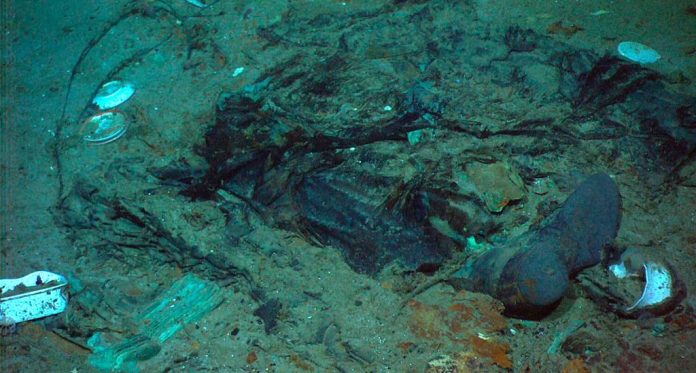
In recent days, the massive hunt for a submersible vehicle lost during a north Atlantic descent to explore the wreckage of the Titanic has refocused attention on that conundrum. And with rescuers and the public fixated first on saving and then on mourning those aboard, it has again made for uneasy conversation.
“Five people have just lost their lives and to start talking about insurance, all the rescue efforts and the cost can seem pretty heartless — but the thing is, at the end of the day, there are costs,” said Arun Upneja, dean of Boston University’s School of Hospitality Administration and a researcher on tourism.
“There are many people who are going to say, ‘Why should the society spend money on the rescue effort if (these people) are wealthy enough to be able to … engage in these risky activities?’”
That question is gaining attention as very wealthy travelers in search of singular adventures spend big to scale peaks, sail across oceans and blast off for space.
The U.S. Coast Guard declined Friday to provide a cost estimate for its efforts to locate the Titan, the submersible investigators say imploded not far from the world’s most famous shipwreck. The five people lost included a billionaire British businessman and a father and son from one of Pakistan’s most prominent families. The operator charged passengers $250,000 each to participate in the voyage.
“We cannot attribute a monetary value to Search and Rescue cases, as the Coast Guard does not associate cost with saving a life,” the agency said.
While the Coast Guard’s cost for the mission is likely to run into the millions of dollars, it is generally prohibited by federal law from collecting reimbursement related to any search or rescue service, said Stephen Koerting, a U.S. attorney in Maine who specializes in maritime law.
But that does not resolve the larger issue of whether wealthy travelers or companies should bear responsibility to the public and governments for exposing themselves to such risk.
“This is one of the most difficult questions to attempt to find an answer for,” said Pete Sepp, president of the National Taxpayers Union, noting scrutiny of government-funded rescues dating back to British billionaire Richard Branson’s hot air balloon exploits in the 1990s.
“This should never be solely about government spending, or perhaps not even primarily about government spending, but you can’t help thinking about how the limited resources of rescuers can be utilized,” Sepp said.
The demand for those resources was spotlighted in 1998 when Fossett’s attempt to circle the globe in a hot air balloon ended with a plunge into the ocean 500 miles off Australia. The Royal Australian Air Force dispatched a Hercules C-130 transport aircraft to find him. A French military plane dropped a 15-man life raft to Fossett before he was picked up by a passing yacht.
Critics suggested Fossett should pay the bill. He rejected the idea.
Late that same year the US Coast Guard spent more than $130,000 to rescue Fossett and Branson after their hot air balloon dropped into the ocean off Hawaii. Branson said he would pay if the Coast Guard requested it, but the agency didn’t ask.
Nine years later, after Fossett’s plane vanished over Nevada during what should have been a short flight, the state National Guard launched a months-long search that turned up the wreckage of several other decades-old crashes without finding the millionaire.
The state said the mission had cost taxpayers $685,998, with $200,000 covered by a private contribution. But when the administration of Gov. Jim Gibbons announced that it would seek reimbursement for the rest, Fossett’s widow balked, noting she had spent $1 million on her own private search.
“We believe the search conducted by the state of Nevada is an expense of government in performance of government action,” a lawyer wrote on behalf of the Fossett estate.
Risky adventurism is hardly unique to wealthy people.
The pandemic drove a surge in visits to places like national parks, adding to the popularity of climbing, hiking and other outdoor activities. Meanwhile, the spread of cellphones and service has left many feeling that if things go wrong, help is a call away.
Some places have laws commonly referred to as “stupid motorist laws,” in which drivers are forced to foot the emergency response bill when they ignore barricades on submerged roads. Arizona has such a law, and Volusia County in Florida, home to Daytona, enacted similar legislation this week. The idea of a similar “stupid hiker law” is a regularly debated item in Arizona as well, with so many unprepared people needing to be rescued in stifling triple-digit heat.
Most officials and volunteers who run search efforts are opposed to charging for help, said Butch Farabee, a former ranger who participated in hundreds of rescue operations at the Grand Canyon and other national parks and has written several books on the subject.
Searchers are concerned that if they did charge to rescue people “they won’t call for help as soon as they should and by the time they do it’s too late,” Farabee said.
The tradeoff is that some might take that vital aid for granted. Farabee recounts a call in the 1980s from a lawyer who underestimated the effort needed to hike out of the Grand Canyon. The man asked for a helicopter rescue, mentioning that he had an important meeting the following day. The ranger rejected that request.
But that is not an option when the lives of adventurers, some of them quite wealthy, are at extreme risk.
At Mount Everest, it can cost tens of thousands of dollars in permit and expedition fees to climb. A handful of people die or go missing while hiking the mountain every year — prompting emergency response from local officials.
While the government of Nepal requires that climbers have rescue insurance, the scope of rescue efforts can vary widely, with Upneja estimating that some could cost “multiple dozens of thousands of dollars.”
Nepal’s Ministry of Foreign Affairs did not respond to a message seeking comment.
On the high seas, wealthy yachtsmen seeking speed and distance records have also repeatedly required rescue when their voyages run astray.
When the yacht of Tony Bullimore, a British millionaire on a round-the-world journey, capsized 1,400 miles off the Australia Coast in 1997 it seemed he might be done for. Clinging to the inside of the hull, he ran out of fresh water and was almost out of air.
When a rescue ship arrived, he swam desperately toward the surface.
’I was starting to look back over my life and was thinking, ‘Well, I’ve had a good life, I’ve done most of the things I had wanted to,” Bullimore said afterward. “If I was picking words to describe it, it would be a miracle, an absolute miracle.′
Australian officials, whose forces rescued a French yachtsman the same week, were more measured in their assessment.
“We have an international legal obligation,” Ian McLachlan, the defense minister said. “We have a moral obligation obviously to go and rescue people, whether in bushfires, cyclones or at sea.”
Less was said, however, about the Australian government’s request to restrict the routes of yacht races — in hopes of keeping sailors to areas where they might require less rescuing.
___
Associated Press writer David Sharp in Portland, Maine contributed to this story.
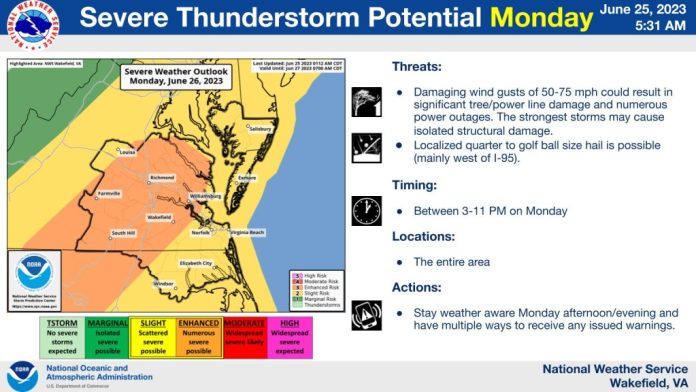
There’s a possibility for severe thunderstorms, with damaging wind gusts and hail, Monday on the peninsula and in south Hampton Roads, according to the National Weather Service in Wakefield.
Storms are likely from 3 p.m. to 11 p.m.
Areas around Wakefield and Williamsburg are under an enhanced risk alert, meaning numerous severe storms are possible.
“We’re basically looking for more widespread showers and storms as we get into the later tomorrow afternoon, tomorrow evening,” said Mike Montefusco, meteorologist at the National Weather Service in Wakefield.
Wind gusts of 50 to 75 mph are possible, which could damage power lines and cause power outages. Isolated structural damage is possible, according to the National Weather Service. Hail, ranging in size from a quarter to a golf ball, is also possible, mainly west of Interstate 95.
South Hampton Roads, including Norfolk and Virginia Beach, are under a slight risk alert, meaning scattered severe storms are possible.
Along with the severe storm alert, the forecasted high for Monday is 93 degrees.
The National Weather Service advised keeping up with the weather Monday afternoon and staying alert for warnings issued through cell phones, TV or radio.
The mermaid city is fringed by 144 miles of shoreline along its lakes, rivers and the Chesapeake Bay, including the popular stretch of beach at Ocean View. Much of that land is situated in residential neighborhoods, and a large chunk of Norfolk’s economy and livelihood is centered on its waters.
But this staple of Norfolk life could become its greatest threat as climate change creates problems for many coastal locales. So the city proposed ways to protect its residents and properties long-term.
Now, the city is poised for big changes.
At an April 25 meeting, the City Council approved the Coastal Storm Risk Management Project, a large-scale series of flood mitigation projects in partnership with the U.S. Army Corps of Engineers over the next 10 years — at a cost of more than $2 billion.
The massive undertaking includes 8 miles of new or extended flood walls built around downtown neighborhoods over the next decade, as well as surge barriers and pump stations in other areas. The plan would be conducted over five phases, and all include new structures — except one.
The final phase, covering the neighborhoods south of the Elizabeth River, will not include new structures and instead focus on improvements to specific properties.
This sparked worries among southside residents that discriminatory practices and decisions made almost 100 years ago were looming within the city’s plans for the next century of flood protection.
But they fought back. And won.
Now, leaders across the board are working toward a solution that would address decades of disenfranchisement on the southside.
The Eastern Branch Elizabeth River is seen from the Campostella Bridge in Norfolk on June 15, 2023. (Billy Schuerman/The Virginian-Pilot)
___
The project and its issues
“Most of the people over here have lived over here, 50 years plus, 80 years plus, and we even have members that lived here for 100 years,” said Lawrence Brown, president of the Campostella Heights Civic League.
His neighborhood is one of Hampton Roads’ oldest communities, he said, and not having the storm surge protections was “unacceptable.” Flooding is not new to the southside — it faces nuisance flooding frequently — but having storm surge protections against severe weather is imperative.
“Most people that live over here, they are retired, they got their home and they paid it off,” Brown said. “And now somebody comes in and tells them that they may have to come in and fill the basement. Basically, we didn’t want a situation that had gone on like what happened in New Orleans during Hurricane Katrina. Those wards flooded, and some of those people are still out of homes today. So that’s basically how it started.”
In March, residents of southside neighborhoods gathered in front of the City Council to express those concerns. The resolution to approve the project already was delayed, but citizens said city leadership should focus on shortcomings in the current plan.
The project is split into five phases. The first, which covers most of the city’s downtown, is divided into several sub-phases. Phase 1A began the design phase in 2022, and will focus on a section from the Berkley Bridge to Campostella Road. Phase 1B will include Town Point Park and the Waterside District while Phase 1C will build structures from Ghent to Town Point Park.
The final portion of the first phase is the downtown floodwall, which is estimated to be complete around 2031. By the end of the sub-phases, a system of floodwalls with a levee, surge barriers and natural features will extend from Ghent through downtown connecting to the Ohio Creek Watershed project.
Lawrence Brown stands for a portrait at his residence in Norfolk on June 15, 2023. Brown’s neighborhood is regularly affected by nuisance flooding and storm surge. (Billy Schuerman/The Virginian-Pilot)
In the Ohio Creek Watershed project, eroding shoreline along the Eastern Branch of the Elizabeth River has been replaced by a 2,000-foot-long earthen berm, about 8 feet in height. Asphalt has been torn out from the three blocks closest to the river and replaced with red brick permeable pavers that allow water to soak into the ground. The $112 million project includes other features to reduce flooding, such as pump stations and hidden drains, and focuses more on nuisance flooding rather than storm surge.
“It is the storm surge flooding and hurricanes flooding that requires these types of structural solutions, but I think what we really need to be doing is kind of looking at hybrid solutions where we look at solutions that can actually maybe cut down some of the energy of a storm surge and then combining that with a structural solution,” said Carol Considine, an associate professor of engineering technology and program head at the Institute for Coastal Adaptation and Resilience at Old Dominion University.
For the second portion, a system of floodwalls and barriers will be built to reduce storm surge from entering Pretty Lake at Shore Drive. The design phase is set to begin in 2024, and construction will continue through the first half of 2028. For Phase three, barriers will be constructed from Norfolk International Terminal to the Lamberts Point area to reduce storm-surge risk to the Lafayette River watershed. Phase four is another system of floodwalls, storm surge barriers and tide gates to reduce storm surge from entering Broad Creek at Interstate 264.
The final phase is the only portion without plans to build new structures. Instead, this portion is property-specific, meaning certain homes and structures will be the focus. That work includes elevating some homes, filling basements, flood-proofing and buyouts. Work would take place in several areas of the city, including Berkley, Campostella, Campostella Heights, Elizabeth Park, Ingleside, Norfolk International Terminal and Willoughby.
In 2018, the evaluation criteria for structural measures was based on a benefit-to-cost ratio. This means the analysis focused primarily on the monetary value of damages to properties but did not allow for consideration of social effects, including life, health and safety.
Sharon Hendrick, president of Campostella Civic League, said residents were unaware they were being left out of structured improvements until the study was completed.
“The idea was presented and when we found out about it, that’s when we voiced our opinion, and started to advocate for our communities,” she said. “Because you can’t put a value on property that has been passed down through generations and people have had for a lifetime.
“To have us displaced or, or even forgotten about, it was unacceptable. So that’s when we started going down to City Hall and voicing our opinions.”
Sharon Hendrick stands for a portrait at her residence in Norfolk on June 15, 2023. The Berkley neighborhood faces frequent nuisance flooding. (Billy Schuerman/The Virginian-Pilot)
After those initial meetings, Hendrick, Brown and other southside leaders began reaching out to citywide leadership. The scheduled vote initially was delayed to address the equity issues and to find a path forward. By the end of April, southside leaders, the city and the Army Corps formed a partnership to make improvements to phase five.
But according to researchers who study housing and environmental impacts, using cost analyses to choose which areas receive structures and which don’t is a flawed process.
___
History of redlining in Norfolk’s southside
Redlining, the mid-20th-century practice by banks and insurers to concentrate Black and other minority homeowners within certain neighborhoods, was banned under the Fair Housing Act of 1968. But its legacy has persisted through entrenched segregation, economic inequality, lack of public services, and negative environmental impacts.
During redlining, Black neighborhoods were cut off from loans and other forms of investment, as well as racial covenants, where restrictions were placed on who could — and could not — buy homes.
Federal redlining would deepen the divide created by city leaders in the 1930s and ‘40s. The maps that showed banks and mortgage lenders the relative risk of investment graded white neighborhoods low risk and Black neighborhoods red: a dangerous investment. That gave Black people far fewer choices for where to live, said Johnny Finn, associate professor of geography and Chair of the Department of Sociology, Social Work and Anthropology at Christopher Newport University. Over time, Finn said, redlining and other discriminatory housing policies have negatively affected property values in Black and other minority neighborhoods.
“Even when you control for household income, for every percentage point increase a neighborhood is African American, home values dropped by $700,” Finn said. “These are neighborhoods where the average annual income is the same. So taken out to the extreme, a neighborhood that is 100% white versus a neighborhood that’s 100% Black, that’s a $70,000 difference in home value, even where household incomes are the same.”
The trend of environmental impacts on Black and other minority neighborhoods exists not just in Norfolk. According to a 2020 study, researchers analyzed more than 100 U.S. cities — and formerly redlined neighborhoods in nearly every city studied had hotter temperatures than the non-redlined neighborhoods, some by nearly 13 degrees.
“Redlined neighborhoods, on average, in Hampton Roads are 5.5 degrees hotter than neighborhoods, in some cases, just a couple of blocks away that escaped redlining,” Finn said. “So these neighborhoods have fewer trees, they have more pavement, they’re significantly hotter.
“I know that floodwalls don’t deal with heat, but in the context of climate change, it’s an increasing (of) baseline temperatures. Extreme heat events are more intense and lasting for longer for the populations that live in these formerly redlined neighborhoods.”
Finn said overlooking or ignoring historic racial disparities in projects can continue negative impacts on low-income and minority communities.
“Another way to think about it is unless they’re actively taking into account the effect of historic discriminatory practices, that’s automatically going to be there,” he said. “Because that effect is widespread, and it permeates every single aspect of housing, such as (property) values, in every single neighborhood nationwide.”
___
Flooding disparities
In the past, other cities have shared similar concerns about disparities in flood planning.
Post-Katrina, residents in some areas in and near New Orleans expressed concerns with early repairs to the levee system. According to The Times-Picayune in 2008, residents were concerned about the area of three canals in western New Orleans that dramatically reduced the risk of flooding in predominantly white neighborhoods, while the risk of flooding in largely African American neighborhoods remained nearly the same as before Katrina.
In 2021, the NAACP released a 40-page report on advancing racial justice in federal flood infrastructure projects. The report conducted case studies in three cities: St. Louis, Indianapolis and New Orleans.
“The federal processes and decision-making criteria used to approve new flood infrastructure are difficult to navigate and are structured in ways that do not always represent the needs of low-wealth communities of color,” a portion of the report read.
The report said the lack of action against disparities has created a vicious cycle for Black and other minority neighborhoods at risk of flooding, as climate change causes more severe inundation. When recovery favors wealthy (and usually white) neighborhoods, it leads to insufficient maintenance of existing systems in low-income neighborhoods. That, in turn, impacts housing and economic inequality.
“Our research confirms that Black Americans are systemically flood exposed and experience disproportionate flood impacts,” the report read. “We also note that it is difficult for communities to identify their level of flood exposure, due to omissions in the Federal Emergency Management Agency’s floodplains. Official floodplain maps, used when making important decisions about zoning and property development, are outdated and omit critical information, in particular about potential climate impacts.”
Since the report, the federal government has taken steps to help address the disparities. One is the Justice40 Initiative, an executive order signed by President Joe Biden. The initiative aims to have 40% of the “overall benefits” of certain federal investments “flow to disadvantaged communities that are marginalized, underserved and overburdened by pollution,” according to an announcement of the initiative.
The initiative uses the Climate and Economic Justice Screening Tool (CEJST), a map that identifies disadvantaged communities marginalized and overburdened by pollution and underinvestment. It will be updated annually each fall. According to the CEJST, all Norfolk neighborhoods south of the Eastern Branch of the Elizabeth River were flagged as disadvantaged communities. The census tract including Berkley is in the 91st percentile for projected risk to properties from tides, rain, riverine and storm surges within 30 years.
“It comes down to the Army Corps of Engineers — and this is not bashing them — for years has had congressional oversight to move these types of projects forward without involving the community,” Brown said. “And unfortunately, in the neighborhoods that we live in, it was always our value of our houses being used in their cost analysis. That’s how we were left out. Let’s make it clear this is not only Norfolk. This is across the country, but it’s beginning to change.”
All of the tracts on the southside, as well as tracts surrounding Harbor Park and Norfolk State University, have “historically high barriers to accessing home loans.”
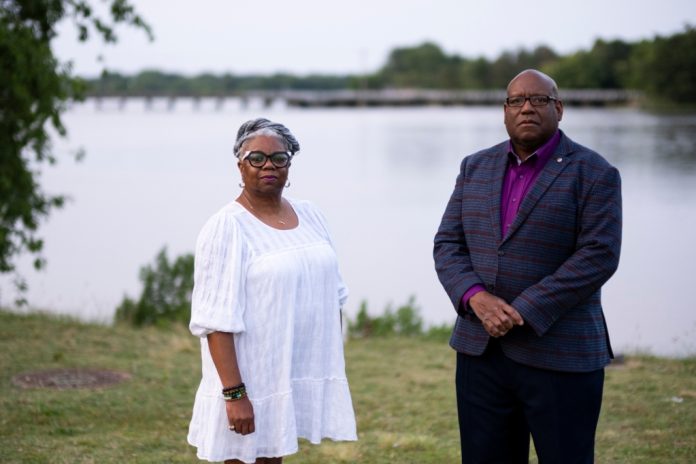
Sharon Hendrick and Lawrence Brown said they look forward to continuing to work for protections for the southside. (Billy Schuerman/The Virginian-Pilot)
___
Going forward
Receiving federal dollars for large-scale mitigation projects can be highly competitive, said Jessica Whitehead, executive director of the Institute for Coastal Adaptation and Resilience at Old Dominion University.
Whitehead, who also served as chief resiliency officer at the North Carolina Office of Recovery and Resiliency, said the process to get access to federal funding also is rigid. Once the plan is in place, it can be very difficult to make changes.
In April, Norfolk City Council passed a resolution to address the issues and commit leadership to reassessing the design and construction of protections for the area. While changes are not guaranteed, and will likely take years, the Army Corps of Engineers has agreed to ask the federal government to modify the way it calculates whether structural flood protection measures could be used in the southside community.
This, for southside city leaders, is a win — not just for Norfolk, but for underrepresented communities across the country. Brown said citizens and leaders from around the country have reached out to speak with local leaders about how they rallied together for changes.
“We’re going to do our best to not continue the inequities of our investments in the past,” said Michael Connor, assistant secretary of the Army for civil works, said at the signing of the project’s formal agreement.
Connor said all parties were committed to fixing the disparities from using the cost-benefit analysis.
“As we design our projects, we seek to maximize the benefits by protecting the most high-value properties in any particular community. We’re not going to throw that out,” Connor said. “But we’ve got to leave room for ourselves to consider social, environmental and equitable benefits that need to be part of these features. And we’re in the middle of that right now.
“There’s a lot of those features in this project. We’ve got the southside community that we’re still working with to see how we can be sure that those protections extend to that community, too. Pres. Biden has pushed us in this area, and I’m very proud (that) the Army for Civil Works and the Army Corps of Engineers have embraced it.”
According to a notice from Resilient Norfolk, another name for the Coastal Storm Risk Management Project, impacts on historically Black neighborhoods in Norfolk were “under assessed.”
“Based on inputs from the southside community members, the city and the USACE recognize the criteria from the initial study was not comprehensive in all the factors impacting this community,” the notice reads. “It is important to take into consideration all social effects of a community, and when done so, there is no better case to be made for structural flood risk reduction features than the southside community.”
As for planning an alternative measure for the fifth phase, that will begin with a post authorization change report, also known as a PACR. Col. Brian P. Hallberg, commander of the Norfolk District of the U.S. Army Corps of Engineers, will put forth the justification and funding request to the Corps of Engineers Headquarters. If approved, the PACR would advance to the assistant secretary of the Army for civil works and the office of management and budget. If the PACR were to require Congressional approval, it would go into the next Water Resources Development Act. That act is slated for 2024.
The timeline for the updates is expected to take three to five years.
“Prior to any construction, the public will be given the opportunity to provide input and feedback regarding the project,” Hallberg said. “We value the community’s involvement in planning, the design and implementation of this critical flood risk management project within the Southside community for their input thus far. We continue to work with the city to address their concerns for structural measures.”
For now, though, Brown and Hendrick said they look forward to continuing to work for protections for the southside.
“That lack of flood protection would have affected some of the country’s largest shipbuilding companies and repair companies,” Brown said. “So we all as the community, as a business community, had to come together and say, ‘Hey, we need the same protection.’ But not just only for us — let’s make sure this whole project is protecting the people that need to be protected.”
When Melissa Vo went into labor late Thursday afternoon, she immediately called her boyfriend.
But Vo’s calls to Christopher Scott kept going straight to voicemail, according to her sister, Delina Moody. While Vo was anxious to get in touch with Scott, she wasn’t too concerned when he didn’t answer, Moody said.
“He’s a truck driver and she just thought he might be sleeping,” the sister said.
Early Friday morning, however, while Vo was still in labor, she learned a tractor-trailer believed to be driven by Scott had gone over the side of the Chesapeake Bay Bridge-Tunnel the day before. A few hours later, she was told Scott’s body had been found in the truck’s cab after it was pulled from the water.
Vo, 33, a resident of Henrico County, gave birth later that afternoon to the couple’s first child together: a son weighing just under 8 pounds, Moody said. He was born just a little more than 24 hours after Scott’s truck drove off the bridge.
“She’s doing OK,” Moody said of her sister during a phone interview Saturday evening. “I think the baby is a good distraction.”
The boy will be called Cameron, the name Vo and Scott had picked out, Moody said.
In a post on Vo’s Facebook page Saturday, she wrote of her heartbreak, as well as her determination to stay strong for her family.
“You will forever be missed, you had such a beautiful soul & will never be forgotten I love you to the moon and back and I know your watching over us,” the post said. “It has truly been hard for me to write this because It has been surreal and I’m still in shock, my heart breaks every time I see your pictures but I will stay strong and carry on to raise all the kids as well as protecting them. Our son will know his dad and how big of a heart he had.”
The post was accompanied by photos and videos of the couple, with the song “Missing You” in the background. One of the videos showed Scott, 36, smiling and laughing while sitting behind the wheel of a tractor-trailer.
“He was the most outgoing person,” Moody said. “Very friendly. Huge personality. He was so good for my sister because she’s the complete opposite.”
According to Chesapeake Bay Bridge-Tunnel officials, Scott was was traveling from Virginia Beach toward the Eastern Shore around 1:50 p.m. Thursday when his rig drove off the bridge. On Friday, the officials announced the truck had been recovered with Scott’s body inside.
The cause of the accident is still unknown, and the investigation by The Chesapeake Bay Bridge-Tunnel Authority Police is ongoing. The truck was hauling landscape supplies. It was owned by Keep It Moving 22, LLC, a moving and storage company based in Mechanicsville, Maryland.
Vo and Scott each had two other children from previous relationships, Moody said. The couple had been dating for about a year and planned to get married, she said.
Moody created a GoFundMe account for her sister Friday to help with expenses in the coming weeks and months. Vo works as a self-employed nail technician, Moody said.
“I just want to help her in any way I can,” the sister said. “I know she’s going to need it.”
As we approach another celebration of the birth of this great nation, I can’t help but turn my thoughts to the current state of our union – and I don’t mean the staged annual performance broadcast from the floor of the Senate chamber. I look about with consternation and deep concern, and wonder if this is really the best we could have accomplished as a people and a country. If this, even in their wildest imaginings, is what the Founders could have envisioned as they stepped forward into an unknowable future when they put pen to paper and wrote these now immortal words in the Declaration of Independence: “We hold these truths to be self-evident, that all men are created equal, that they are endowed by their Creator with certain unalienable Rights, that among these are Life, Liberty and the Pursuit of Happiness. That to secure these rights, governments are instituted among men, deriving their just powers from the consent of the governed… ”
It’s been 247 years since those words laid the foundation on which our republic stands, and once again we find ourselves on the brink of a dark and unknowable future. What lies ahead for our nation is a question many are afraid to ponder, and to which some believe themselves to have the answer. The only thing of which I’m certain is that more people need to stand up and ask the hard questions; demand more than simplistic sound bites for answers; demand action of those elected to represent us in the halls of government; and demand more of these representatives of the people than simply using the bully pulpit of their offices to further their own personal agendas, and monetizing their 15 minutes on the national stage while bellying up to the public trough.
And make no mistake; those of whom I speak are our representatives, not our leaders. They are in office to do our bidding, and it is up to each of us to hold them accountable for their actions, and their words. This is especially true when those self same words and actions fly in the face of the wishes of the majority of the citizenry, and only serve to further rend the fabric of our American way of life. There truly is no place for hate-mongering, divisive partisanship and political posturing. The obstructionism and obfuscation seen at every level of government in recent years is, in my humble opinion, tantamount to treason and should be dealt with as such. As I see it, the sole business of those elected to office is to act in the best interest of the nation as a whole, not simply for their party, some vocal minority of their constituencies, or to the benefit of special interest groups, and campaign donors with deep pockets. In other words, do their jobs!
Sure, we’re a military and industrial superpower, but that alone is not what makes a nation great. The jingoism and myopia of those who would have us believe in a mythical Camelot – in a time when all was right, and just and good in America – is, at best, delusional. There has never been such a time in the history of our nation. The American Dream has always been about the potential for individual success, a meritocracy if you will. But there have always been those who believe the end justifies the means. Today, these amoral grifters are, unfortunately, considered role models by some.
Whatever the tendencies of those currently in power positions in business and government, the nation builders of the past – and the lesser men who followed – have had the same tendencies in equal measure. The toughest, not necessarily always the brightest, took what they wanted. They bent the land and the people they encountered to their will. They worked indentured and enslaved humans, and when that was no longer fashionable, they hired impoverished immigrants whom they paid a pittance. Those are the backs on which this nation was built; the root stock from which the ancient vine of our democracy is sprung, and from which the bitter grapes of broken hopes and dreams of many Americans now hang.
As an immigrant myself, I’ve always believed the so called “American Experiment” is about the coming together of people of diverse races, religions, ethnicities, and cultural backgrounds; the setting aside of those differences – as well as our baser human natures – for the good of the nation and the betterment of all people, not simply a bold or fortunate few. While some great strides have been made towards creating a more egalitarian society, we still have a long way to go. Of one thing I’m certain: attempting to go back to some mythical past is definitely heading in the wrong direction. Happy birthday, America, here’s wishing you many more!
W.R. van Elburg is a James City County resident. He can be reached at [email protected].
The game of bocce ball is among the oldest in the world. It started in Italy and began gaining popularity in the United States when Italian immigrants brought it with them. It goes by a few different spellings, such as bocci or boccie in Italy, or bocha or bochas in South American countries. However, the game remains the same. The gist is that a small ball called the jack or pallino is tossed into a small zone, and the larger balls are tossed in an attempt to get them as close as possible to the pallino.
Size and weight
Bocce balls come in various sizes to best match the intended players or for other reasons, such as being smaller for easier travel. The balls in tabletop bocce ball sets can be as small as marbles, but most measure between 65 and 107 millimeters. Official regulation-size bocce balls must measure 107 millimeters, but most sets don’t quite hit that mark.
Along with varying sizes also comes varying weights. Depending on the size and the material, bocce balls can weigh as little as 9 ounces to as much as the regulation weight of 2.03 pounds.
Material
Bocce balls can be made of several types of material.
Resin is the most common for several reasons, namely that they feel good in the hand and are easy to balance and hit the regulation weight. They’re also among the most durable.
Plastic is a common choice for low-cost sets or those who struggle with weightier balls such as the young and elderly.
Metal is an uncommon though not ineffective option. It’s plenty durable and when made of stainless steel can resist rust. It can be difficult to tell which balls belong to who, though.
Wood bocce balls are typically the most beautiful, especially when colored and varnished properly. However, they’re also the least durable, making them a common choice for decoration rather than play.
Color and markings
Bocce balls typically come in at least two colors per set, though there can be up to four. Typically, the colors are red and green, with yellow and blue popping up on occasion, too. Some balls can also have markings to differentiate between teams and players or might have only markings and no color at all.
Case
Most bocce ball sets include a storage/carrying case. They are typically made of one of three materials.
Plastic cases are easy to carry but don’t offer much protection. They’re also prone to breaking. It does keep the prices low for budget sets, though.
Nylon bags are found in most midrange sets. However, the balls are usually kept in one compartment, which can cause them to bump and scratch each other.
Wooden cases are the most expensive but provide the best protection.
Measuring method
As bocce ball is a game of distances, most bocce ball sets also include a method of measuring said distances, like a fabric tape measure or a string. You can also use a tape measure.
Price
Low-priced bocce ball sets can cost as little as $15 and are usually made of plastic. Midrange sets can cost up to $100 and can be made of wood, metal or resin. High-end bocce ball sets can cost $300-plus and are usually made of the highest-quality resin.
These balls are 100 millimeters and are made of a poly-resin composite. There are four each in the colors red and green, plus a pallino, a measuring device and a helpful carrying/storage case.
The main balls in this set measure either 90 or 107 millimeters, are made of poly-resin and come four each in red and green. The pallino is either 50 or 60 millimeters and there is a measuring device and a storage bag.
The balls of this set are made in Italy and from wood. They can be either 90 or 100 millimeters and there is two each of the colors yellow, blue, red and green. The pallino is 40 millimeters.
The balls of this set measure 100 millimeters and there are four each in the colors red and green, but two each of each color have square or circle markings to make it easier for team play.
This set stands out for its colorful, glossy balls which can be made of rubber or resin. The four included colors make it possible to play in four teams or two.
When it’s too hot during the day for bocce, use these LED-light-containing balls to play in the coolness of the evening. There’s one each in the colors green, red, blue and yellow and they can be 85 or 100 millimeters.
These miniature bocce balls are perfect for playing while camping or in the park. They measure only 65 millimeters and weigh just 9 ounces each. The set also includes a tote back.
This tabletop bocce set is perfect for rainy days or for teaching younger kids the rules with less chance of them fumbling heavy balls. The table has color-matching score tabs on the sides for easy tracking.
This poly-resin set mimics the feel and look of a more expensive set and works well for casual players and especially for beginners. There’s a red-and-green and a petanque set.
Top products to measure distance between bocce balls
Jordan C. Woika is a writer for BestReviews. BestReviews is a product review company with a singular mission: to help simplify your purchasing decisions and save you time and money.
BestReviews spends thousands of hours researching, analyzing and testing products to recommend the best picks for most consumers. BestReviews and its newspaper partners may earn a commission if you purchase a product through one of our links.
While plenty of modern gardening tools can help prepare your garden for planting, you shouldn’t overlook the value of traditional tools. The garden hoe dates back to ancient Egypt, but it’s still highly effective for removing weeds and breaking up the soil before planting.
There are several types of hoes, though, so choosing the right size and shape can make all the difference in how well a garden hoe performs. But no matter what type of garden you have, one of these premium garden hoes can help get your soil ready for planting in no time.
Types of garden hoes
While all garden hoes are similar, they come in different shapes and sizes. Depending on the tasks you plan to use them for, one type may be better than another.
Paddle hoes: Paddle hoes are the most common style and have a rectangular paddle angled 90 degrees from the handle. They work well for removing weeds at the roots and breaking up dirt to ready it for planting.
Stirrup hoes: A stirrup hoe has a paddle that resembles the stirrup on a saddle and is designed to be used in a back-and-forth motion. It works well for scooping out stubborn weeds.
Dutch hoes: A Dutch hoe has a flat triangle blade angled 90 degrees from the handle. Its pointy edge can help dig out tough weeds or reach into tighter areas of your garden.
Prong hoes: Prong hoes usually have a paddle hoe on one side and a forked blade on the other. They are especially effective for weeding but also let you move soil precisely around growing plants.
Garden hoe materials
If you want your garden hoe to be as durable as possible, pay attention to its material.
Budget-friendly hoes often have welded steel blades, with a joint that can eventually wear out. Stainless steel hoes are rust- and corrosion-resistant and are a single piece without any welding that can create weak spots. However, they can be somewhat soft and may lose their shape over time.
The highest quality garden hoes typically have tempered steel blades, which are thicker and sturdier than stainless steel hoes. However, while they are corrosion-resistant, they can rust over time.
It’s also important to consider a garden hoe’s handle material. Most are made of wood, which offers excellent shock absorption. Unfortunately, wooden handles can rot and split over time, but you can replace a wooden handle fairly easily. Fiberglass handles also provide effective shock absorption and are not prone to mold or rot. But they are more difficult and expensive to replace than wood handles.
This garden hoe has a long handle made of European ash wood and a boron steel blade that gives it a sturdy feel. It is designed for pushing and pulling when removing weeds below the soil surface. It’s also lightweight and comfortable enough to use for long periods.
This pro-grade hoe has a premium North American white ash handle that is easy to replace and provides the ideal ratio of resistance and flexibility. It has a solid, forged head that stands up well to regular use and breaks up soil and roots easily. It’s even backed by a lifetime warranty.
This weeding hoe has a flat blade for removing light weeds and a two-pronged blade for breaking up soil and pulling out stubborn weeds. Its handle is made of durable hardwood and has a cushioned grip to prevent fatigue. The lightweight design makes it easy to use, too.
This traditional garden hoe has a 7-inch head that is ideal for working in tighter sections of your garden. The blade is sharp on three sides for more efficient weeding and cultivating and is handcrafted in the United States.
This combination hoe works well for aerating and loosening soil, as well as removing weeds. It has a durable fiberglass handle with a loop at the end to hang it for storage and an efficient three-prong design that allows you to work more quickly.
This handcrafted garden hoe has a double-sided blade perfect for removing weeds and grass in your garden. Its head is made of highly durable tempered boron steel, while its handle is made of sturdy ash wood. It is also backed by a lifetime guarantee.
With a premium hardwood handle, this hoe offers a strong, durable construction that can provide years of use in your garden. It has a matte black painted head ideal for breaking up compacted soil, but it’s lightweight, making it comfortable to use even for long periods.
This hoe has a sturdy fiberglass handle that offers enough strength and flexibility to make it easy to remove weeds and break up the soil. The 6-inch head is made of premium steel and is sharp enough to cut through even thick roots. It’s still lightweight and easy to use, though.
This garden hoe has a flat, forged steel blade with a serrated edge that allows for cleaner cutting while wedding or clearing other growth from your garden. It has a lightweight fiberglass handle with a cushioned grip to make it comfortable enough to prevent fatigue.
Want to shop the best products at the best prices? Check out Daily Deals from BestReviews. Sign up here to receive the BestReviews weekly newsletter for useful advice on new products and noteworthy deals. Jennifer Blair writes for BestReviews. BestReviews has helped millions of consumers simplify their purchasing decisions, saving them time and money.
BestReviews spends thousands of hours researching, analyzing and testing products to recommend the best picks for most consumers. BestReviews and its newspaper partners may earn a commission if you purchase a product through one of our links.
The game of bocce ball is among the oldest in the world. It started in Italy and began gaining popularity in the United States when Italian immigrants brought it with them. It goes by a few different spellings, such as bocci or boccie in Italy, or bocha or bochas in South American countries. However, the game remains the same. The gist is that a small ball called the jack or pallino is tossed into a small zone, and the larger balls are tossed in an attempt to get them as close as possible to the pallino.
Size and weight
Bocce balls come in various sizes to best match the intended players or for other reasons, such as being smaller for easier travel. The balls in tabletop bocce ball sets can be as small as marbles, but most measure between 65 and 107 millimeters. Official regulation-size bocce balls must measure 107 millimeters, but most sets don’t quite hit that mark.
Along with varying sizes also comes varying weights. Depending on the size and the material, bocce balls can weigh as little as 9 ounces to as much as the regulation weight of 2.03 pounds.
Material
Bocce balls can be made of several types of material.
Resin is the most common for several reasons, namely that they feel good in the hand and are easy to balance and hit the regulation weight. They’re also among the most durable.
Plastic is a common choice for low-cost sets or those who struggle with weightier balls such as the young and elderly.
Metal is an uncommon though not ineffective option. It’s plenty durable and when made of stainless steel can resist rust. It can be difficult to tell which balls belong to who, though.
Wood bocce balls are typically the most beautiful, especially when colored and varnished properly. However, they’re also the least durable, making them a common choice for decoration rather than play.
Color and markings
Bocce balls typically come in at least two colors per set, though there can be up to four. Typically, the colors are red and green, with yellow and blue popping up on occasion, too. Some balls can also have markings to differentiate between teams and players or might have only markings and no color at all.
Case
Most bocce ball sets include a storage/carrying case. They are typically made of one of three materials.
Plastic cases are easy to carry but don’t offer much protection. They’re also prone to breaking. It does keep the prices low for budget sets, though.
Nylon bags are found in most midrange sets. However, the balls are usually kept in one compartment, which can cause them to bump and scratch each other.
Wooden cases are the most expensive but provide the best protection.
Measuring method
As bocce ball is a game of distances, most bocce ball sets also include a method of measuring said distances, like a fabric tape measure or a string. You can also use a tape measure.
Price
Low-priced bocce ball sets can cost as little as $15 and are usually made of plastic. Midrange sets can cost up to $100 and can be made of wood, metal or resin. High-end bocce ball sets can cost $300-plus and are usually made of the highest-quality resin.
These balls are 100 millimeters and are made of a poly-resin composite. There are four each in the colors red and green, plus a pallino, a measuring device and a helpful carrying/storage case.
The main balls in this set measure either 90 or 107 millimeters, are made of poly-resin and come four each in red and green. The pallino is either 50 or 60 millimeters and there is a measuring device and a storage bag.
The balls of this set are made in Italy and from wood. They can be either 90 or 100 millimeters and there is two each of the colors yellow, blue, red and green. The pallino is 40 millimeters.
The balls of this set measure 100 millimeters and there are four each in the colors red and green, but two each of each color have square or circle markings to make it easier for team play.
This set stands out for its colorful, glossy balls which can be made of rubber or resin. The four included colors make it possible to play in four teams or two.
When it’s too hot during the day for bocce, use these LED-light-containing balls to play in the coolness of the evening. There’s one each in the colors green, red, blue and yellow and they can be 85 or 100 millimeters.
These miniature bocce balls are perfect for playing while camping or in the park. They measure only 65 millimeters and weigh just 9 ounces each. The set also includes a tote back.
This tabletop bocce set is perfect for rainy days or for teaching younger kids the rules with less chance of them fumbling heavy balls. The table has color-matching score tabs on the sides for easy tracking.
This poly-resin set mimics the feel and look of a more expensive set and works well for casual players and especially for beginners. There’s a red-and-green and a petanque set.
Top products to measure distance between bocce balls
Jordan C. Woika is a writer for BestReviews. BestReviews is a product review company with a singular mission: to help simplify your purchasing decisions and save you time and money.
BestReviews spends thousands of hours researching, analyzing and testing products to recommend the best picks for most consumers. BestReviews and its newspaper partners may earn a commission if you purchase a product through one of our links.