
Home Blog Page 106

Ukraine wins G7 security pledges, but NATO membership remains elusive – Daily Press

0

By CHRIS MEGERIAN, LORNE COOK and SEUNG MIN KIM (Associated Press)

VILNIUS, Lithuania (AP) — Ukrainian President Volodymyr Zelenskyy welcomed fresh pledges of weapons and ammunition to fight Russia’s invasion along with longer-term security commitments from the West on Wednesday even as he expressed disappointment over the lack of a clear path for his country to join NATO as the alliance wrapped up its annual summit.

“The Ukrainian delegation is bringing home a significant security victory for the Ukraine, for our country, for our people, for our children,” he said while flanked by U.S. President Joe Biden and other leaders from the Group of Seven most powerful democratic nations.

A joint declaration issued by the G7 lays the groundwork for each nation to negotiate agreements to help Ukraine bolster its military over the long term. Zelenskyy described the initiative as a bridge toward eventual NATO membership and a deterrent against Russia.

“We will not waver,” Biden vowed after the summit in Lithuania ended. “I mean that. Our commitment to Ukraine will not weaken. We will stand for freedom today, tomorrow and for as long as it takes.”

The Ukrainian and American presidents also met privately along with their advisers, and Biden acknowledged that Zelenskyy is sometimes “frustrated” by the pace of military assistance.

Zelenskyy thanked Biden, saying that “you spend this money for our lives,” and said shipments of controversial cluster munitions would help Ukraine’s fight against Russia.

It was a marked shift in tone from Zelenskyy’s complaints a day earlier, when he said it was “unprecedented and absurd” to avoid setting a timeline for Ukraine to join NATO.

Biden said Zelenskyy now understands that whether his country is formally in NATO is “not relevant as long as he has commitments” such as security guarantees. ”So he’s not concerned about that now.”

On the final day of NATO’s summit, the alliance launched a new forum for deepening ties with Ukraine: the NATO-Ukraine Council. It’s intended to serve as a permanent body where the alliance’s 31 members and Ukraine can hold consultations and call for meetings in emergency situations.

The setting is part of NATO’s effort to bring Ukraine as close as possible to the military alliance without actually joining it. On Tuesday, the leaders said in their communique summarizing the summit’s conclusions that Ukraine can join “when allies agree and conditions are met.”

“Today we meet as equals,” NATO Secretary-General Jens Stoltenberg said at a news conference with Zelenskyy. “I look forward to the day we meet as allies.”

The ambiguous plan for Ukraine’s future membership reflects the challenges of reaching consensus among the alliance’s current members while the war continues.

“The results of the summit are good, but if there were an invitation, that would be ideal,” Zelenskyy said, through a translator. He added that joining NATO would be “a serious motivating factor for Ukrainian society” as it resists Russia.

“NATO needs us just as we need NATO,” he said alongside Stoltenberg.

Ukraine’s future membership was the most divisive and emotionally charged issue at this year’s summit. In essence, Western countries are willing to keep sending weapons to help Ukraine do the job that NATO was designed to do — hold the line against a Russian invasion — but not allow Ukraine to join its ranks and benefit from its security during the war.

“We have to stay outside of this war but be able to support Ukraine. We managed that very delicate balancing act for the last 17 months. It’s to the benefit of everyone that we maintain that balancing act,” Belgian Prime Minister Alexander De Croo said.

Symbols of support for Ukraine are common around Vilnius, where the country’s blue-and-yellow flags hang from buildings and are pasted inside windows. One sign cursed Russian President Vladimir Putin. Another urged NATO leaders to “hurry up” their assistance for Ukraine.

However, there was caution inside the summit itself, especially from Biden, who has explicitly said he doesn’t think Ukraine is ready to join NATO. There are concerns that the country’s democracy is unstable and its corruption remains too deeply rooted.

Under Article 5 of the NATO charter, members are obligated to defend each other from attack, which could swiftly draw the U.S. and other nations into direct fighting with Russia.

Defining an end to hostilities is no easy task. Officials have declined to define the goal, which could suggest a negotiated cease-fire or Ukraine reclaiming all occupied territory. Either way, Putin would essentially have veto power over Ukraine’s NATO membership by prolonging the conflict.

British Defense Secretary Ben Wallace warned Wednesday of bubbling frustration over Zelenskyy’s demands, adding that “people want to see gratitude” for Western military support. Wallace also said he’s heard “grumbles” from some U.S. lawmakers that “we’re not Amazon.”

“I mean, that’s true,” Wallace said, according to multiple British media outlets. He recalled telling the Ukrainians the same thing when he visited the country last year and was presented with a list of weapon requests. “I’m not Amazon.”

At the same time, the new G7 framework would include long-term commitments to Ukraine’s security.

To repel Russian attack, the major powers promise “swift and sustained security assistance, modern military equipment across land, sea and air domains, and economic assistance.” They also vow to slap more sanctions on Russia.

For now and into the future, they say, they will provide weapons and military equipment, including combat air power, as well as more training for Ukraine’s beleaguered army. Zelenskky has asked that these assurances last at least until Ukraine joins NATO.

Moscow reacted harshly to the G7 plan.

The Russian Foreign Ministry said the summit cemented Ukraine’s “role as the main expendable” in the “hybrid war” that it falsely claimed was “unleashed by NATO against Russia.”

“Having embarked on an escalation course, they issued a new batch of promises to supply the Kyiv regime with more and more modern and long-range weapons in order to extend the conflict of attrition for as long as possible,” the ministry said in a statement.

Kremlin spokesman Dmitry Peskov told reporters that “by providing security guarantees to Ukraine, they’re infringing on Russia’s security.”

Ukraine has been let down by security guarantees in the past. In the 1994 Budapest Memorandum, Russia, the U.S. and U.K agreed that “none of their weapons will ever be used against Ukraine except in self-defense” in exchange for Kyiv transferring its Soviet-era nuclear weapons to Russia.

But in 2014, Russia annexed Ukraine’s Crimean Peninsula and seized territory in the south and east. In 2022, Russia launched a full-scale invasion in an attempt to topple Kyiv, leading to the current bloody conflict.

Zelenskyy told reporters that the Budapest Memorandum was no help without NATO membership and its mutual defense agreement.

“In fact, Ukraine was left with that document and defended itself alone,” he said.

Although international summits are often tightly scripted, this one in Vilnius seesawed between conflict and compromise.

At first leaders appeared to be deadlocked over Sweden’s bid for membership in the alliance. However, Turkey unexpectedly agreed to drop its objections on Monday, the night before the summit formally began.

___

Associated Press writers Karl Ritter and Liudas Dapkus in Vilnius, Lithuania; Joanna Kozlowska and Jill Lawless in London; and Darlene Superville in Washington contributed to this report.

Humans’ impact on Earth began a new epoch in the 1950s called the Anthropocene, scientists say – Daily Press

0

By SETH BORENSTEIN (AP Science Writer)

From climate change to species loss and pollution, humans have etched their impact on Earth with such strength and permanence since the middle of the 20th century that a special team of scientists says a new geologic epoch began then.

Called the Anthropocene — and derived from the Greek terms for “human” and “new” — this epoch started sometime between 1950 and 1954, according to the scientists. While there is evidence worldwide that captures the impact of burning fossil fuels, detonating nuclear weapons and dumping fertilizers and plastics on land and in waterways, the scientists are proposing a small but deep lake outside of Toronto, Canada — Crawford Lake — to place a historic marker.

“It’s quite clear that the scale of change has intensified unbelievably and that has to be human impact,” said University of Leicester geologist Colin Waters, who chaired the Anthropocene Working Group.

This puts the power of humans in a somewhat similar class with the meteorite that crashed into Earth 66 million years ago, killing off dinosaurs and starting the Cenozoic Era, or what is conversationally known as the age of mammals. But not quite. While that meteorite started a whole new era, the working group is proposing that humans only started a new epoch, which is a much smaller geologic time period.

The group aims to determine a specific start date of the Anthropocene by measuring plutonium levels at the bottom of Crawford Lake.

The idea of the Anthropocene was proposed at a science conference more than 20 years ago by the late Nobel Prize-winning chemist Paul Crutzen. Teams of scientists have debated the issue since then and finally set up the working group to study whether it was needed and, if so, when the epoch would start and where it would be commemorated.

Crawford Lake, which is 79 feet (29 meters) deep and 258,333 square feet (24,000 square meters) in area, was chosen over 11 other sites because the annual effects of human activity on the earth’s soil, atmosphere and biology are so clearly preserved in its layers of sediment. That includes everything from nuclear fallout to species-threatening pollution to steadily rising temperatures.

There are distinct and multiple signals starting around 1950 in Crawford Lake showing that “the effects of humans overwhelm the Earth system,” said Francine McCarthy, a committee member who specializes in that site as an Earth sciences professor at Brock University in Canada.

“The remarkably preserved annual record of deposition in Crawford Lake is truly amazing,” said U.S. National Academies of Sciences President Marcia McNutt, who wasn’t part of the committee.

The Anthropocene shows the power — and hubris — of humankind, several scientists said.

“The hubris is in imagining that we are in control,” said former U.S. White House science adviser John Holdren, who was not part of the working group of scientists and disagrees with its proposed start date, wanting one much earlier. “The reality is that our power to transform the environment has far exceeded our understanding of the consequences and our capacity to change course.”

Geologists measure time in eons, eras, periods, epochs and ages. The scientific working group is proposing that Anthropocene Epoch followed the Holocene Epoch, which started about 11,700 years ago at the end of an ice age.

They are also proposing that it starts a new age, called Crawfordian after the lake chosen as its starting point.

The proposal still needs to be approved by three different groups of geologists and could be signed off at a major conference next year.

The reason geologists didn’t declare the Anthropocene the start of a bigger and more important time measurement, such as a period, is because the current Quaternary Period, which began nearly 2.6 million years ago, is based on permanent ice on Earth’s poles, which still exist. But in a few hundred years, if climate change continues and those disappear, it may be time to change that, Waters said.

“If you know your Greek tragedies you know power, hubris, and tragedy go hand in hand,” said Harvard science historian Naomi Oreskes, a working group member. “If we don’t address the harmful aspects of human activities, most obviously disruptive climate change, we are headed for tragedy.”

___

Follow AP’s climate and environment coverage at https://apnews.com/hub/climate-and-environment

___

Follow Seth Borenstein on Twitter at @borenbears

___

Associated Press climate and environmental coverage receives support from several private foundations. See more about AP’s climate initiative here. The AP is solely responsible for all content.

Snow shovels in hand, volunteers help Vermont communities clear the mud from epic floods – Daily Press

0

By LISA RATHKE (Associated Press)

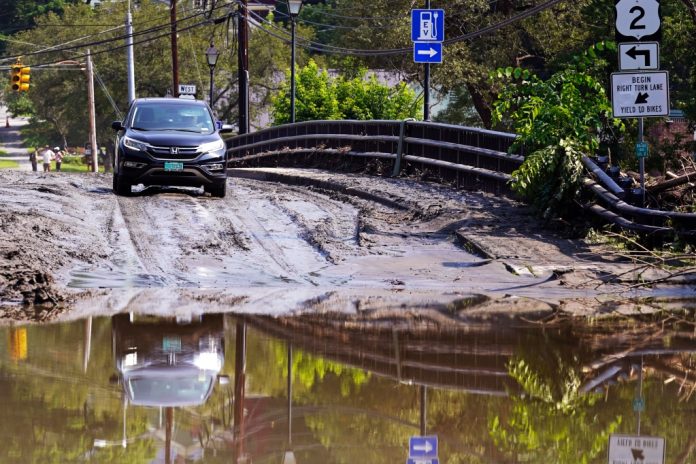
ANDOVER, Vt. (AP) — Volunteers pulled out their snow shovels Wednesday to clear inches of mud after torrential rain and flooding inundated communities across Vermont, trapping people in homes, closing roadways and littering streets and businesses with debris.

The water drained off most streets in the state capital of Montpelier, where the swollen Winooski River flooded basements and ground floors, destroying merchandise and furniture across the picturesque downtown. Other communities cleaned up as well from historic floods that were more destructive than Tropical Storm Irene in many places. Dozens of roads remained closed, and thousands of homes and businesses are damaged.

But with people still being rescued, high water still blocking some roads and new flash flood warnings issued with more rain on the way, the crisis is far from over, according to state Public Safety Commissioner Jennifer Morrison.

“Vermonters, keep your guard up, and do not take chances,” she said.

Morrison said urban search and swift water rescue teams came to the aid of least 32 people and numerous animals Tuesday night in northern Vermont’s Lamoille County, bringing the total to more than 200 rescues since Sunday, and more than 100 evacuations.

Volunteers turned out in droves to help flooded businesses in Montpelier, a city of 8,000, shoveling mud, cleaning, and moving damaged items outside. “We’ve had so much enthusiasm for support for businesses downtown that most of the businesses have had to turn folks away,” said volunteer organizer Peter Walke.

Similar scenes played out in neighboring Barre and in Bridgewater, where the Ottauquechee River spilled its banks, and in Ludlow, where the Black River sent floodwaters surging into several restaurants co-owned by chef Andrew Molen. He said Sam’s Steakhouse is likely closed for good after the water inside reached nearly 7 feet (more than 2 meters) high.

“The only thing that’s probably gonna be salvageable is the silverware, and even then, after being in that muck for so long, you wash everything, do you really want to put that on the table? It’s pretty intense what happened,” Molen said.

Another of his restaurants, Mr. Darcy’s, had a couple feet of water inside, damaging the foundation. But Molen said he hasn’t focused on cleaning up yet, because the first order of business has been making sure local residents and first responders stay fed. His crew has been cooking at one of the restaurants that remains functional and using ATVs through standing water to bring the meals to a local community center.

Gov. Phil Scott toured the disaster areas with Deanne Criswell, administrator of the Federal Emergency Management Agency, whose teams began aerial and on-the-ground damage assessments a day after President Joe Biden declared an emergency and authorized federal disaster relief.

The total cost of the damage could be substantial. According to to the National Oceanic and Atmospheric Administration, even before these floods, this year has seen 12 confirmed weather/climate disaster events with losses exceeding $1 billion in the United States.

“I think we all understand we are now living through the worst natural disaster to impact the state of Vermont since (the flood of) 1927,” U.S. Sen. Bernie Sanders said. “What we are looking at now are thousands of homes and businesses which have been damaged, sometimes severely. We’re looking at roads and bridges, some of which have been wiped out and will need basic and fundamental repairs.” The 1927 floods killed dozens of people and caused widespread destruction.

Scott said floodwaters surpassed levels seen during Tropical Storm Irene, which killed six people in Vermont in August 2011, washing homes off their foundations and damaging or destroying more than 200 bridges and 500 miles (805 kilometers) of highway.

Atmospheric scientists say destructive flooding events happen more frequently now because clouds carry more water as the atmosphere warms, and the planet’s rising temperatures will only make it worse.

New York ‘s Hudson River Valley also was hit hard, along with towns in southwest New Hampshire and western Massachusetts.

Massachusetts Gov. Maura Healey got a bird’s eye view in a helicopter ride to the small town of Williamsburg on Wednesday, where roads were washed out and some people had to be rescued from their homes. Even after two days of receding waters, the Connecticut River retained a muddy brown hue and farmland along the river remains saturated, she said.

Much of that water was carrying debris including entire trees, boulders and even vehicles south through Connecticut to Long Island Sound. Major waterways including the Connecticut River overflowed their banks, and were expected to crest Wednesday at up to 6 feet (2 meters) above flood stage, closing roads and riverside parks in multiple cities.

By mid-day Wednesday, all the rivers in Vermont had crested and water levels were receding, although at least one was 20 feet (6 meters) above normal, said Peter Banacos, a meteorologist with the National Weather Service. Thunderstorms, gusty winds and hail were forecast for Thursday and Friday in Vermont, but Banacos said they’ll blow through quickly enough that more flooding isn’t likely.

One death was blamed on the storm — a woman whose body was found after she was swept away in Fort Montgomery, New York.

About 12 Vermont communities, including the state capital, were under a boil water alert, but at least they were reachable again after being marooned by high water. The American Red Cross of Northern New England supported shelters in Rutland, White River Junction and Barre, where the city auditorium had 58 evacuees Wednesday morning, compared to more than 200 on Tuesday.

Many people were passing through to recharge their phones and get something to eat, said John Montes, regional disaster officer. Red Cross volunteers from across the Northeast were helping with disaster assessment and handing out clean-up kits to homeowners ahead of the next rains.

This flooding was catastrophic for Bear Pond Books, a 50-year-old store in Montpelier, said co-owner Claire Benedict. Water about 3 1/2 feet deep ruined many books and fixtures. Staffers and volunteers piled waterlogged books outside the back and front doors on Wednesday.

“The floor was completely covered with soaked books this morning,” she said as they cleared out the mud. “It’s a big old mess.”

Ludlow Municipal Manager Brendan McNamara said his town also suffered catastrophic damage. The water treatment plant was out of commission, the main supermarket and roadway through town were closed, the Little League field and a new skate park were destroyed and he said he couldn’t begin to estimate how many houses and businesses were damaged.

“We just really took the brunt of the storm,” McNamara said. But he said his town will recover. ”Ludlow will be fine. People are coming together and taking care of each other.”

___

Associated Press contributors include Kathy McCormack in Concord, New Hampshire; Pat Eaton-Robb in Hartford, Connecticut; Michael Hill in Albany, New York; and Mark Pratt, Michael Casey and Steve LeBlanc in Boston.

General Daily Insight for July 13, 2023 – Daily Press

0

General Daily Insight for July 13, 2023

It’s time to synchronize our hearts and minds. We begin with the emotional Moon trotting into intellectual Gemini at 3:26 am EDT, bringing an air of thoughtfulness to our inner lives. The Moon then stumbles into dynamic Mars, making it difficult to suppress our impulses and manage our tempers. Fortunately, playful Mercury works well with the Moon to realign our thoughts and feelings, as well as showing us how to be more empathetic with others. Don’t shy away from connection — reach toward it.

Aries

March 21 – April 19

Your mind is buzzing with activity today, Aries. You may find yourself being more intentional about communicating and spending time with the people who matter to you, and you’re possibly hatching engaging new plans together that will give everyone the space to connect with each other in healthy ways. Your impulsivity is boosted as well, so try to channel that toward positive activities that you’ve been wanting to do with your friends or family. Don’t let boredom get the best of you.

Taurus

April 20 – May 20

Stability is of utmost importance at the moment. It may feel like you’re trying to put down roots, but the people that you’re trying to grow and flourish with aren’t on board to do so. It might be discouraging to spend time with people who aren’t letting you create your foundation — you could risk feeling like a balloon in the breeze, flying to and fro, waiting for someone to take hold of you. You don’t have to get approval to create your safe haven.

Gemini

May 21 – June 20

You could be engaging in some silliness at this time. Your sense of humor is heightened, and it might be tempting to play a prank on someone that you’re close to. A playful joke can lighten the energy and let you laugh together, but before you begin, some thought needs to be put into the process. Their feelings need to be taken into consideration, because if they don’t think it’s funny, it’s not going to be fun for anyone! Laugh with them, not at them.

Cancer

June 21 – July 22

Engaging ways to connect with your spiritual side are currently available. There may be some elements to spiritual practices that you find boring, such that trying to do them alone could put you right to sleep. While you can connect with your spiritual side anywhere, contemplate adding some elevating elements to your spiritual practices so that they don’t feel so much like chores. Perhaps you could meditate in a beautiful park or do yoga by a body of water — whatever motivates your soul.

Leo

July 23 – August 22

Friends can pull you out of an ongoing rut. You might feel like you’re doing the same thing again and again for a good cause, but it’s likely making you feel stagnant. Don’t ignore those who reach out to you — whether it’s a group of pals or one good buddy. You may have blown them off multiple times recently in order to stick with your responsible routine, but life is short. You deserve a fun night with people who matter to you.

Virgo

August 23 – September 22

Virgo vigilance for the win! It’s possible that your workplace is allowing you an opportunity to show off your leadership skills, or your regular life could show you a decision that needs to be made, but no one else is willing to make it. Regardless of the details, take charge to prove just how capable you are when responsible for anything. That said, there’s no need to take things too seriously! Keep in mind that camaraderie is just as important as authority.

Libra

September 23 – October 22

There is particular power in caring for others today. Someone you know likely feels led astray in their current life and needs some guidance to return to their highest path. It can feel like you need to supply sage wisdom, but in reality, they would probably prefer a friend to listen and cheer them up. Unless they explicitly ask for advice, it might be wiser to let them cry on your shoulder and then eat some snacks and watch a movie. Sometimes healing is simple.

Scorpio

October 23 – November 21

Dancing around today’s feelings probably looks easier than confronting them. Be aware of your wants — especially if you have an acquaintance that you’d like to get to know better, but can’t figure out how to get close to them. This could be a colleague you want to network with or a friend-of-a-friend you want to chat with. They might even feel the same way about you! Keep any conversations light and thoughtful, but don’t be afraid to take the first step and reach out.

Sagittarius

November 22 – December 21

Entertaining other people is possibly taking the forefront of your concerns. You might be about to find that you’re stuck with someone who you’re supposed to care for and keep out of trouble. The best way to do this is likely by distracting them and entertaining them through showing them the sights or providing them with activities that will keep their attention. You could feel tempted to boss them around at times, but gentle suggestions should be all you need to keep the show going.

Capricorn

December 22 – January 19

Work may not feel as much like work as usual. You have the potential to get things done faster than normal, and your charm and wit can spur you to entertain those around you while you go through your to-do list. Your biggest obstacles could be your desire for fun and any opportunities to procrastinate, as your distractions might be more distracting and time-consuming than normal. Stay focused until you’re finished with that last task, then you’re free to enjoy the day.

Aquarius

January 20 – February 18

Creativity abounds! You plausibly have a good opening to show other people your creative abilities, whether they’re dancing, singing, acting, painting, or even scrapbooking. Whatever your talents and skills are, you will potentially be able to show an audience and hear their feedback. You might be tempted to keep your imagination a secret, so that you don’t receive any unwanted criticism, but what you’re doing is meant to be shared. Shed any insecurities and brighten up someone’s day with your talents.

Pisces

February 19 – March 20

Your family connections may be stronger than you once expected. A relative or roommate could be struggling, but you can be there to lend them a helping hand. They might argue with you at first, perhaps out of a desire for control or independence, but no matter how independent either of you are, everyone needs a little assistance sometimes. They will likely eventually allow you to put in your own efforts and be grateful for them. You can both lift each other up!

Humans’ impact on the earth began a new epoch in the 1950s called the Anthropocene, scientists say – Daily Press

0

By SETH BORENSTEIN (AP Science Writer)

From climate change to species loss and pollution, humans have etched their impact on the Earth with such strength and permanence since the middle of the 20th century that a special team of scientists says a new geologic epoch began then.

Called the Anthropocene — and derived from the Greek terms for “human” and “new” — this epoch started sometime between 1950 and 1954, according to the scientists. While there is evidence worldwide that captures the impact of burning fossil fuels, detonating nuclear weapons and dumping fertilizers and plastics on land and in waterways, the scientists are proposing a small but deep lake outside of Toronto, Canada — Crawford Lake — to place a historic marker.

“It’s quite clear that the scale of change has intensified unbelievably and that has to be human impact,” said University of Leicester geologist Colin Waters, who chaired the Anthropocene Working Group.

This puts the power of humans in a somewhat similar class with the meteorite that crashed into Earth 66 million years ago, killing off dinosaurs and starting the Cenozoic Era, or what is conversationally known as the age of mammals. But not quite. While that meteorite started a whole new era, the working group is proposing that humans only started a new epoch, which is a much smaller geologic time period.

The group aims to determine a specific start date of the Anthropocene by measuring plutonium levels at the bottom of Crawford Lake.

The idea of the Anthropocene was proposed at a science conference more than 20 years ago by the late Nobel Prize-winning chemist Paul Crutzen. Teams of scientists have debated the issue since then and finally set up the working group to study whether it was needed and, if so, when the epoch would start and where it would be commemorated.

Crawford Lake, which is 79 feet (29 meters) deep and 258,333 square feet (24,000 square meters) in area, was chosen over 11 other sites because the annual effects of human activity on the earth’s soil, atmosphere and biology are so clearly preserved in its layers of sediment. That includes everything from nuclear fallout to species-threatening pollution to steadily rising temperatures.

There are distinct and multiple signals starting around 1950 in Crawford Lake showing that “the effects of humans overwhelm the Earth system,” said Francine McCarthy, a committee member who specializes in that site as an Earth sciences professor at Brock University in Canada.

“The remarkably preserved annual record of deposition in Crawford Lake is truly amazing,” said U.S. National Academies of Sciences President Marcia McNutt, who wasn’t part of the committee.

The Anthropocene shows the power — and hubris — of humankind, several scientists said.

“The hubris is in imagining that we are in control,” said former U.S. White House science adviser John Holdren, who was not part of the working group of scientists and disagrees with its proposed start date, wanting one much earlier. “The reality is that our power to transform the environment has far exceeded our understanding of the consequences and our capacity to change course.”

Geologists measure time in eons, eras, periods, epochs and ages. The scientific working group is proposing that Anthropocene Epoch followed the Holocene Epoch, which started about 11,700 years ago at the end of an ice age.

They are also proposing that it starts a new age, called Crawfordian after the lake chosen as its starting point.

The proposal still needs to be approved by three different groups of geologists and could be signed off at a major conference next year.

The reason geologists didn’t declare the Anthropocene the start of a bigger and more important time measurement, such as a period, is because the current Quaternary Period, which began nearly 2.6 million years ago, is based on permanent ice on Earth’s poles, which still exist. But in a few hundred years, if climate change continues and those disappear, it may be time to change that, Waters said.

“If you know your Greek tragedies you know power, hubris, and tragedy go hand in hand,” said Harvard science historian Naomi Oreskes, a working group member. “If we don’t address the harmful aspects of human activities, most obviously disruptive climate change, we are headed for tragedy.”

___

Follow AP’s climate and environment coverage at https://apnews.com/hub/climate-and-environment

___

Follow Seth Borenstein on Twitter at @borenbears

___

Associated Press climate and environmental coverage receives support from several private foundations. See more about AP’s climate initiative here. The AP is solely responsible for all content.

Snow shovels in hand, Vermonters volunteer to clean up after epic floods – Daily Press

0

By LISA RATHKE (Associated Press)

ANDOVER, Vt. (AP) — Volunteers pulled out their snow shovels Wednesday to clear inches of mud after torrential rain and flooding inundated communities across Vermont, trapping people in homes, closing roadways and littering streets and businesses with debris.

The water drained off most streets in the state capital of Montpelier, where the swollen Winooski River flooded basements and ground floors, destroying merchandise and furniture across the picturesque downtown. Other communities cleaned up as well from historic floods that were more destructive than Tropical Storm Irene in many places. Dozens of roads remained closed, and thousands of homes and businesses are damaged.

But with people still being rescued, high water still blocking some roads and new flash flood warnings issued with more rain on the way, the crisis is far from over, according to state Public Safety Commissioner Jennifer Morrison.

“Vermonters, keep your guard up, and do not take chances,” she said.

Morrison said urban search and swift water rescue teams came to the aid of least 32 people and numerous animals Tuesday night in northern Vermont’s Lamoille County, bringing the total to more than 200 rescues since Sunday, and more than 100 evacuations.

Volunteers turned out in droves to help flooded businesses in Montpelier, a city of 8,000, shoveling mud, cleaning, and moving damaged items outside. “We’ve had so much enthusiasm for support for businesses downtown that most of the businesses have had to turn folks away,” said volunteer organizer Peter Walke.

Similar scenes played out in neighboring Barre and in Bridgewater, where the Ottauquechee River spilled its banks, and in Ludlow, where the Black River sent floodwaters surging into several restaurants co-owned by chef Andrew Molen. He said Sam’s Steakhouse is likely closed for good after the water inside reached nearly 7 feet (more than 2 meters) high.

“The only thing that’s probably gonna be salvageable is the silverware, and even then, after being in that muck for so long, you wash everything, do you really want to put that on the table? It’s pretty intense what happened,” Molen said.

Another of his restaurants, Mr. Darcy’s, had a couple feet of water inside, damaging the foundation. But Molen said he hasn’t focused on cleaning up yet, because the first order of business has been making sure local residents and first responders stay fed. His crew has been cooking at one of the restaurants that remains functional and using ATVs through standing water to bring the meals to a local community center.

Gov. Phil Scott toured the disaster areas with Deanne Criswell, administrator of the Federal Emergency Management Agency, whose teams began aerial and on-the-ground damage assessments a day after President Joe Biden declared an emergency and authorized federal disaster relief.

The total cost of the damage could be substantial. According to to the National Oceanic and Atmospheric Administration, even before these floods, this year has seen 12 confirmed weather/climate disaster events with losses exceeding $1 billion in the United States.

“I think we all understand we are now living through the worst natural disaster to impact the state of Vermont since (the flood of) 1927,” U.S. Sen. Bernie Sanders said. “What we are looking at now are thousands of homes and businesses which have been damaged, sometimes severely. We’re looking at roads and bridges, some of which have been wiped out and will need basic and fundamental repairs.” The 1927 floods killed dozens of people and caused widespread destruction.

Scott said floodwaters surpassed levels seen during Tropical Storm Irene, which killed six people in Vermont in August 2011, washing homes off their foundations and damaging or destroying more than 200 bridges and 500 miles (805 kilometers) of highway.

Atmospheric scientists say destructive flooding events happen more frequently now because clouds carry more water as the atmosphere warms, and the planet’s rising temperatures will only make it worse.

New York ‘s Hudson River Valley also was hit hard, along with towns in southwest New Hampshire and western Massachusetts.

Massachusetts Gov. Maura Healey got a bird’s eye view in a helicopter ride to the small town of Williamsburg on Wednesday, where roads were washed out and some people had to be rescued from their homes. Even after two days of receding waters, the Connecticut River retained a muddy brown hue and farmland along the river remains saturated, she said.

Much of that water was carrying debris including entire trees, boulders and even vehicles south through Connecticut to Long Island Sound. Major waterways including the Connecticut River overflowed their banks, and were expected to crest Wednesday at up to 6 feet (2 meters) above flood stage, closing roads and riverside parks in multiple cities.

By mid-day Wednesday, all the rivers in Vermont had crested and water levels were receding, although at least one was 20 feet (6 meters) above normal, said Peter Banacos, a meteorologist with the National Weather Service. Thunderstorms, gusty winds and hail were forecast for Thursday and Friday in Vermont, but Banacos said they’ll blow through quickly enough that more flooding isn’t likely.

One death was blamed on the storm — a woman whose body was found after she was swept away in Fort Montgomery, New York.

About 12 Vermont communities, including the state capital, were under a boil water alert, but at least they were reachable again after being marooned by high water. The American Red Cross of Northern New England supported shelters in Rutland, White River Junction and Barre, where the city auditorium had 58 evacuees Wednesday morning, compared to more than 200 on Tuesday.

Many people were passing through to recharge their phones and get something to eat, said John Montes, regional disaster officer. Red Cross volunteers from across the Northeast were helping with disaster assessment and handing out clean-up kits to homeowners ahead of the next rains.

This flooding was catastrophic for Bear Pond Books, a 50-year-old store in Montpelier, said co-owner Claire Benedict. Water about 3 1/2 feet deep ruined many books and fixtures. Staffers and volunteers piled waterlogged books outside the back and front doors on Wednesday.

“The floor was completely covered with soaked books this morning,” she said as they cleared out the mud. “It’s a big old mess.”

Ludlow Municipal Manager Brendan McNamara said his town also suffered catastrophic damage. The water treatment plant was out of commission, the main supermarket and roadway through town were closed, the Little League field and a new skate park were destroyed and he said he couldn’t begin to estimate how many houses and businesses were damaged.

“We just really took the brunt of the storm,” McNamara said. But he said his town will recover. ”Ludlow will be fine. People are coming together and taking care of each other.”

___

Associated Press contributors include Kathy McCormack in Concord, New Hampshire; Pat Eaton-Robb in Hartford, Connecticut; Michael Hill in Albany, New York; and Mark Pratt, Michael Casey and Steve LeBlanc in Boston.

3 dead, 14 hurt after Greyhound bus strikes semis in Illinois; NTSB investigating – Daily Press

0

By The Associated Press

HIGHLAND, Ill. (AP) — A Greyhound passenger bus crashed into three tractor-trailers parked along a highway rest area exit early Wednesday in southern Illinois, killing three people and injuring 14 others, some seriously, state police said.

The St. Louis-bound bus was traveling westbound along Interstate 70 in Madison County when it crashed into the three semis just before 2 a.m., Illinois State Police said, citing an initial investigation.

Four people were taken to the hospital by helicopter and at least 10 others were taken by ambulance, state police said in a news release. Police did not immediately release details about those who were injured and killed.

No one in the three trucks was hurt in the crash near the city of Highland, about 25 miles (40 kilometers) east of St. Louis, police said.

State Police spokesperson Melaney Arnold said those killed and injured were all on the bus.

Amalgamated Transit Union, which represents Greyhound drivers, said in a Facebook post that the driver was in serious condition at a hospital.

The crash closed westbound traffic on I-70.

A team from the National Transportation Safety Board arrived at the scene Wednesday. U.S. Rep. Mike Bost, an Illinois Republican, said an NTSB official told him the bus was equipped with monitoring cameras “so they’ll be able to do a full check to see how the accident occurred.”

Photos and video from the scene showed the side of the bus peeled open and its roof crumpled. A second tractor-trailer appears to have made contact with the right rear of the bus while a third tractor-trailer appears to have crashed into the rear of that second semi.

Passenger Edward Alexander of Pine Bluff, Arkansas, told the St. Louis Post-Dispatch he helped a pregnant woman get off the bus and was searching for his phone when he “realized smoke was coming in the bus. I was like, ‘forget that phone,’ and went on and jumped out the window.”

Edwin Brown, 22, of Friars Point, Mississippi, told the Post-Dispatch that he felt the bus shake as it passed over rumble strips before the side of the vehicle “opened up like a can opener.” The driver was in and out of consciousness as Brown turned the ignition off with the help of a trucker, he said.

Greyhound spokesperson Mike Ogulnick said in an email that the bus was traveling from Indianapolis to St. Louis with a scheduled arrival of 2:20 a.m. About 30 people were on board.

“Our primary concern is ensuring we care for our passengers and driver at this time,” Ogulnick said. “We are working closely with local authorities, and a relief bus is on the way for passengers.”

It is illegal in Illinois for trucks to park on exit ramps. But trucking industry experts say semis often stop there for the night because overnight parking is hard to find at rest areas and other places such as truck stops.

“And that’s not only dangerous for them but it’s dangerous for the motoring public because they do need their rest and they deserve their rest,” Lewis Pugh of the Owner-Operator Independent Drivers Association said at a May hearing before a House Committee on Transportation and Infrastructure subcommittee.

Tom Chapman, an NTSB board member, declined to discuss specifics of the crash during a briefing Wednesday, including the reports that the rigs were stopped along the ramp.

“Rest area safety is one of the issues that will be a part of this investigation,” he said. “Again, we don’t know enough to be able to say with certainty that that’s what occurred, but that’s certainly one of the issues that we’ll be looking at as part of our investigation.”

The findings of the inquiry could lead to recommendations designed to “help ensure that similar tragedies not occur in the future,” he added. Another briefing was planned for Thursday.

Last month the National Highway Traffic Safety Administration announced that it will require trucks and buses to include automatic emergency braking equipment within five years. AEBs use forward-facing cameras and sensor technologies to detect when a crash is imminent.

The system automatically applies the brakes if the driver has not done so, or, if needed, applies additional braking force to supplement the driver’s actions. The proposed standard would require the technology to work at speeds ranging from 6 to 50 mph (10 to 80 kph).

___ Associated Press writers Jim Salter in St. Louis, Tom Krisher in Detroit, Kathleen Foody in Chicago and Heather Hollingsworth in Mission, Kansas, contributed to this report.

Amendments to defense spending bills offer differing views of U.S. role in NATO – Daily Press

0

Congress’ consideration of the defense budget now includes a debate on whether the United States should be a member of NATO, which it helped found after World War II to protect Europe from Russian aggression.

The Senate and House will consider amendments on their own versions of the National Defense Authorization Act that could force the country’s withdrawal from the North Atlantic Treaty Organization or lock it in indefinitely, barring an act of Congress.

During his administration, former president Donald Trump reportedly discussed withdrawing from the organization. On Tuesday, Rep. Marjorie Taylor Greene, an influential member of House leadership, introduced an amendment to the House bill that would direct the president to withdraw from the international military alliance. And on Wednesday, Sen. Tim Kaine (D-Va.) reintroduced legislation to prohibit any U.S. president from withdrawing from NATO without Senate approval or an Act of Congress.

Norfolk is home to the only NATO headquarters on U.S. soil, and the outcome could have a significant effect on Hampton Roads. While NATO’s presence in Norfolk dates to 1952, the Allied Command Transformation was established June 19, 2003, following a restructuring in response to the 9/11 terrorist attacks. For the past two decades, the Norfolk-based alliance has led NATO’s development of new warfighting capabilities through scientific research, experimentation and technological development.

Kaine said there has been “some ambiguity” surrounding the country’s partnership with NATO, referencing a statement made by a cabinet secretary to President Donald Trump.

“Cabinet Secretary (Mark) Esper indicated that it was President Trump’s desire to exit NATO if he were to have a second term as president. It’s very important that we send a message to NATO allies and those who rely upon NATO support, that no matter how the 2024 presidential election comes out, no president of either party at any time can withdraw from NATO without congressional authorization,” Kaine said Wednesday. 

But in outlining her reasoning for an amendment to the House’s version of the defense spending bill, Greene said NATO is “not a reliable partner whose defense spending should be paid for by American citizens.”

The House will consider Greene’s amendment, along with approximately 1,000 others, this week. Both of the Republican House members who represent parts of Hampton Roads, Rob Wittman and Jen Kiggans, indicated Wednesday that they support a continued partnership with NATO.

“Rep. Wittman has always been a strong supporter of NATO, which plays a vital role in promoting democratic values around the globe. This alliance is more relevant than ever as Europe unites to counter Russia’s senseless war of aggression in Ukraine. Virginia is proud to be NATO’s home in North America with its presence in Norfolk, and the United States is safer because of our role as a leader in NATO,” said Julianne Heberlein, communications director for Wittman.

“Congresswoman Kiggans is a staunch supporter of the NATO Alliance and its positive impact on global security. She will continue to be a loud voice for strong national security and a unified global defense in Congress,” said Reilly Richardson, press secretary for Kiggans.

In a statement to The Virginian-Pilot on Wednesday, Sen. Mark Warner (D-Va.) called Greene’s amendment “ludicrous” and “completely disconnect from reality.”

“NATO stands for democracy, peace, and strategic coordination with our closest allies around the globe – crucial work that actually happens in large part at the NATO Allied Command Transformation in Hampton Roads. Particularly now, amid heightened Russian aggression and an increasingly antagonistic China, we need to bring our allies closer, not push them away,” Warner said in an emailed statement.

Meanwhile, Kaine’s version of the amendment would require the president to seek the advice and consent of the Senate before suspending or withdrawing U.S. membership from NATO.

The amendment circulating the senate has received bipartisan support and was co-sponsored by Republican Sen. Marco Rubio of Florida. Kaine’s bill was first introduced last year, passing the Senate Foreign Relations Committee with a 20 to 1 vote.

“But I could never maneuver it for action on the Senate floor. But because the vote was so bipartisan, I wanted to do it again this year as a way of sending a strong message that Congress is very much supportive of U.S. NATO leadership and the incredible work NATO has been doing, particularly in the war in Ukraine,” Kaine said.

The Senate will consider the amendment next week.

Caitlyn Burchett, [email protected]

After a third attempt, Portsmouth City Council approves storage facility on formerly contaminated superfund site – Daily Press

0

PORTSMOUTH — A third attempt to place a storage facility on a formerly contaminated superfund site on Effingham Street finally gained City Council approval Tuesday.

SAFStor Real Estate Co. has tried since 2021 to get the green light to build a three-story, 103,350-square-foot storage facility with nearly 800 storage units at 0 Effingham St. Due to past lead contamination, it’s an Environmental Protection Agency superfund site, which restricts how the land can be used.

The planning commission and planning staff recommended approval for the project. Tuesday’s approved requests included a use permit and a rezoning from downtown sub-district to conditional general mixed use.

Attorney Don Scott represents the applicants and made the request at Tuesday’s meeting. He told council members the project amounts to an $11.5 million investment, with the potential to eventually generate up to $1.4 in annual tax revenue for the city.

“That’s money for our tax rolls here in Portsmouth,” Scott said. He said civic league members in the Brighton and Prentis Park neighborhoods were supportive of the project.

The applicant would have to purchase the property from the Portsmouth Redevelopment and Housing Authority, which owns the 5-acre property and has tried to sell it for decades.

The area was once home to the Washington Park public housing development, which was demolished in 2006 following the discovery of lead in the soil due to a nearby brass and bronze foundry. The EPA placed the vacant property on the National Priorities List in 1990 and cleaned it up nearly 20 years later by excavating the soil and placing a concrete layer on top.

Last year, council members Mark Whitaker, Paul Battle and Chris Woodard, along with then-Vice Mayor De’Andre Barnes, voted against the project, citing health concerns and the desire for something more than a storage facility. The four also voted against a similar project in 2021.

Scott told The Virginian-Pilot following last year’s vote that he wasn’t surprised and had plans then to bring it back and try again. Battle and Woodard are no longer on the council.

Whitaker and Barnes said Tuesday they would remain consistent in their votes against the project, reiterating the aforementioned concerns. The vote was ultimately 5-2. Barnes said he’d like to see more for an area that’s an extension of downtown.

“We’re definitely not lacking when it comes to storage,” Barnes said. “But I just think that we need to be putting things in place that’s going to bring people to the city of Portsmouth, that’s going to provide entertainment to the city of Portsmouth and that’s going to be a benefit and real tax revenue. And also bring jobs.”

The previous denials of the project also became a talking point during last year’s City Council election, with Bill Moody attributing the vote to what he called an “anti-development” majority on City Council at the time.

Natalie Anderson, 757-732-1133, [email protected]

How do you buy a home with little or no credit? Turn rent payments into credit score points – Daily Press

0

Lizzie Kane | Chicago Tribune (TNS)

Zhiqiang Su, 50, and Yuping Liang, 50, moved from China to Chicago in 2020, seeking a life with better education opportunities for their now 21-year-old daughter and more freedom.

They have been renters since they immigrated, living in a single-family, two-bedroom home in Bridgeport for $1,200 a month, never having missed or been late on a payment.

But, Su said, they want a place to call their own to help them achieve their American Dream.

“I want to purchase a house because it will allow me to have a more stable life,” Su said in Cantonese as Ivan Man and Sharon Wong, two members of his real estate team, translated.

Being immigrants, however, adds extra layers of difficulty to the already challenging housing market.

The couple works hard to make a living: Su works 10-hour days, six days a week making sushi in a restaurant, and his wife does the same while working a part-time job as a home care aide. But their real estate team expects them to run into challenges qualifying for a home loan given that they may have a limited credit profile. Typically, someone needs a credit score of 620 or higher from a traditional lender to qualify for a home loan. (The Federal Housing Administration, Su’s likely lender, requires a lower score of 580 or 500 with a higher down payment.)

For millions of people in the United States like Su and Liang, the challenges that come with buying a home escalate because they have limited to no credit, and immigrants are particularly vulnerable given that they have no credit score when they come to the U.S. Various private and federal mortgage lenders and the government-sponsored mortgage financier Fannie Mae are trying to make it easier by allowing applicants’ on-time rent payment histories and other similar payments to help them qualify for a home loan.

The Consumer Financial Protection Bureau has found 26 million Americans have no credit record, which is also known as being “credible invisible.”

Gunnar Blix, director of housing market research for real estate data provider Black Knight, said people with thin credit scores — people who don’t have a history of using credit — have compounding issues given their credit status and the lack of affordability in the housing market with higher mortgage rates and prices.

“We are seeing credit tightening, and we see that in terms of higher credit scores (required to finance a home purchase),” Blix said, adding that average credit scores for homebuyers have gone up seven points since December. Black Knight data shows that in June, average credit scores for homebuyers were 735, the highest recorded since the company started collecting the data in 2000.

The Federal Housing Administration began allowing first-time homebuyers applying for an FHA-insured mortgage to include positive rent payments — late or missed payments are not included — as an additional factor in their credit assessments in September 2022.

“If you’re regularly paying your rent on time, that’s a good indication you will also pay your mortgage on time,” Federal Housing Commissioner Julia Gordon said in a news release from September 2022. “We hope that adding this positive factor to all of the characteristics currently considered in an FHA credit evaluation will increase access to affordable FHA-insured mortgages for first-time homebuyers.”

Fannie Mae also began incorporating new methods to determine credit readiness through a change in its mortgage underwriting system and a recent pilot program.

In 2021, Fannie Mae’s automated underwriting system began considering a person’s positive rent payment history in the mortgage credit evaluation process. The system does this by allowing mortgage lenders for single-family homes to identify recurring rent payments in a person’s bank statement data, according to Fannie Mae.

In September 2022, Fannie Mae began a yearlong pilot program to help multifamily property owners report positive rent payments to the three major credit bureaus for their renters in an effort to build or boost the tenants’ credit scores. Fannie Mae partners with financial technology companies that serve as the go-betweens for property owners and credit reporting agencies and covers the multifamily property owners’ costs of collecting and reporting rent payment histories to the agencies for a year.

Priscilla Almodovar, CEO of Fannie Mae, said incorporating on-time rental payments into a consumer’s credit standing will create more housing opportunities for all.

“A home is more than shelter,” Almodovar said in a statement to the Tribune. “It defines who we are, provides stability to our communities, and promotes generational wealth.”

National real estate firm Related Companies is one organization that partners with Fannie Mae to report positive rent payments to credit reporting agencies.

Since Fannie Mae launched its pilot program, Jeff Brodsky, vice chairman of Related Companies, said his company reports on-time rent payments for more than 50,000 families nationally, with 4,600 of those families living in Related’s affordable housing portfolio in Chicago. The company works with Esusu, one of the fintech companies partnering with Fannie Mae. Esusu’s website states that only around 10% of Americans build credit through on-time rent payments.

Because of this partnership, more than 1,200 families in Chicago who didn’t have credit scores now do, according to Brodsky. He said in Chicago and nationally, more than 70% of residents have seen their credit scores improve, on average by 47 points.

The credit reporting service is provided free of charge to all residents, with 80% of Related’s residents opting to participate.

“This is improving the financial resiliency of large-scale numbers of folks who have very little options to do so with their income levels,” Brodsky said, adding that Related’s average affordable housing resident has an income of $15,000 a year. “This practice works and is scalable and is cost effective.”

While Related is not collecting information on how many residents go on to purchase a home, the company hopes to do so in the future, Brodsky said.

Su wants to buy a house by next year, with his price range between $300,000 and $380,000. His search is concentrated in the Chinatown and Bridgeport areas, two popular spots in the immigrant community, which make them competitive and less affordable markets, said Wong, managing broker and founder of Century 21 Realty Associates in Chinatown and Su’s agent.

Wong said this makes it challenging for people like Su and his wife because their debt-to-income ratio — a calculation of how much of one’s monthly income is being spent on debt payments — would be too high given the prices of homes in the areas. She said homes in Bridgeport and Chinatown sell for around $500,000. Su and his wife have a combined income of around $70,000 a year and limited savings, but they may rely on relatives to lend them money for their down payment.

This “missing middle” housing in the real estate market is not limited to Bridgeport and Chinatown but is a problem throughout the Chicago area, though the housing shortage here is not as severe compared with other U.S. markets, according to the National Association of Realtors.

Su’s mortgage lender, Bing He, said that while he has not run a credit check yet on Su given that he has not found a home he wants to buy, people typically need two lines of credit to help them qualify for a loan. Su only has one, in the form of a credit card, since last May. Su will also need to get a payment proof letter from his property management company because he pays his rent in cash, and the Federal Housing Administration typically requires bank statements to show proof of on-time rent payments.

Another lender that Wong’s office works with is Citibank, which has a bilingual office in Chinatown.

Citi Mortgage, the mortgage lending arm of Citibank, has had a “long-standing” policy to consider nontraditional credit histories, according to the company.

Brad Wayman, president and CEO of Citi Mortgage, said the company considers on-time rental payment history and utility and cellphone payments to help people achieve homeownership.

“A traditional credit profile is only one piece of the puzzle when considering a person’s ability to manage a home loan,” Wayman said in a statement. “Our message for aspiring homeowners is don’t give up hope merely for lack of traditional credit experience.”

Rocket Mortgage and Veterans United Home Loans also consider alternative forms of credit for their mortgages.

Wong also works with some local banks, including International Bank of Chicago and Royal Business Bank (formerly Pacific Global Bank), that have similar products, but they require higher mortgage rates and down payments of 35% to 50%, which is out of reach for many people, she said. Su would be her first client who she has helped qualify for a loan through alternative credit programs.

While there are many lenders who have started these programs, one of the main difficulties in reaching the immigrant community is the language barrier, Wong said. New immigrants, she said, also typically rent from smaller landlords, not larger ones like Related, making it tougher for them to use Fannie Mae’s program.

“When we hear about alternative credit, it’s just really good news for us to explore a bit more,” Wong said. Her office has been reaching out to various lenders to see how they can help more people — not only immigrants but also younger people or others who may have limited or no credit.

Su said he has a few co-workers who are running into his same challenges and would also be interested in the programs he is hoping will help him buy a home with his wife.

For Su, being a renter is something that comes with uncertainty because his landlord could ask him to leave or raise his rent. These programs will hopefully shorten his timeline to becoming a homeowner and help him become his own boss — with someone making sushi for him, he said.

While he has only been searching for a few weeks, his goal is to find a single-family house, bungalow-style with at least three bedrooms.

Su shared an old Chinese saying, which his real estate team helped translate into English: “Build your roots where you live.”

[email protected]

©2023 Chicago Tribune. Visit chicagotribune.com. Distributed by Tribune Content Agency, LLC.