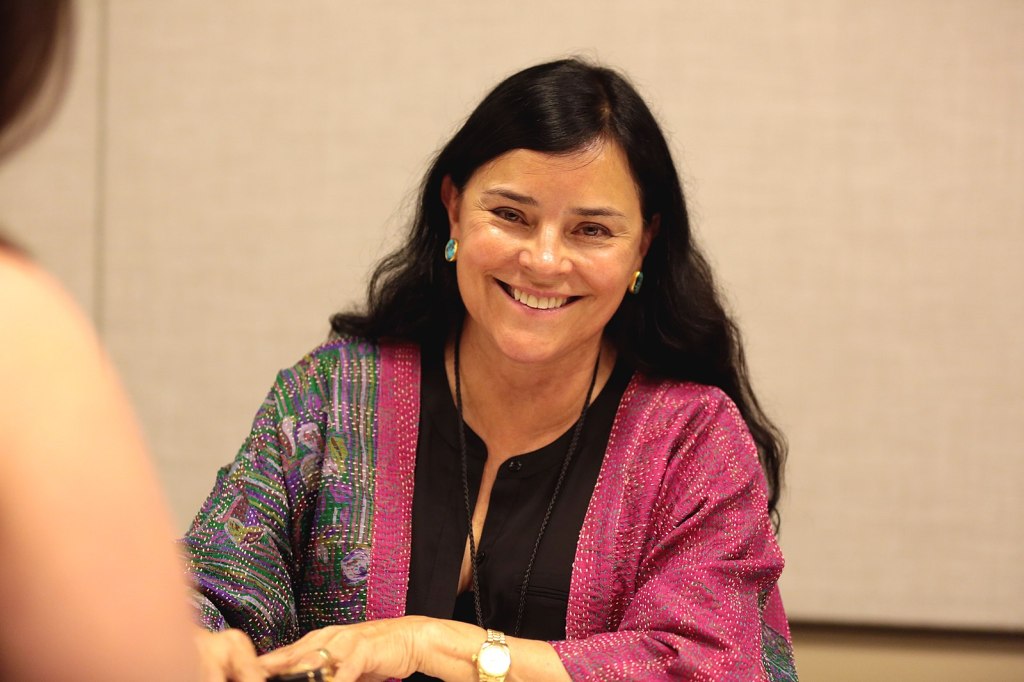
Diana Gabaldon, the author of the best-selling “Outlander” novels that inspired a successful television series, plans to visit Yorktown for two days in September, giving a lecture and walking the battlefield.
“My talk came at an opportune time,” she said in a recent telephone interview from her Arizona home, “because I’m now working on my 10th book, and it will include the end of the American Revolution at Yorktown.”
Although Gabaldon has walked the Yorktown battlefield twice in the past three years, “I plan to stay an extra day to walk again” over the fields, putting the atmosphere firmly in her mind. “And, oh yes, Jamie (one of the series’ two main characters) will be at Yorktown.”
She enjoys battlefield walks whether they’re at Yorktown, at Cowpens in South Carolina or at Guilford Courthouse in North Carolina. “I like them; they’re extremely interesting, and I like to write about battlefields,” which she has on numerous occasions in her books, such as Culloden — the Jacobite conflict in the Scottish highlands near Inverness.
Gabaldon will present a program and sign books on Sept. 16 at the American Revolution Museum at Yorktown in connection with the “Reign & Rebellion,” a special exhibition focusing on the Royal Stuarts and their ties to America and its revolution. Her talk, however, is already sold out.
Gabaldon’s book series began with a focus on the Stuarts of Scotland and the Jacobite rebellion against the English in the mid-18th century with primary characters Claire Elizabeth Beauchamp Randall and Jamie Fraser. Beauchamp Randall, a former World War II nurse, visits Scotland and accidentally travels in time back and meets Fraser, a dashing highland warrior 200 years earlier in time. The saga through her books continues to the colonies and the American Revolution.
Looking back over her work, she said she appreciates the Sony-produced television series released on Starz “given the time they have to operate. But in my books, I have more space and time for the stories,” she added.
It’s almost a believe-it-or-not situation for her because “Outlander” — the first novel she ever wrote — was begun in a church parking lot.
“I had happened to see a ‘Dr. Who’ program with a young man in a kilt, and it stuck with me. There really wasn’t much and what I wrote doesn’t really matter, but it was Scotland in the 18th century — that’s all I had.”
Gabaldon said she reached under the front seat of her car, found a shopping list and began to write. “The next day, I went to the university library. The card catalog had just been put on a computer, and I scanned Scotland and the 18th century.”

Up came more than 400 books on Scotland. As a faculty member — she was a professor at Arizona State University — “I could take out as many books as I wanted and keep them for as long as I wanted. Then, I began with the Stuarts.”
Gabaldon said she had always wanted to be a novelist. “When I turned 35, I thought, ‘Mozart was dead by 36; I ought to get busy.’”
Before the novels, she had writing experience as a professor, as a freelancer and for writing Walt Disney comic books.
“So, I decided (in 1988) to write a novel for practice — to get the feel of research, daily commitment and the mental organization. I wouldn’t show it (to) anyone and decided the easiest novel for me perhaps would be historical fiction.”
Gabaldon does not work with an outline, “and I don’t even write in a straight line. I write in disconnected scenes, where I can see things happening, and then gradually as I work (and continue doing research and reading — I do this all the time, no matter what), the pieces I have begin to stick together and form shapes.
“It’s kind of like playing Tetris in my head, but very slowly.”
She said she doesn’t tend to rewrite. “I’m pretty sure of everything as it put it down.”
Her published book in 1991 was initially titled “Cross Stitch,” but later changed to “Outlander.” Usually, it takes her three to four years to complete her lengthy tomes, she said.

File Photo Joe Fudge / Daily Press
Diana Gabaldon’s 10th book will include the end of the American Revolution at Yorktown. File photo
After now writing nine books, several of them 1,000 pages or more, Gabaldon said she faces a “major conundrum.” How can she provide enough information to let a new reader know enough to enjoy a new book, “while at the same time not reiterating so much information that a continuing reader would become bored or impatient?”
Gabaldon calls this her “Jacquard” technique because it’s “like weaving using the same color of thread or yarn, but picking up a pattern of threads from the background or viewing it from a different angle. However, if you look at it straight on you’re not likely to notice the small patterns.”
Regardless of how she writes and what pattern she uses, her “Outlander” series has now sold more than 50 million copies worldwide and has been published in 114 countries and in 38 languages. All of the “Outlander” books have made it onto The New York Times bestseller list.
Prior to writing novels, Gabaldon completed three degrees in science — zoology, marine biology and a doctorate in quantitative behavioral ecology. She also holds an honorary doctorate degree for “services to literature” from the University of Glasgow.
The “Reign & Rebellion” exhibition, which is what is bringing her to the area, is a two-fold exhibit that has been at the American Revolution Museum at Yorktown and at the Jamestown Settlement since last November and is scheduled to close after Sept. 19.
At the Jamestown Settlement, the exhibit depicts how the reign of the Stuarts in the 17th century “solidified Virginia’s identity as the Old Dominion, which has lasting impacts not only (for the colonial years) but for the world we live in today,” according to the museum.
Among the memorabilia on display is the Rolfe family Bible, a mourning ring of Charles I with a secret message, and Indigenous and English objects, reflecting religious and political authority.
At the American Revolution Museum, the exhibit, emphasizing the 18th century, explores how the “legacies of the Stuart era contributed toward Virginia’s distinct American identity, resulting in formerly loyal Cavaliers fighting for independence from Great Britain.”
Wilford Kale, [email protected]