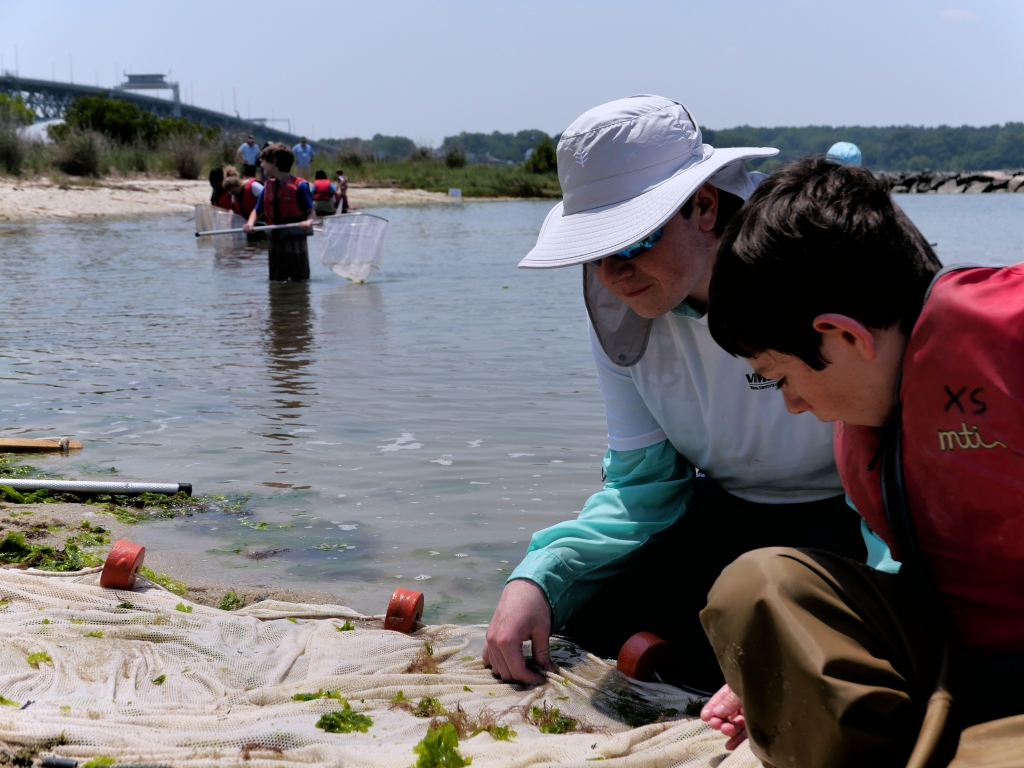
GLOUCESTER — More than 1,000 people attended the 21st annual Marine Science Day on Saturday at the Virginia Institute of Marine Science, which offered a glimpse to those both young and old about the wonders of coastal ocean life and beyond.
“We’ve been trying to come for years,” said parent Laura Hall. “My kids love going in the water and finding all kinds of little creatures. They love fishing, so we thought we’d bring them down here.”
The campus, in Gloucester Point, opened its doors for visitors to explore and learn about VIMS’ state-of-the-art equipment, laboratories and surrounding wetlands. Talks were given on the biology of aquatic creatures and migration patterns, children played educational games and made arts and crafts at the pavilion, and VIMS staff briefed onlookers about various exhibits.
In the Acuff Center for Aquaculture, Darian Kelley, a laboratory specialist with the VIMS Eastern Shore Laboratory, talked about bay scallops, which have been raised at the Castagna Shellfish Research Hatchery since 2009.
“We grow them in this system for 30-50 days until they’re pinkie-nail size,” Kelley said, “and then we will take them down to the restored grass beds, and we will deploy a portion of them into cages, so that they can spawn and contribute to a natural population.”
Kelley’s team releases some scallops into the wild and also gives some to local shellfish growers in the hope that they will someday become a viable commercial product.
Next to a table with microscopes where attendees could view seagrass epifauna, Marine Scientist Julia Mackin-McLaughlin told visitors about her research at the Coastal and Estuarine Ecology Lab. She explained how her team researches the expansion or decline of seagrass in the Chesapeake Bay.
“In recent years, we’ve noticed that Ruppia, which is also known as widgeongrass, has expanded while eelgrass has declined,” Mackin-McLaughlin said. “So we’re curious to see how that’s going to affect the organisms that rely on both these species.”

VIMS Dean and Director Derek Aday said Marine Science Day is an opportunity for the institute to show the breadth of its work across three campuses and 500 employees.
Aday said he hopes that Science Day and VIMS outreach work in general can start to carry the public conversation around marine science toward the topic of coastal resilience, which involves safeguarding the animals, land and people on the Atlantic shoreline against changes in the environment.
One sign of that change came in the form of smoke last week in Virginia, which drifted down from wildfires in Canada. Organizations like the American Geophysical Union claim that such fires are becoming more common with global warming and less precipitation.
Among its many initiatives, like its recently funded derelict fishing gear removal project, VIMS offers forecasting tools on its website that can be used to predict sea level rise and potential flooding when storms are on the way.
“Everything from transportation to real estate to water quality and development — we’re connected to all of those things,” Aday said. “And so whether you’re a boater or a homeowner or an angler or a seafood lover or just someone that appreciates coastal and marine environments, it’s almost guaranteed that not only are we doing something connected to what you’re interested in but also that we have some sort of outreach or education program (related to it).”
Those interested can sign up for the VIMS newsletter at vims.edu to stay informed about programming and upcoming events.
J.W. Caterine, [email protected]