Colonial taverns in Virginia and elsewhere in the colonies were not places folks went to get drunk — although intoxication developed more than occasionally.
Taverns and ordinary enterprises were established to serve colonial travelers in the 18th century. A colonial tavern was a place to sleep, get a meal, and learn the news of the day. Taverns also served their local communities as venues for public gatherings, political discussions and entertainment.
The Three Tun Tavern that stood amid the storehouses on South Island in Great Bridge before the American Revolution was no exception. It served itinerants, local workers and residents before it perished sometime during the Revolutionary War.
An exhibit in one of the Great Bridge Battlefield Museum’s galleries depicts the interior of the Three Tun Tavern complete with a cage bar, tables and a fireplace.
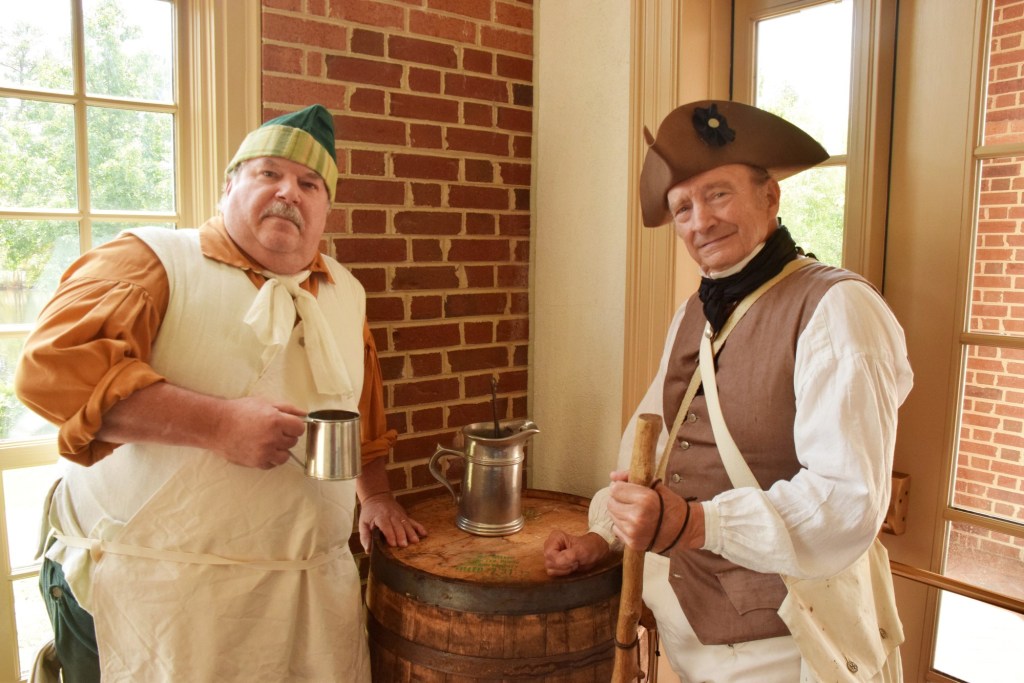
Museum volunteer interpreter Louis Scott Mosier enthusiastically portrays the tavern keeper at the museum’s tavern exhibit and during special tavern-themed events at the museum. Mosier interprets local colonial history in the first person as Lewis Scott, proprietor of the Three Tun Tavern.
During his inquiry into Virginia’s colonial taverns, Mosier came to a reference in an ad in the Virginia Gazette in 1769 to a Three Tun Tavern located in Great Bridge across from a billiard hall.
“We believe the tavern existed here close to where the museum is now in the area called South Island. It was an area among all the warehouses where produce and supplies were stored for shipment to Norfolk,” Mosier said. “It was a perfect location for a tavern, separated a little way from the main part of the village with easy access to the village itself.”
The (Continental) Marine Corps came into existence in the Tun Tavern on Front Street in Philadelphia on Nov. 10, 1775. Establishing the Marine Corps was proposed less than a month before the Battle of Great Bridge took place. The U.S. Marine Corps celebrates the anniversary of the organization’s establishment on Nov. 10 every year.
“A tun, T-U-N, was actually one of the largest barrels of the period. It was normally used for storage rather than for shipping. It was much bigger than a hogshead. It stored about 250 gallons,” explained Mosier. “A modern barrel holds only about 53 gallons. A 250-gallon barrel is very big. By advertising yourself as the Three Tun Tavern, it suggested that you have a lot of drinks to offer your patrons.”
Ale and cider were the first choices of English colonists in America. The ingredients were readily available and the beverages were simple to make. Wine, rum and hard liquors were also considered part of the usual fare.
Rattle skull was a popular alcoholic colonial potion with its blend of rum, porter or brown ale, lime juice and syrup spiced with nutmeg. Rattle skull was a sobriquet for a chatterbox or an empty-headed person. Folks who consumed too much rattle skull often lived up to the moniker inadvertently.
Bacon, ham and roasted meats were inexpensive foods that were generally included in typical tavern fare. Hot biscuits were popular too.
Card games, gambling and billiards were also popular in taverns while horse races that often began and ended in front of the local tavern encouraged wagering.
Unfortunately, Lou Mosier’s research didn’t reveal the actual name of the proprietor at the Three Tun Tavern. Mosier wanted to create a persona to portray during his tavern interpretations so he “invented” a name for the character: Lewis Scott.
Mosier anglicized his first name to “Lewis” and used his middle name “Scott” as the last name of his tavern keeper.
“I developed a character who was Scottish. I do have Scottish ancestry and I was able to use some of my Scottish ancestral story to employ as his background,” he said. “My great, great grandfather was James Scott. He was captured during the English civil war at the Battle of Worcester in the middle 1600s. King Charles decided to get rid of some of the Scottish miscreants so he sent my ancestor to Sudbury, Massachusetts, as an indentured servant.”
James Scott served out his indenture, so the story goes, bought some property and established roots in the colony. His son Lewis fled an unwanted relationship and relocated to Virginia.
When the Three Tun Tavern became available Lewis Scott bought the business from the owner who was forced to sell off some of his assets to cover his debts.
“My character would have purchased the tavern when [the owner] was having to liquidate,” said Mosier. “He got it for a good price and was able to continue on running the tavern.”
During an era when men could travel an average of 20 to 25 miles on a good day, taverns, ordinaries and inns were indispensable establishments for road weary travelers in need of food and shelter.
“You could go to a tavern, find a place to spend the night, get some food and drink, have your horse stabled and taken care of,” said Mosier. “That was the primary function of taverns for travelers.”
“If you were traveling — normally it was the men who were traveling — and you needed to spend the night at a tavern, you didn’t get your own room. You likely didn’t even get your own bed,” noted Mosier. “You had to share your bed with a couple of other men who were traveling those same hot, dusty roads, or wet, muddy roads.”

Before the American Revolution, the Village of Great Bridge had a couple dozen very nice homes, not unlike those in Williamsburg and Norfolk. The folks who lived in the village were of the merchant class. Merchants made their living by controlling the warehouses where the farm produce from Princess Anne and Norfolk counties and the timber products from the Dismal Swamp were stockpiled for transport.
“The only land access to Norfolk was across the Great Bridge itself,” said Mosier. “Farmers could continue hauling their products to Norfolk by wagon or come to Great Bridge, offload them, and sell them to the merchants here,” he said. “Then they would be shipped up the Elizabeth River to Norfolk.”
Great Bridge became a thriving commercial hub during the 18th century. The influx of people, produce, and timber brought prosperity. There were some fairly nice homes. Based upon surviving tax records and historic documents, Great Bridge was a “nice little community” according to Mosier.
“Folks who lived here were the middling sort. They weren’t quite gentlemen. They weren’t independently wealthy and able to play into politics or become lords,” said Mosier. “These people were well-to-do merchants so they lived rather well.”
Well enough to support at least two public houses — the Three Tun Tavern and Polly Miller’s ordinary.
“We know the Three Tun Tavern by name. We also know that Polly Miller, one of the residents of Great Bridge, also ran an ordinary which is another name for a tavern or inn,” Mosier said. “She’s known because took in some wounded (British) soldiers after the Battle of Great Bridge and served as their nurse,” he explained. “She was credited with saving the lives of a number of men by taking good care of them.”
No trace of the Three Tun Tavern remains today except as a recreated tavern exhibit in the museum gallery. The replicated tavern cage bar was constructed by Kimball Thompson.
The Three Tun Tavern was probably among the buildings, storehouses and homes on South Island that were burned down before the Battle of Great Bridge to clear the battlefield for action.
“Believing that the tavern was among the warehouses, we think it might have been destroyed then,” speculated Mosier. “If it survived that period, when the British came back into Great Bridge in 1781 under (General Benedict) Arnold, Colonel Simcoe built a new fort. The wood used to build the platforms in the fort came from the local buildings. That’s why we have no historic buildings in Great Bridge itself.”

Museum interpreters and docents say they enjoy working with Mosier, who helps the museum staff to host student groups and to offer museum visitors in general a memorable and meaningful experience.
“I’ve been working hand in glove with Lou for a number of years. He brings a great wealth of information concerning tavern life and colonial life to the site,” said Jon Stull, a museum docent. “I certainly appreciate the colonial recipes for tavern drinks that he has mastered in a great style. Lou’s a great friend. It was always smart to make the tavern keeper one of your best friends.”
Note: The Great Bridge Battlefield and Waterways History Museum has scheduled a Tavern Night for Saturday, Sept. 23, at the museum. Space is limited and advanced tickets are required. For more information, call 757-482-4480.