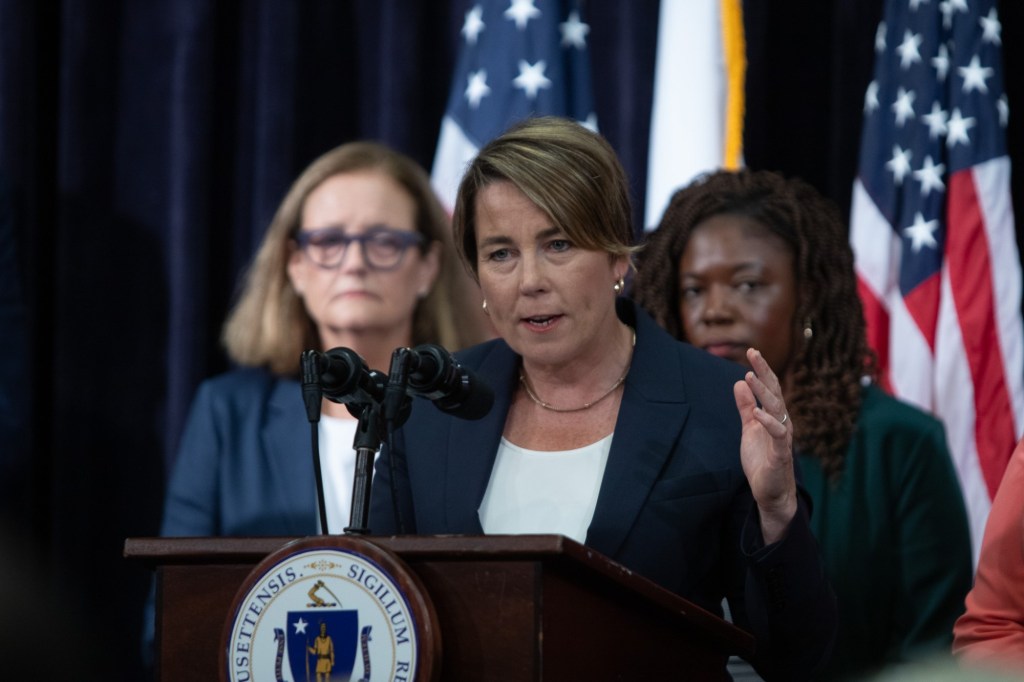
Gov. Maura Healey declared a state of emergency in Massachusetts Tuesday as local emergency shelters fill up with an ever-increasing number of migrants arriving from other countries and surging housing costs hurt residents already here.
Healey is the latest governor to turn to emergency action to respond to migrants fleeing unstable conditions in their home countries. The Massachusetts Democrat also paired the declaration with a full-throated appeal to the federal government for funding and expediting work authorizations for migrants, which she said was a primary driver of the emergency.
At a press conference inside the State House with shelter providers, faith leaders, and other advocates, Healey said the emergency declaration directs local officials to utilize “all means necessary” to secure housing, shelter, and health and human services to address the “humanitarian crisis.”
“These families include newborns, very young children, and expecting mothers. It’s more families than our state has ever served, exponentially more than our state has ever served in our emergency assistance program,” Healey said. “These numbers are being driven by a surge of new arrivals in our country who have been through some of the hardest journeys imaginable.”
A steady stream of migrant families arriving in Massachusetts over the past year has put a strain on the state’s emergency shelter system. As space dwindled, the Healey administration turned to everything from hotels and motels to college dorms and military bases to house people.
A spokesperson for the Executive Office of Housing and Livable Communities said 5,550 families were in state shelters as of Monday morning — 1,887 in hotels, 3,546 in permanent shelter, 62 at Joint Base Cape Cod, and 55 in a college dorm in Quincy.
The numbers cover more than just newly-arrived migrants, the spokesperson said, though the administration estimates that just over one-third of sheltered families are new arrivals. Healey said the data points are 80% higher than one year ago and represent more than 20,000 people.
Shelter providers have stepped up over the past year to bring online thousands of shelter units with help from the state, said Father Bill’s and MainSpring President John Yazwinski.
“But the demand continues,” he said. “And now we need a change in approach if we’re going to meet the unique and varied needs of our both extremely low-income Massachusetts residents, as well as our newly arriving families.”
As part of her appeal to federal officials, Healey sent a letter Tuesday to U.S. Homeland Security Secretary Alejandro Mayorkas that said “burdensome barriers” to work authorizations for newly-arrived migrants is one of the main drivers of the crisis in Massachusetts.
Massachusetts “has stepped up to address what sadly has been a federal crisis of inaction that is many years in the making,” Healey said.
“But we can no longer do this alone,” Healey wrote in the letter. “We need federal partnership, federal funding, and urgent federal action to meet this moment and to continue to serve some of our most vulnerable families.”
A spokesperson for the U.S. Department of Homeland Security did not immediately respond to a request for comment.
Healey said speeding up work authorizations would help Massachusetts businesses at a time when they are encountering “significant labor shortages.” Congress “has simply failed to act” on work authorizations, Healey said, and wait times stretch from several months to several years.
“We know there are employers around this state, across industries, who are looking for that workforce. It’s also a talented workforce,” she said.
The last time Massachusetts was in a state of emergency was from March 10, 2020 through May 11 as a result of the COVID-19 pandemic. A state of emergency was also declared in September 2018 for the Merrimack Valley gas explosion.
Healey would not say how long she expects the new state of emergency to last, only telling reporters that “we’ll do whatever is necessary.”
A governor is granted the power to issue a proclamation “setting forth a state of emergency” in the event or imminent threat of a natural or man-made disaster under a 1950 law that has been updated over the years.
Massachusetts is also a right-to-shelter state, which means eligible families have immediate access under a 1983 law to housing options. Healey said she was not considering lifting that law and does not “have the authority to end right to shelter in the state.”
Republican state Rep. Peter Durant, who is running for a central Massachusetts Senate seat, called for a repeal of the law, arguing the state has become a “magnet” for migrants.
Healey is not alone in taking emergency action over immigration woes. New York Gov. Kathy Hochul issued an executive order in May that allowed for the mobilization of the National Guard as the state prepared for an increase in newly-arrived migrants.
The lead-up to the state of emergency saw the Healey administration open two welcome centers in Allston and Quincy this summer to help families find temporary and longer-term shelter as well as basic necessities.
Healey administration officials have also turned to a lengthy list of hotels and motels — more than 40 as of Tuesday — in 80-plus municipalities to house people on a temporary, emergency basis. The cost of those state contracts is unclear but could run into the millions.
Local nonprofits have also sought to recruit private residents to briefly house migrant families in their homes or apartments. Lt. Gov. Kim Driscoll urged those with an extra room in their home to consider hosting a family.
“Safe housing and shelter is our most pressing need,” Driscoll said.