Photographs on the staircase wall inside the Anne Spencer House in Lynchburg show some of its famous visitors: poet Langston Hughes, Justice Thurgood Marshall, inventor George Washington Carver, and actor and activist Paul Robeson, among others.
Spencer was a poet of the Harlem Renaissance, the African American cultural revival of the 1920s and 1930s. Her works, infused with botanical references, explore human relationships, the rights of women, and nature. After being born near Danville in 1882, she lived most of her life in Lynchburg, where her home became a pilgrimage site for Black writers and intellectuals to discuss literature, poetry, politics and her greatest passion, gardening.
“My grandmother never lived in Harlem, but I would say Harlem came to her,” said Spencer’s granddaughter Shaun Spencer-Hester, executive director of the Anne Spencer House & Garden Museum.
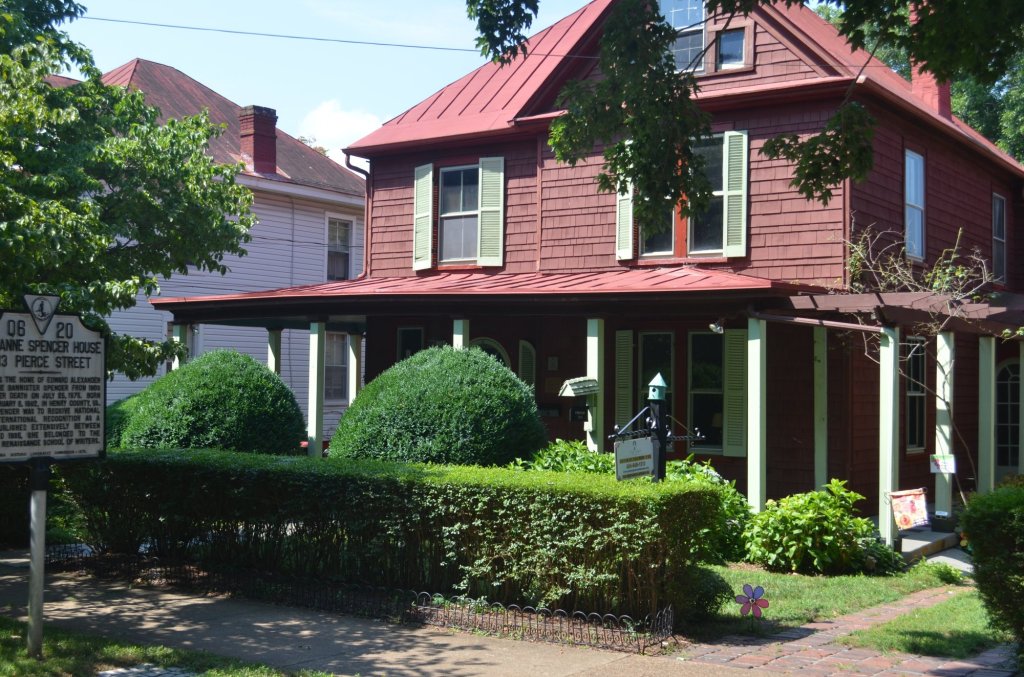
My wife, Carol, and I recently traveled there, where we met Spencer-Hester. The house, on Pierce Street, is remarkably intact: More than 95% of the furnishings are original to her grandparents. Indeed, walking through the front door is like entering a home, not a museum. The house, a Virginia Historic Landmark, is also on the National Register of Historic Places.
The fact that the house and its furnishings remain so intact is thanks to Anne Spencer’s son (and Shaun’s father), the late Chauncy Spencer, who saw the value of keeping his parents’ home available to the public.
Anne Spencer did not publish many poems, about 30. She wrote primarily for herself, not for a wider audience. But her distinguished house guests recognized her talent and urged her to seek publishers. Her poems have been widely anthologized, and she was the second African American to be featured in the Norton Anthology of Modern Poetry.
“There’s so much to admire in the energy and musicality of Anne Spencer’s poems — her life in the Harlem Renaissance, as a practicing artist and as a civil rights leader, is such an important part of Virginia’s humanities legacy,” said Michele Rozga, an associate professor of English at Norfolk State University, in an email.
Anne Spencer’s husband, Edward, built their Queen Anne style house in 1903. He was a parcel postman and entrepreneur. She was a librarian at Lynchburg’s Dunbar High School; she had studied library science at what is now Hampton University. Together they helped found the Lynchburg chapter of the NAACP.
The hand of Edward is everywhere in the house. On his postal route, he’d collect discarded material to bring home. This is apparent in the kitchen, where there are two heavily padded red doors he salvaged from a Lynchburg movie theater when it was being demolished. The kitchen’s floor-to-ceiling cabinets are also products of his collecting.
Pasted on one of the cabinets is an excerpt from Spencer’s 1927 poem “Lines to a Nasturtium” written in a fine hand on contact paper decorated with nasturtiums. The words were copied by Amaza Lee Meredith, a Lynchburg-born artist and architect and a relative of Spencer’s by marriage.
Meredith’s copy reads in part:
… Day-torch, Flame-flower, cool-hot Beauty,I cannot see, I cannot hear your flutey Voice lure your loving swain,But I know one other to whom you are in beautyBorn in vain: Hair like the setting sun,Her eyes a rising star,Motions gracious as reeds by Babylon, barAll your competing;Hands like, how like, brown lilies sweet,Cloth of gold were fair enough to touch her feet …
It is a dramatic contrast to see this powerful poem placed on a cabinet door next to the kitchen sink and a box of dish detergent. In the dining room, the table is set with Anne’s plates, bowls, silverware and wine glasses. On the mantelpiece is Meredith’s stunning mosaic of multi-colored tiles surrounding orange, red and pink nasturtiums, commemorating the poem.
The sunroom off the dining room was added in 1922. It offers a view of the garden and has a big fireplace. Anne’s and Edward’s easy chairs are here. “It was my grandmother’s favorite place,” Spencer-Hester said.
She led us to the upstairs guest room. Some of the visitors who slept here include scholar W.E.B. DuBois, poet James Weldon Johnson, and politician Adam Clayton Powell and his wife, Isabel Washington Powell, a well-known dancer and actor. The bed is original, as are the blankets, pillowcases and quilt neatly tucked at the foot of the bed.
In Anne and Edward’s bedroom are twin beds covered by Anne’s quilts. In the middle of the night when she got inspired, she would write on the wall. “We called it her nighttime writing tablet,” her granddaughter said.
The writings are no longer visible. In 1944, they were covered up by Dolly Allen Mason’s painting “The Cocktail Party” pasted directly onto the wall. The original has since been removed, and in its place is a print.
A second-floor room overlooking the garden served as Anne Spencer’s dressing room. Her vanity is still there with her hand mirror, lamp, brushes, perfume and a summer hat.
Spencer-Hester envisions her grandmother in this room.
“She’s looking out on her garden,” she said, “thinking about what she’s going to do for the day.”
Much of Anne Spencer’s life revolved around her garden. Carol, the gardener in our family, pointed out flowering flat peas with pink petals, light blue clusters of hydrangeas, flame-like red and yellow lilies, and the soft white blossoms of larkspur. The garden has been re-created to reflect what Anne would have grown in the 1930s.

Central to the garden is Edankraal, Anne Spencer’s writing cottage built by Edward — “Ed” for Edward, “an” for Anne, and “kraal” for enclosure. The patio outside the cottage and the floor inside are greenstone rock slabs quarried nearby. Inside is the writing desk, her papers still in place and her shawl draped over the chair. A note from Langston Hughes thanks her for her hospitality.

Spencer-Hester told us stories about her grandparents. One day two boys from Virginia Beach who were visiting Lynchburg stopped Edward on his postal route and begged him to take their pet bird, which they would be forced to leave behind when they returned home. Edward took the bird and named it Joe Crow. Joe lived in Anne’s garden for the next 10 years. Today Joe Crow is commemorated on a bench in the garden built by seventh graders as a project after they visited the home.
Back in the upstairs dressing room overlooking the garden, we can see a large purple martin house on a tall pole. Was Spencer looking through the same window when she wrote her poem “Another April” later in her life?
She is too weak to tendher garden last year, thisyear — and old.The plants know, andcluster, running free.The wisteria, purple and white,leaps from tree to martinbox dragged down by globsof the fragrant wet petals …And the window from which she stares needs washing —
Anne Spencer died in 1975. She and Edward are buried in the Forest Hills Cemetery in Lynchburg.
___
If you go
Where: 1313 Pierce St., Lynchburg
When: Tours are by appointment only Wednesday through Saturday, April through October.
Tickets: $15; ages 65 and older, $10; under 12, $3; college student with ID, $5
Details: 434-845-1313, annespencermuseum.org