A reader and I recently compared notes about tomato varieties we are growing this season and some we’ve grown in the past. It seems we like some of the same varieties, including Early Girl, an early indeterminate variety that produces ripe fruit about 60 days after transplant. I added that I was leaving it out of my mix this year and that I am getting away from growing the indeterminate types. The reader asked why, and I joked, “Maybe I’m just getting lazy.” To be honest, there is a bit of truth to that.
I’ve addressed this in the past, but perhaps it’s a good time to revisit. Most tomatoes fall into one of two categories of growth habit: determinate and indeterminate. There is a third, semi-determinate, type, whose characteristics are somewhere in between. Determinate types set fruit in a relatively shorter time, and as the stems stop elongating, the bushy plants top out at 3 to 5 feet tall. Their growth is “determined.” After a concentrated harvest period, they die. Their bushy habit means growth is more easily managed, so they’re a good choice for containers.
Indeterminate types are much taller growing, from around 6 feet to, sometimes, more than 10 feet. The harvest is slow and steady, as they continue to produce more fruit along the lengthening vine. They require more pruning and training to keep them from toppling over. A healthy plant can keep going until the cooler fall temperatures slow it down, and frost finally finishes it off. (Another example is the popular Better Boy variety, 70 to 75 days.)
In choosing which type you want, consider the length of your growing season, the space you have and the time you are willing to devote to training the plants. Consider, too, how you intend to use the tomatoes. For instance, if you are making sauce to store, a determinate variety can deliver the amount you need in a short time frame and let you get your processing done.
Orchestrating an extended harvest with determinate types can require a bit more planning. You might choose several varieties with different maturity dates, or you might stagger your plantings. If you are sowing your own seed, staggering may complicate things: You’ll need to make successive sowings. Otherwise you’ll need to make an extra trip or two to the garden center to get transplants for staggering the times. I usually add a late planting of several plants, rooted from suckers later in June, to keep the tomatoes coming.
I grow most of my tomatoes in 18- by 15-inch round nursery containers, the ones that trees and shrubs are sold in. Years ago, I purchased a roll of concrete reinforcing wire and made 5-inch cages that fit around the containers. The system works well with determinate types, and they are much easier for me to manage. Containers do require frequent watering, but you can still call me lazy.
And one more thing
If it seems as if your tomatoes have been taking their good time ripening this season, you are not alone. I’ve heard it from a few friends. Halfway through July, I’m getting tomatoes, but I’m impatient with the slow dribble.
May and June were unseasonably cool, which may have contributed to plants’ getting off to a slow start. And then July came roaring in hot. Through the first two weeks of the month, daily temperatures averaged 82.2 degrees (90 daytime and 74.4 nighttime), according to the National Weather Service. For plants that were started late, these temperatures might have interfered with pollination and fruit set.
But I didn’t have this problem. What I have is plenty of large, beautiful green tomatoes that don’t want to color up and ripen. And ripening is about the proper temperature and a plant hormone called ethylene.
In optimum temperatures — 70 to 75 degrees — tomatoes take about six to eight weeks to go from pollination to full maturity, according to Cornell and Purdue universities. In the early stages of development, the fruits get bigger, reaching “mature green” stage in some 45 to 50 days. At this point — which is where I seem to be stuck — the lycopene and carotene pigments develop, coloring up the fruit and signaling its ripening. For this, optimal temps are 68 to 77 degrees. Above 85, tomatoes don’t produce the pigments, and above 85 to 90, ripening slows and eventually stops.
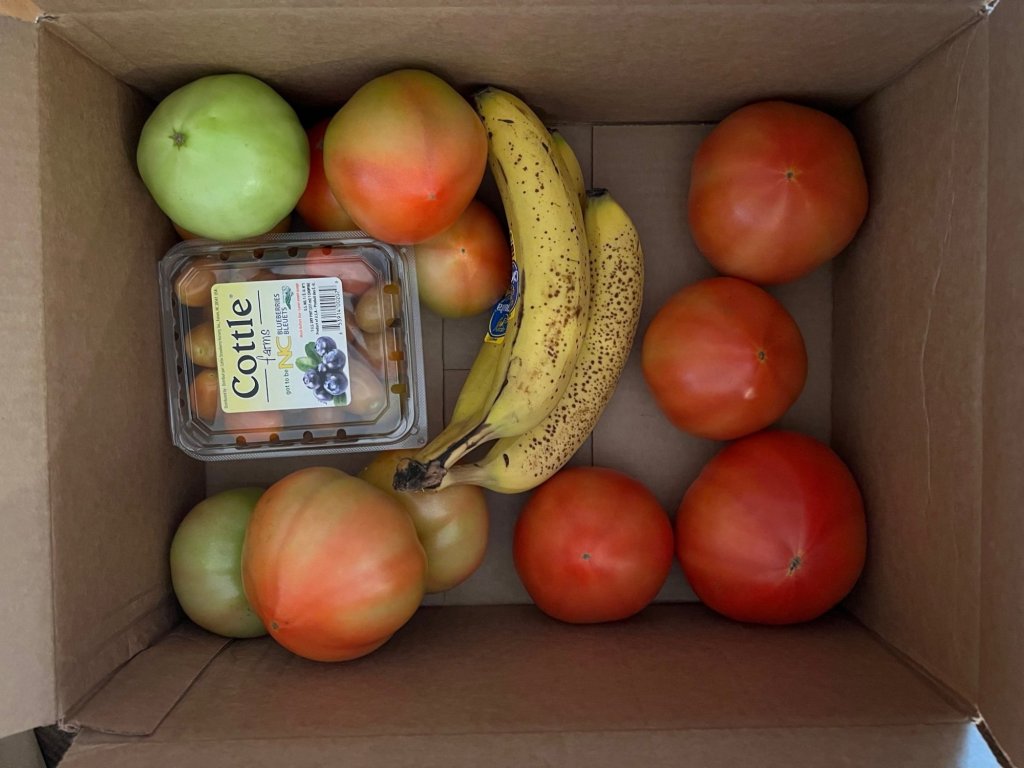
Is there a workaround? Yes! Call it the old banana or apple in a bag trick. Bring your tomatoes indoors where the temperatures are close to the optimum. Place them in a sealed paper bag or box with a ripening banana or apple (this provides the ethylene, or ETH). In a few days you should be on track. If the tomatoes were picked when the blossom end was pink, they should ripen in four to five days. Next, be sure to have good bread, bacon, lettuce and Duke’s mayo on standby. And don’t forget the mozzarella and basil.
What’s going on in your garden and landscape this year? Doing something differently or trying something completely new? Write in and let us know.
Send questions to [email protected]