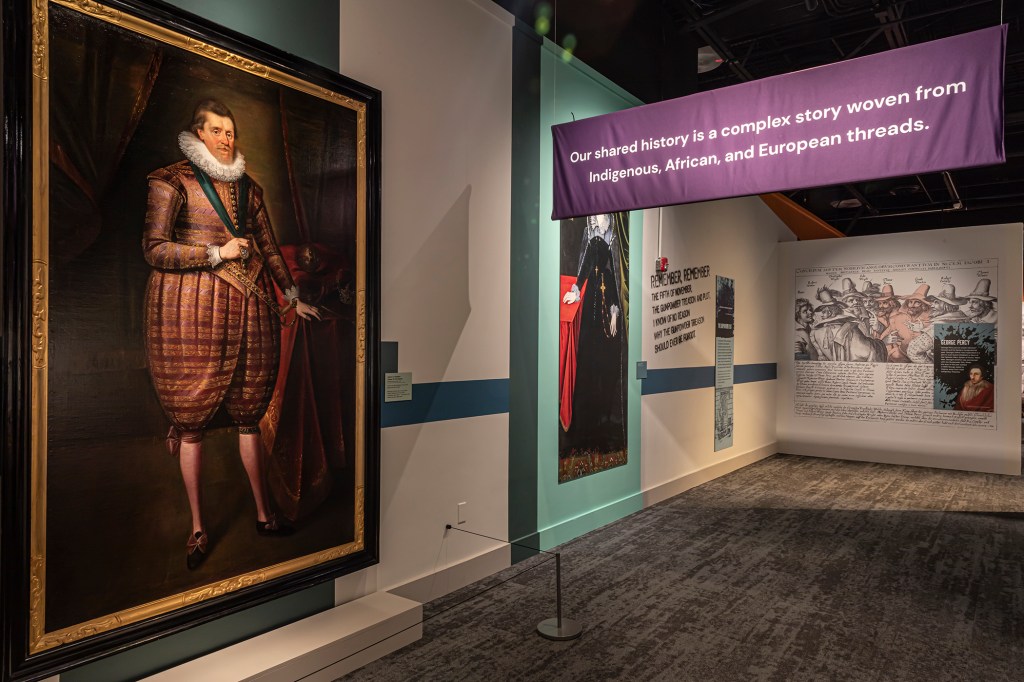
Only three weeks remain to examine “Reign & Rebellion,” a special exhibition in Jamestown and Yorktown that focuses on the Stuart monarchs of England and Great Britain and their effects on early America and Virginia.
Situated at Jamestown Settlement and the American Revolution Museum at Yorktown, the two-part exhibit will run through Sept. 19 and spans the 100-plus year reign of the Scotland-born dynasty.
The exhibit was extended to welcome “Outlander” author Diana Gabaldon, who will give a sold-out talk and book signing in Yorktown on Sept. 16. Gabaldon plans to include the end of the American Revolution at Yorktown in her 10th book.
“We’ve received overall very positive responses to this exhibition,” said Kate Egner Gruber, manager of curatorial services. “We hope that this multi-layered exhibit has shed light on the complex tapestry of Virginia history we are continuing to weave together in our Commonwealth because of its Stuart-era past.”
Not only does the presentation survey those historical events of the 17th century that shaped early Virginia, it also relates the lasting impacts the monarchy had on the later 18th century, continuing to today’s world.
Video introductions, developed for each location, present the significant elements that will be examined and studied. Do not expect to breeze through the exhibits, which include additional videos, as well as numerous artifacts and history-lesson narratives.
At Jamestown Settlement, where the story begins, the Stuart reign was intertwined with the beginnings of the Old Dominion. Important to the early settlers were the Indigenous people who lived in Tsenacommacah, a district of Chiskiak in the Powhatan Paramount Chiefdom.
The paramount chief, Powhatan, had to cope with the settlers while trying to maintain his own power and influence. Through those early years, there were military encounters and wars that James I of England (James VI of Scotland) faced in his initial years on the throne.
James I met Pocahontas, Powhatan’s daughter, when she visited London, and promoted trade in Africa. His heirs, the exhibit relates, established the Royal African Company that later supplied enslaved Africans to the colonies.
The exhibits at Jamestown Settlement include the Rolfe Family Bible. John Rolfe married Pocahontas, beginning that lineage of Virginia’s first families. Also included is a mourning ring of Charles I with a secret message.

Among the artifacts of the Indigenous is a turkey feather mantle, or cape, a reproduction of the type possibly worn by tribal chiefs and elders. It was hand-woven in the early 1930s by Mollie Wade Holmes Adams, a full-blooded member of the Upper Mattaponi nation whose husband was chief of the tribe at that time.
The American Revolution Museum at Yorktown continues the Stuart story, primarily demonstrating the impact of the era on Virginia today — the role of religion and the separation of church and state and the function of government.
Slavery is an important element in both portions of the exhibit with the ongoing reckoning with injustice and social and racial inequality existing today.
There is an in-depth examination of the Brafferton, the school at William & Mary where Indigenous children were educated, and a look at the Bray School, also associated with the college where free and enslaved Black children received an education within the city.
In addition to artifacts from the Jamestown-Yorktown collection, more than 125 artifacts are on loan from more than 25 international and national institutions and private collections. A number of early pieces are from the William & Mary Muscarelle Museum of Art and at Special Collections Research Center at William & Mary Libraries.

Jamestown-Yorktown Foundation
The Rolfe Family Bible, circa 1580, is one of the artifacts on display in the “Reign & Rebellion” exhibit at Jamestown Settlement. Before marrying John Rolfe in 1614, Pocahontas accepted Christian baptism with the name Rebecca. There is no record of her innermost religious beliefs or what she thought about Biblical teachings. Regardless, Virginia Company officials promoted Pocahontas as a successful convert. Courtesy of Jamestown-Yorktown Foundation
This exhibit is included with the general admission to the two state-operated facilities. There is a combined admission ticket of $30 for adults and $15 for children ages 6-12. Residents of James City and York counties and the city of Williamsburg, including William & Mary students, can receive free admission.
Additionally, in conjunction with the “Reign & Rebellion” special exhibition will be “Counter Cultures: Rebellion,” a special program on Saturday at the American Revolution Museum at Yorktown. From 11 a.m. to 5 p.m., visitors will encounter first-person portrayals of patriot/traitor Benedict Arnold in 1780, freedom fighter Gabriel Prosser’s wife Nan in 1800, suffragist Mary A. Nolan in 1917 and Civil Rights activist Fannie Lou Hamer in 1964.
For more information on the exhibits, visit jyfmuseums.org/events/special-exhibits/reign-rebellion.
Wilford Kale, [email protected]