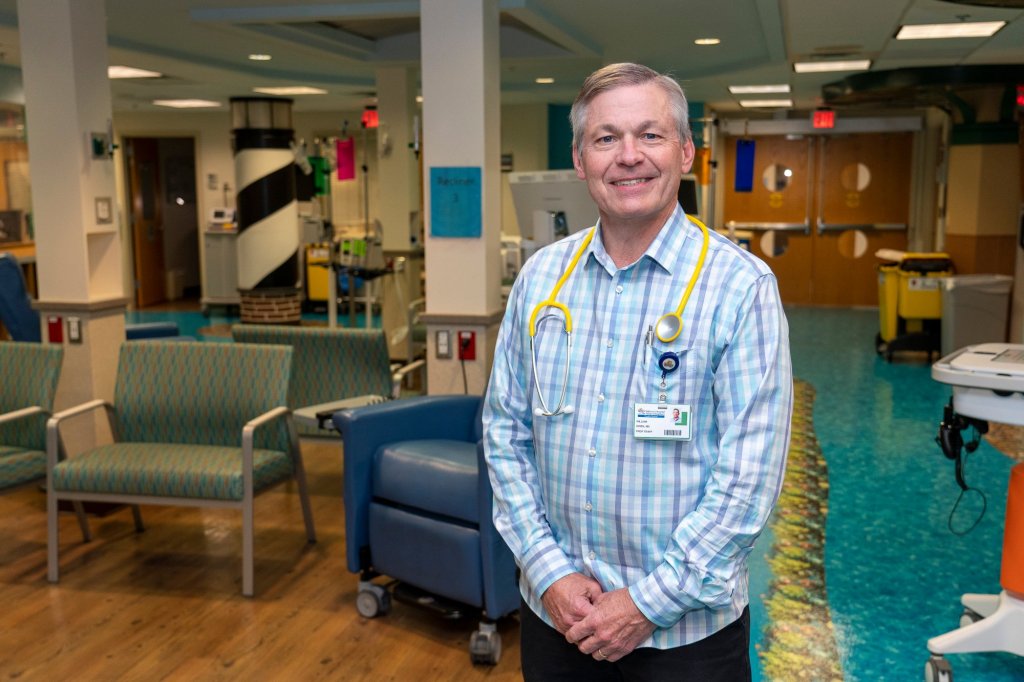
Award: Physician — Oncology
Dr. William Owen has attended many funerals for young patients, especially early in his career. But as treatments for blood disorders and cancer have improved, he’s found himself celebrating more with current and former patients as they graduate from school, get married and have children of their own.
Owen came to Children’s Hospital of The King’s Daughters in Norfolk 30 years ago to treat children at the Children’s Cancer and Blood Disorders Center and to be the medical director of the sickle cell disease program. He also is the academic medical director of the division of pediatric hematology and oncology at Eastern Virginia Medical School.
“Yes, I’ve attended funerals,” Owen said. “But we’re also able to see kids who grow through cancer treatment and have good outcomes. … There’s a lot of downs, but there’s a lot of ups.”
Owen said he entered medicine “on the upswing of better outcomes” for children with cancer. In the 1960s and 1970s, children with cancer didn’t do well, and care was largely aimed at relieving suffering, he said.
Today, with major treatment advances, 85% of children with cancer survive five or more years, according to the American Cancer Society.
Sickle cell treatments also are improving, but not as quickly. The disease, which mainly affects Black patients, did not get the same attention, federal funding or research dollars as other diseases, Owen said.
“It’s always been kind of an underserved population,” Owen said. “I like helping underserved populations, figuring out mysteries. That goes along with my interest in global health.”
Sickle cell is a group of hereditary blood disorders that result in lifelong issues with anemia, chronic organ damage and pain episodes. Many patients used to die before they reached adulthood.
Owen has been involved in clinical research that’s led to some of the treatments helping patients to live longer. He also has promoted sickle cell screening and education in this country and in Haiti and the Dominican Republic.
Sickle cell is difficult to manage because of all the problems it causes, Owen said. Treatments initially prolonged lives without improving them but in the last decade, progress has been made in decreasing complications, he said.
Tymiere Grayson has been a patient of Owen’s for 17 of his 18 years. By the time he was 9 months old, he had been hospitalized 17 times for sickle cell, said his mother, Genene Milligan.
They were living in New Jersey when Milligan did some research and learned about Owen and CHKD’s sickle cell program. Knowing nothing about Norfolk, she moved here so Owen could treat her son.
Grayson has had kidney and lung damage and needed a hip replacement, and he suffers from overall chronic pain. Owen has brought him “a long way,” Milligan said.
Grayson used to spend three out of four weeks a month in the hospital. Now he’s there about once every six months, Milligan said.
“Dr. Owen is just passionate about what he does,” she said. “I don’t know what we would have done without him.”
“He’s done so much for Tymiere, and also for me,” said Milligan, who was diagnosed in February with non-Hodgkin’s lymphoma, a cancer that begins in the lymph system.
Grayson was in the hospital for a pain episode, and Milligan was with him when she received her biopsy results.
“Dr. Owen was there on the floor and took the time to translate the results for me,” she said.
Owen cheered Grayson for graduating high school this June. Inspired by Owen, Grayson plans to be a sickle cell nurse.
Owen said it’s an honor to care for young patients like Grayson and be so involved in their lives.
“To see these kids get to normal milestones and be the given the opportunity to celebrate with those kids makes it all worthwhile,” he said.