REMLINGEN, Germany — Sascha Hruzik was serving in the German army nearly 20 years ago when he was asked to become a bone marrow donor.
He didn’t think twice. He is the kind of guy who will do anything for others.
A steelworker who has renovated much of his two-story home with his own hands, he is also a volunteer fireman who recently spent 48 consecutive hours rescuing residents in a nearby town from flooding.
So, 20 years ago, he got his mouth swabbed and his DNA went into the World Marrow Donor Association database. And for a decade, he didn’t think much about it.
Then in late 2015, a German Red Cross official knocked on his door.
Your DNA matches someone in the United States, he told Sascha. She’s terribly sick and without a bone marrow treatment soon, she will die. Sascha immediately agreed to be her donor.
That someone was my sister-in-law, Patti Minium Moonis, who lives in Newport News. Her husband was my brother, Mike, who died of cancer in 2001.
In 2015, Patti was sick with chronic myeloid leukemia, a particularly deadly form of cancer that had not been cured by four rounds of conventional treatment. Without a bone marrow transplant, she might survive a year, but more likely she had just months.
She has a loving second husband in Mike Moonis, who for years has worked two jobs to support the blended family of seven kids. He lost his first wife, Lea, to cancer. Now he and the kids were preparing for a life without their mother and spouse.
That November in Richmond, Patti got the infusion of bone marrow cells. It worked. Though health issues remain, she’s enjoyed seven years of life that in 2015 she did not know she would have.
But for months afterward, she wondered.
“I really wanted to get to know the person who saved my life,” she said. “I wondered if that would ever happen.” But many countries insist on donor anonymity.
In July 2016, she finally knew. She’d gone for her weekly appointment at the Massey Cancer Center’s bone marrow transplant clinic, and a nurse handed her an envelope. “From your donor,” it said.
Inside was a note. The writer had included his address but not his name. Attached to the note were two linked pearls.
Hello, unknown patient,
I am a 30 year-old man from Germany. I have belonged from the it goes well to you and you could celebrate Christmas with your family. This has made me and my family very happy!!! we wish you furthermore quite a lot of strength and would like to hand over to you this selfformed angel.
Dear greetings from your donator and my family
Patti wrote back. Not having a name, she chose “Otto,” the name of her German grandfather. The nickname would stick.
They began emailing on Facebook. But their communication was haphazard because no one in Sascha’s family speaks much English and Patti knew no German at all. Sascha’s wife, Nadine, speaks better English than he, and kept Patti up to date on how the family was doing.
Yet for seven years, Patti and Sascha did not speak.
That changed on June 30 when I picked up a rental car in Berlin, where I was visiting friends, and made the 140-mile drive to Remlingen.
Nadine had texted that Sascha would be home from work at 4:30 p.m., so I left Berlin around 10:30 a.m. and took a leisurely drive through the back roads of Germany. I killed time by stopping to take pictures and wander through the small towns.
I worried about how things would go because I speak little German and we had no plan other than for Patti and Sascha to connect by video call. The family hoped to find a friend to help interpret, but there were no promises.
When I arrived, four people were waiting on the front porch: Sascha and Nadine; Nadine’s mother, Conny; and Patrick, one of Sascha’s co-workers. Patrick was there, thank goodness, to interpret. Sascha and Nadine’s daughter, Johanna, was at a school party.
Germans often aren’t overly friendly when you first meet them. It’s a cultural thing I’ve come to understand, and things were a little formal at first. But I quickly felt like a member of the family.
They invited me in and we ate cake in their dining room. I told them of how my brother, Mike, met Patti. He was an editor at the Daily Press newspaper who interviewed her for an editing job.
He hired her; then they began dating and married. They were devoted to each other and their children until the day he died. I described how I was there when Mike died and Patti hugged him for a while, repeating “I love you” over and over. Tears welled in Nadine’s eyes.
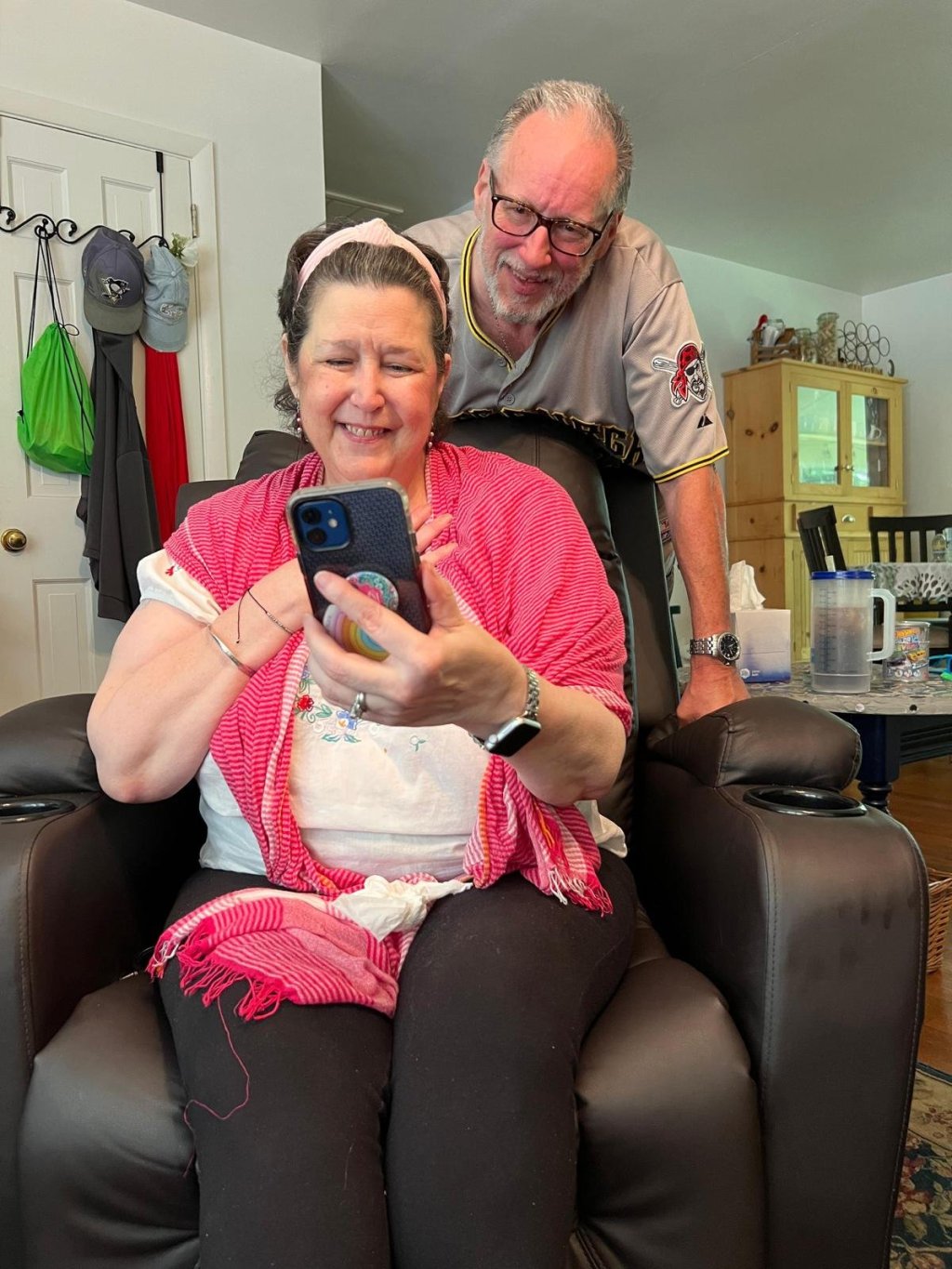
I suggested we do a WhatsApp video call with Patti, who was waiting in Newport News, where it was six hours earlier, with her husband and daughter. I called her and said, “Someone here wants to speak to you.”
I turned the phone toward Sascha.
“Hi, oh, hi!” Patti exclaimed. I couldn’t see her, but I could hear that she was already in tears.
“I am so happy to see you.”
Patrick translated: “He also says he’s happy.”
Pretty soon Conny was crying. Later, the two steelworkers were dabbing at their eyes. Eventually I lost it, too.
“This is,” Sascha said, “one of the greatest experiences of my life. I will never forget this day.”
“I can’t thank you enough,” Patti said later in the conversation. “It is unbelievable that you are so far away. I wish I could touch you.”
He did touch her, I said, with his blood.
“I wish I could give you a hug,” Patti said.
“He may not like it,” I replied, “but I’m going to give him a hug when I leave.”
“Is everything OK with the illness?” he asked.
“Yes. I’m in remission. Everything is perfect. You saved my life.”
He didn’t quite understand so I told him, “Alles sehr gut.” All is very good.
“You will always be my dear Otto,” Patti said later.
“Yes, I am,” he responded.
After about 20 minutes, I suggested we take a break and I would call back.
Nadine and Conny continued to weep.
___
In 2015, the Red Cross contacted Sascha and he went to a nearby hospital for tests. Patti, meanwhile, underwent treatment to essentially destroy her immune system lest it reject the transplanted cells.
Doctors needed to confirm that Sascha was healthy and an ideal match for Patti. Once the match was confirmed, he began injecting himself three times a day in the stomach with filgrastim, which increases the amount of certain blood-forming cells in the bloodstream.
Marrow can be drawn directly from the bone under anesthesia or can be distilled from a donor’s blood. Sascha’s procedure was the less invasive one; he spent a few hours in the hospital with IVs taking blood out of one arm and returning the blood to him in the other.
Patti, the former editor, has blogged about her struggles since my brother died, struggles that more recently have included breast cancer. On the blog, she posted her first letter to Otto:
Our seven children were terrified, six of whom already lost a parent to cancer … But I am alive and thriving thanks to you.
Sweet Otto, I just need you to know how special you are in my heart, in my husband’s heart, in my kids’ hearts. We consider you a member of our family – your blood pumps through my veins.
___
On our visit, I brought presents from Patti. After the first call, Sascha and the family opened them. He immediately claimed the T-shirt that said, “Someone in Virginia loves me.”
It was small and intended for Johanna, but he put it on anyway. He beamed as I took a photo, and he wore it the rest of the day.

I learned more about the family during the break. Sascha and Nadine grew up in Remlingen, a town of about 1,000 people nestled in rural Lower Saxony about 50 miles south of Hanover. They met when he was 12 and she was 11, and they’ve been a couple ever since they were teenagers. Nadine works with special needs students.
Johanna returned home during the break and was as shy as you would expect any 11-year-old to be. She sat on her dad’s lap as I called Patti again.
Johanna said little, but moments into the conversation, tears began rolling down her cheeks. Even at her age, but with a German schoolchild’s grasp of English, she knew her father had saved Patti’s life.
Goodbyes on the phone were hard. After we hung up, we talked about the experience.
“I was so excited and so happy to see Patti,” Nadine said. “We’ve waited so long.”
When we walked outside, we all hugged.
“Thank you so much,” I said as I hugged Sascha, “for saving Patti’s life.”
“I would do it again tomorrow,” he said. “To save someone’s life, of course I would do it. I am so glad to have talked to Patti. It’s so hard to put into words how much this means.
“I will never forget this day.”
___
For information on becoming a bone marrow donor, go to bethematch.com
Minium is a former Virginian-Pilot and Daily Press reporter who is senior executive writer for athletics at Old Dominion University. Reach him at [email protected]