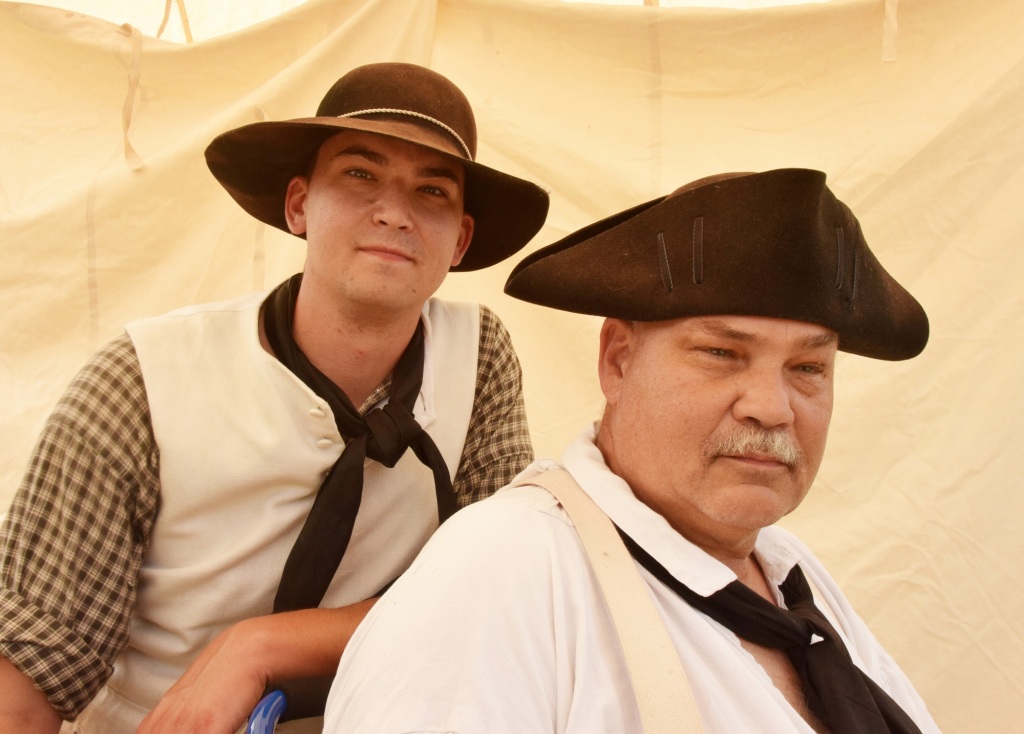
Visitors to the Great Bridge Battlefield and Historic Waterways Museum are often offered a realistic glimpse of the lives of 18th century sailors, pirates and privateers, courtesy of the Brethren of the Coast, a living history organization based in Hampton Roads.
Historically speaking, the Brethren of the Coast was a “loose coalition” of pirates, brigands, and buccaneers who prowled the waters of the Atlantic Ocean, Caribbean Sea, and Gulf of Mexico during the 17th and 18th centuries.
“Brethren of the Coast is a historical re-enactment group that focuses on maritime history and the watermen who worked on the waterways,” said Elizabeth Goodwin, museum director. “A lot of times, they’ll focus on colonial privateers. Today, they’re doing a cooking demonstration on what sailors would have cooked aboard ship.
“They fit in with our mission because we are the Great Bridge Battlefield and Waterways Museum. We talk about the sailors on the waterways. Most people don’t realize that events on the waterways were part of the Revolutionary War.”
Mike Johnson, a Chesapeake resident, founded the living history unit to explore the lives of privateers during and immediately after the American Revolution. Generically, the brethren of the coast included any buccaneer, freebooter, pirate, or privateer, according to Johnson.
“They basically did what they wanted. If they decided to take a ship, they took the ship and everything on it,” he said. “They would crew the ship and take it back to their home base. They’d sell everything on it. They would keep the ship and make it part of their fleet.”
Privateers were armed merchant ships that were granted a letter of marque from a government official with written permission to attack the shipping of an enemy country during wartime. The French, English and Spanish sanctioned privateers. America had privateers during the Revolutionary War that harassed British shipping. Privateers strengthened the navies. Merchant ships armed with guns worked as agents for governments.
If captured, pirates were hanged while privateers were generally treated as prisoners of war. Whether sailors were considered to be pirates or privateers had significant, often terminal, consequences. It was an important legal distinction.
“They had letters of agreement for distributing shares. Everybody got some type of share of everything that was taken and cashed in,” said Johnson. “Sometimes their shares would include physical items that they seized. Basically, the government got 50 percent. The other half of the take went to the captain and crew of the privateer.”
Johnson and his associates Eric and Connor Jeanneret agreed upon depicting privateers because few other groups were portraying privateers.
“We have no military regimen so to speak. We can wear mustaches and beards if we want to. We don’t have to be politically correct,” said Johnson. “We come from the merchant world. We’re just merchant seaman who are armed and work for the government.”
Johnson does what he calls a “sea chest presentation.” He pulls artifacts out of his sea chest relating to medicine and navigation and shares “tidbits of information” relating to seamanship with inquiring visitors. He hopes that his guests leave understanding a little bit about the life of a sailor in the late 18th and early 19th centuries.
Among the artifacts in Johnson’s chest are a pair of whale’s teeth engraved with scrimshaw featuring whaling scenes. Scrimshaw was a form of folk art produced by whaling men on bone and ivory. During long voyages, whalers often took up carving to pass the time. Scrimshaw comes from the term “scrimshanker” which means “one who wastes time.”
“These were given to me as whale’s teeth. I think they’re beautiful,” said Johnson. “All I know is that they spark interest. With that interest, I can tell a story. They represent the artwork of a sailor on a whaling vessel.”

Eric Jeanneret, a retired U.S. Navy veteran, enjoys portraying the cook aboard a privateering vessel in the age of sail. The crew appreciates his cooking, especially his savory bean soup.
According to Jeanneret, the ship’s cook was respected by the crew. Normally, the cook was a disabled man or an older sailor with years of seagoing experience. He was particularly valued for his maritime knowledge. Having an additional veteran sailor as part of the crew was considered a plus.
“He would usually have had to learn how to cook. He was respected for his prior knowledge,” said Jeanneret. “Even in today’s Navy, the one person that you don’t want to upset is the cook. You don’t want to upset the cook, the guy who pays you, the disbursing clerk, or the barber. Those three people could make your life miserable.”
The food aboard 18th century sailing ships was bland. Sailors usually ate beef, pork, or fish and rice, beans, or peas. Sailors were generally well fed. They received three hot meals a day whereas laborers ashore may have had only one meal and that may not have even been warm.
“They were getting about 4,000 calories per day. We were eating fairly well,” said Jeanneret. “They were definitely working it off. They were getting pretty decent food.”
Sea biscuit was an unsavory staple of the 18th century sailor’s diet. It was a mixture of salt, flour, and water that was double baked. There was really not much of a taste to it.
“It was designed as something that could fill you up, and something that could be preserved for a long time,” said Jeanneret. “You had to break it up, soak it. You could suck on the crumbs for a while to get some nutrition and some carbs.”
Food preservation techniques at the time were limited. Nearly everything was salted. All the meats were salted. When the cook was getting ready to prepare a meal, say pork, normally the cook would have to soak that piece of pork in water three separate times, just trying to get the salt out of it.
“There are diary accounts of a cook taking that piece of meat and dragging it behind the ship in the salt water just trying to get the salt out,” said Jeanneret. “It was just so salty.”
Grog was a mixture of rum, lemon juice, and water. Sailors were issued a daily grog ration, usually about a half pint. The lemon juice contained vitamin C and helped sailors avoid scurvy and kept spirits high too.
Especially in the 1700s, there were a lot of hogs and chickens roaming around the North Carolina-Virginia border. They survived shipwrecks and washed ashore. Livestock escaped from ships that came ashore and ran wild. Sailors were a superstitious lot. Chickens and pigs on sailors’ tattoos served as marks for identification and “insurance” against drowning. Sailors frequently tattooed a chicken on one leg and a pig on the other as protection.
“Sailors thought that they wouldn’t drown because so many chickens and pigs washed safely ashore. So they had the tattoos as protection,” said Jeanneret. “You see that even today. That’s an old sailor’s superstition.”
Connor Jeanneret, Eric’s son, is the youngest member of Brethren of the Coast. He also has years of experience in the maritime living history field.
“We used to belong to another unit called the Tidewater Maritime Living History Association,” said Connor Jeanneret. “We are still part of that unit, but we wanted to break off and do an earlier time period. We do mainly colonial history now but we will do War of 1812 when the need arises.”
Jeanneret finds the colonial period interesting, especially depicting the first privateers connected with the first (American) navy.
“Privateer comes from private-man-of-war. We were a seagoing militia,” he said. “They ended up combining the private-man-of-war idea with buccaneers, and they became privateers. That’s where that came from.”
Bean soup is Connor Jeanneret’s favorite shipboard fare. It’s simple and easy to prepare. Cooked properly, bean soup is delicious. It is basically a savory blend of navy beans and ham hocks with a few “secret” ingredients.

“We get our ham hocks from Piggly Wiggly. It’s just ham hocks and beans. We throw honey in there. We add some beef bouillon and some salt and pepper,” said Jeanneret. “That’s it. It’s a real simple one-pot meal. You let it boil for a couple hours. It just gets so good. It makes sea biscuit softer.”
Connor Jeanneret hopes that visitors to his camp leave with an appreciation and understanding for the difficult lives that 18th century sailors lived.
“A sailor’s life was the worst and best of both worlds. Being a sailor during this time period, an enlisted sailor, you were asking for one of the hardest lives you could get. It was extremely dangerous. You basically became an able seaman by surviving for a year, give or take. Being a sailor on watch was so dangerous. There were no safety harnesses for climbing. There was no GPS. There was no radar. Everything was kind of a ‘guesstimation’ about where you were using celestial navigation and the tools of time.”
While a sailor’s work was demanding and the work environment was dangerous, sailors’ pay was comparatively good. An 18th century sailor could easily survive on the compensation he earned.
“A young single sailor wouldn’t necessarily struggle. You were making enough money. You didn’t have to pay bills. You didn’t have to pay for a place to sleep,” said Jeanneret. “You didn’t even really have to worry about clothing or food. Your room and board was taken care of. It was a way to make a decent living and even save up if you were smart.”