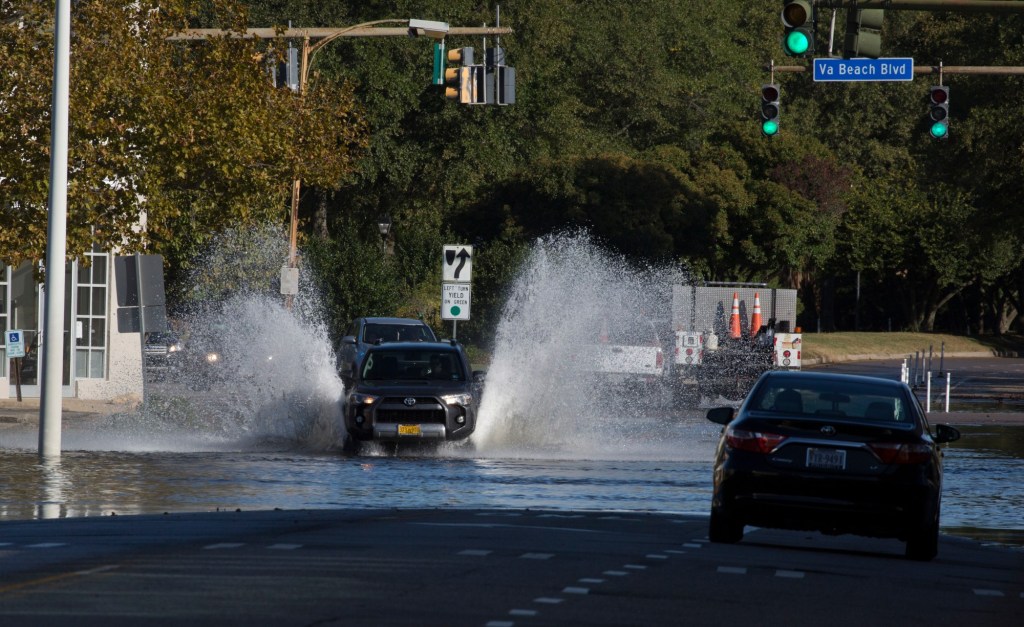
The National Oceanic and Atmospheric Administration has released its yearly outlook for high-tide flooding, and the greater Hampton Roads area is looking at anywhere between nineand 19 high-tide flooding days.
The average for high-tide flooding days in the mid-Atlantic, also called “nuisance flooding” or “sunny-day flooding,” was eight days, according to Nicole LeBoeuf, assistant administrator for NOAA’s National Ocean Service. Nationally, the average last year was four high-tide flood days.
At Sewells Point in Norfolk, the 2023 estimate is anywhere between 15 and 19 days. On the Eastern Shore, the estimate is closer to 9-13 days.
“The 2023 annual high-tide flooding outlook projects us coastal communities will see four to nine high-tide flood days on average between May 2023 And next April,” LeBoeuf said. “That’s up from last year’s prediction of three to seven days. NOAA’s 2022 data also indicate the increased high-tide flooding is not isolated to a few regions.”
Last year, Sewells Point recorded 12 flood days, and Kiptopeke on the Eastern Shore saw 11.
Unsurprisingly, factors such as sea-level rise and El Nino effects are likely the cause of a lot of the increase over the past year. LeBoeuf said by 2050, NOAA predicts that coastal communities across the nation will experience an average of 45 to 85 high-tide flood days per year.
Last year, the administration announced plans to unveil a new model in 2023 to more accurately predict when and where high-tide flooding will likely occur up to a year ahead of time. Details of the update were published in December 2022.
“NOAA currently provides a range of dates each season when the tides will be highest,” reads a statement from NOAA when the update was announced. “With this update, each day in the calendar year will be assigned a likelihood of actual flooding to occur to better enable communities to make risk-informed management decisions, like whether to close roads, perform maintenance on storm drain systems, or prepare flood mitigation actions for vulnerable infrastructure.”
On Tuesday, National Ocean Service oceanographer William Sweet said there are many reasons that high-tide flooding is increasing, especially for mid-Atlantic regions like Hampton Roads and the Outer Banks. He said global anthropogenic warming, which is higher temperatures caused by human behavior, has likely made a large impact.
“The mid-Atlantic is definitely an area with high rates of land subsidence versus natural and unnatural reasons — natural being compaction of sediments, sort of an impact crater that had formed billions of years ago,” Sweet said. “There’s also still settling from the last glacial maximum, as well as some natural reasons, pumping of groundwater for drinking. That is really currently causing about half the overall rate that we’re witnessing. It’s hard to really break it down in terms of floods that are caused by land subsidence versus sea-level rise. There’s a very strong signal in the ocean-rise component itself that upwards of 70% or so of the rise that we’ve been experiencing in the last several decades has been attributed to anthropogenic warming.”
Leadership at NOAA and the National Ocean Service say the estimates aren’t to scare residents, but to prepare them. They said they hope the tool will be used to help guide decisions and priorities for local leadership and communities when it comes to flood infrastructure.
“(Civil engineers) are going to be looking at this now as they’re planning out those construction projects to look at when it’s a good time to be doing excavation and when it’s a good time to maybe not,” said Karen Kavanaugh, coastal hazards oceanographer with NOAA. “So, I think eventually, as this is wrapped up into weather forecasts and stuff, this will be that much more useful for a daily use, such as finding your commute or getting your kids to school and stuff like that. But we’re working up to that.”
Eliza Noe, [email protected]