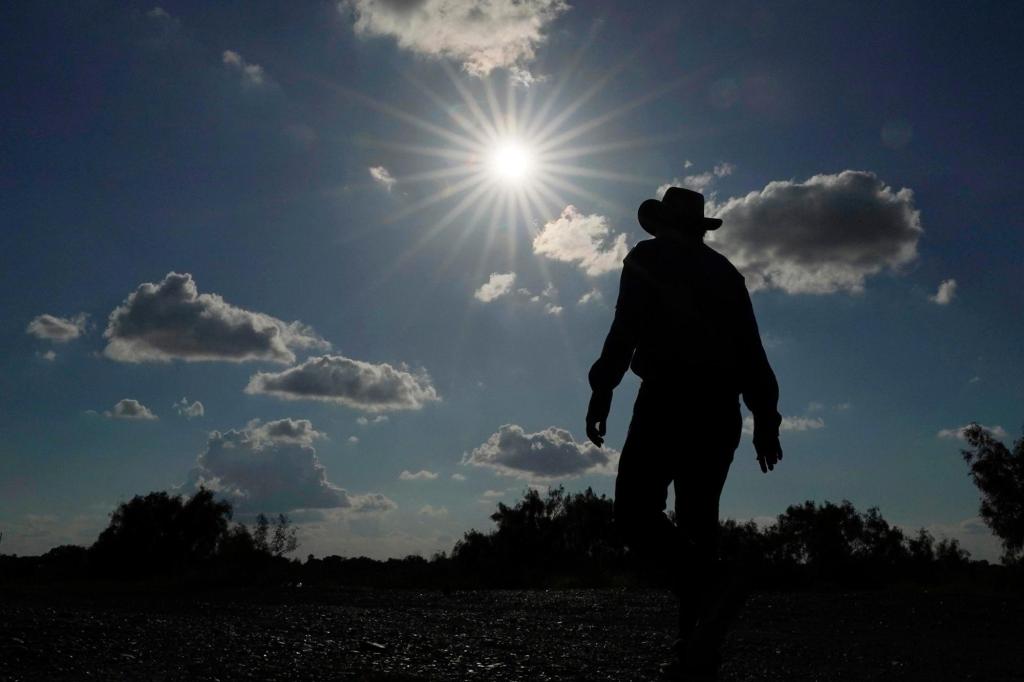
Seems things are heating up just a tad. I’ve recently read a few articles bemoaning the fact that the average temperatures worldwide are on the increase, with many areas recently seeing record high temperatures. Dr. Maria Neira, an environmental scientist and director of the Public Health, Environment and Social Determinants of Health Department of the WHO, recently stated: “Yes, it’s hot. But this could be one of the coolest summers of the rest of your life.”
Really? Wow!
I believe my first real conscious sense of truly oppressive heat was those two summers spent in the third floor apartment my parents rented in Langley Park, Maryland, while my father completed his studies at the University of Maryland. The heat radiated downward from the flat tar roof into our apartment below, often making sleep impossible. Between the heat and a mandated 7:30 bedtime, I was convinced I was finally in that Hell I’d been hearing so much about in Sunday School.
Dad finally gave up and tapped out. He said he needed a window A/C for the master bedroom where he studied because it was just too darn hot in there. After it was installed, I used every excuse I could think of to sneak in to enjoy a few minutes respite from the blazing inferno of the living room. Ultimately, I was always discovered and run out. It was an early, but immensely important, life lesson: Some get A/C, some don’t.
Air-conditioning became a moot point in our family dynamic when we moved to California, land of the ugly — yet functional — rooftop sump cooler. These are essentially just big metal boxes mounted on your roof containing a cage-style fan and a water-filled pan at the bottom over which the air is blown as it enters the ducts into the home. Despite many triple digit days in Southern California and the San Joaquin Valley — where the streets would actually start melting — we never did have air-conditioning. It didn’t seem to slow us kids down too much, and we roamed the neighborhood from morning until dinner time with only occasional stops to drink from someone’s garden hose or run through a lawn sprinkler.
I’ve lived in the South since I was 20 years old, and in my younger days, I rented a few older homes that had no A/C. To keep things somewhat bearable, my wife and I would use the cheap 20-inch box fan we bought at Kmart and move it from room to room around the house as needed. At night, it was placed in an open bedroom window, where it would blow hot humid air over us until we’d eventually pass out from sheer exhaustion on sheets puddled by our own perspiration. Affordable rentals with whole house A/C, or even just a big window unit, were highly desirable but few and far between for a young couple in Gainesville’s student ghetto. I’ve come a long way from those early days, but the experience did give me a profound appreciation for life’s little luxuries.
Unfortunately, not everyone enjoys the same comforts I take for granted. I wonder how, at this stage of life, I would cope with the loss of this luxury. It’s a somewhat sobering but realistic question to ask, given southern and western parts of the country are currently enduring extremely high temperatures. Even countries in Europe and in our Northeast and Northwest, none typically big on air-conditioning, have been suffering through hotter summers in recent years. Despite nearly 90% of households nationwide having some sort of air-conditioning, many households still do not have it.
Regardless of one’s views on the subject of climate change, some facts can’t be denied: The planet has seen an increase in the average temperature worldwide of roughly 2 degrees Fahrenheit since 1900. Current projections call for a minimum 4-degree increase by the end of this century. The impact of such temperature increases is already being felt and can’t be overstated.
From the challenge of raising crops and animals to the warming oceans’ impact on both marine life and weather, the fragile balance of nature is tilting in a direction that doesn’t bode well for us here in the first quarter of the 21st century. One recent article even points to possible mass migrations of entire populations away from regions of Africa, Asia and South America already experiencing food instability due to the devastating effects of heat and draught.
Despite such apocalyptic thoughts, I’m no “end timer.” I remain hopeful for the future — that greater minds than mine might somehow find a fix which ensures a continuing quality of life for us all. In the meantime, if you need me, I’ll be enjoying the A/C and a cool drink at my place while hoping things don’t go completely off the rails any time soon.
W.R. van Elburg is a James City County resident. He can be reached at [email protected].