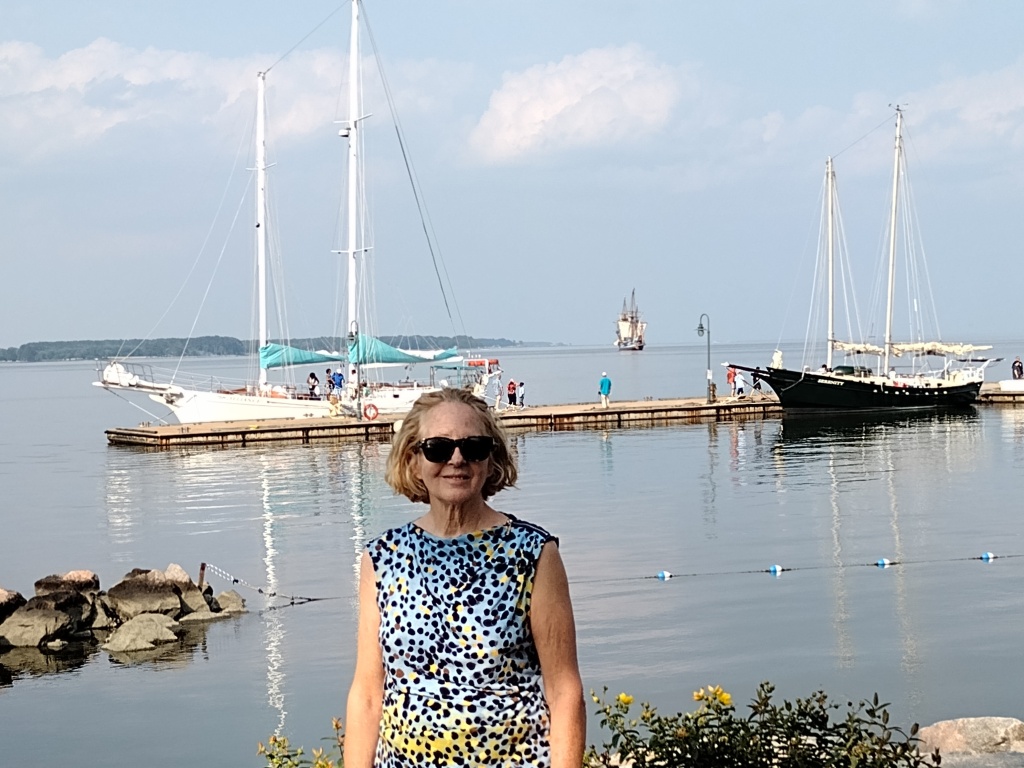
GLOUCESTER — Becoming one of America’s first female airline pilots was a dream come true for Mary Bush Shipko.
But the job was also a nightmare.
Hired in 1976 by Hughes Airwest, the airline owned by magnate Howard Hughes, Shipko said she endured 5½ years of sexual harassment, discrimination and bullying that damaged her physical and mental well-being.
Now 74, the Gloucester Point resident is an author and speaker who shares her story and that of other early female commercial aviators. Her latest self-published book, “The Firsts: Women Pilots and How They Changed the Airlines,” also aims to inspire young girls and teenagers to pursue their own dreams.
“Certainly, things have changed for the better, but it’s still powerful to know about our past,” Shipko says. “These women showed amazing courage and resilience, and they opened doors that other women can now walk through.”
“The Firsts” is an insider’s look at six early female airline pilots in the United States, including Shipko. All were hired in the 1970s, from Emily Warner at Frontier Airlines in 1973 to Jill Brown, the first Black female pilot, at Texas International Airlines in 1978. The book also touches on the stories of trail-blazing aviators around the world.
“The Firsts” follows Shipko’s 2015 autobiography “Aviatrix: First Woman Pilot for Hughes Airwest,” and a 2022 children’s book, “Daring Mary: Aviation Pioneer.” She and her husband, Gary Smith, have lived in Gloucester since 2018.
A Florida native, Shipko was raised by a pilot father who encouraged all six of his children — three sons and three daughters — to fly. Shipko was sitting in her dad’s lap during flights by age 5, took flying lessons as a teen and accomplished her first solo takeoff and landing at 16.
“That was such a mixture of excitement, anxiety and joy,” she recalls. “It’s like when you get to drive a car on your own for the first time after getting a license, only much better and to me much more fun.”
Shipko earned an Industrial Technology degree from Florida International University while continuing to rack up her pilot ratings. She knew that working for a passenger airline would mean steady work and good pay, yet women had largely been dismissed as pilots.

During World War II, for example, volunteer females weren’t allowed to fly combat missions and instead delivered planes to men in the field or handled other domestic tasks. Even in an early job flying cargo planes out of Miami International Airport, Shipko often was denied work because male pilots didn’t want to fly with her.
But when Shipko was 25, a brother — the only other sibling who wanted to be an airline pilot — was lost at sea during a flight. “I became determined to complete my goal, for my parents and myself,” she says. “I didn’t care how much I had to struggle. Nothing could stop me.”
At 26, Shipko landed her job at Hughes Airwest after applying to 50 airlines. From the start, she said, her male colleagues attacked her abilities and made lewd comments, dirty jokes and sexual advances, and even looked at pornographic images in the cockpit. Complaints to her superiors, a labor lawyer and the Equal Employment Opportunity Commission went nowhere.
“They all told me to suck it up,” she says. “I kept thinking I could overcome it. I tried to gracefully survive it, one incident at a time, but eventually I lost all hope and self-confidence. It took me years to gain that back — to feel human again.”
In 1981, Shipko, by then a DC-9 first officer, left Hughes Airwest with health concerns that included anxiety, depression, weight loss and a form of post-traumatic stress disorder. She went on to earn a Master of Social Work from the University of Georgia and saw a psychiatrist who introduced her to the expression “hostile work environment.”
As times changed, Shipko later brought a workers’ compensation claim against her airline, winning the first trial before declining to go through a second. She also successfully fought for a medical retirement, which thanks to a series of mergers is through Delta Airlines.
Researching “The Firsts” made Shipko realize that many of her fellow female pilots had experienced the same open hostility as she had, none of it related to their abilities. At least two others had retired for medical reasons, in fact, and later were diagnosed with PTSD. Not surprisingly, women of color had faced even greater resistance.
Today, Shipko is the proud mother of two grown sons — both color-blind and unable to be pilots — and three stepdaughters, who have five children between them. She enjoys boating, cooking, hiking, gardening and playing second violin in the Courthouse Community Orchestra.

Fifty years after Emily Warner’s hiring, only about 6 or 7 percent of U.S. airline pilots are female, according to Shipko, who plans to continue researching and writing on women’s aviation history for adults and children.
However, girls and young women can find plenty of support and scholarship opportunities through organizations such as Women in Aviation, the International Society of Women Airline Pilots and the Experimental Aircraft Association.
Their dreams, Shipko hopes, won’t come with any nightmares attached.
“Get a mentor and develop a plan, and you can make it,” she advises. “Don’t be intimidated by the amount of work. It’s worth it. Even today when I hear a plane overhead, I feel a sense of pride and think, ‘I can do that. I once did that.’”
Want to know more?
Shipko will be the guest speaker at 7 p.m. Friday at the Mathews Historical Museum, 200 Main St. in Mathews. Her remarks will precede a showing of Part II of a movie detailing Virginia’s role in aviation history, “Taking Flight — Stories of Modern Virginia Aviation, 1941 to Present Day.” She is available as a speaker as well as a resource to would-be young pilots and can be reached at [email protected]. Shipko’s books are sold online at Amazon and Barnes & Noble.
Alison Johnson, [email protected]