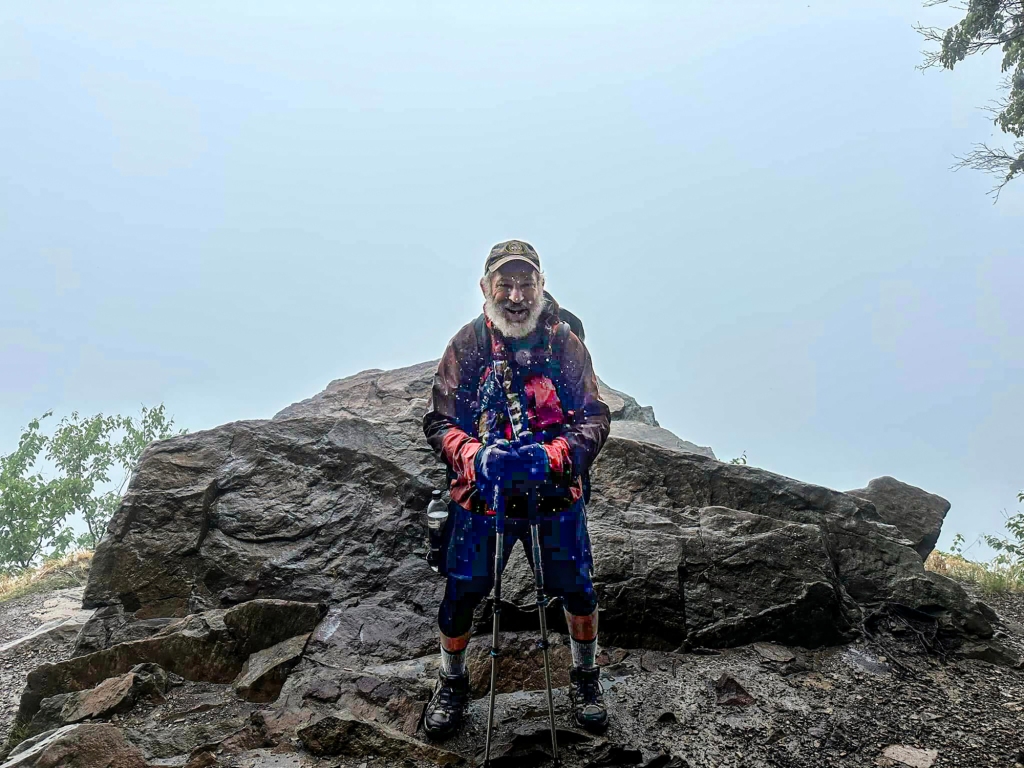
It took Rob Weisberg, also referred to by the trail name of “sleepwalker,” over 20 years to be able to sleep through the night again.
Weisberg, a volunteer firefighter of 29 years and a 9/11 survivor, said he had been sleepwalking through his life after the attacks.
Now, he’s walking the Appalachian Trail.
Having grown up as an Eagle Scout, Weisberg said he always knew about the Appalachian Trail and wanted to walk it.
“The woods were my happy place,” he said.
But after experiencing the 9/11 attacks firsthand and dealing with post-traumatic stress disorder, Weisberg said his desire to walk the trail slowly shifted to a need.


Since March 11, Weisberg has been hiking the Appalachian Trail to raise money and awareness for veterans and first responders dealing with mental health illnesses.
Weisberg started his journey in Georgia and plans to hike the entire 2,190-mile trail up to Maine. His trip took him through the Lehigh Valley this weekend.
The Appalachian Trail is the longest hiking-only footpath in the world, traveling through 14 states. Around 3,000 people attempt to hike the entire trail each year, with only a quarter of those people making it all the way.
For the past three and a half months, Weisberg said, his days have consisted of waking up around 6 a.m., getting on the trails around 7:30 a.m., hiking 15 to 18 miles per day and then finding a place for shelter to do it all over again the next day.
Weisberg said it’s been an amazing experience so far as well as “the most challenging physical and mental” thing he’s ever taken on intentionally.
“Out here I forget about everything,” Weisberg said. “This is what makes me happy.”
Throughout his journey, Weisberg said he’s encountered “trail angels,” who are people who have either hiked the trail in the past or are there to support the hikers.
They perform what Weisberg calls “trail magic,” in that they’ll provide hikers with food like hamburgers, hot dogs, kielbasa, pancakes and egg sandwiches, along with supplies to help hikers get through the day.
“Why did these people do it? Because they want to,” Weisberg said. “They just want to see a smile on your face when you’re leaving and know that you’re in a better place than when you first got there.”
Weisberg said he could be having a miserable day but once he hears there’s trail magic, “it could be pouring but the sun is shining.”
On the trail, Weisberg said he’s met lots of hikers and they all have one thing in common: wanting to succeed in the trail.
“I don’t know that person, but I want them to succeed just like they want me to succeed,” Weisberg said. “Everybody’s out there to help each other. We’re all in this together.”
Weisberg said he’s come across many people that are on the trail for different reasons and part of his reasoning was to “let people know they’re not out there alone” and if they need help, get it.
At the end of every day, Weisberg said he posts on Facebook about what his hike was like for that day and what life has been like living with PTSD.
Weisberg said the suicide rates in the veteran, active duty and first responder communities is high and people don’t talk about it.
There’s a certain stigma, Weisberg said.
It’s one he’s been hiding for 20 years now, but Weisberg said he’s tired of it and he’s not hiding it anymore.
“I just want to be me,” Weisberg said.
All of the donations received will go toward Paws of War, a nonprofit organization that trains dogs to support veterans, active military and first responders.
Weisberg attends the Paws of War support center in Nesconset, New York, and said he’s received lots of support and camaraderie.
“Unless you have it, you’re not going to really fully get it and there, I’m with a ton of other people that have it and get it,” Weisberg said. “They provide me with a safe place where I could just be me. Nobody judges me. Nobody points fingers. I’m just Rob.”
Weisberg said an expression he has with the boys he hikes with is to “embrace the suck.”
“There are gonna be days that just suck, deal with it,” Weisberg said. “You have a choice: You can be cold and wet or you can be cold, wet and miserable. The choice is yours.”
Having hiked the trail for over three months now, Weisberg said he’s already recognizing the results when it comes to the change in his mindset.
“I was thinking about killing myself,” Weisberg said. “I went from thinking about killing myself to now be concerned about my safety.”
Weisberg said his biggest takeaway thus far has been “don’t quit.”
“I’m not talking about the trail. I think it’s more just life,” he said. “There are gonna be times it’s gonna suck but get help, because when you think it’s something that can be dealt with or managed or fixed or addressed, it can be. Don’t quit, because if you make that decision, you can’t turn it around.”