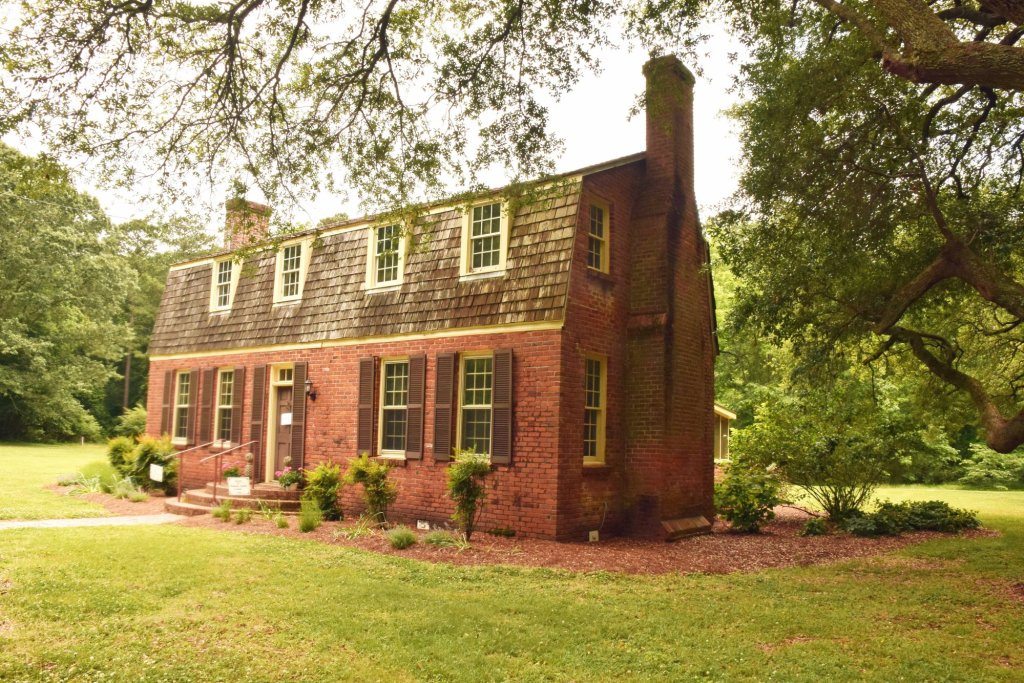
The Whitehurst-Buffington House has been designated as one of the 50 most historically significant historic edifices in Virginia Beach. It is, indeed, a place worth preserving.
Situated on an eight-acre site, surrounded by the West Neck Creek Natural Area, and located at the apex of a lengthy gravel-paved drive, the Whitehurst-Buffington House seems isolated and exceptionally peaceful compared to the bustling Virginia Beach Municipal Center on the other side of North Landing Road.
The Whitehurst-Buffington House Foundation, a not-for-profit organization, has been a primary driving force in the preservation of this historic home. Partnering with the City of Virginia Beach and other not-for-profit organizations, the foundation has actively promoted its historical significance as a living example of early American life in Virginia and recognized the property’s potential as a recreational oasis for the local community.
“A group of ladies including myself saw this house closed and boarded up by the city for 20 years,” said Phyllis Sawyer, foundation president. “This is city property. We are tenants in a city owned house. We have a 40-year lease,” Sawyer noted.
The foundation manages and operates the historic house while the city and foundation care for the property jointly. The city mows the grass and maintains the drive. City horticulturists work with the foundation in caring for the trees surrounding the historic house while foundation volunteers tend the flower beds.
“We have a wonderful relationship with parks and recreation and their horticulturists,” said Sawyer. “One of their supervisors, Symsi Denson, has been with us since before we ever got the house. She maintains a very friendly relationship with us. We have a great relationship with the city.”
While construction on the initial phase of the Whitehurst homeplace began in 1793, it continued to grow and evolve over the next two centuries under the conscientious stewardship of the Whitehurst, Bratten and Buffington families.
The original Whitehurst dwelling was a single room with an overhead loft for sleeping and an attached parlor hall for conducting business. Outfitted with a large brick fireplace and a heart-of-pine floor, the structure was a couple of cuts above the home of the middling Virginia farmer of the period — a simple cabin with a dirt floor and a clay-lined wooden chimney.
“All the cooking was done in the fireplace behind me, all of the meals,” Sawyer said. “The heat from the fireplace was a great source of light. This was the hearth of the home. At night there was a sleeping loft overtop of this room. Family members would have slept on a pile of blankets.”
The land on which the current house rests was owned by Francis Whitehurst who willed 150 acres to his son Daniel in 1793. Whether the single-room dwelling was built by Francis or Daniel Whitehurst is uncertain. Inscribed on an exterior brick in the chimney — “1793” — indicates the probable year of construction for the modest initial structure which was enlarged a few years later. It was locally called the Whitehurst Farm.
Daniel Whitehurst was a successful farmer and a respected figure in Princess Anne County (now Virginia Beach). He was appointed as a Princess Anne County Commissioner in 1820 and authorized the construction of a new courthouse and jail near his farm. Whitehurst willed the expanded Whitehurst residence and 150 acres of land to his son, James Murden Whitehurst who passed it on to his son James Howard Whitehurst who was born in 1843 or 1844.
During the War of the Rebellion, James Howard Whitehurst served in the 16th Virginia Regiment. He was wounded twice — first at Malvern Hill and later at Spotsylvania. After being captured at Amelia Courthouse and held briefly as a prisoner of war, he returned to his parents’ farm in Princess Anne County.
The Whitehurst Farm remained in the family until 1940 when it was purchased by George and Marie Bratten. The Brattens made significant changes to the exterior and interior of the old Whitehurst place. They covered the clapboard exterior in brick and added a kitchen, heating system, and indoor plumbing. Perhaps inspired by the Colonial Revival effort in Williamsburg, they retained the original fireplaces intact — and the engraved brick with the date.
“George Bratten had a business making barrels, shingles, and woodworking. He was very enamored with Colonial Williamsburg,” said Sawyer. “He added many of the details that you see inside the house, the woodworking, the wainscotting and the fancy mantels. Those were things that he supervised.”
Marie Bratten sold the updated dwelling to James (Jay) Buffington and his family. The Buffingtons added a screened back porch with a brick paved surface that matched the kitchen floor installed by George and Marie Bratten. The Buffington estate included the house, a stable, and a barn.
“James (Jay) Buffington was a banker. His wife was a very friendly, charming lady. She had been a society columnist in Maryland and wrote for the newspaper there,” said Sawyer. “They had two sons and a daughter. They lived here from 1953 to about 1985.”

Courthouse Associates purchased the property from the Buffington family and sold it to the City of Virginia Beach in 1986.
The city rented the former Buffington house to two teachers who served as caretakers for the house and barn. After the last tenants left the property in 2004, the historic old edifice was boarded up and all but forgotten.
An archaeological assessment by the James River Institute convinced the city that the house and grounds were historically significant enough to be proffered to an organization for public use.
A group of citizens — a precursor to the Whitehurst-Buffington House Foundation — prepared a proposal for preserving the old Whitehurst-Buffington home and property that was accepted by the city in 2011. The foundation immediately began working to preserve the vacated house by initiating efforts to provide critical fixes.
The furnishings, with the exception of a walnut corner cabinet, are gifts and donations and more representative of a country farm house than a museum. Collectively the furniture suggests a simpler time in the not-too-distant past rather than a specific period.
“Many of the things we have in here just came to us. By interpreting it as ‘a house over time’ we don’t limit ourselves to particular period furnishings,” Sawyer said. “When you put it all together, it creates an ambiance that is very warm and inviting.”
The foundation and city with the support of local citizens and organizations stepped up to restore and maintain a meaningful slice of Princess Anne County-Virginia Beach history for posterity.
A pair of large stone pineapples, compliments of Concrete Creations, flank the front door of the Whitehurst-Buffington House welcoming visitors to the historic home.

“The pineapple was a symbol of hospitality. Those stoneware pineapples were gifted to us by a business called Concrete Creations. They have been very supportive of us,” said Sawyer.
The Whitehurst-Buffington House is located at 2441 North Landing Road in Virginia Beach and is open for tours on Wednesday, Saturday, and Sunday from 1-4 p.m. For more information, call 757-427-1151.