Six weeks after our church received a bomb threat early on the morning of May 4th, the first word that comes to mind for me is this: gratitude. The outpouring of words of support that we received were so encouraging. Letters and emails and text messages from friends and faith leaders alike reminded us that we were doing such good and vital work in our community, and so many people pledged to pray for us. Dozens of churches locally, across the state and even across the world reached out with words of affirmation; if I were to list them all here, I would use up my entire word count for this article.
John Donne was right when he said, “no man is an island,” and the same should be said for communities of faith. We are beyond grateful for your prayers and thoughts and words of encouragement.
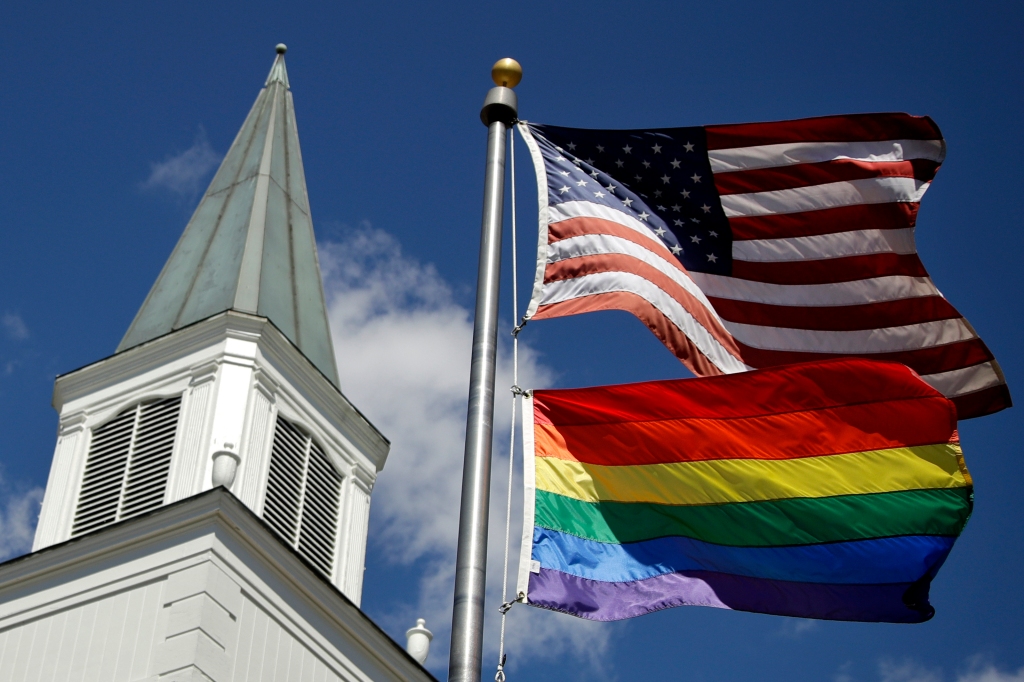
The person who phoned in the bomb threat accompanied it with a slew of anti-gay rhetoric. This was not surprising to us, given our open and affirming stance and our tendency to hang a rainbow banner out front to signal our welcome for all. That doesn’t mean the threat didn’t hurt or rattle our sensibilities, however. Rather than meeting for worship the following Sunday after the bomb threat, we gathered at a park and had a big picnic together. It felt more like a party, to be honest. We had a huge crowd and more food than we could have imagined. Children played on the playground and threw frisbees while adults talked and made new friends. We had a family of five join our congregation as members that morning, and another young couple told me, “We are now certain that this is the place that God is calling us to join.”
For me, the picnic represented a beautiful display of welcome and celebration of life that stood in stark contrast to the threat we had just received. It just felt good to be together, to be family and have fun and to welcome new people into our community.
When my thoughts linger on the threat, however, the secondary emotions I feel are anger and sadness. Anger at the senseless act that caused anxiety and fear, and sadness at the fact that this person thought there was no better way to deal with ideological and theological disagreements with our church. To me, this feels tragically symptomatic of where we are at as a country, with very low levels of trust between people who disagree politically and ideologically. As best as I can tell, this country was founded on the notion that each and every person has a right to gather in a community of worship that aligns with their beliefs and values. All people deserve to be able to gather for worship, or in schools, or in community groups and Fourth of July celebrations without fear of violence. All people deserve to feel safe. This is foundational to our democratic principles in this country. We have to be able to disagree peacefully and find ways to listen across party lines in order to have true dialogue. We have to remember that we are all in this together, and that our diversity is actually a good and beautiful thing. This is essential in faith communities, too, and we try so hard to model our unity in diversity in our own congregation.
If you and I disagree about something, let’s go get a cup of coffee and talk about it. We can even meet at Williamsburg Alewerks and hash it out over a couple of pints. I’d be glad to share why I believe what I believe and why being a fully inclusive church is so important to us. And I’d be glad to listen to your point of view as well. I would love nothing more. But please don’t attack us. We are simply doing our best to live out our values and our faith in a God who welcomes all. If someone is offended by our perspective, there are dozens of other churches they can attend.
Aside from tightening up some of our security measures at our church, most of us have moved on from the immediacy of the threat by now. A whole host of people, however, have asked how they can support us, aside from offering prayers. I’ve been thinking carefully about this, and this is the best I can suggest if you’d like to help in a tangible way: take some time to think about where you or your own faith community are at in terms of LGBTQ+ inclusion and acceptance. Then find a way to take a step forward to deepen your own understanding, wherever you are at. Good biblical scholarship has existed for decades that supports full inclusion of LGBTQ+ siblings in communities of faith, but we’ve just largely chosen to ignore it. There are a whole host of books out there that will help explain why traditional interpretations of Scripture and sexuality need to be reconsidered: we just finished a series on Colby Martin’s “UnClobber” at our church and found it tremendously helpful and accessible. Matthew Vines has a delightful and short book called “God and the Gay Christian.” “Transforming: The Bible and the Lives of Transgender Christians” by Austen Hartke is also well worth your time.
These are just the tip of the iceberg. As I think about our recent experience as a church, as well as the ongoing challenges and even dangers of being out as an LGBTQ+ person in our country today, taking one intentional step to learn more and deepen your own understanding would mean the world to us.
To everyone who has reached out to offer words of encouragement and prayers of support these past few weeks: we are beyond grateful. We love being rooted in Williamsburg, and we feel so blessed to be a part of this amazing community. Thank you!
The Rev. Dr. Art Wright is the senior pastor of Williamsburg Baptist Church.