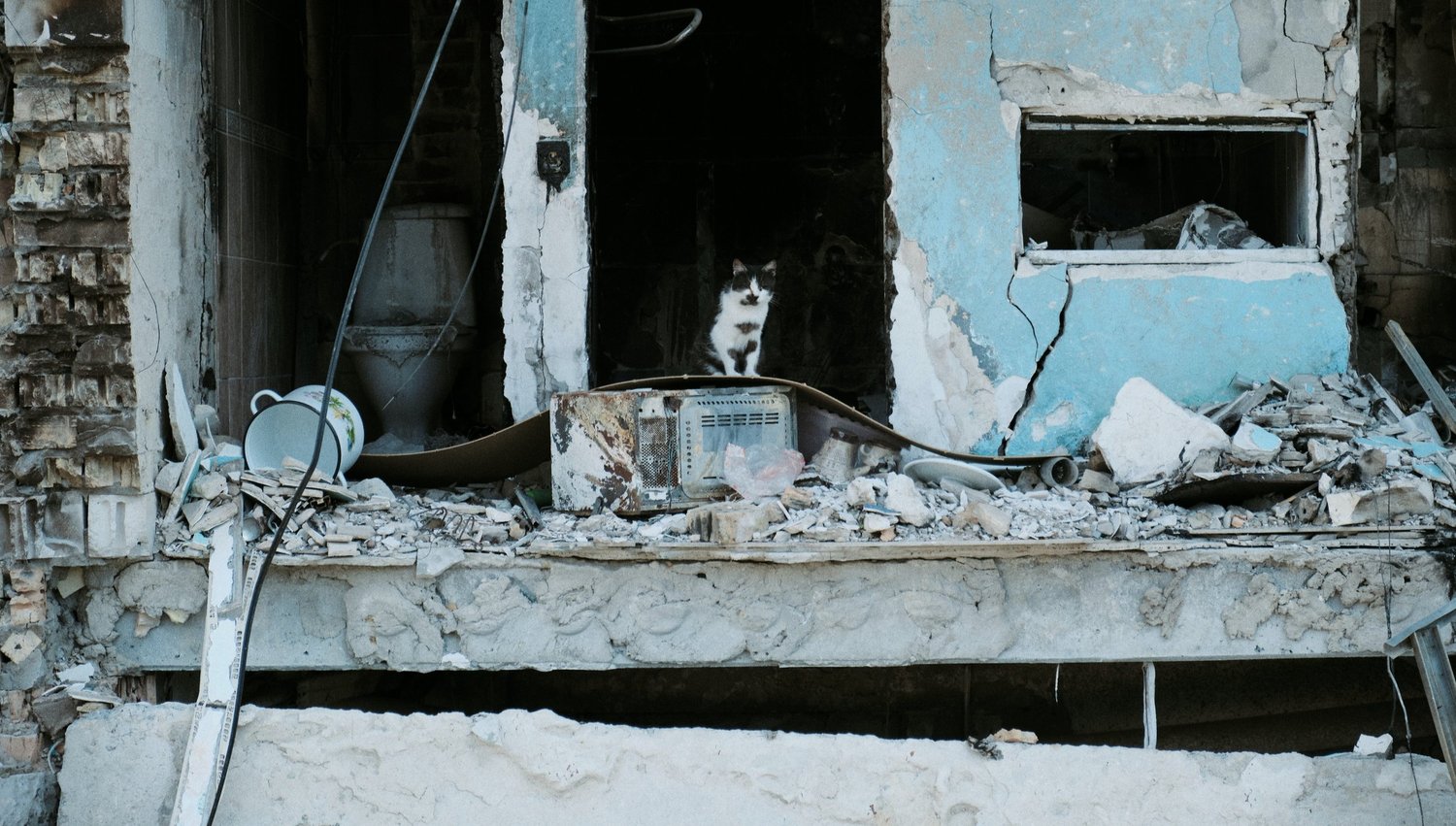
Mongols, Teutonic Knights, Napoleon, and the Germans are but a few of the many invaders who wreaked havoc from the Vistula to the Urals and created a fear of invasion that is deeply ingrained in the Russian psyche. Prior to the Mongol invasion of the 13th century, Kievan Rus was loosely connected through blood and economic relationships. A collective military force was only achieved in an ad hoc manner and limited in scope to principalities that found it beneficial to temporarily unite in battle. Thus, when the Mongols invaded what is now Russia and Eastern Ukraine they encountered limited resistance and subjugated the Rus for nearly two centuries. While the Russians were under Mongol rule, the Teutonic Knights invaded from the West. The Russians rallied under Alexander Nevsky and repulsed the invaders. This event is celebrated every year and is used by Russian President Vladamir Putin as an example of the continuous threat the West poses to the motherland also referred to as the Rodina.[1] Invasions continued from the west through the centuries, but Napoleon’s march across Russia and into Moscow, known in Russia as the Patriotic War, and Hitler’s Operation Barbarossa, known as the Great Patriotic War are two more examples of invasions of Western powers which reaffirm the suspicions Russians have of the West. The anxiety these invasions created has been passed down from generation to generation. It has also provided, in both cultures, the fortitude required to survive as nations on the fringes of both the East and the West.
Unwavering defense of the Rodina, as well as Ukrainian actions during collectivization, show the willingness of both countries to suffer all things rather than submit to invaders. During our trips into Russia, the crews I flew with had a saying, “you can’t out suck the Russians.” In the process of interacting with the Russians it seemed there was no limit to the amount of suffering the Russians were willing to endure. On a trivial level, this was recognized in the meals, lodging, and temperature controls on the exhaust-filled buses in Siberia whenever we landed in the country. However, there are historic examples that show how much the Russians and Ukrainians are willing to endure for their homeland and their posterity. During the Patriotic War, Russians set their crops and towns on fire during their retreat to prevent Napoleon’s forces from scavenging for resources despite the complete destruction that was brought upon their own territory. When Napoleon reached Moscow, he found it ablaze. Napoleon waited a month in the heart of Russia for a surrender, but the Russians refused to give up their land. Napoleon was forced to retreat and lost over half a million men, predominantly to the elements and starvation. This was repeated during the Great Patriotic War. Four million people were left in Stalingrad for two years as it was besieged by the Nazis while both sides died of hunger and the elements. Nearly a million more civilians died in the Siege of Leningrad (St. Petersburg).
Soviet military, partisans, and civilians destroyed anything from factories to fields that could be used by the Nazi war effort. On 28 July 1942, Stalin issued order number 227, commonly known as “not one step back.” This order prevented troops from retreating during battles by establishing lines of soldiers behind the front who were ordered to shoot anyone retreating. Soviet citizens and soldiers had to suffer all things rather than surrender. This mentality is true for the Ukrainians as well. During collectivization under Stalin, the Ukrainians were ordered to hand their livestock and land over to the government. Rather than allow the government control of their property, the Ukrainians killed their livestock and burned their crops. This, along with the disastrous policies of collectivization, led to the death of millions of Ukrainians in a single year in the famine known as Holodomor.[2] These are but a few examples that lend credence to the facetious saying “you can’t out suck the Russians.” In Eastern Ukraine, there are two peoples with distinct cultures and intersecting histories that prove neither nation is willing to give in and relinquish their claim to sovereign soil, particularly Crimea. These claims are once again deeply rooted in history, but also in strategic significance.
Ukrainian Cossacks and Russian soldiers have fought and died on the Crimean Peninsula since the reign of Ivan the Terrible in the 16th century. The territory from the River Don to Crimea, once dominated by Tartars and Turkish tribes, became a haven for nomads, bandits, and Russians who were unable to effect change in their society and chose to vote with their feet by leaving their homes and joining the ranks of the Cossacks. Russian tsars often tasked the Cossacks with defending this territory from invading Turks. Through several centuries, Cossacks also aided foreign invaders and supported uprisings and usurpers from this region. During this same time, Russia grew as an empire. Russia dealt with two issues simultaneously. First, there was an inferiority complex; Russia grappled with this problem by expanding its territory to “civilize” its neighbors, believing this would elevate their status in the eyes of Western Europe. Second, Russia’s maritime trade is limited by its warm water access. St. Petersburg was established to help solve this issue, thereby gaining access to the Baltic Sea. This, however, was not enough. Russia needed another port, one that would provide access to the Mediterranean and true access to global trade. This could only happen through the Black Sea. Peter the Great, Catherine the Great, and Nicholas I are a few of the most well-known rulers who have gained and/or lost Crimea for the Russian Empire prior to Putin’s invasion in 2014. The problem with competing globally for prestige and resources is that the Russian government’s desires may be too lofty for the people to bear.
Silent protest has been a hallmark of Russian and Ukrainian defiance to authoritative figures, but both cultures share a propensity for violence against malevolent regimes. Prior to the fall of the Soviet Union, peasants and serfs in the Russian Empire and rural people in the Union of Soviet Socialist Republics (U.S.S.R) made up the majority of the Russian population. Only in the 1950s was the majority of the population “urban” by Soviet definitions of urban, which was defined by growth in “industrialization, transportation accessibility, and immigration.”[3] This meant there was no representation for the common Russian in an autocratic society or for rural citizens of the U.S.S.R. The only means of influence serfs before Emancipation in 1861 and peasants had over the government was their ability to vote with their feet. Peasants and runaway serfs fled to Siberia, Ukraine, and Poland. This was, perhaps, the safest way to defy the government.